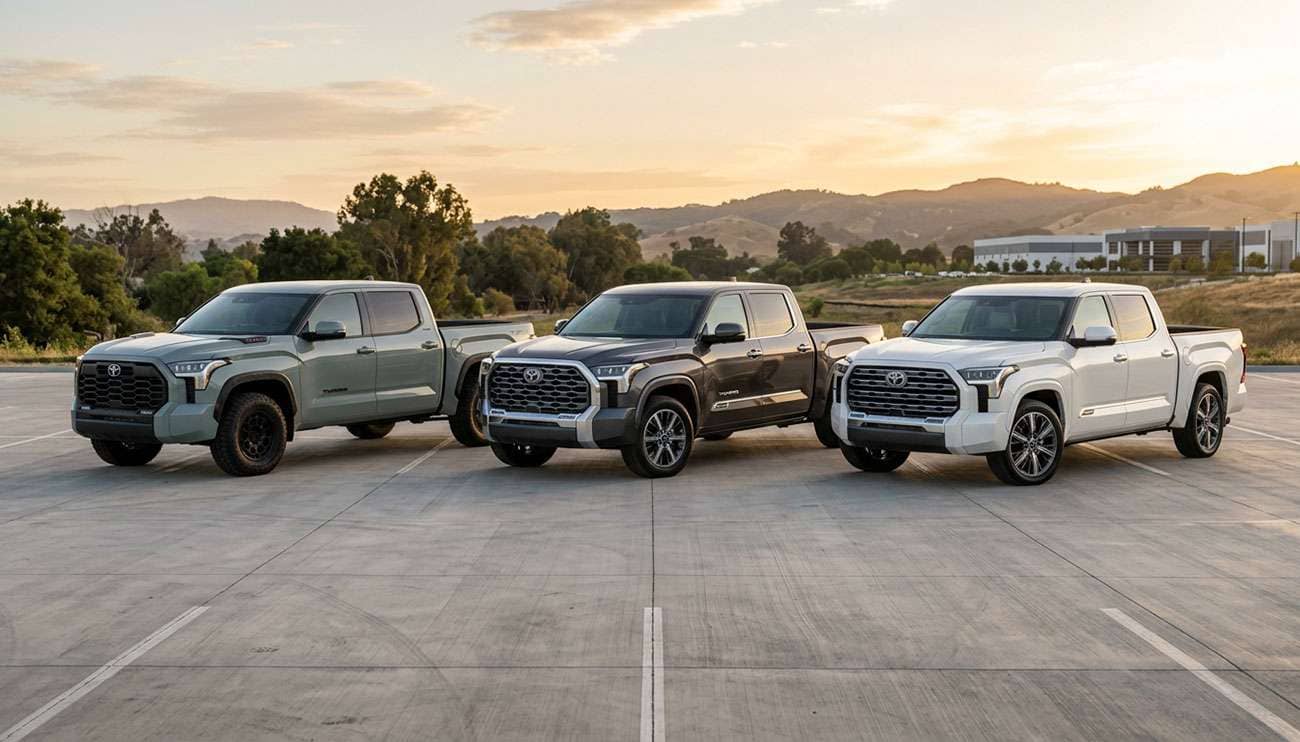
I see this one at our Long Beach counter more often than you'd think. A Tundra owner walks in with a printout of a tire size chart that says "TRD Pro: 275/65R18" and asks for four. That chart is right, for a 2019 TRD Pro. If the truck in the lot is a 2022 or newer, it takes a different size on a different bolt pattern, and the tire on that printout would be half an inch shorter and below the factory load index.
The short answer: Your Tundra's tire size depends on two things most charts never put side by side: the generation and the factory wheel diameter. A 2007 to 2021 Tundra runs 255/70R18, 275/65R18, or 275/55R20, all about 32 inches tall. A 2022 and newer Tundra runs 245/75R18, 265/70R18, 265/60R20, 265/50R22, or 285/65R18, all about 32.5 inches tall. Within the third gen, the trim changes the wheel, the width, and the load index, but almost never the height. That's why the TRD Pro's "33-inch" tire stands no taller than an SR5's.
Here's every factory size from 2007 on, with the load index Toyota put on the door placard. "Counts as" is what a P-metric tire is actually good for on a pickup, which I'll explain in the load index section.
Trim |
Years |
Wheel |
Factory size |
Height |
Load index |
Counts as on a truck |
|---|---|---|---|---|---|---|
SR |
2022-2026 |
18x8 steel |
P245/75R18 112T |
32.5 in. |
112 (2,469 lb) |
2,245 lb |
SR5, SR5 TRD Off-Road (18 in.), TRD Rally |
2022-2026 |
18x8 alloy |
P265/70R18 116T |
32.6 in. |
116 (2,756 lb) |
2,505 lb |
SR5 with 20 in. package, Limited, Platinum, 1794 Edition (gas or hybrid) |
2022-2026 |
20x8 alloy |
P265/60R20 112H |
32.5 in. |
112 (2,469 lb) |
2,245 lb |
Capstone |
2022-2026 |
22-in. alloy |
P265/50R22 112H XL |
32.4 in. |
112 XL (2,469 lb) |
2,245 lb |
TRD Pro |
2022-2026 |
18x8 forged BBS |
P285/65R18 116T |
32.6 in. |
116 (2,756 lb) |
2,505 lb |
SR, SR5 on steel wheels |
2007-2021 |
18-in. steel |
P255/70R18 112T |
32.1 in. |
112 (2,469 lb) |
2,245 lb |
SR5 alloy, TRD Off-Road, Limited or 1794 on 18s, Trail, TRD Pro |
2007-2021 |
18x8 alloy |
P275/65R18 114T |
32.1 in. |
114 (2,601 lb) |
2,365 lb |
Limited, Platinum, 1794 on 20s, TRD Sport, Nightshade |
2007-2021 |
20x8 alloy |
P275/55R20 111H |
31.9 in. |
111 (2,403 lb) |
2,185 lb |
Look down the height column. Every third-gen size lands between 32.4 and 32.6 inches. Every second-gen size lands between 31.9 and 32.1. Toyota picked one height per generation and changed everything else around it.
Two second-gen notes. Some 18-inch trucks in the middle of that run came on 255s and others on 275s, depending on whether the SR5 had steel or alloy wheels, so trust the placard over the trim badge. And the old TRD Rock Warrior package rode on 17-inch wheels, which puts it outside this chart entirely.
If your Tundra is a 2007 through 2021, it's a second gen. If it's a 2022 or newer, it's a third gen. The quickest tell in the parking lot is the engine: second gens have a V8 (or the early V6), and third gens have the twin-turbo V6 or the i-FORCE MAX hybrid. The quickest tell at the wheel is the lug count.
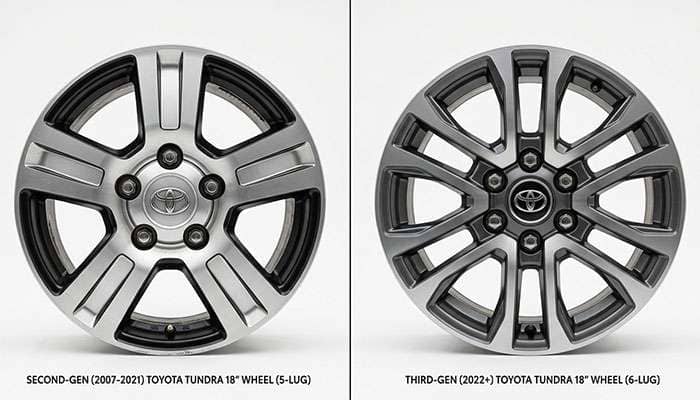
That's why a generic "Tundra tire size" lookup can steer you wrong. The sizes look close, 275/65R18 versus 265/70R18, and they're both 18-inch tires. But the wheels they mount on don't interchange between generations, and the tires themselves aren't the same height, width, or load index.
If you're shopping wheels for a second gen, start with our list of vehicles that use the 5x150 bolt pattern. If you've got a third gen, our guide to whether Tundra wheels fit a Tacoma covers the 6x139.7 hub and lug details that decide what bolts on.
Physically, a 275/65R18 will mount on a third-gen 18x8 wheel. But it's about half an inch shorter than the 265/70R18 the SR5 came with, so your speedometer will read about 1.7% fast. And most passenger 275/65R18s carry a 116 index, while some carry 114, which falls below the SR5's 116. A second-gen tire on a third-gen truck isn't a size match, it's a substitution, and it has to clear the load index first.
A 2022 and newer TRD Pro runs P285/65R18 116T on 18x8 black forged BBS wheels. Toyota fits a Falken Wildpeak all-terrain and calls it a 33-inch tire. A second-gen TRD Pro runs P275/65R18 114T, the same size and index as the 18-inch TRD Off-Road and Limited trucks of that era, and it came on a Michelin LTX A/T2.
Here's what nobody puts in front of you. A 285/65R18 works out to 32.59 inches. The SR5's 265/70R18 works out to 32.61 inches. The SR5 tire is actually a hair taller. What the TRD Pro gets is 0.8 inch more width, 11.2 inches against 10.4, plus the same 116 load index as the SR5.
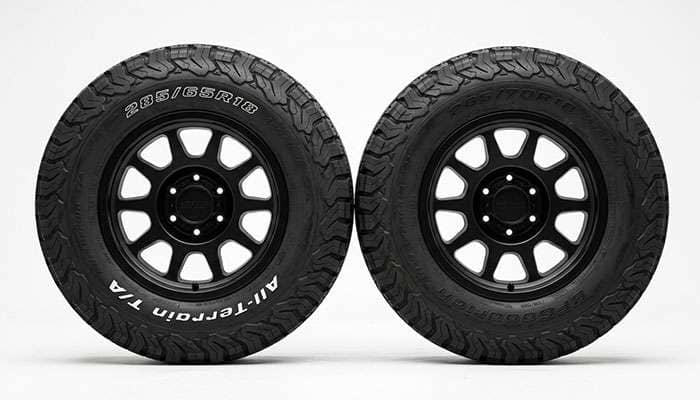
That matters two ways. If you own an SR5 and want the TRD Pro look, a 285/65R18 bolts onto your factory 18x8 wheel without changing your speedometer. And if you own a TRD Pro, the "33" on the window sticker isn't extra height you'll lose by going to a different tread. It's width.
Toyota put a passenger-construction 116 on the TRD Pro. The replacement market didn't follow. Almost every 285/65R18 on the market is an LT tire, Load Range E at a 125 index, and passenger versions like the factory tire are rare. An LT 125 carries far more than the truck needs, but it's heavier, stiffer, and built to run at higher pressure. Your ride changes, and the door placard pressure no longer tells you the right number. Our breakdown of P-metric vs. LT tires explains what you're trading.
A 2022 and newer SR5 runs P265/70R18 116T on 18x8 alloys. That covers the standard SR5, the 18-inch TRD Off-Road package, and the TRD Rally package added for 2025. Order the 20-inch TRD or SX package and the SR5 moves to the same P265/60R20 112H the Limited runs.
The base SR is the one to watch. It runs P245/75R18 112T on steel wheels, the narrowest tire in the lineup at 9.6 inches. It's also a thin market. Only a handful of tires are built in 245/75R18, so a lot of SR owners move to 265/70R18 when it's time to replace. That's a reasonable move: same 18-inch wheel, 0.15 inch taller, and a 116 index instead of 112.
The 2027 Tundra adds a Trailhunter package built on the SR5. Toyota bills its tire as a 33-inch all-terrain, and it's the same 265/70R18 size the SR5 already runs. If you want the specifics on the SR5's size, our 265/70R18 tire size guide covers the dimensions and what fits.
Second-gen SR5s are split. Steel-wheel trucks ran P255/70R18 112T. Alloy-wheel trucks, including the TRD Off-Road package, ran P275/65R18 114T. Both are about 32.1 inches, but they're different widths and different indexes, so read the placard before you order.
On a 2022 and newer truck, all three run P265/60R20 112H on 20x8 wheels. That includes the i-FORCE MAX hybrid versions, and it includes trucks with the TRD Off-Road package. On a 2007 to 2021 truck, the 20-inch versions ran P275/55R20 111H, and some Limited and 1794 trucks were built on 18s with P275/65R18 114T.
Here's the detail I'd want to know as an owner. The hybrid Limited, Platinum, and 1794 are among the heaviest Tundras Toyota builds, and they ride on the same 112-index tire as the gas trucks. That's within Toyota's spec, but it leaves less room than the SR5's 116. When you replace, match 112 at minimum. Don't go below it.
The 20-inch replacement market leans hard toward LT, too. Most 265/60R20s on the market are LT Load Range E at a 121 index. Passenger 112s are a smaller group, with a few 115 XL options. A passenger 112 or 115 XL rides the way the truck did new. An LT 121 rides like a work truck.
The Capstone runs P265/50R22 112H on 22-inch wheels. That 112 is an extra load (XL) rating. A standard-load 265/50R22 would carry less, so Toyota needed the XL construction to hit the same 112 the 20-inch trucks get. The Capstone's placard also calls for more pressure than the 20-inch trucks to carry it.
Two things follow. First, every replacement has to be XL to match. Second, the 265/50R22 is a thin market, with only a handful of tires built in the size, and every one I see is a 112 XL. With a sidewall just over 5 inches tall, it's also the Tundra tire most likely to take a pothole hit on the rim edge.
That's why a lot of Capstone owners keep a second set of wheels. Every third-gen Tundra clears an 18-inch wheel, hybrids included, since the hybrid TRD Pro rides on 18s. A 265/70R18 or 265/60R20 on aftermarket wheels keeps the same height within about two tenths of an inch, so your speedometer doesn't move.
At minimum, the index on your door placard: 112 for the SR, the 20-inch trucks, and the Capstone; 116 for the SR5 on 18s and the TRD Pro; and 111, 112, or 114 for a second gen, depending on the size.
Here's why the minimum is tighter than it looks. Every factory Tundra tire is P-metric. Under Tire and Rim Association rules, also applied under FMVSS 110, a P-metric tire on a pickup has its rated load divided by 1.10. That's the "counts as" column in the first table. A P265/60R20 112 is a 2,469 lb tire on a sedan and a 2,245 lb tire on your Tundra. Drop to a 110 and you're below what Toyota specified. Our article on whether a lower load index tire is safe covers the math, and the Tire Industry Association's guidance is the same: match or beat the original capacity.
Here's what's actually available in each factory size, and which way to go.
Size |
Factory spec |
Passenger options |
LT option |
Best match |
|---|---|---|---|---|
245/75R18 (3rd gen SR) |
P 112 |
112 SL or 115 XL |
121, rare |
112 or 115 XL; or move up to 265/70R18 at 116 |
265/70R18 (3rd gen SR5, TRD Rally) |
P 116 |
116 common; some 114s |
124, Load Range E, the most common |
Passenger 116 for factory ride; skip the 114s |
265/60R20 (3rd gen Limited, Platinum, 1794) |
P 112 |
112 SL or 115 XL, fewer choices |
121, Load Range E, most of the market |
Passenger 112 or 115 XL; LT if you tow heavy |
265/50R22 (Capstone) |
P 112 XL |
112 XL only |
Not made |
112 XL, or a second set of 18s or 20s |
285/65R18 (3rd gen TRD Pro) |
P 116 |
116, rare |
125, Load Range E, nearly all of the market |
LT 125 set by load table, or a passenger 116 if you find one |
255/70R18 (2nd gen SR, SR5 steel) |
P 112 |
113 SL most common; 116 XL |
117, limited |
113 SL or better |
275/65R18 (2nd gen alloy 18s, TRD Pro) |
P 114 |
116 SL most common; some 114s |
123, Load Range E, the most common |
Passenger 116 for factory ride |
275/55R20 (2nd gen 20s) |
P 111 |
117 XL most common; 113 SL |
120, Load Range E |
113 SL or 117 XL |
The pattern is the same across the board. The factory tire is a P-metric, and in most sizes the replacement shelf is weighted toward LT Load Range E. LT tires out-carry the factory tire by a wide margin, but they're built to do it at much higher pressure, and they usually carry an R or S speed rating instead of the factory T or H. If you go LT, set your pressure from the tire maker's load-inflation table, not the door placard, which was written for the P-metric tire.
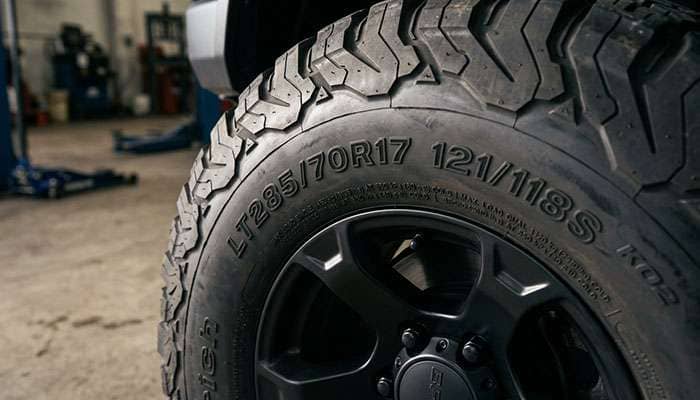
A wrong tire on a Tundra rarely fails on day one. It costs you a little at a time, and it climbs in about this order.
Put a 32.1-inch second-gen size on a 32.6-inch third-gen truck and the speedometer reads fast. Go the other way and it reads slow. A 1.7% error sounds small until it shows up on your odometer, your fuel math, and your warranty mileage.
An LT Load Range E on a Limited that came with a passenger 112 rides stiffer at placard pressure and can wear the center if you pump it too high. A wider tire than the truck came with changes steering feel and can find the liner at full lock.
A tire below the placard index, or a P-metric tire you didn't derate, works harder every mile. Load the bed or hook up a trailer and that tire flexes more and builds heat. Heat is what breaks down a tire from the inside.
Overloaded or underinflated sidewalls flex past what they were built for, and the 22-inch Capstone tire has the least sidewall to give. A bulge or a cut on the sidewall can't be repaired. If you're looking at one now, read our guide on whether sidewall damage is safe to drive on before you load the truck again.
Every step above ends at the same place: a set of tires replaced early. Getting the generation, the size, and the load index right the first time is the cheapest tire decision you'll make.
Step 1: Confirm the generation. 2007 to 2021 is a second gen on 5x150. 2022 and newer is a third gen on 6x139.7. Count the lugs if you're not sure.
Step 2: Read the door placard. The sticker on the driver's door jamb lists the factory size, the load index, and the pressure. It overrides the trim badge, the window sticker, and every chart, including this one.
Step 3: Read the sidewall. Compare what's on the truck with what's on the placard. A previous owner may have changed sizes. If the sidewall says something different, go by the placard.
Step 4: Match or beat the load index. 112, 114, or 116, depending on your size. Never go lower. If the factory tire was P-metric and you buy another P-metric, you're matching like for like. If you go LT, you're well over, so set pressure from the load table.
Step 5: Decide whether to stay on size. Within the third gen, you can move between 265/70R18, 265/60R20, 265/50R22, and 285/65R18 without changing your speedometer by more than about half a percent, as long as the wheel fits. If you want to go bigger than that, our guide on whether 35s fit a Tundra with a leveling kit covers what changes.
Step 6: Shop by year and trim. When you know your size and index, shop tires for your Tundra by year and trim and filter to the load index on your placard.
A Tundra tire size chart is only as good as the generation it's written for. Second gens run 32-inch tires on a five-lug wheel. Third gens run 32.5-inch tires on a six-lug wheel, and within that generation the trim changes the wheel, the width, and the load index instead of the height. The TRD Pro's tire is wider, not taller. The hybrid trucks ride on the same 112 as the gas trucks. And in most sizes, the replacement shelf is full of LT tires that ride nothing like what the truck came with. Read the placard, match the index, and pick the construction on purpose.
It depends on the generation and trim. A 2022 and newer Tundra comes on 245/75R18 (SR), 265/70R18 (SR5), 265/60R20 (Limited, Platinum, 1794), 265/50R22 (Capstone), or 285/65R18 (TRD Pro). A 2007 to 2021 Tundra came on 255/70R18, 275/65R18, or 275/55R20. Your door placard lists the exact size and load index.
A 2022 and newer TRD Pro runs P285/65R18 116T on 18-inch forged BBS wheels. A 2007 to 2021 TRD Pro runs P275/65R18 114T. The newer TRD Pro tire is about 32.6 inches tall, the same height as an SR5 tire, and 0.8 inch wider.
A 2022 and newer SR5 runs P265/70R18 116T on 18-inch wheels, or P265/60R20 112H with the 20-inch package. A 2007 to 2021 SR5 ran P255/70R18 112T on steel wheels or P275/65R18 114T on alloys.
No. A 275/65R18 is about 32.1 inches tall and 10.8 inches wide, and a 265/70R18 is about 32.6 inches tall and 10.4 inches wide. Putting a 275/65R18 on a third-gen SR5 makes the speedometer read about 1.7% fast, and some 275/65R18s carry a 114 index, below the SR5's 116.
No. A 2007 to 2021 Tundra uses a five-lug 5x150 bolt pattern, and a 2022 and newer Tundra uses a six-lug 6x139.7 pattern with a 95.1 mm center bore. The wheels don't interchange, even though both generations use 18-inch and 20-inch wheels.
Yes, on a 2022 and newer SR5 with 18-inch wheels. A 285/65R18 is the same height as the factory 265/70R18, so the speedometer doesn't change, and it's 0.8 inch wider. Match the SR5's 116 load index; most 285/65R18s on the market are LT Load Range E, which exceed it.