
I've had this conversation across the counter more times than I can count. A fella rolls in with a beautiful '57 Bel Air or a Model A he's been chasing for thirty years, and the first thing out of his mouth is, "Hank, do I need tubes in these?" Fair question. The honest answer is: it depends on what your wheels are built to do, not on how old the car is. Folks assume "old car" automatically means "needs a tube," and that's just not how it shakes out.
So let's settle it once and for all. Below I'll walk you through what these two really are, how to tell which camp your classic falls in, and what I'd put on it if it were sitting in my own garage.
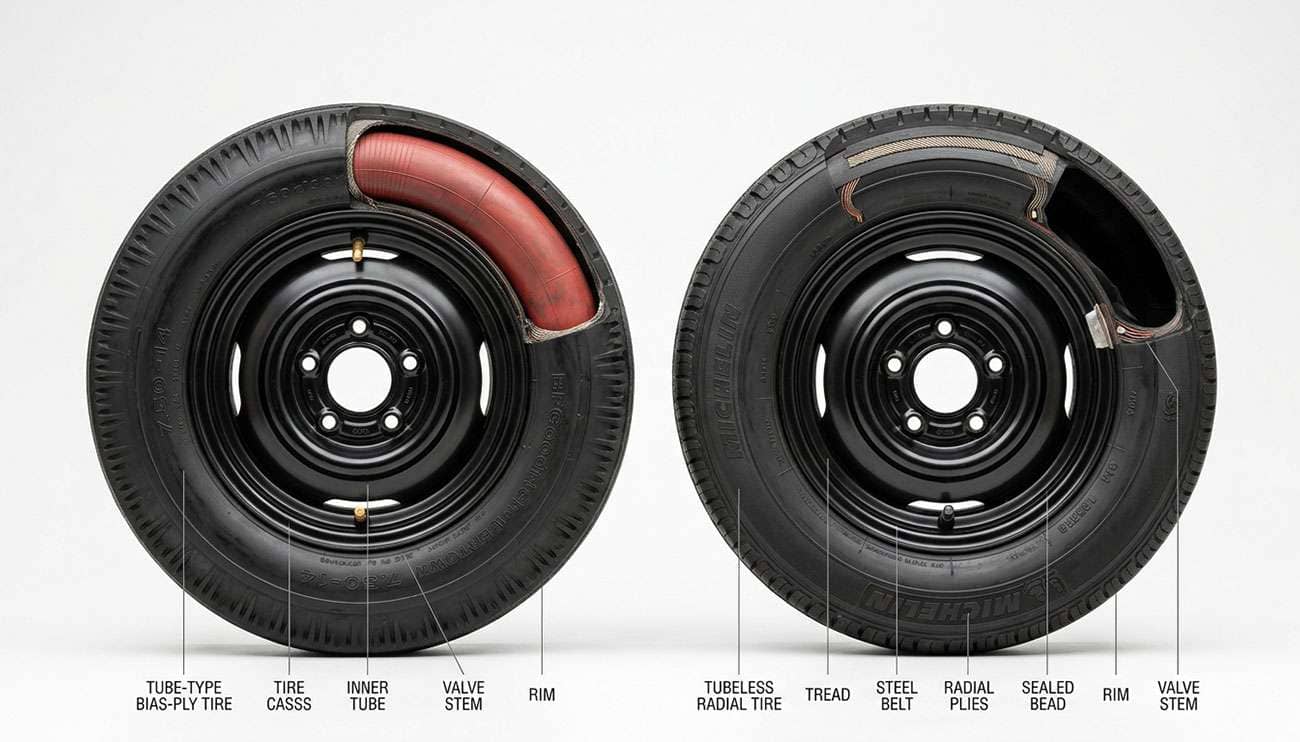
Strip away the jargon and it comes down to one thing: what's holding the air. In a tube-type setup, there's a separate rubber bladder — the inner tube — tucked inside the tire. The tire is really just the armor; the tube is the balloon doing the actual work of holding pressure. Poke it and it lets go in a hurry.
A tubeless tire throws the tube out entirely. The air sits right inside the tire casing, and an airtight seal between the tire bead and the rim keeps it from leaking. That's the whole trick — and it took a special bead shape and a more airtight rubber compound to pull off. Pick up a nail and a tubeless tire tends to hiss down slow and give you time to limp it to a shop, whereas a tube can let go all at once. That difference is the heart of why the industry moved on, and it's the same story I tell anybody weighing radial versus bias-ply for a classic — construction drives behavior.
Here's the bit of history that clears up most of the confusion. For the first half of the twentieth century, every car wore tube-type tires. There wasn't an alternative. B.F. Goodrich landed the patent for a workable tubeless tire back in 1952, and the thing caught on fast — by the mid-1950s tubeless was rolling off the showroom floor as standard equipment on new American cars.
That gives you a rough rule of thumb. If your car left the factory before about 1955, it was almost certainly born on tubes. From the late '50s forward, factory cars were running tubeless. But — and this is the part people miss — the wheel is what really decides it, not the model year. I've seen plenty of post-'55 cars wearing wire wheels that still want a tube, and pre-war cars on the right rims that can run tubeless just fine. If you want the longer arc of how all this evolved, we laid it out in our piece on tire evolution from bias-ply to modern radials.
This is the real question, so let's get practical. Walk out to the car and look at the wheels themselves — that's where your answer lives.
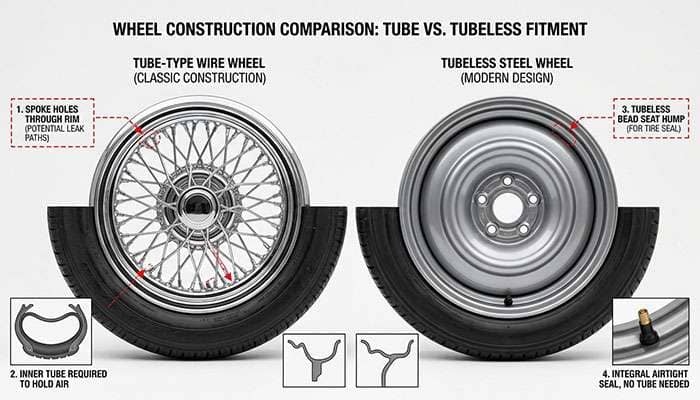
Wire wheels. If your classic rides on spoked wire wheels, you need a tube, plain and simple. The spokes pass through the rim, and every one of those spoke holes is a place air would walk right out of a tubeless tire. I won't mount a tire on a customer's wire wheel without a tube in it, and any shop worth its salt will tell you the same. Run a rim tape or flap in there too, so the spoke ends don't chew up the tube.
Sealed steel and alloy wheels. If you've got a solid, one-piece steel wheel or a cast alloy with no holes for air to escape, you're a candidate for tubeless. Look at the inside edge of the rim where the tire bead seats. A "safety hump" — a little raised ridge that the bead snaps over — is the tell that the wheel was built to hold a tubeless tire and keep the bead seated if you lose pressure. See that hump, and you can run tubeless with confidence.
The gray area. Some early sealed rims hold air but lack that safety hump. They'll often run tubeless okay, but a cautious owner puts a tube in for peace of mind. And one hard rule: don't put a tube inside a low-profile radial. Tubes and low-profile tires build up heat against each other at speed, and heat is how tubes fail. Same goes for proper tire pressure across the board — if you're not sure where to set it, our guide on classic car tire pressure will square you away.
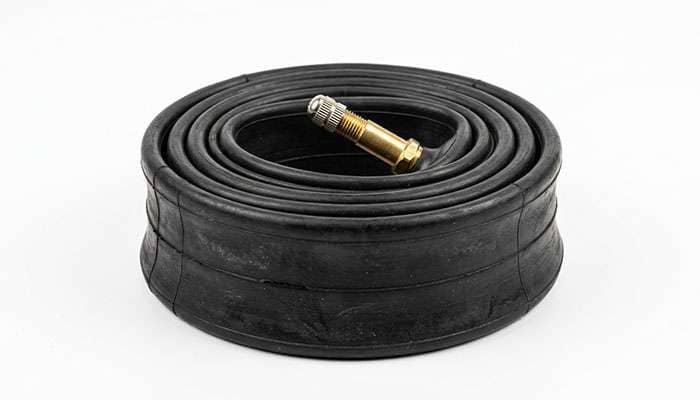
Tubes get a bad rap, but for the right car they're exactly right. On a wire-wheel classic, a tube isn't a compromise — it's the only correct answer, and it keeps the car period-honest. They're cheap to buy on their own, and on a genuine antique they're part of doing the job properly. If you're chasing authenticity on a show car, there's a real case for them.
The downsides are the same ones that pushed the industry to tubeless. A punctured tube tends to deflate fast rather than slow, which is more drama than you want on the highway. There's that heat-and-friction issue at sustained speed. And every time you replace the tire, you ought to replace the tube — an old tube in a new tire is false economy. For the full rundown on outfitting an older car the right way, the antique car tire guide covers the territory.
Feature |
Tube-Type |
Tubeless |
|---|---|---|
Holds air with |
Separate inner tube |
Sealed tire-to-rim bead |
Best wheel type |
Wire / spoked wheels |
Sealed steel or alloy with safety hump |
Behavior on puncture |
Tends to deflate quickly |
Usually leaks slowly |
Heat at sustained speed |
Higher (tube friction) |
Lower |
Period authenticity |
Correct for pre-mid-1950s |
Correct for late-1950s onward |
For most classics that left the factory after the mid-1950s and ride on sealed rims, tubeless is the smarter daily-driver choice — and that's most of the cars I see actually getting driven rather than trailered. They run cooler, they handle a puncture with more grace, and there's simply less to go wrong with no tube to pinch, chafe, or overheat. They're also a touch lighter, which never hurt anybody.
The catch is that tubeless only works on a wheel that can seal. Drop a tubeless tire on a leaky old rim or a wire wheel and you'll be airing it up every weekend, if it holds at all. The good news for classic owners is that today's bias-look radial tires give you that old-school tall-sidewall appearance with modern tubeless radial construction underneath — the looks of yesterday, the manners of today. If you're weighing the whole modern-versus-vintage decision, the modern tires classic car buyers guide is the one I point people to.
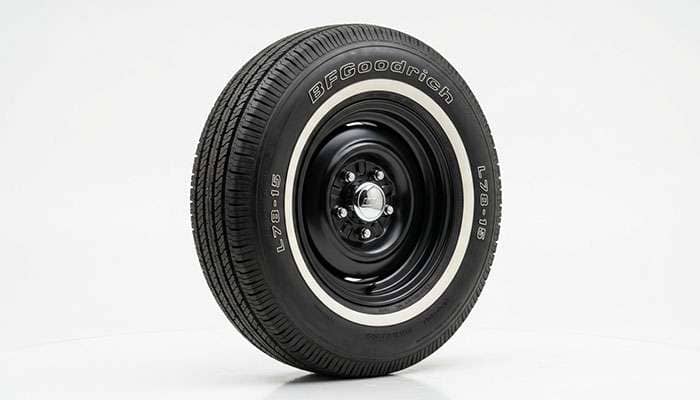
Here's how I'd call it sitting across the counter from you. If your classic wears sealed steel or alloy wheels, I'd put you on an American Classic Bias Look Radial and run it tubeless — you get the period-correct tall sidewall and whitewall options with cooler-running radial construction. For a whitewall cruiser, the American Classic Wide Whitewall Radial nails the look on a sealed rim.
If you're restoring something on genuine wire wheels — a Model A or a pre-war ride — then a tube is the right answer, and the American Classic Model A Plus Radial is built for exactly that application. Browse the full lineup of American Classic tires or the broader classic tires selection, and if you'd rather just talk it through, that's what we're here for. For the deep-restoration crowd, our notes on Coker tires for antique and classic restoration projects are worth a read too.
Don't let the calendar decide this for you — let the wheel decide. Wire wheels want a tube. Sealed rims with a safety hump want tubeless. Everything else is a judgment call you can make in five minutes by looking at the rim. Get that right and your classic rides safe, looks correct, and keeps you out on the road where it belongs instead of up on a jack. When in doubt, bring it by and we'll sort it out together.
Not safely. The spoke holes in a wire wheel let air escape, so a tubeless tire won't hold pressure. Always use an inner tube — plus a rim tape or flap to protect it from the spoke ends — on spoked wire wheels.
Check the inside of the rim where the tire bead seats. A raised "safety hump" that the bead snaps over indicates the wheel was designed for tubeless tires. A solid, one-piece rim with no spoke holes and that hump is a good tubeless candidate.
It can be done in some cases, but never in a low-profile radial. Tubes and low-profile tires generate heat against each other at speed, and that heat is the main cause of tube failure. On taller-sidewall tires with the correct rim, it's less of a concern, but tubeless on a sealed rim is the cleaner solution.
Yes. We always recommend fitting a fresh tube whenever you mount a new tube-type tire. An old tube inside a new tire is false economy — it may already be stretched, chafed, or weakened, and replacing it is cheap insurance.



