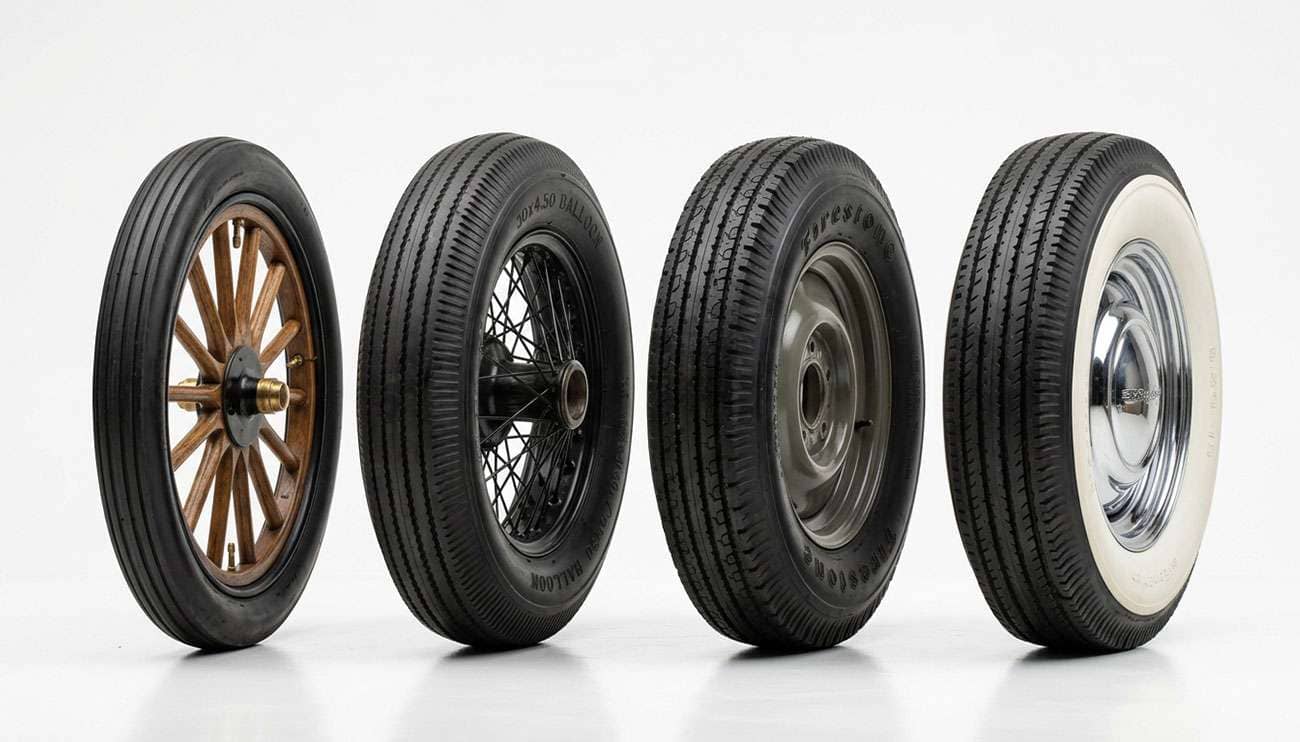
Buying tires for an antique car is nothing like buying tires for a modern vehicle. You can't type your year, make, and model into a website and get a list of options. The sizing systems have changed multiple times over the last century. The construction types available — bias ply, radial, bias look radial — each change how the car rides and handles. And the hardware underneath (tubes, flaps, valve stems) adds a layer of complexity that doesn't exist on any car built after the 1960s.
I've been fitting antique tires to pre-war and early post-war cars for years, and the number one problem I see is owners buying the wrong size, the wrong construction, or the wrong hardware — not because they're careless, but because the information isn't laid out clearly anywhere. This guide fixes that. I'm going to walk you through every era, every sizing system, every construction type, and every brand we carry so you can order with confidence.
Modern tires are standardized. A 225/60R16 is a 225/60R16 regardless of manufacturer — the dimensions, construction, and mounting method are universal. Antique tires operated under a patchwork of sizing conventions that changed decade by decade. Wheel diameters ranged from 17 to 24 inches. Some tires clamped onto the rim with a clincher bead; others used a wired-on bead like modern tires. Some required inner tubes and flaps; others didn't. The whitewall width, tread pattern, and even the color of the rubber varied by era and manufacturer.
The good news is that the antique tire market in 2026 is the strongest it's ever been. Several manufacturers produce brand-new tires in virtually every antique size, using modern rubber compounds that are safer and longer-lasting than anything available in the original era. You can get a tire that looks factory-correct on your 1931 Ford Model A and is built with materials and processes that didn't exist until decades later. But you have to know what to ask for.
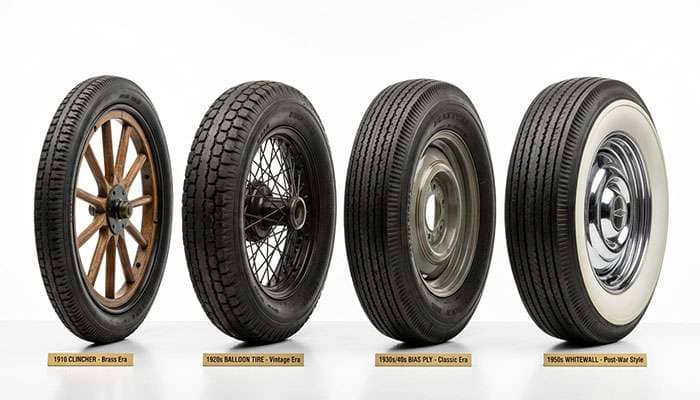
Antique car tires break down into four distinct eras, each with its own sizing system, construction method, and available options:
The earliest automobiles ran on high-pressure tires inflated to 60-80 PSI. These tires used a clincher bead — the tire literally hooked onto the rim rather than seating against it with air pressure like modern tires. Sizes were expressed in inches (30x3, 30x3½, 32x4) with the first number being the overall diameter and the second being the cross-section width. These tires always require inner tubes and are available from specialists like Excelsior, which produces beaded edge tires for this era. If you're restoring a brass era car, your tire options are limited but they do exist — and the ones available today use far better rubber than the originals.
The introduction of balloon tires in the early 1920s was revolutionary. These tires ran at lower pressures (30-35 PSI instead of 60-80), rode dramatically more comfortably, and used a wired-on bead that's closer to modern tire mounting. Ford's Model T adopted balloon tires as an option in 1925, and by the time the Model A arrived in 1928, they were standard equipment. Sizes from this era use a numeric system: 4.50-21 means the tire has a 4.50-inch section width and fits a 21-inch wheel. The Ford Model A used 4.50-21 (1928-1929) and 4.75-19 (1930-1931). Universal and Firestone both produce excellent reproductions in these sizes.
By the mid-1930s, tire sizing consolidated around a smaller set of standard sizes. The most common was 6.00-16, which became virtually universal for American passenger cars through the early post-war years. Tires from this era are all bias ply construction, tube-type, and available in blackwall or various whitewall widths. The 16-inch wheel diameter dominated, and sizes like 5.50-17, 6.00-16, and 6.50-16 covered the vast majority of vehicles. Excelsior's Stahl Sport Radial offers a modern radial alternative in these sizes for owners who want period-correct looks with modern ride quality.
After World War II, American cars got wider, heavier, and more powerful. Tire sizes grew to match — 7.10-15, 7.60-15, 8.00-15, and eventually 8.20-15 became common. This era also introduced the wide whitewall as a mainstream styling element, with whitewalls ranging from 2 inches to over 4 inches wide. By the late 1950s, 15-inch wheels had become the standard, and they remained so through the muscle car era. This is the era with the most tire options available today — including bias ply reproductions, modern radials in vintage sizes, and bias look radials that combine the best of both worlds. Our Kontio Tyre WhitePaw and Autobahn Bias Look Radial lines are particularly strong in this era.
The biggest source of confusion in antique tires is the sizing. Here's how to decode each system and, critically, how to cross-reference sizes when your original tire is no longer made in its exact designation:
Sizing System |
Era |
Format |
Example |
What the Numbers Mean |
|---|---|---|---|---|
High Pressure (Clincher) |
1900–1920s |
OD x Width |
30x3½ |
30" overall diameter, 3.5" section width |
Balloon / Numeric |
1920s–1960s |
Width–Rim |
6.00-16 |
6.00" section width, 16" wheel diameter |
Combined Numeric |
1920s–1930s |
Width/Width–Rim |
475/500-19 |
Covers both 4.75" and 5.00" widths on 19" wheel |
Modern Metric |
1970s–present |
Width/Aspect-Rim |
205/75R15 |
205mm width, 75% aspect ratio, 15" wheel, Radial |
Through the years, some sizes were combined. A tire listed as 475/500-19 fits wheels that originally took either 4.75-19 or 5.00-19. This is common for 1920s and 1930s tires where production economies made it impractical to manufacture two nearly identical sizes. If you're not sure what size your antique car needs, use our Antique Tire Size Conversion tool or call us at 888-926-2689 — we can look up the original equipment specification for virtually any antique vehicle.
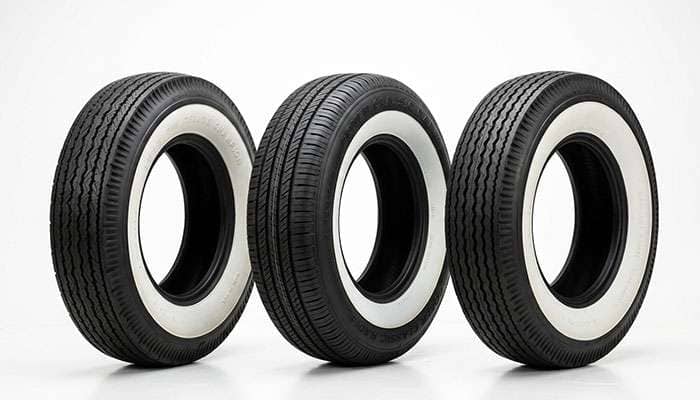
Every antique car owner faces this choice: do you go with historically accurate bias ply tires, modern radials in vintage sizes, or the hybrid bias look radial? Each has a legitimate place:
If your antique car is a concours-level restoration where every component must be period correct, bias ply is the only option. The internal crisscross ply construction matches what the car was designed for, the sidewall profile is correct, and the ride characteristics are authentic to the era. The trade-off is shorter tread life (15,000-25,000 miles), reduced wet traction, and a ride that wanders on modern highways. Firestone and Coker Classic produce excellent bias ply reproductions across virtually every antique size.
If you actually drive your antique car — weekend cruises, car shows you drive to, road trips — radial tires are a significant safety and comfort upgrade. Radials track straight on the highway, stop shorter in wet conditions, last 2-3 times longer, and ride more comfortably than bias ply. The downside is that the sidewall profile looks slightly different (rounder shoulders, slightly wider contact patch), and strict concours judges will deduct points. American Classic and Kontio Tyre WhitePaw both produce radials in period-correct widths and whitewall configurations for post-war antique cars.
Bias look radials are manufactured in molds that replicate the exact profile, tread pattern, and sidewall shape of vintage bias ply tires, but the internal construction is modern radial. The result is a tire that looks period-correct from the outside but delivers all the ride, grip, and longevity benefits of a radial underneath. The Kontio Tyre WhitePaw Vintage Bias Look Radial and Autobahn Bias Look Radial are our top picks in this category — both produce genuine whitewalls built into the tire (not painted) with 400 treadwear ratings. For the antique car owner who wants the look of the era with the performance of today, this category is the answer.
Here's the part nobody explains clearly: most antique car tires require inner tubes, and many also require flaps and specific valve stems. This catches first-time antique car buyers off guard because modern tires are almost universally tubeless.
Inner tubes are required for any tire mounted on a wheel that isn't airtight — which includes nearly every antique car wheel made before the late 1950s. Wire wheels, wood spoke wheels, and early steel wheels all require tubes. Always buy tubes sized to match your tire, not your wheel — a tube for a 6.00-16 tire is different from a tube for a 6.50-16.
Flaps (also called rim strips) protect the inner tube from the rim's edges and bolt heads. They sit between the tube and the rim and prevent chafing that causes slow leaks or sudden tube failures. If your antique car has split-rim wheels or any wheel with exposed bolt heads inside the barrel, you need flaps.
Valve stems on antique cars can be either rubber snap-in stems (like modern cars) or metal screw-in stems with lock nuts. Brass era and Model A/T cars typically used metal stems. If you're doing a show-quality restoration, matching the correct valve stem type to the era matters. We stock all three types — rubber, metal screw-in, and brass-era threaded stems — and can include them with your tire order.
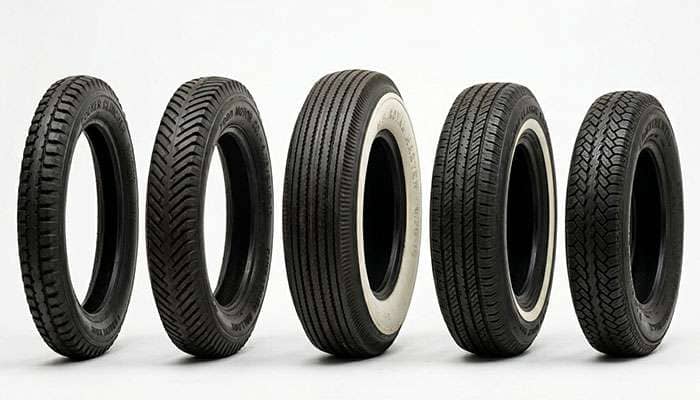
Not every antique tire brand covers every era. Here's what each one does best so you can narrow your search quickly:
Firestone — The strongest selection of bias ply reproductions for brass era through post-war cars. Their clincher tires for pre-1920 vehicles are among the few options available. Firestone bias ply tires are the go-to for concours restorations where total authenticity is required.
Excelsior — Specializes in beaded edge tires for brass era cars and the Stahl Sport Radial for pre-WWII European classics. If your car predates 1920 or is a European pre-war vehicle, Excelsior likely has your size.
Universal — Focused on pre-WWII American cars, particularly Model A and Model T Fords. Universal offers the most affordable Model A tires on the market and is well known among HCCA and AACA club members. Available in blackwall and whitewall configurations.
Kontio Tyre WhitePaw — Finnish-made genuine whitewall tires in both classic radial and bias look radial construction. The whitewall is built into the tire during manufacturing, not applied after the fact. 400 treadwear rating, A traction grade. Best for post-war cars (1940s-1960s) where you want period-correct whitewalls with modern performance.
Autobahn — Bias look radial tires with Continental-replica tread patterns, specifically designed for European classics like VW Beetle, Karmann Ghia, and Porsche 356. If you're restoring a European antique, Autobahn is the only brand that replicates the original Continental tread design.
American Classic — USA-made bias look radials and wide whitewall radials covering the broadest range of American fitments from the 1930s through the 1960s. Eleven sizes across 13-, 14-, and 15-inch wheels plus Model A sizes in 19 and 21 inch.
Coker Classic — Comprehensive range of bias ply reproductions, wide whitewall radials, and specialty tires covering virtually every antique and classic application. The deepest catalog in the industry.
Not sure which brand fits your car? Browse our full antique tire selection or check the Whitewall Tires Guide for help matching sidewall styles to eras. Call us at 888-926-2689 and tell us the year, make, and model — we'll pull the original equipment spec and recommend the best options in every construction type.
The 1928 and early 1929 Ford Model A used 4.50-21 tires on 21-inch wheels. The 1930-1931 Model A used 4.75-19 tires on 19-inch wheels. These sizes are commonly listed as 440/450-21 and 475/500-19 in current catalogs because similar sizes were combined during production. Universal, Firestone, and Coker Classic all produce tires in both Model A sizes in blackwall and whitewall options. American Classic also makes a Model A Plus Radial in 19 and 21 inch for owners who want modern radial construction with a vintage appearance.
Almost always, yes. Antique car wheels — wire wheels, wood spoke wheels, and early steel wheels — are not airtight, which means the tire cannot hold air without an inner tube. Even some later antique cars with steel wheels that appear modern still require tubes because the rim construction doesn't create an airtight bead seat. The safest approach is to assume your antique car needs tubes unless you can confirm the wheels are tubeless-compatible. Always buy tubes sized to match the tire, not the wheel, and include rim flaps to protect the tube from chafing against the rim.
In terms of tread wear, bias ply antique tires last 15,000-25,000 miles and radial antique tires last 30,000-50,000 miles. But for most antique car owners, age is the limiting factor — not mileage. A car driven 1,000 miles per year would take 25 years to wear out a set of bias ply tires, but the rubber degrades from UV exposure, ozone, and heat long before that. Replace antique car tires after 6-8 years regardless of tread depth. Check the DOT date code on the sidewall (last four digits = week and year of manufacture) to determine age.
Yes, with some considerations. Radial tires apply force to the rim differently than bias ply tires, so your wheels need to be in good condition — no cracks, excessive rust, or weakened spoke connections. Radials also change the car's handling characteristics, making the steering feel lighter and more responsive. Most antique car owners who switch to radials report a dramatic improvement in ride quality, tracking, and braking. If you want the appearance of a bias ply with radial performance, a bias look radial is the ideal compromise. Always replace all four tires at once — never mix bias ply and radial on the same vehicle.
A clincher tire uses a hooked bead that physically clamps onto a matching groove in the rim, rather than seating against the rim flange with air pressure like modern tires. Clincher tires were standard on cars built before approximately 1920 — brass era automobiles and early Ford Model T's used them. If your car has clincher rims (with an inward-facing hook at the rim edge), you must use clincher tires. You cannot mount a modern wired-on bead tire on a clincher rim. Excelsior produces beaded edge clincher tires for this era, and they're available through Performance Plus Tire.
Whitewall width varied by era. Pre-war cars (1920s-1930s) typically used all-white or very wide whitewalls (3-4+ inches). Post-war cars of the late 1940s and 1950s used wide whitewalls (2-3¼ inches). By the early 1960s, narrow whitewalls (¾-1 inch) became the standard factory option, and wide whitewalls were no longer offered on new cars after the 1961 model year. Matching the correct whitewall width to your car's era is an important detail for authenticity. Kontio Tyre WhitePaw offers both wide and narrow whitewall options across their entire size range to cover every era accurately.