
Every guide to this question gives you the same single test: swerve gently at speed, and if the noise changes, it is a wheel bearing. That test is real, it works, and it is also the reason so many people end up paying for a bearing they did not need. It has a meaningful false-positive rate, most articles state the resulting side backwards, and used alone it cannot distinguish a bad bearing from a cupped tire, which is the single most common misdiagnosis in this entire category.
The variable that actually separates these two is not turning. It is what the noise responds to. A bearing responds to load. A tire responds to the road surface underneath it. Those are independent inputs, you can vary each one on purpose, and running both in a single ten-minute drive gets you to an answer with far more confidence than the swerve test alone.
Here is how to run all three tests, what each result means, and why one of them is worth more than the other two combined.
Find a stretch of road where the pavement changes surface, with light traffic, and give yourself ten minutes. Windows up, radio off, fan off.
Test |
How to Run It |
Bearing Result |
Tire Result |
|---|---|---|---|
Surface change |
Hold one steady speed and drive from asphalt onto concrete, or onto a coarse chip-seal section |
Barely changes. The noise is coming from inside the hub. |
Changes immediately and obviously. Different surface, different noise. |
Load transfer |
At 40 to 50 mph, gentle sustained S-sweeps left and right, staying in your lane |
Rises and falls with the sweeps. Usually loudest when the bad side is on the outside of the turn. |
Largely unchanged. Some rise on a badly cupped tire, but not a clean on-off. |
Pitch and character |
Accelerate slowly through 30 to 60 mph and listen to the quality of the sound, not just the volume |
A cyclic growl or rumble with a repeating beat you can almost count |
A broadband roar or hum that rises smoothly in pitch with speed |
Coast in neutral |
At steady speed on a clear road, shift to neutral and let engine rpm drop |
Unchanged. It tracks wheel speed, not engine speed. |
Unchanged. Also tracks wheel speed. |
That last row is not there to separate the two. It is there to rule out everything else at once. If the noise changes when you drop the engine to idle at the same road speed, you are chasing something in the driveline or the engine bay and neither the tires nor the bearings are the problem.
Read the results as a set. Surface test negative and load test positive points hard at a bearing. Surface test positive and load test negative points hard at the tires. If both come back positive, the most likely reality is that you have irregular tire wear, and the section further down on the feedback loop explains why that is not a contradiction.
Both noises reach your ear through the same path and both are tied to wheel speed, which is why the brain cannot separate them from the driver's seat.
Tire noise starts at the contact patch. Tread blocks slam into the pavement and release from it thousands of times per second, air is compressed and expelled from the tread grooves, and the whole tire carcass acts as a drumhead. That energy travels up through the suspension into the body structure. Manufacturers work hard on this. Tread blocks are deliberately arranged in a varying pitch sequence rather than an even one, precisely so the sound spreads across a band of frequencies instead of concentrating into a single tone your ear would find irritating.
Bearing noise starts inside the hub. A wheel bearing is a set of rolling elements running between two hardened races. When a race develops a spall, which is a small pit where the surface has fatigued and flaked away, every rolling element that passes over it produces a small impact. That energy travels through the knuckle into the suspension and into the same body structure.
Same delivery path, same speed dependence, similar frequency range. What differs is what modulates them, and that is what the three tests exploit.
This is the highest-value test in this article and it is almost entirely absent from the guides that cover this question.
Tire noise is generated at the interface between rubber and road. Change the road and you change the noise. Coarse chip seal is loud. Smooth new asphalt is quiet. Grooved concrete produces its own distinct hum. Drive from one onto another at a constant speed, and if what you are hearing is tire noise, the sound will change the instant the surface does. You do not need to guess whether it changed. It is not subtle.
A wheel bearing does not care what the pavement is made of. The defect is inside a sealed assembly, driven by rotation and load. Cross onto a different surface at a steady 45 mph and a bearing growl will carry straight through essentially unchanged, sitting on top of whatever the tires are doing.
How to run it properly:
The reason this test is so useful is that it has almost no overlap with the load test. Surface and load are independent variables, so two tests that each isolate one of them give you far more information than running the same test twice.
The swerve test works. The physics behind it is straightforward: when a vehicle turns, weight transfers laterally to the outside of the turn. Turn left, and load moves onto the right-hand wheels. A bearing with a damaged race is louder when it is carrying more load, because the rolling elements are pressed harder into the defect.
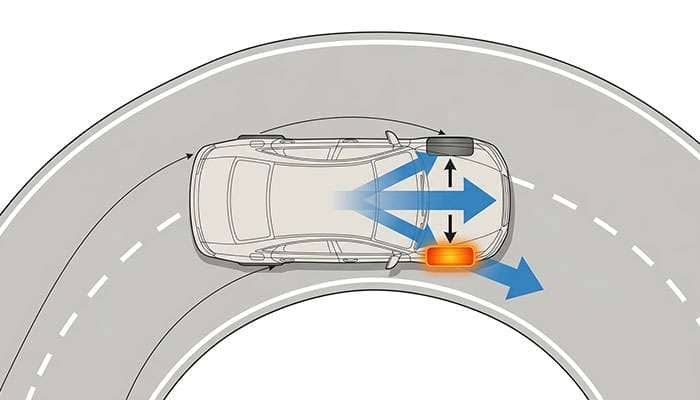
Follow that through and you get a result that is the opposite of what a lot of write-ups state. A noise that gets louder when you turn left points at the right-side bearing. Louder turning right points at the left side. You are loading the side away from the direction you are steering. Plenty of articles say the noise gets louder "when turning toward the affected side," which has the geometry backwards and sends people to the wrong corner.
Two honest caveats, because this test is more useful when you know its limits:
It is not universal. Where the spall sits on the race matters. A defect positioned so that it unloads during cornering can produce the reverse behavior, getting quieter under load and louder when unloaded. It is less common, but it happens, and it is one reason to treat a change under cornering as evidence of a bearing rather than proof of which corner.
Cupped tires can fake it. A tire with a scalloped wear pattern is louder when it is pressed harder into the pavement, so a badly cupped tire can produce a modest rise during the loaded sweep. The tell is that a bearing usually gives you a clean, proportional on-and-off as you sweep, while a cupped tire gives a vaguer swell. If the load test is ambiguous, the surface test is the tiebreaker.
Run the sweeps gently at 40 to 50 mph, stay within your lane, and use a road with room around you. This is a listening exercise, not a handling test.
The third test is about the quality of the sound, and once you know what to listen for it is hard to un-hear.
Tire noise is broadband. Because tread blocks are laid out in a varied pitch sequence, the sound they produce is spread across a wide range of frequencies. Subjectively it reads as a roar, a hum, or a rush. It rises smoothly and continuously in pitch as you accelerate, with no particular structure to it.
Bearing noise is cyclic. Each rolling element passing over the same defect produces one impact, so the sound has a repeating structure at a fixed multiple of wheel rotation. There are typically somewhere between eight and a dozen or so rolling elements in a passenger wheel bearing, which means at a given road speed you get a growl with a distinct beat sitting underneath it. At 30 mph you can sometimes count the pulses. Push to highway speed and the individual pulses blur into a continuous drone, which is exactly why so many people say the noise appears around 40 mph and then seems to disappear higher up. It has not gone away. It has climbed out of the range where you perceive it as separate beats.
Practical version, no equipment needed: accelerate very gradually from about 25 mph to about 60. If the sound has a beat or a rhythm underneath it at the low end that smooths out as you climb, that is a bearing signature. If it is a smooth featureless rise the whole way up, that is tires.
Nearly every guide on this topic tells you to jack the corner up, spin the wheel by hand, and listen for roughness, or to grab the tire at nine and three and check for play. Both are worth doing. Neither is worth trusting when it comes back clean.
The reason is load. A modern sealed hub bearing carries the weight of the vehicle, and the noise it makes when damaged is largely a product of that clamping load pressing the rolling elements into the defect. Lift the wheel off the ground and you have removed the one input the defect depends on. A bearing that is unmistakable at 45 mph can feel perfectly smooth when you turn it by hand, and can show no measurable play at all. Play is a late-stage symptom. Noise arrives first, often by thousands of miles.
So a positive result means something and a negative result means nothing. Roughness, grinding, or detectable rock at nine and three confirms a bad bearing. A smooth, tight spin does not clear it.
The same lift is genuinely useful for the tire side of the question, though, and worth doing for that reason. With the wheel off the ground, run a gloved hand around the tread face. Cupping and feathering are far easier to feel than to see, and they are the most common cause of a bearing-like noise that is not a bearing.
This is where the misdiagnoses come from. Certain irregular wear patterns do not just make noise, they make bearing-shaped noise, because they are also cyclic.
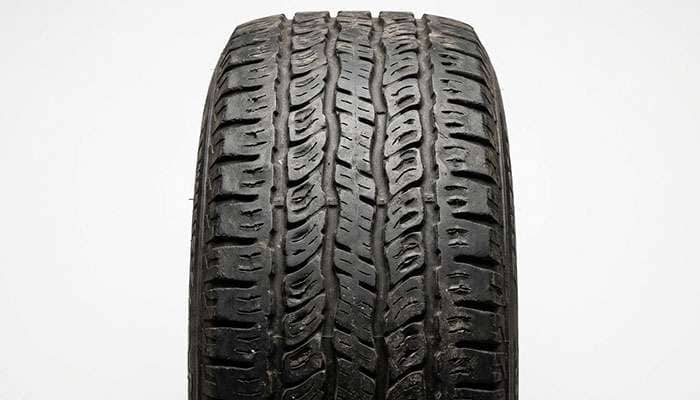
Cupping, also called scalloping. Repeating high and low patches around the circumference of the tire, usually from worn shocks or struts letting the tire skip rather than track. Because the pattern repeats at a regular interval, the noise it produces has a beat to it, exactly like a bearing. Run your hand around the tread and it feels like a washboard. Our guide to what causes tire cupping covers the underlying causes.
Feathering. Tread ribs worn into a saw-tooth profile, sharp on one edge and rounded on the other, almost always from a toe alignment problem. It produces a distinct growl that gets worse as the pattern deepens. Run your hand across the tread laterally, then the other direction. If it feels smooth one way and catches the other, that is feathering, and no bearing will fix it.
Heel-toe wear. Individual tread blocks worn taller at one end than the other. Common on the non-driven axle and on tires that have not been rotated.
Simply loud tires. Sometimes there is no defect at all. Aggressive all-terrain and mud-terrain patterns generate real roar by design, and it usually gets worse as the tread wears down and the blocks lose stiffness. If your noise arrived with a new set of tires rather than developing over time, this is your answer, and there is nothing to diagnose. Our breakdown of what causes tire noise goes through the pattern-level reasons.
A directional tire mounted backwards. Worth checking and it takes five seconds. Directional tires have an arrow on the sidewall. One mounted against its rotation direction will roar noticeably, and it is a surprisingly common error after a rotation done by someone in a hurry.
If your tests come back mixed, do not assume you ran them wrong. These two problems cause each other.
A worn bearing lets the wheel deflect slightly under cornering load. That deflection changes the contact patch geometry through the corner, which produces irregular wear on the tire. So a bearing that has been bad for a while will often have produced a cupped tire on that corner, and now you have two noise sources on the same wheel.
It also runs the other direction. A badly out-of-round or heavily cupped tire delivers a cyclic load spike into the hub on every revolution, which is a fatigue input the bearing was not designed to see continuously. It will not destroy a bearing quickly, but it does not help it.
The practical consequence: if you have a growl on one corner and you find both a rough bearing and a cupped tire, replacing only one of them will leave you with a car that is quieter but not quiet, and you will be back. Sort out which came first, because the answer determines whether you also need to look at alignment or at worn dampers. If the tire cupped because the shocks are tired, a new bearing and a new tire will get you the same cupping again in another 20,000 miles. Fresh tires on a car with an unresolved alignment problem wear out fast, which is why checking alignment with new tires is not an upsell.
Before you commit to either answer, clear these. Several produce a very similar complaint.
Source |
Distinguishing Behavior |
|---|---|
Differential or ring and pinion |
Changes between steady throttle, acceleration, and coasting at the same road speed. Bearings and tires do not care about throttle position. |
CV joint |
Clicking rather than growling, loudest at full steering lock and low speed, often in a parking lot |
Brake pad wear indicator |
High-pitched squeal, often changes or stops when you apply the brake pedal |
Dragging brake |
Grinding plus a hot wheel. Touch the wheels after a drive; the affected one will be noticeably hotter. |
Tire belt separation |
A rhythmic thump rather than a continuous growl, and it gets worse as the tire warms up over the drive |
Loose or missing wheel weight |
Vibration at a specific speed band rather than a growl. Check for adhesive residue where a weight used to be. |
The warm-up row deserves attention. Anything that gets meaningfully worse over the first ten or fifteen minutes of a drive is heat-sensitive, and neither a bearing nor a normal tire noise behaves that way. That pattern points at a structural problem inside the tire, and it is a different and more urgent conversation. If the complaint is more vibration than noise, our guide on whether steering wheel vibration is your tires or your wheels walks the full decision tree.
The two answers carry very different consequences, which is worth knowing while you decide how fast to act.
A failing wheel bearing is a real safety item. It is a slow failure with a long warning period, so there is no need to panic at the first growl, but it does not stabilize. As the races degrade, clearance opens up, the wheel begins to deflect under load, and that affects steering response and braking stability. Most modern vehicles also run the ABS wheel speed sensor at the hub, so a failing bearing can throw ABS and stability control faults. At the far end, in the rare cases where one is driven to complete failure, the hub can seize or the assembly can separate. Practically: a growl that has appeared recently means schedule an inspection in the next week or two, not this afternoon. A growl that has become a grind, or that comes with any play at nine and three or any looseness in the steering, means stop driving it and get it looked at now.
Noisy tires are usually a comfort problem, with two exceptions. A tire that is simply loud because of its tread pattern is an annoyance and nothing more. But if the noise comes from cupping or feathering, that wear is telling you something is wrong with the alignment or the dampers, and the tires will keep being consumed until that gets addressed. And if the tread has worn to the point that the wear pattern is producing noise, check the depth while you are down there, because a tire near the wear bars is a wet-weather braking problem regardless of how it sounds.
If the surface test says tires and the wear looks even, the tread pattern is simply what it is, and no alignment or rotation is going to quiet it down. Cabin noise is a design decision the manufacturer made, and the way to change it is to change tires.
What actually moves the needle is a touring pattern designed for it. The engineering is real: varied pitch sequencing to spread the sound across frequencies, closed shoulder blocks to reduce air pumping out of the grooves, and on some premium models a layer of polyurethane foam bonded to the inner liner that damps the cavity resonance inside the tire itself. That foam layer is the single biggest step change available, and it is worth understanding how foam-lined quiet tires work before you shop.
Tire |
Size Shown |
Best For |
Price |
|---|---|---|---|
215/60ZR16 95V |
Sedans where cabin quiet is the whole point |
$198.54 |
|
225/55R17 XL 101H |
Quiet plus long tread life on cars and crossovers |
$218.99 |
|
P195/65R15 91H |
Commuters wanting quiet without a premium price |
$146.99 |
|
215/65ZR16 98V |
Ride comfort alongside noise reduction |
$170.99 |
Two things to do at the same time as new tires. Have the alignment checked, because if irregular wear caused the noise, fresh tires without fixing the cause just restarts the clock. And if the noise had any vibration alongside it, ask for road force balancing rather than a standard spin balance, since a conventional balancer measures the assembly with no load on it and will pass a tire that misbehaves on the road. If you want to compare more options first, our road-tested rundown of the quietest tires gets more specific.
The swerve test is not wrong, it is just incomplete, and on its own it will send some people to a bearing they did not need and others to the wrong corner of the car. Add two tests to it and the picture resolves. Change the road surface at a constant speed and see whether the noise follows; a bearing will not care and a tire absolutely will. Listen for structure in the sound, because a bearing produces a countable beat at low speed while tires produce a smooth featureless rise.
Remember that turning left loads the right side, so a noise that grows in a left sweep points at the right-hand corner. Do not clear a bearing just because it spins smoothly on a jack, since removing the vehicle's weight removes the very thing that makes the defect audible. And check the tread with your hand before you buy any parts, because a cupped or feathered tire makes a noise that sounds like a bearing to almost everybody.
If it turns out to be the tires and the wear is even, the pattern is simply doing what it was designed to do, and the fix is a quieter tire. Performance Plus Tire carries touring and acoustic-damped options across every size. Find your size, match your placard load and speed rating, and get your cabin back.
The whole method, condensed.
Use two independent tests rather than one. First, hold a constant speed and drive from one pavement surface onto another; tire noise changes the instant the surface does, while bearing noise carries through essentially unchanged because the defect is inside a sealed hub. Second, make gentle sustained sweeps left and right at 40 to 50 mph; bearing noise rises and falls with the load transfer, while tire noise stays largely flat. A bearing also produces a countable beat at lower speeds, where tire noise is a smooth broadband rise.
The right side. Vehicle weight transfers to the outside of a turn, so steering left loads the right-hand wheels, and a bearing with a damaged race gets louder as load presses the rolling elements harder into the defect. Louder turning right points at the left side. Be aware that a minority of bearings behave in reverse depending on where the damage sits on the race, so treat a change under cornering as strong evidence that a bearing is involved rather than as certainty about which corner.
Yes, and this is why the jack-and-spin test misleads people. A sealed hub bearing makes noise largely because the vehicle's weight presses the rolling elements into a damaged area of the race. Lift the wheel and you remove that load, so a bearing that growls clearly at 45 mph can turn smoothly by hand and show no play at nine and three. Roughness or play confirms a bad bearing, but a clean result does not clear one. Play in particular is a late-stage symptom that arrives thousands of miles after the noise starts.
Very much so, and it is the most common misdiagnosis in this category. Cupping produces repeating high and low patches around the tire, and because that pattern is cyclic the noise it makes has a beat to it just like a bearing does. Feathering, where tread ribs wear into a saw-tooth profile from a toe alignment problem, produces a similar growl. Both are far easier to feel than to see, so run a gloved hand around and across the tread before buying any parts.
There is no reliable mileage figure, but a bearing that has just started to growl is generally not an emergency, but it will not improve. Schedule an inspection within a week or two rather than the same afternoon. Escalate immediately if the growl becomes a grind, if you can detect play by rocking the tire at nine and three, if the steering feels loose or vague, or if ABS or stability control warnings appear, since many vehicles integrate the wheel speed sensor into the hub assembly. Those signs mean the clearance has opened up and the vehicle should be inspected before further driving.
Most often the new tires simply have a louder tread pattern than the ones they replaced, which is common when moving to an all-terrain or a more aggressive performance pattern. There is nothing to diagnose in that case; it is a design characteristic. Two installation errors are worth ruling out first, though. Check that any directional tires are mounted with the sidewall arrow pointing in the direction of rotation, since one fitted backwards will roar noticeably. Also confirm the size and load rating actually match your door placard.



