
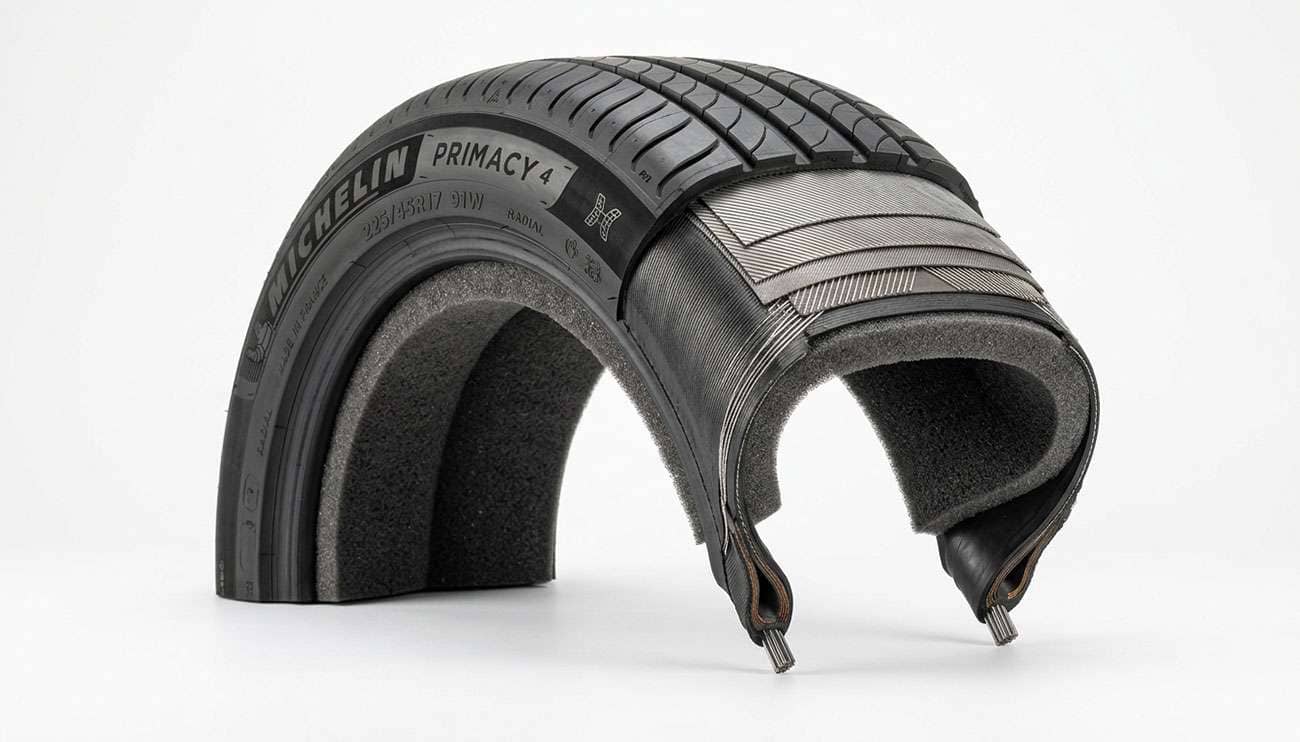
If you've ever pulled a modern touring or EV tire off the rim and found a thick black strip of foam glued to the inside, your first thought was probably that something had come apart in there. It hasn't. That foam is engineered to be there, and it's solving a very specific acoustic problem that became impossible to ignore once cars got quiet. Let's get into exactly what it does, how well it works, and what it means for you when the tire needs a repair or a replacement.
Start with the problem. As a tire rolls, the column of air sealed inside the cavity gets stirred up by the tread slapping the road, and that air begins to resonate. It's the same physics that lets you get a tone out of an empty bottle by blowing across the top — a trapped volume of air has a natural frequency it wants to ring at. For a typical passenger tire, that resonance lives in a fairly narrow low-frequency band, roughly 170 to 230 hertz, and it shows up as a low droning boom inside the car.
Here's the part that makes it hard to fix anywhere else: this isn't airborne noise leaking through the door seals. The vibration travels structurally, up through the wheel, the hub, and the suspension, and into the body of the car, where you finally hear it. Engineers can pile insulation into the doors and floor all day and barely touch it, because the noise is arriving through the chassis, not the air. The most effective place to kill it is right where it starts — inside the tire. If you want the full rundown on every source of tire noise, we cover that in what causes tire noise.
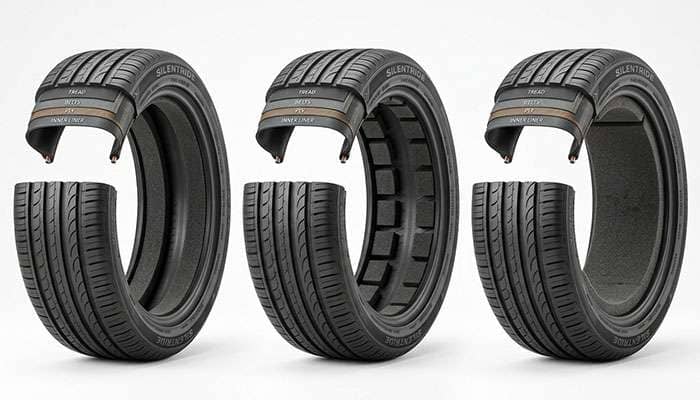
The fix is elegantly simple. After the tire has been built and cured in its mold, a layer of open-cell polyurethane foam is bonded to the inner liner — the smooth airtight surface on the inside of the tire. Open-cell is the key detail: the foam is riddled with interconnected pockets, which gives the air a huge amount of surface to push against. As the cavity tries to resonate, the air movement gets dissipated as tiny amounts of heat inside all those cells instead of ringing freely. The resonance gets damped before it can build into something you'd hear.

The strip itself usually runs somewhere between a half-inch and an inch thick, sits roughly across the width of the tread area, and can be applied as one continuous band or as several shorter sections. Because the foam goes in as a finishing step after the tire is otherwise complete, the tire is mechanically identical to its non-foam twin underneath — same casing, same compound, same tread. That's why manufacturers state that the foam doesn't change the load rating, the speed rating, or the tread life. It's an acoustic add-on, not a structural change.
This is where I like to keep expectations honest, because the marketing numbers can read bigger than they feel. The hard measurement is a reduction of roughly two to three decibels inside the cabin within that resonance band. Now, the decibel scale is logarithmic, so a two-to-three decibel drop is genuinely meaningful — manufacturers describe it as roughly halving the perceived loudness of that particular droning frequency, and you'll see claims of around a 20 to 25 percent reduction in perceived noise.
The honest framing is this: the foam attacks one specific band of noise very effectively, and it does nothing for the rest. It won't quiet a coarse tread howling on rough chip-seal, and it won't silence wind noise. What it removes is that low, tiring boom on smooth highway, and on the right vehicle that single change makes the cabin feel noticeably calmer. If your priority is overall quiet, it's worth pairing this knowledge with our road-tested rankings in the quietest and smoothest tires and our road noise test results.
Every major manufacturer that offers this has its own trade name, but under the skin they all work the same way — bonded foam targeting cavity resonance. The differences are mostly in foam geometry, placement, and which lines get it. Here's how the naming shakes out:
Manufacturer |
Trade Name |
Approach |
|---|---|---|
Pirelli |
Noise Cancelling System (PNCS) |
Open-cell foam strip on the inner liner |
Continental |
ContiSilent |
Foam layer under the tread area |
Michelin |
Acoustic Technology |
Custom foam tuned per vehicle, often OE-only |
Goodyear |
SoundComfort Technology |
Bonded inner-liner foam |
Hankook |
Sound Absorber |
Bonded inner-liner foam |
Falken |
Silent Core |
Bonded inner-liner foam |
Dunlop |
Noise Shield Technology |
Bonded inner-liner foam |
We carry a number of these on the shelf. The Falken Azenis FK460 A/S Silent Core builds the foam right into a performance all-season. Goodyear's ElectricDrive and ElectricDrive 2 use SoundComfort foam on tires built for the heavy, torque-rich demands of EVs. And the Michelin Pilot Sport EV pairs Acoustic Technology with a tread tuned for electric performance. You can browse the full range on our tires page. One tip from the bench: tires equipped with these systems often carry a small sidewall marking — a speaker icon with sound waves and a bar through it is common — so you can spot one without dismounting it.
It's worth understanding that acoustic foam is only half of the quiet-tire story, and it solves a different problem than tread design does. The foam handles the low-frequency cavity boom that comes from the air inside. The tread pattern handles the higher-frequency hum that comes from the blocks striking the pavement.
That higher hum is tackled with what's called variable-pitch or multi-pitch tread design. If every tread block were the same size and spacing, each one would hit the road at the same interval and produce a single concentrated frequency — a clear, irritating tone. So engineers deliberately vary the size and spacing of the blocks around the tire, which scatters the sound across a range of frequencies that the ear reads as softer, broadband background instead of a sharp pitch. A tire chasing a genuinely quiet ride usually combines both tricks: foam for the boom, pitch sequencing for the hum.
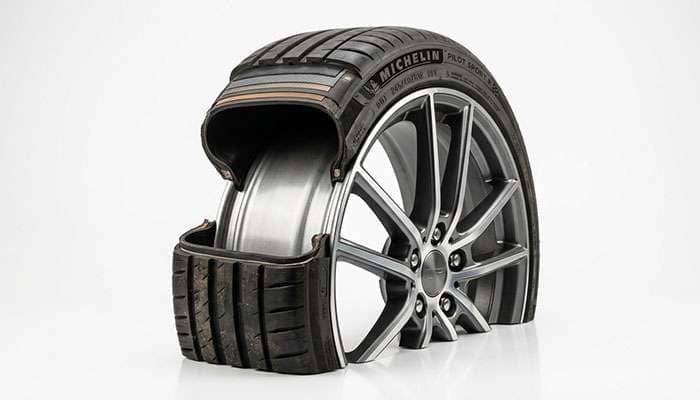
Cavity resonance is not new — it has been ringing inside tires for as long as there have been pneumatic tires. What changed is everything around it. For decades, a combustion engine produced enough sound to completely mask that low boom; you simply never heard it over the motor. As cabins got better insulated and, more dramatically, as electric vehicles removed the engine noise entirely, that masking disappeared. Suddenly a noise that was always present became the loudest thing in a hushed cabin.
That's why you see foam show up so heavily on EV-specific and luxury-fitment tires. It also explains why automakers in the premium segment were the first to demand it. If you want the broader picture of how electric vehicles change tire requirements, our guide on why EV tires are different walks through the weight, torque, and rolling-resistance side of the equation. Acoustic foam is one piece of a larger shift, alongside other emerging ideas we track in self-sealing and puncture-resistant tire technology.
Here's the practical side that doesn't make the brochures. First, repairs. A foam-lined tire can usually still be patched from the inside for a proper nail-in-the-tread fix, but the technician has to work around the foam — sometimes carefully removing a section of it over the puncture to seat the patch against the liner, then handling it correctly. Not every shop is set up to do that cleanly, which is one more reason a tire repair isn't always as simple as it looks. We get into the broader reasons in why a shop won't always patch a tire.
Second, the failure mode worth knowing about. The foam is held on by adhesive, and adhesive lives a hard life inside a tire — heat, constant flexing, and time all work against it. On higher-mileage or older tires, that bond can let go. When a chunk of foam detaches and slides to one side, it throws the tire out of balance, and you feel it as a vibration that can come on suddenly at speed. The fix is straightforward: dismount the tire, remove the loose foam, and rebalance. The tire reverts to behaving like a standard one, just without the noise reduction. Finally, if quiet is the reason you bought them, plan to keep a matched set. Manufacturers recommend running the foam tires on all four corners for the full effect, which fits with our general advice in our roundup of the quietest SUV tires.
The foam inside a quiet tire isn't a defect, a gimmick, or a repair waiting to happen — it's a precise acoustic tool aimed at one stubborn problem. Cavity resonance produces a low droning boom that travels structurally into the cabin and can't be killed effectively anywhere but the tire itself. A bonded layer of open-cell foam damps that resonance for a real two-to-three decibel reduction in the band that matters, with no penalty to load, speed, or tread life. It pairs with smart tread design to round out the quiet, it earned its place because EVs and well-insulated cabins finally exposed the noise, and the only real maintenance wrinkle is being aware of the foam at repair time and the rare detachment that a rebalance solves. Know what it does and what it doesn't, and it's an easy feature to appreciate.
It's a layer of open-cell polyurethane acoustic foam bonded to the inner liner of the tire. Its job is to absorb the resonant air vibration inside the tire cavity that would otherwise be heard as a low droning noise in the cabin.
No. The foam is added after the tire is built and cured, so the casing, compound, and tread are unchanged. Manufacturers state it does not alter the load rating, speed rating, or tread life. It only reduces noise in a specific frequency band.
Usually yes, for a standard puncture in the tread, but the technician has to work around the foam to seat the patch against the liner. Not every shop is equipped to do this cleanly, so it's worth asking before you drop the tire off.
For the full effect, yes. Manufacturers recommend running the noise-reducing tires on all four corners. Mixing foam and non-foam tires means the untreated tires keep contributing cavity noise, so you lose much of the benefit.
It can, over time. The adhesive holding the foam is exposed to heat and constant flexing, and on older or higher-mileage tires the bond can let go. Detached foam shifts to one side and unbalances the tire, which you feel as a vibration. The remedy is to remove the loose foam and rebalance the tire.



