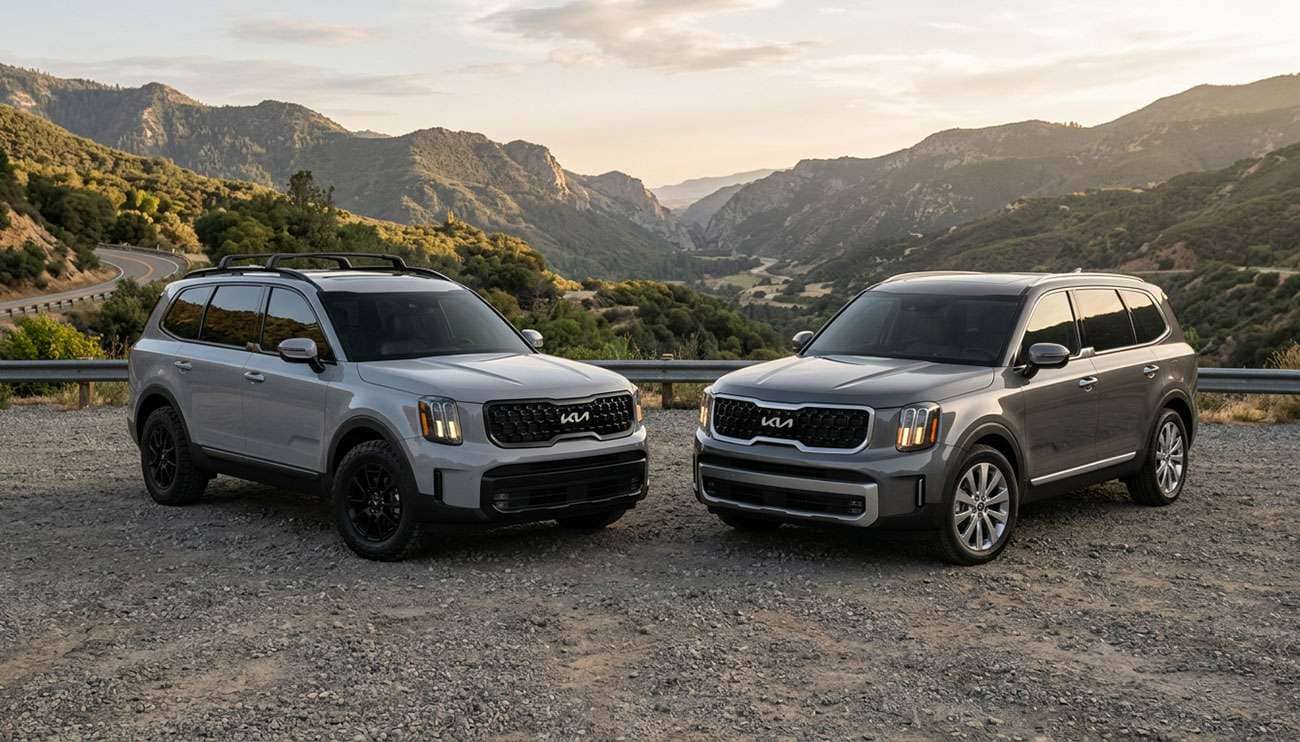
When I pull the factory specs for every Telluride side by side, one number barely moves: overall tire height. The X-Pro's all-terrain, the LX's touring tire, and the SX's 20-inch tire are all within a tenth of an inch of each other in the same generation. What the trim changes is the wheel diameter, the sidewall, the tread, and the load index. That's the part most size charts leave out, and it's the part that decides what you can put on your Telluride next.
The short answer: A 2020 to 2025 Telluride runs 245/60R18 (LX, X-Pro, early EX) or 245/50R20 (S, SX, SX-Prestige, X-Line, later EX), both about 29.6 inches tall. A 2027 Telluride runs 235/65R18 (LX, Hybrid EX), 255/60R18 (X-Pro), 255/50R20 (S, EX, SX, SX-Prestige), or 265/45R21 (X-Line), about 30.0 to 30.4 inches tall. The X-Pro is the only trim on all-terrain tires. The X-Line looks the part but rides on street tires.
Here's every factory fitment with the load index and the capacity it carries. Sidewall height is the column that separates the X-Pro from the 20-inch trims.
Trim |
Years |
Factory size |
Height |
Sidewall |
Load index |
Max load per tire |
|---|---|---|---|---|---|---|
LX; EX through 2022 |
2020-2025 |
245/60R18 105H |
29.6 in. |
5.8 in. |
105 SL |
2,039 lb |
X-Pro (EX, SX, SX-Prestige) |
2023-2025 |
245/60R18 105H all-terrain |
29.6 in. |
5.8 in. |
105 SL |
2,039 lb |
S, SX, SX-Prestige, X-Line, Nightfall; EX from 2023 |
2020-2025 |
245/50R20 102V |
29.6 in. |
4.8 in. |
102 SL |
1,874 lb |
LX, Hybrid EX |
2027 |
235/65R18 106H |
30.0 in. |
6.0 in. |
106 SL |
2,094 lb |
X-Pro SX, X-Pro SX-Prestige |
2027 |
255/60R18 108H all-terrain |
30.0 in. |
6.0 in. |
108 SL |
2,205 lb |
S, EX, SX, SX-Prestige (gas and hybrid) |
2027 |
255/50R20 109V XL |
30.0 in. |
5.0 in. |
109 XL |
2,271 lb at XL pressure |
X-Line EX, SX, SX-Prestige (gas and hybrid) |
2027 |
265/45R21 108V XL |
30.4 in. |
4.7 in. |
108 XL |
2,205 lb at XL pressure |
Read the height column top to bottom. In the first generation, the 18s and the 20s are 29.57 and 29.65 inches, a difference of less than a tenth. In the second generation, the 18s and the 20s are all within 0.02 inch of 30.04. Only the 2027 X-Line's 21s stand apart, about a third of an inch taller.
A 2020 through 2025 Telluride is a first gen. The 2027 is the all-new second gen, with a boxier body, a turbocharged 2.5-liter four in place of the V6, and the first Telluride hybrid. Both use the 5x114.3 bolt pattern, which is exactly why owners get tripped up: a wheel may bolt on across generations while the tire sizes don't carry over.
Here's what changed between them, by the numbers:
The jump to XL makes sense when you look at weight. The 2027 Telluride runs roughly 4,700 to 4,900 pounds at the curb, and Kia specifies extra load construction on its 20-inch and 21-inch sizes. If you're shopping for a used first gen and a new second gen at the same time, don't assume your old tire spec carries over.
It will mount if the wheel width is in range, but it's a substitution, not a match. A 245/60R18 is about 0.48 inch shorter than the 2027 X-Pro's 255/60R18, so the speedometer reads about 1.6% fast, and its 105 index falls below both the X-Pro's 108 and the LX's 106. A 245/50R20 102 on a 2027 SX is worse: about 0.39 inch shorter, and well under the 109 XL on the placard. Going the other way, a 2027 size on a first gen makes the speedometer read slow by about the same margin. Stay inside your own generation's sizes.
The 2023 to 2025 X-Pro runs 245/60R18 105H, and the factory tire is a Continental TerrainContact A/T. That's the same size and load index as the LX. The X-Pro didn't get a bigger tire. It got the LX's size in an all-terrain tread on its own 18-inch wheel.
The 2027 X-Pro moves to 255/60R18 108H on a Continental CrossContact ATR, about 0.4 inch wider than the first-gen X-Pro tire and 0.48 inch taller. It's AWD only, turbo only, and the second-gen X-Pro adds 9.1 inches of ground clearance and an electronic limited-slip differential to go with the tire.
Here's what the X-Pro tire actually buys you over a 20-inch trim in the same generation:
That last point matters if you're comparing an X-Pro to an SX for trail use. The X-Pro's advantage is sidewall and tread, not diameter. Our breakdown of all-terrain vs. all-season tires covers the trade in noise and wear you accept for that tread.
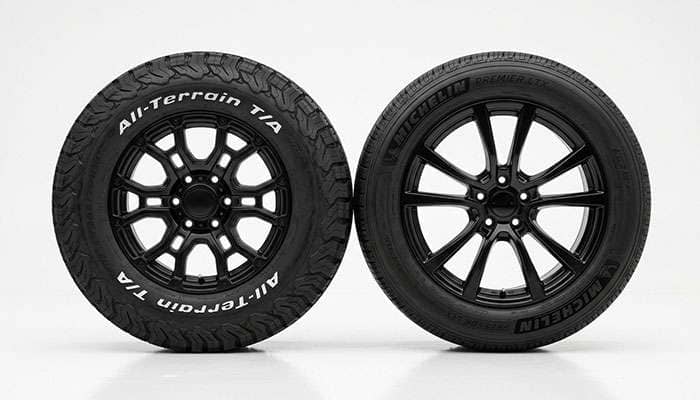
No. This is the most common mix-up I see. On a 2023 to 2025 Telluride, the X-Line rides on the same 245/50R20 102V street tire as the SX. On a 2027, it rides on a 265/45R21 108V XL, the lowest-profile tire Kia has put on a Telluride, with a sidewall under 4.7 inches.
The X-Line gets the rugged styling, standard AWD, and the trim pieces. The X-Pro gets the all-terrain tire. If trail use is the reason you're looking at the X badge, the X-Pro is the only one that comes with the tire for it.
A 21-inch wheel with a 4.7-inch sidewall is also the Telluride most likely to take a pothole hit on the rim edge and the tire most likely to come back with a sidewall bubble. If you're looking at a bulge or a cut right now, read our guide on whether sidewall damage is safe to drive on before your next highway trip.
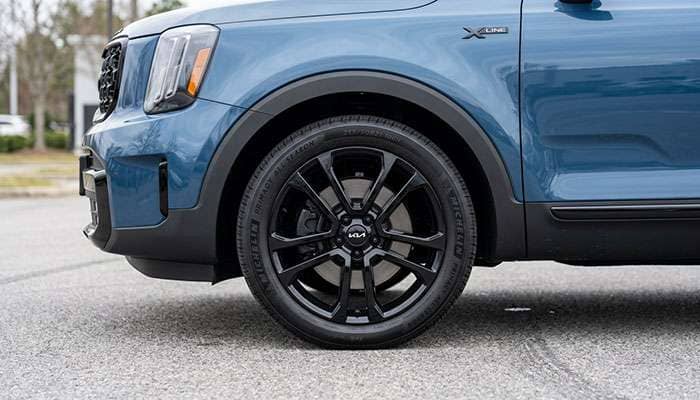
A 2020 to 2025 SX and SX-Prestige run 245/50R20 102V. A 2027 SX and SX-Prestige, gas or hybrid, run 255/50R20 109V XL.
Here's the number that stands out on the first gen. The SX and SX-Prestige are the best-equipped, heaviest trims, and their 102 index is the lowest in the lineup: 1,874 pounds per tire, 165 pounds less than the 105 on an LX or X-Pro. Kia specified it, so it's within spec, but it leaves the least margin of any Telluride. When you replace, 102 is the floor, not the target.
On the 2027, Kia went the other way and specified a 109 XL. That's a 2,271 pound tire, but only at its XL reference pressure, 42 psi for a metric tire. At the 36 psi reference for standard load, an XL tire carries about what a standard-load tire of the same size carries, which for a 255/50R20 is a 105. Our guide to SL vs. XL tires explains why the XL label doesn't mean extra capacity at everyday pressure.
Yes, and because the heights match, it's one of the cleanest swaps on the truck. Put the X-Pro size on 18-inch wheels and your speedometer and AWD system see the same rolling diameter they had on 20s:
Brake clearance isn't the obstacle either. Kia builds its top X-Pro trims, SX-Prestige included, on 18s, so an 18-inch wheel clears the brakes on the 20-inch trims of the same generation. Check the wheel's load rating and center bore against your Telluride, and match the offset closely so the wider tire doesn't find the strut.
Why go to 18s instead of putting an all-terrain on the 20s? Two reasons. The first is sidewall: the 18 gives you about one more inch of it, which is the whole point of an all-terrain on a rocky road. The second is selection, at least on the first gen. The 245/60R18 has roughly twice as many all-terrain tires to choose from as the 245/50R20. On a 2027, both sizes are thin on all-terrains, so the sidewall is the bigger reason. If you're on a first gen and want the X-Pro size, our roundup of the best 245/60R18 tires covers the field.
Whatever you choose, all four have to match. Every Telluride X-Pro and X-Line is AWD, and the system reads any difference in rolling diameter between axles as slip. Most AWD guidance holds tread depth within 2/32 inch across all four tires, which our guide to AWD tire requirements explains in detail.
At minimum, the index on your door placard: 105 or 102 on a first gen, depending on wheel size; 106, 108, 109 XL, or 108 XL on a 2027. Never lower.
Two things make that tighter than it looks. First, XL capacity only shows up at XL pressure, as covered above. Second, Kia's factory tires are metric. If you buy a P-metric replacement, Tire and Rim Association rules, also applied under FMVSS 110, divide its rated load by 1.10 on an SUV. A P245/60R18 104 is a 1,984 pound tire on a sedan and about 1,804 pounds on your Telluride, roughly 235 pounds short of the factory 105. Our article on whether a lower load index tire is safe walks through that math.
Here's what's actually available in each factory size and where the traps are.
Size |
Factory spec |
Most common replacement |
The trap |
All-terrain choices |
|---|---|---|---|---|
245/60R18 (1st gen LX, X-Pro) |
105 SL |
105 SL; 109 XL also built |
P-metric 104s, about 12% short once derated |
The widest of any Telluride size |
245/50R20 (1st gen S, SX, X-Line) |
102 SL |
102 SL; 105 XL also built |
P-metric 102s, which derate below factory |
About half as many as the 18-inch size |
235/65R18 (2027 LX, Hybrid EX) |
106 SL |
106 SL; 110 XL also built |
P-metric 104s, below factory before derating |
A few |
255/60R18 (2027 X-Pro) |
108 SL |
112 XL, then 108 SL |
P-metric 107s, below factory |
Several, including the factory tire |
255/50R20 (2027 S, EX, SX) |
109 XL |
109 XL |
105 and 104 standard-load tires, below the XL spec |
A few |
265/45R21 (2027 X-Line) |
108 XL |
108 XL |
104 standard-load tires, below the XL spec |
Almost none |
The two 2027 XL sizes carry the biggest trap. Standard-load 255/50R20s and 265/45R21s are built in quantity, they fit the wheel, and they carry a lower index than the placard. If your door says XL, buy XL.
If you tow, the load index becomes the spec that matters most. A trailer's tongue weight lands on the rear axle, so the rear tires see the heaviest load the Telluride will ever put on them. That's where a P-metric derate, or a standard-load tire in an XL size, stops being paperwork and becomes a real shortfall.
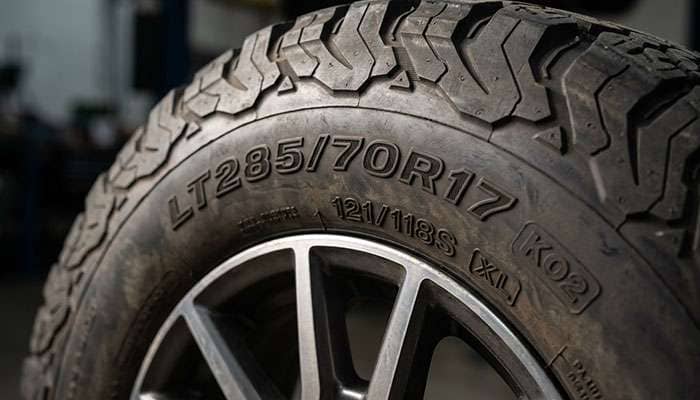
The wrong tire on a Telluride rarely shows up on day one. It shows up as cost, in about this order.
Mix a worn tire with a new one, or a first-gen size with a second-gen size, and the rolling diameters stop matching. A 245/60R18 on a 2027 is 0.48 inch shorter than the 255/60R18 it replaces. The AWD coupling reads that as slip and engages to correct it, mile after mile.
That same 1.6% height gap shows up on your speedometer and odometer. It's small per mile and adds up over a set of tires.
A Telluride is a seven- or eight-passenger SUV, and the 2027 is rated to tow up to 5,000 pounds. A tire below its placard index, or a P-metric tire you didn't derate, flexes more under a full cabin and a trailer. Flex builds heat, and heat breaks a tire down from the inside.
Underloaded capacity and low-profile sidewalls both end at the same place: a bubble or a cut on the sidewall, which can't be repaired. The 20s and 21s have the least sidewall to give.
On an AWD Telluride, one ruined tire often means four, because a single new tire can't match the tread depth of three worn ones. Our guide to whether you have to replace all four tires covers when shaving a new tire saves the set and when it doesn't.
Step 1: Confirm the generation. 2020 to 2025 is a first gen. 2027 is a second gen. The tire sizes don't overlap.
Step 2: Read the door placard. It lists the factory size, the load index, the speed rating, and the pressure. It overrides the trim badge and every chart, including this one.
Step 3: Check for XL. If the placard size ends in XL, every replacement has to be XL too.
Step 4: Match or beat the index, in the right construction. Buy metric or XL to match the factory tire. If you buy P-metric, divide its load by 1.10 before you compare.
Step 5: Decide on the tread. If you want all-terrain capability on a 20-inch trim, price the X-Pro size on 18-inch wheels before you hunt for a 20-inch A/T. The height matches, and you gain about an inch of sidewall.
Step 6: Shop by year and trim. With your size and index confirmed, shop tires for your Telluride by year and trim and filter to the load index on your placard.
The Telluride's tire chart looks long, but the logic is simple once the numbers are side by side. Each generation holds one tire height, about 29.6 inches on the 2020 to 2025 trucks and about 30.0 on the 2027. The trim changes the wheel, the sidewall, the tread, and the load index around that height. The X-Pro is the only trim on all-terrain tires, and its edge over the 20-inch SX is sidewall and tread, not diameter. The X-Line is a styling package on street tires. And the 2027's XL sizes need XL replacements, every time. Get the generation, the index, and the construction right, and the rest is a tread choice.
A 2020 to 2025 Telluride uses 245/60R18 on the LX and X-Pro or 245/50R20 on the S, SX, SX-Prestige, and X-Line. A 2027 Telluride uses 235/65R18 on the LX and Hybrid EX, 255/60R18 on the X-Pro, 255/50R20 on the S, EX, SX, and SX-Prestige, and 265/45R21 on the X-Line. Your door placard lists the exact size and load index.
A 2023 to 2025 X-Pro runs 245/60R18 105H all-terrain tires on 18-inch wheels, the same size as the LX. A 2027 X-Pro runs a wider 255/60R18 108H all-terrain. In both generations the X-Pro tire is the same height as the other trims; it adds sidewall and all-terrain tread, not diameter.
No. The 2023 to 2025 X-Line uses the same 245/50R20 street tire as the SX, and the 2027 X-Line uses a 265/45R21 108V XL. Only the X-Pro comes with all-terrain tires from the factory.
A 2020 to 2025 SX and SX-Prestige use 245/50R20 102V on 20-inch wheels. A 2027 SX and SX-Prestige, gas or hybrid, use 255/50R20 109V XL. Replacements for the 2027 size need to be XL to match.
Yes. Kia builds its top X-Pro trims on 18s, so an 18-inch wheel clears the brakes. On a 2020 to 2025 SX, a 245/60R18 is within 0.3% of the factory 245/50R20's height. On a 2027 SX, a 255/60R18 matches the 255/50R20 almost exactly. Match the wheel's load rating, center bore, and offset to the Telluride.
Nearly. A 245/60R18 is about 29.57 inches tall and a 245/50R20 is about 29.65 inches, a 0.3% difference. The 245/60R18 has about one more inch of sidewall, and on a first-gen Telluride it carries a 105 load index versus 102 for the 20-inch tire.