
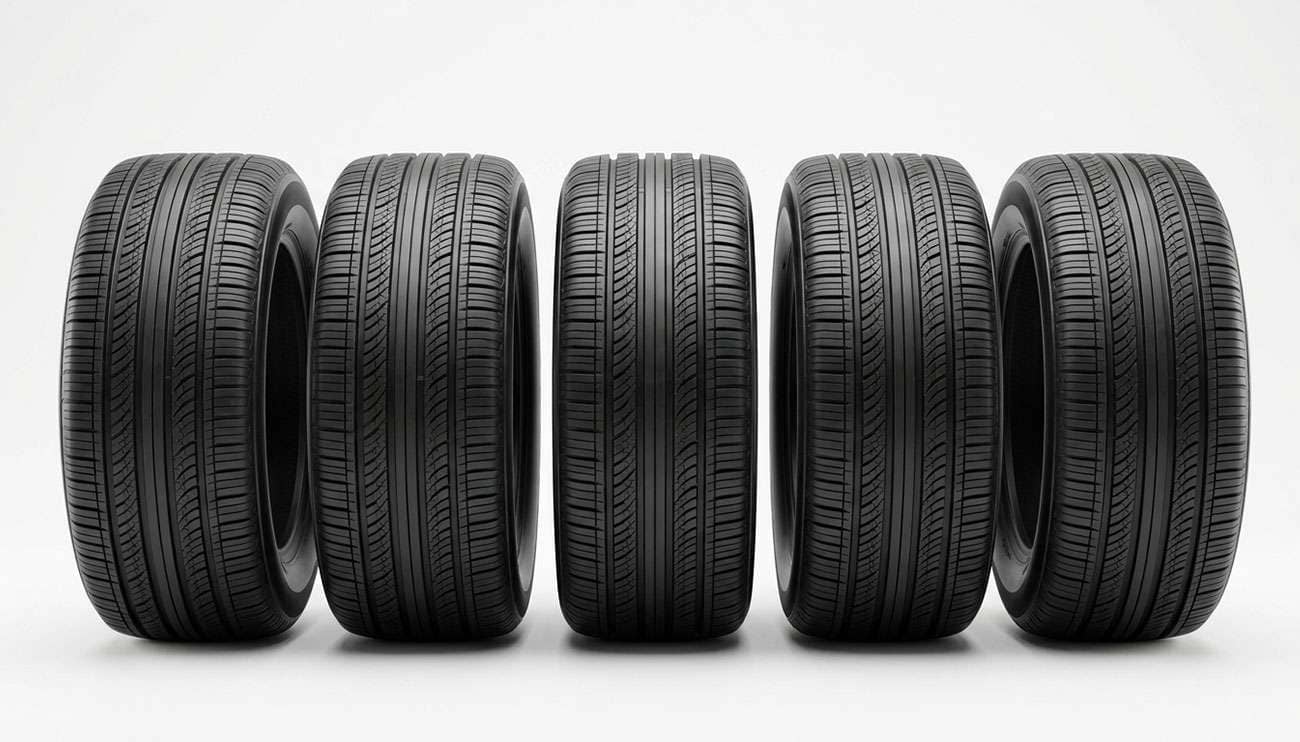
There is no single best 245/60R18 tire, because this size is sold in three different load indexes and they are not interchangeable. The same size ships as 104, 105, and 109. That is a 287-pound spread in carrying capacity per corner, or 1,148 pounds across the axle set. For a 105-placard crossover, the Michelin Defender2 is the strongest all-around pick in the size. For a 109 XL placard, that tire is the wrong part number. Almost every roundup names one winner and skips the number that decides whether it legally fits your vehicle.
So the first question is not which brand. It is which of the three service descriptions your door placard calls for. Get that wrong and the best-reviewed tire on the internet is still the wrong tire for your truck.
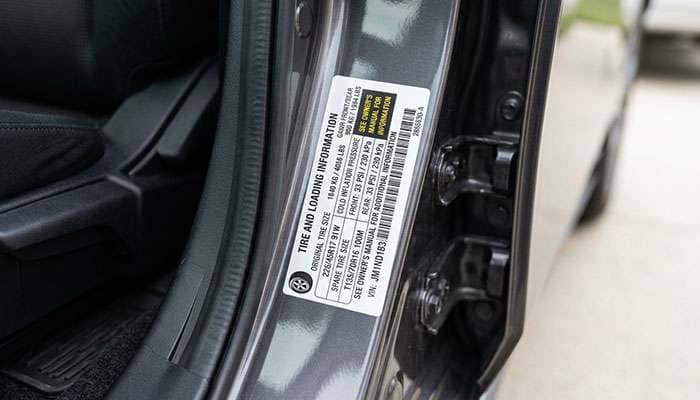
Every vehicle sold in the United States carries a tire and loading information placard on the driver door jamb, required under Federal Motor Vehicle Safety Standard 110. It lists the original tire size, the cold inflation pressure, and the vehicle capacity weight. The service description printed after the size, something like 105H or 109V, is the part almost nobody reads and the part that matters most in this particular size.
Here is the spread you are choosing between:
Load Index |
Capacity Per Tire |
Load Range |
Who It Is For |
|---|---|---|---|
104 |
1,984 lb |
SL (P-metric) |
Older two-row and midsize crossovers with a P-metric placard. Rare now. |
105 |
2,039 lb |
SL |
The large majority. Most three-row crossovers and midsize SUVs from 2011 forward. |
109 |
2,271 lb |
XL |
Heavier three-row SUVs, tow-package trims, and anything with a high vehicle capacity weight. |
Two rules follow from that table, and both come straight from Tire and Rim Association replacement practice. You may always go up in load index. You may never go down. A 109 XL tire on a 105 placard is fine, if slightly firmer riding. A 105 SL tire on a 109 XL placard is a downgrade of 928 pounds across four corners, and it is the single most common mistake made when shopping this size online.
There is one wrinkle worth knowing. A P-metric 104 and a Euro-metric 105 in this size are functionally equivalent, because P-metric tires are derated by roughly nine percent when fitted to a truck or SUV. If your placard reads P245/60R18 104 and you buy a 245/60R18 105, you have not lost anything. The gap that actually matters is 105 to 109. For a deeper walk through how these ratings are built, our breakdown of load range vs load index covers the underlying math.
This is a mainstream crossover and midsize SUV size, fitted across roughly 35 makes and more than 70 model lines. The vehicles you will most often see it on include the Toyota Highlander from 2014 through 2019, the Ford Explorer from 2011 through 2019, the Ford Edge, the Nissan Murano, the Jeep Grand Cherokee, the Jeep Commander, the Acura MDX, the Honda Pilot, the Volkswagen Atlas, the Chevrolet Traverse, the Buick Enclave, the Kia Sorento, and the Hyundai Santa Fe.
The important part is that those vehicles do not all share a load index. A 2015 Highlander LE runs 105. A loaded three-row with a tow package can call for 109. Two vehicles that look nearly identical in a parking lot can require different tires in the same printed size. That is why the placard beats the model year lookup every time, and why a set bought off a generic size page can be legal on one and not the other.
Speed rating follows the same logic. The size is offered in T, H, and V, and a handful of winter fitments in Q and R. You may go up a speed rating freely. Going down changes the vehicle handling calibration the manufacturer signed off on, and on European-market fitments it can also void the tire against the OE approval. If your placard says V, buy V.
This is where most readers land. The 105 SL group is by far the deepest part of the size, and the competition is genuinely close. Here is how the top of the field separates.
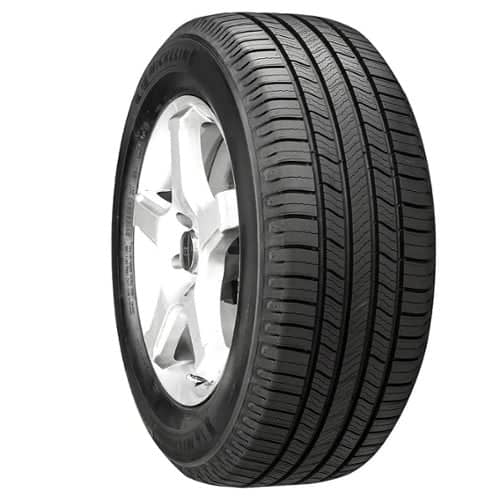
The Michelin Defender2 in 245/60R18 105H carries a UTQG treadwear grade of 840 and an 80,000-mile limited tread life warranty. Nothing else in this size in a 105 SL comes to that number. Treadwear grades are only comparable within a single manufacturer, but Michelin backing 840 with 80,000 miles of warranty is the company putting real money behind the compound.
What you give up is outright steering crispness. The Defender2 is tuned for a long, quiet, composed highway life rather than sharp turn-in. On a Highlander or an Edge, that is exactly the right trade. Price runs about $218 per tire.
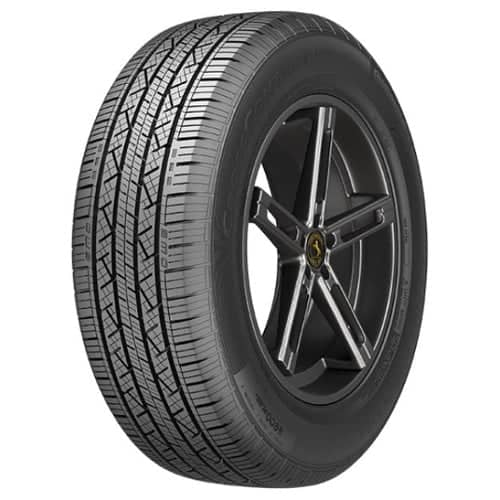
The Continental Cross Contact LX25 in 245/60R18 105H is the most frequently recommended tire in this size, and the recommendation holds up. It grades A for traction and A for temperature, a pairing that is less common than you would expect, and carries a 740 treadwear grade with a 65,000-mile warranty at roughly $209.
The LX25 is the tire to buy if wet braking and ride refinement rank above absolute mileage. It gives up about 15,000 warranty miles to the Defender2 and gains a slightly more absorbent ride over broken pavement. A 105T version is also stocked at about $208 if your placard calls for T rather than H.
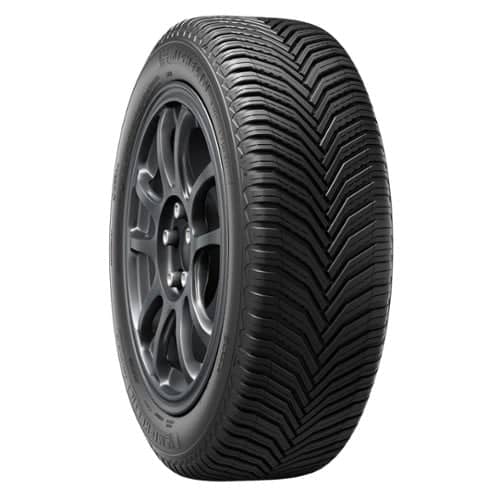
If you see real snow but do not want to store a second set, the Michelin CrossClimate2 CUV in 245/60ZR18 105V is the answer at about $205. It carries the Three-Peak Mountain Snowflake severe snow certification, which means it passed a measured traction test rather than simply wearing an M+S marking that any tire can self-certify.
The trade is tread life. A 640 treadwear grade and a 60,000-mile warranty sit meaningfully below the Defender2. You are buying winter capability with mileage, which is the correct trade for anyone north of the snow line.
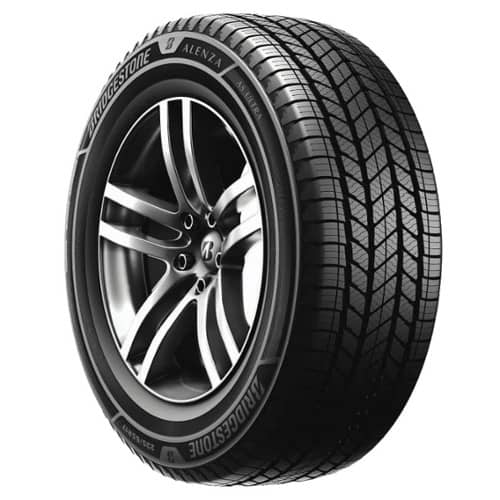
The Bridgestone Alenza AS Ultra in 245/60ZR18 105V pairs an 800 treadwear grade with an 80,000-mile warranty and A/A traction and temperature grades, at about $277. It is the only tire in the size that matches the Defender2 warranty term while also carrying a V speed rating, which makes it the natural pick for a placard that specifies V.
It is the most expensive tire on this list. Priced per warranted mile it is competitive; priced per tire on the invoice it is not the value play.
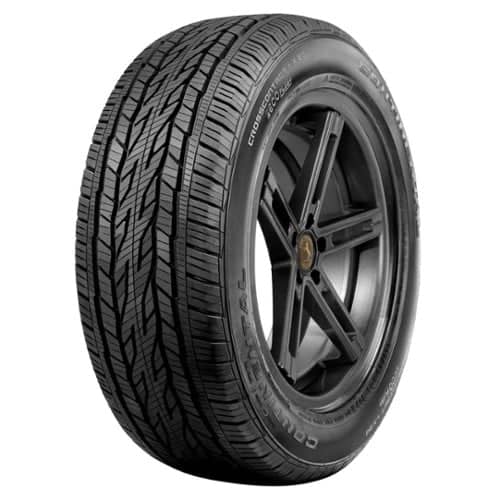
The Continental CrossContact LX20 in 245/60R18 105T delivers a 740 treadwear grade and a 70,000-mile warranty for about $170. That is the strongest warranty-per-dollar figure in the size by a clear margin.
It is a previous-generation compound relative to the LX25, and it grades B rather than A for temperature. For a highway-heavy commuter that never sees standing water at speed, that difference is academic and the money saved is real. Our guide to how to read tire treadwear ratings explains why the grade alone should not drive the decision.
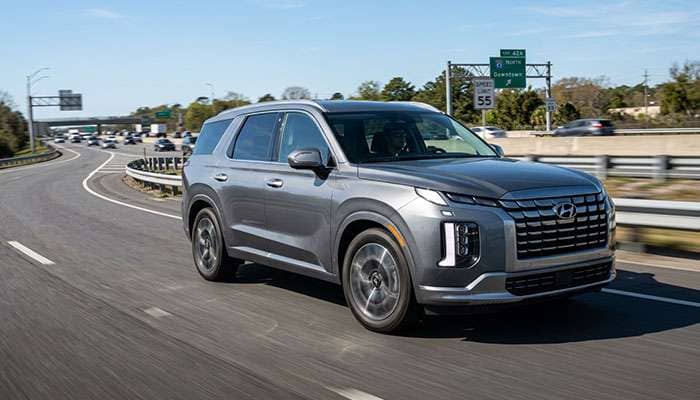
The XL group is smaller, and the shortlist is correspondingly tighter. If your placard reads 109, these are the tires actually built to it.
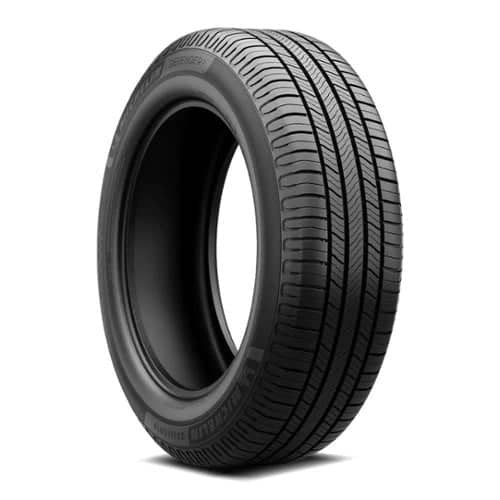
The Michelin Defender 2 in P245/60R18 109H XL is the same 840 treadwear compound and 80,000-mile warranty as the 105 version, built on an extra load casing, at about $240. If you liked the reasoning above and your placard says 109, this is simply the correct part number.
Expect a firmer ride than the SL version at the same pressure. That is the extra load casing doing its job, not a defect.
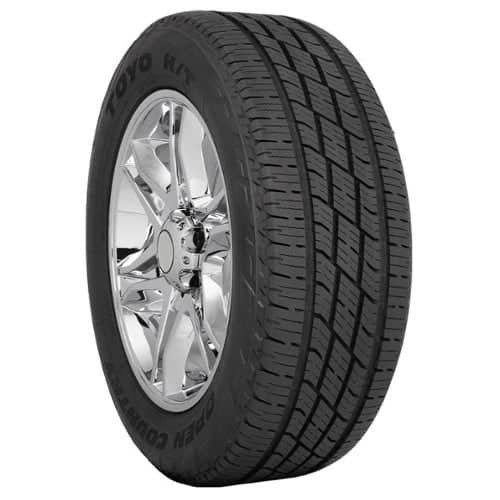
The Toyo Open Country H/T II in 245/60ZR18 109V XL is the value standout of the XL group at about $211, with a 740 treadwear grade, a 70,000-mile warranty, A/A traction and temperature, and 11/32 of an inch of tread depth. It is the rare tire that undercuts the field on price without giving up warranty term.
Toyo tunes this one firm and stable rather than plush. On a tow-rated three-row that is the behavior you want.
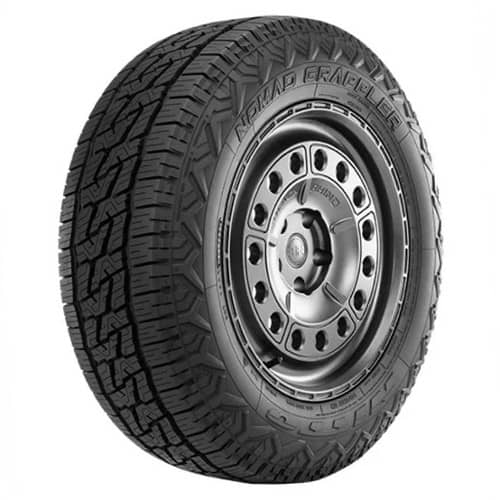
For anyone who actually leaves pavement, the Nitto Nomad Grappler in 245/60R18 109H XL runs 13/32 of an inch of tread depth against the 10/32 typical of the touring tires above, at about $222. That extra depth is what buys you dirt-road and gravel capability.
Deeper tread carries a noise penalty and a 540 treadwear grade with a 60,000-mile warranty. It is a purposeful trade, not a compromise, and it only makes sense if the capability gets used.
If Your Priority Is |
105 SL Pick |
109 XL Pick |
Approx. Price |
|---|---|---|---|
Maximum tread life |
Michelin Defender2 105H |
Michelin Defender 2 109H |
$218 to $240 |
Quiet and wet grip |
Continental Cross Contact LX25 105H |
Toyo Open Country H/T II 109V |
$209 to $211 |
Snow without a second set |
Michelin CrossClimate2 CUV 105V |
Michelin Crossclimate 2 109V |
$205 to $278 |
Lowest cost per warranted mile |
Continental CrossContact LX20 105T |
Toyo Open Country H/T II 109V |
$170 to $211 |
Light off-road use |
Falken Wildpeak A/T Trail 105H |
Nitto Nomad Grappler 109H |
$222 to $227 |
Tire noise in this size tracks two things more reliably than any marketing claim: tread depth and tread pattern continuity. Shallower tread with a continuous center rib is quieter. Deeper tread with open shoulder blocks is louder. That relationship holds across brands and it is measurable.
By that standard the quietest options in 245/60R18 are the Continental Cross Contact LX25, the Michelin Defender2, and the Bridgestone Alenza AS Ultra. All three run 10/32 of an inch of tread depth with closed, rib-dominant patterns. The Defender2 edges the group on sustained highway drone because the compound stays quieter as it wears, which is the part you notice in year three rather than week one.
The tires to skip if silence is the goal are the all-terrain options. The Nitto Nomad Grappler at 13/32 and the Falken Wildpeak A/T Trail are both noticeably louder above 55 mph, by design. There is no all-terrain tread in this size that is as quiet as a touring tread, and any listing that claims otherwise is describing the first 5,000 miles. Our road-tested rundown of the quietest and smoothest tires goes deeper on how noise is actually measured.
One practical note that costs nothing: a tire that is quiet when new gets loud when it wears unevenly. Feathered shoulder blocks from a missed rotation will make a Defender2 sound like an all-terrain by 30,000 miles. Rotation interval matters more than model choice for long-term noise.
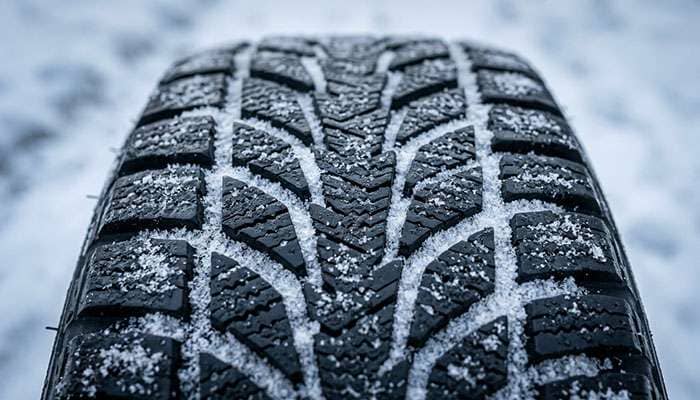
About a quarter of the tires offered in this size carry the Three-Peak Mountain Snowflake symbol. That symbol certifies performance in a measured acceleration test on medium-packed snow. An M+S marking does not; it is a self-declared tread geometry statement with no test behind it. If you drive where it snows, that distinction is the whole ballgame.
Tire |
Service Description |
Type |
Approx. Price |
|---|---|---|---|
Michelin X-Ice Snow SUV |
245/60R18 105T |
Dedicated studless winter |
$232 |
Continental Viking Contact 7 |
245/60R18 109H XL |
Dedicated studless winter |
$194 |
Michelin CrossClimate2 CUV |
245/60ZR18 105V |
All-weather, 3PMSF |
$205 |
Nokian Hakkapeliitta R5 SUV |
245/60R18 109R XL |
Dedicated studless winter |
$264 |
The decision is straightforward. If you face genuine winter for three months or more, a dedicated winter set on a second wheel package outperforms any all-weather tire and costs less over the life of both sets, because neither wears while the other is mounted. If winter means a handful of storms a year, the CrossClimate2 CUV is the better answer than owning two sets you have to swap and store.
Dimensionally, yes. A 235/60R18 measures 29.10 inches in overall diameter against 29.57 inches for the 245/60R18. That is a 1.6 percent reduction, comfortably inside the plus-or-minus 3 percent window that is standard practice for a substitution. Your speedometer will read about 1.6 percent high, so an indicated 70 mph is an actual 68.9 mph.
The problem is not the diameter. It is the load index. A 235/60R18 is most commonly offered at 103, which is 1,929 pounds per tire. Against a 105 placard you have given up 110 pounds per corner, and against a 109 placard you have given up 342 pounds per corner, or 1,368 pounds across the vehicle. On a three-row SUV loaded with people and cargo, that is not a theoretical margin.
There is a second issue. A 235 section on a wheel sized for a 245 sits closer to the narrow end of its approved rim width range, which stretches the tread face and moves the wear pattern toward the shoulders. It is legal on most 18-by-7.5 and 18-by-8 wheels, but it is not free.
The short version: if you find a 235/60R18 in a load index that meets or exceeds your placard, and the rim width falls in the tire's approved range, the swap is sound. If you are doing it purely because a 235 was cheaper, you are trading capacity for a modest discount. Our comparison of 235 vs 245 tires covers the handling side, and if you decide to go that route, the roundup of the best 235/60R18 tires has the model-level picks.
A 65 is taller. The aspect ratio is the sidewall height expressed as a percentage of section width, so at a fixed 245 section width the 65-series sidewall is 159.25 mm against 147 mm for the 60-series. Doubled for both sides, a 245/65R18 stands 30.54 inches tall against 29.57 inches for a 245/60R18. That is a 0.97-inch difference in overall diameter, or 3.3 percent.
The consequences are worth spelling out, because that 3.3 percent shows up in four places at once. Your speedometer reads low by 3.3 percent, so an indicated 70 mph is an actual 72.3 mph and every mile logged on the odometer is short. Revolutions per mile drop from roughly 682 to roughly 660, which slightly lowers effective gearing and can dull acceleration. Ride quality improves, because there is more sidewall to absorb impacts. Ground clearance rises about half an inch.
Whether it fits is a separate question from whether it is taller. A 3.3 percent increase is inside the conventional 3 percent tolerance only by a hair, and on a vehicle with tight strut clearance or an active safety system calibrated to the original rolling circumference, it may not be the right call. Advanced driver assistance systems read wheel speed to estimate vehicle speed, and a rolling circumference change propagates into those calculations. Our explainer on tire aspect ratio walks through the geometry in more detail.
There is no recommended pressure for a 245/60R18 tire. There is a recommended pressure for your vehicle, and the tire has nothing to do with it. Across the vehicle applications that use this size, the factory cold inflation specification ranges from 26 psi to 38 psi. That is a 12 psi spread inside a single printed tire size, which is exactly why a generic answer is useless here.
The pressure molded into the sidewall is the maximum the tire is rated to hold, not a target. Inflating to the sidewall number on a vehicle specified at 32 psi will crown the tread, shrink the contact patch, wear the center rib prematurely, and make the ride harsh for no benefit at all.
The number you want is on the driver door jamb placard, and it applies cold, meaning before the vehicle has been driven more than a mile or has been parked at least three hours. Tire pressure rises roughly 1 psi for every 10 degrees Fahrenheit of ambient temperature change, which is why a vehicle set correctly in September triggers a TPMS warning on the first cold morning in November. Our guide to finding your recommended tire pressure covers the placard-versus-sidewall question in full.
One exception worth knowing: if you regularly load to the vehicle capacity weight or tow near the rated limit, some manufacturers publish a higher rear pressure for loaded conditions. That figure is in the owner manual, not on the placard, and it is the only case where you should deviate from the door jamb number.
Running a 105 SL tire on a 109 XL placard does not fail immediately. It fails progressively, and the progression is predictable.
It starts with sidewall deflection. An underrated casing flexes more under the same load, and flexing generates heat. Heat is the primary enemy of a radial tire, because it degrades the adhesion between the steel belts and the rubber they are bonded to. In the first stage you notice nothing. In the second, you notice slightly vague steering when the vehicle is loaded and slightly faster wear at the shoulders. In the third, the belt edges begin to separate internally, which shows up as a vibration that no amount of balancing fixes. In the fourth stage, on a hot day, on a loaded highway run, the tread separates from the casing.
Along the way there is a cost you will feel before any of that. An overworked casing runs a smaller and less stable contact patch, which lengthens wet braking distances and accelerates irregular wear. You will replace a mismatched set thousands of miles early and pay for the replacement on top of the tires you should have bought the first time.
There is also a liability dimension that rarely gets mentioned. In a collision investigation, a tire that does not meet the placard specification is a documented deviation from the manufacturer's safety specification. That is a conversation nobody wants to have with an insurance adjuster over a $30 per tire difference.
Open the driver door and read the placard. Write down three things: the tire size, the service description including the load index and speed rating, and the cold inflation pressure. That takes ninety seconds and it eliminates every guess in this article.
If the placard reads 104 or 105, your field is wide and the Michelin Defender2 is the strongest default. If it reads 109, filter to XL only before you compare anything else, and the Michelin Defender 2 or Toyo Open Country H/T II should be the shortlist. If you see real winter, decide between a dedicated set and the CrossClimate2 CUV before you shop model names.
Then check your current tires while you are down there. Look at the four-digit DOT date code on the sidewall. Tires older than six years should be evaluated regardless of remaining tread, because the compound ages whether or not the vehicle is driven. Check tread depth with a gauge at three points across the face; a difference between inner and outer readings is an alignment problem that will eat a new set the same way it ate the old one.
Shop 245/60R18 tires at Performance Plus Tire and filter by the exact service description on your placard.
The 245/60R18 is a well-supplied size with genuinely good tires at every price point, which is why the review roundups all converge on similar names. What they leave out is that the size splits three ways on load index, and the split is the actual decision. A 105 placard and a 109 placard are shopping two different lists that happen to share a printed size.
Sort by the placard first. Then pick between tread life, quiet, and winter capability, because at this point in the market you are choosing which strength to prioritize rather than avoiding a bad tire. Get the load index right and almost any of these will serve you well for 60,000 miles or more.
It depends on your load index. For a 105 SL placard, the Michelin Defender2 leads with an 840 treadwear grade and an 80,000-mile warranty. For a 109 XL placard, the Michelin Defender 2 in XL or the Toyo Open Country H/T II are the picks. A 105 tire on a 109 placard is a downgrade of 928 pounds across four corners regardless of how well the tire reviews.
Roughly 35 makes and more than 70 model lines use it, including the Toyota Highlander from 2014 to 2019, the Ford Explorer from 2011 to 2019, the Ford Edge, Nissan Murano, Jeep Grand Cherokee, Acura MDX, Honda Pilot, Volkswagen Atlas, Chevrolet Traverse, Buick Enclave, Kia Sorento, and Hyundai Santa Fe. Load index varies between them, so check the placard rather than the model.
The Continental Cross Contact LX25, Michelin Defender2, and Bridgestone Alenza AS Ultra are the quietest options, all running 10/32 of an inch of tread depth with continuous center ribs. The Defender2 holds its quiet best as it wears. All-terrain patterns in this size, including the Nitto Nomad Grappler at 13/32, are noticeably louder above 55 mph by design.
Dimensionally yes. A 235/60R18 is 29.10 inches tall against 29.57 for a 245/60R18, a 1.6 percent reduction that is well inside tolerance. The catch is load index. A 235/60R18 is commonly a 103, which gives up 110 pounds per tire against a 105 placard and 342 pounds against a 109. Only make the swap if the replacement meets or exceeds your placard load index.
There is no pressure recommendation for the tire, only for the vehicle. Across the vehicles that use this size, factory cold specifications range from 26 psi to 38 psi. Use the number on the driver door jamb placard, measured cold. The pressure molded on the sidewall is the tire's maximum rating, not a target, and inflating to it will crown the tread and wear the center rib early.
A 65 is taller. At a 245 section width, a 245/65R18 stands 30.54 inches against 29.57 inches for a 245/60R18, a difference of 0.97 inches or 3.3 percent. That change makes the speedometer read low by 3.3 percent, drops revolutions per mile from about 682 to about 660, adds roughly half an inch of ground clearance, and softens the ride.



