
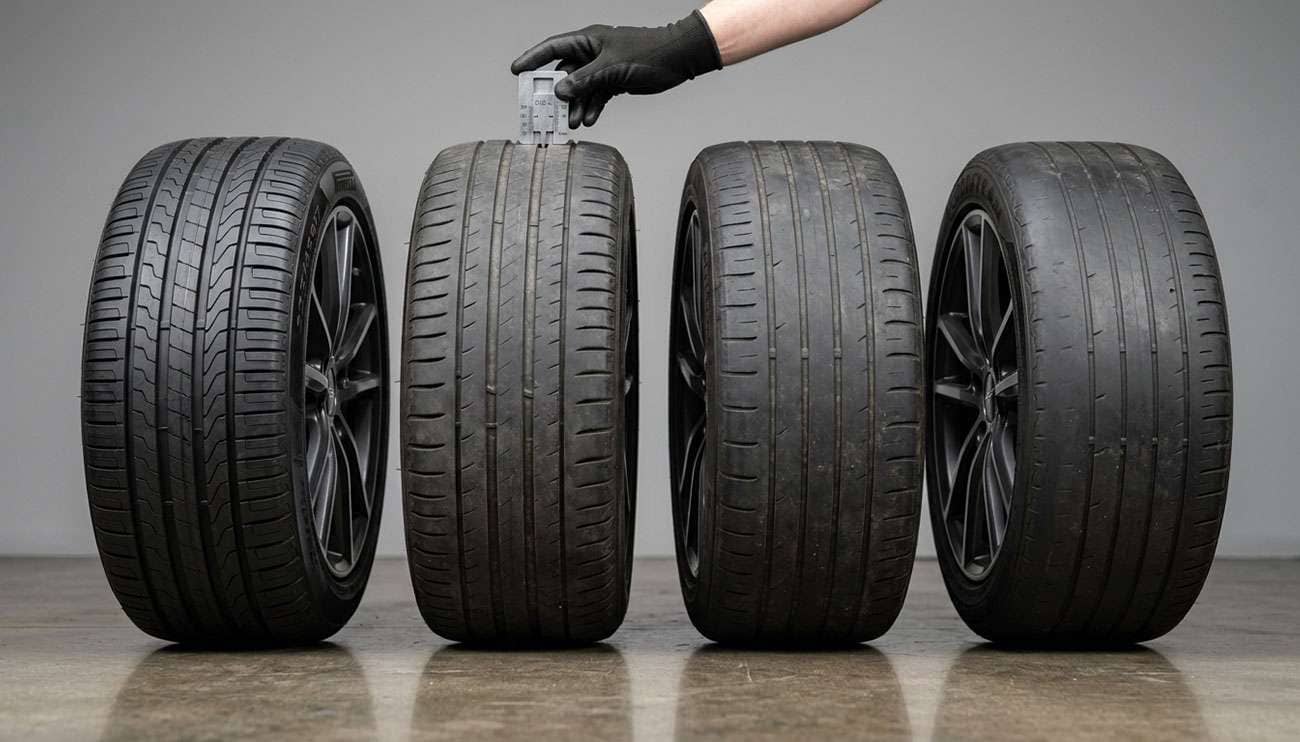
You walk into the shop with one bad tire. The tech checks it out, comes back with the bad news, and then drops the bigger bomb: "You're going to need to replace all four." Suddenly your $200 problem is an $800 problem, and you're standing in the waiting area wondering whether you just got the truth or the upsell.
I've been on the floor more than 40 years, and I'll tell you straight — sometimes the shop is right, and sometimes they're not. The honest answer to "how many tires do I have to replace?" depends on exactly two things: what drivetrain you've got, and how worn the rest of your tires are. Get those two facts straight and you can walk into any shop knowing the right answer before they tell you. Here's how the math actually works.
Before we talk tread depth, before we talk pricing, before any of it — there's exactly one question that splits the answer in half: is your car all-wheel drive, or two-wheel drive? Front-wheel drive and rear-wheel drive (collectively two-wheel drive, or 2WD) play by one set of rules. All-wheel drive (AWD) and four-wheel drive (4WD) play by a different, much stricter set. Mix those rules up and you'll either spend more than you need to or wreck a $3,000 differential trying to save $200.
Check your owner's manual or look up your specific vehicle. If you're not sure, the badge on the back of the car or the build sticker in the doorjamb will tell you. Then read the section that applies to you below.
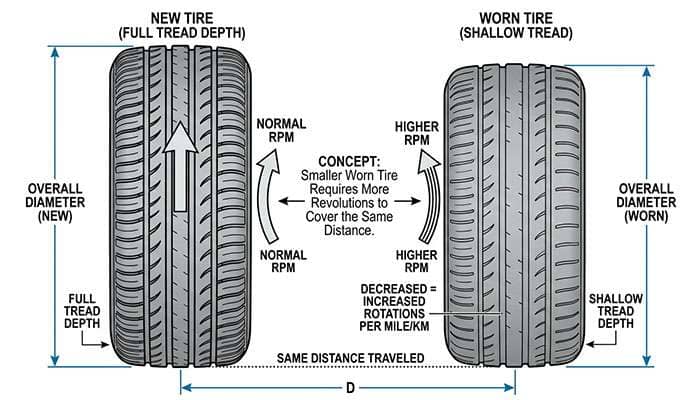
If your car is two-wheel drive, you have flexibility — and a tight-budgeted shop owner shouldn't be pushing you into a full set unless your tires actually need it. The decision comes down to how worn the other three tires are. The cleanest way to think about it: every new tire has roughly 10/32" of tread depth, and a tire is legally worn out at 2/32". So a "fully worn" tire has lost 8/32" of tread.
Consumer Reports' tire program has a clean three-tier framework that lines up with what most reputable shops use:
This isn't arbitrary. It comes from how tires actually behave. A new tire is taller in diameter than a worn one — that's just geometry. When you mix a brand-new tire with worn ones on the same axle, the new tire has a different traction profile, a different contact patch, and slightly different rotation per mile. On a wet road or in a panic stop, that mismatch can show up as a pull, a swerve, or worse. Our breakdown of tread depth and when to replace tires covers the measurement side in more detail.
This part trips up half the customers I talk to. They drive a front-wheel-drive car, they assume the new tires go on the front because that's where the power and the steering are. The shop puts them on the rear. They get suspicious.
The shop's right. New tires go on the rear, regardless of which axle drives. The reason is rear-wheel hydroplaning. If your rear tires lose grip in a wet corner — what's called oversteer — most drivers can't recover from it. The rear of the car comes around and you're spun. If your front tires lose grip, you get understeer, which is uncomfortable but recoverable: you just slow down and the front tires regain bite. Putting the freshest rubber on the rear gives you the survivable failure mode. The Tire Industry Association and every major tire manufacturer agree on this. We've covered the placement details in our piece on what to do when you only need two tires.
Field shorthand for 2WD: as long as the new tire's tread depth is within 4/32" of the existing tires, you're fine to do just one or two. More than 4/32" of difference and you're starting to mismatch enough that the car won't feel right. That's a working rule across most reputable shops, and it lines up with the 30-50% wear bands above.
Match brand and model wherever possible. A new Michelin Defender on a car with three half-worn Continental ProContacts will behave noticeably differently from the rest, even at identical tread depths — different rubber compounds and different tread designs handle wet braking and cornering grip differently. Mixing tire brands is sometimes unavoidable, but it's not ideal, and we get into the consequences in detail in that piece.
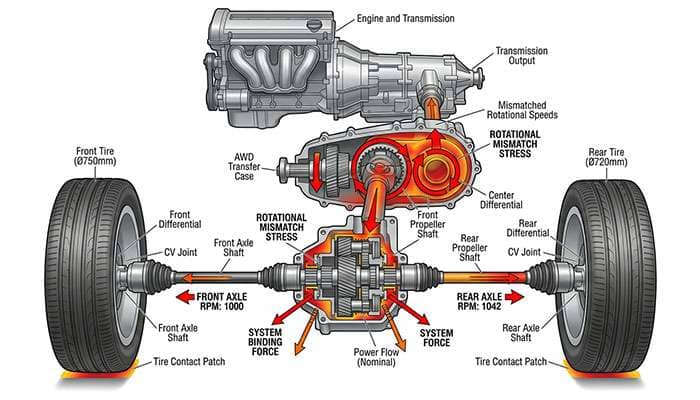
If your car is AWD or 4WD, the math gets a lot tighter — and the consequences of getting it wrong get a lot more expensive. The reason is the drivetrain. On a 2WD car, only two wheels are mechanically driven. On AWD, all four are connected through a center differential, transfer case, or viscous coupling that's constantly balancing rotation between front and rear axles. That balancing system assumes all four tires are turning at the same rate. When they're not, it works overtime to compensate, and over miles, it grinds itself out.
Most AWD manufacturers spec a maximum tread-depth difference between any two tires at 2/32" — a quarter of what's allowed on a 2WD car. Subaru is the strictest, and they publish this number in every owner's manual. Audi, Volvo, and most other AWD systems are in the same neighborhood. Some specs are written as a circumference tolerance instead — Subaru calls for all four tires within 1/4" of total circumference, which works out to roughly the same 2/32" tread depth limit.
That tolerance is small. A new tire with 10/32" tread paired with an existing tire that's lost 3/32" is already at the edge — and that's a tire that's still relatively young. By the time you've got a damaged tire and three tires that are halfway through their life, you're well outside the spec.
This is the part the shop usually undersells. When the AWD system is constantly compensating for mismatched tire diameters, what wears out depends on the specific drivetrain — but it's never cheap. On Subarus, it's typically the center differential and the viscous coupling unit. On Audis with quattro, it's often the transfer case or the rear differential. On many crossover SUVs with on-demand AWD, it's the power transfer unit or the rear electromagnetic clutch pack.
Replacement costs run from about $1,500 on the lower end to $4,000+ for a complete differential rebuild on a luxury AWD. Compare that to the cost of buying one extra tire — or even three extra tires — to keep the set matched. The math isn't even close. I've seen Subaru owners come in for what they thought was a simple flat repair and end up needing a $3,200 transmission service nine months later because they put one new tire on a worn set and the system couldn't handle the difference. That's not the shop being conservative. That's physics.
Here's a trick most customers don't hear from the average tire shop because it cuts out the upsell. Tire shaving is a service offered by some specialty retailers — Tire Rack is the most well-known — where you order a single new tire of the same brand and model as your existing set, and they grind down the tread depth to match what's already on your car before they ship it. Cost is typically $15-20 over the price of the tire itself. The result is one new tire that's mechanically identical in diameter to the other three, which keeps your AWD system happy.
This option only makes sense when your existing tires are reasonably young — say, less than half worn. If your other three tires are already at 5/32" or below, shaving a new tire down to match them just means you're spending money on a tire that's already most of the way through its useful life. At that point, four new tires is the better long-term play. But for the AWD owner with a freshly punctured tire and three healthy ones, shaving is the cheapest way out of the dilemma.
Here's where it gets interesting: some all-wheel-drive electric vehicles don't follow these rules at all. Tesla's dual-motor AWD, for example, uses two independent electric motors — one on each axle — with no mechanical center differential connecting them. Each motor controls its axle independently, so a tread-depth mismatch between the front and rear pairs doesn't stress a shared mechanical component the way it does on a Subaru.
That means Tesla AWD vehicles, and similar dual-motor EVs from other manufacturers, can typically replace just two tires (front pair or rear pair) without the same drivetrain risk. Always check your specific vehicle's owner's manual — manufacturer specs vary, and some EVs do still recommend full-set replacement for performance reasons even when the drivetrain doesn't require it.
If a shop tells you you need four tires when you walked in expecting one, ask the following before you accept the verdict:
Question to Ask |
Why It Matters |
|---|---|
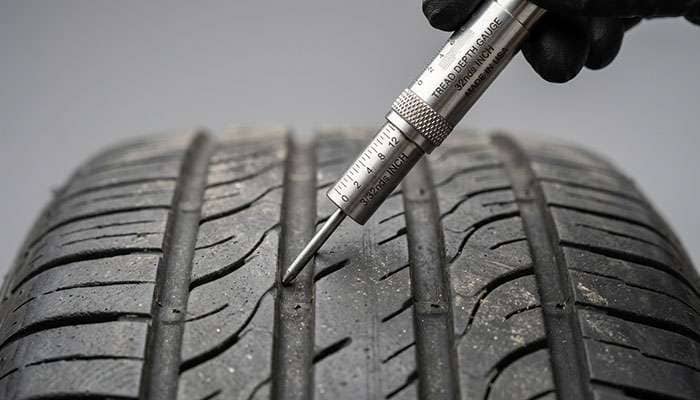
"Can you measure the tread depth on all four tires and tell me what each one reads?" |
This forces the shop to give you real numbers. If the difference between your worst and best is under 4/32" on 2WD or under 2/32" on AWD, you may not need all four. |
"What's my drivetrain — and what does the owner's manual specify?" |
The owner's manual is the source of truth. A reputable shop will check it (or know it for your model). A shop that hand-waves this question is guessing. |
"Is tire shaving an option for me?" |
Asking this signals you know about the shaving option. Most shops won't bring it up unprompted because it's not a service most of them offer. |
"If we go with two tires, which axle do they go on and why?" |
The right answer is "rear, because of oversteer risk in wet conditions." If the shop says "drive axle" or hesitates, get a second opinion. |
"Can you show me the wear pattern on each tire?" |
Uneven wear (cupping, edge wear, center wear) signals an alignment or suspension problem that needs fixing before you put new tires on. Otherwise the new tires will wear unevenly too. |
An honest shop will answer all of these calmly with specifics. A shop that's pushing you into more tires than you need will get vague, change the subject, or appeal to "shop policy" without showing you measurements. If you're getting hand-waving instead of numbers, take the car somewhere else for a second opinion. The PPT inventory has thousands of replacement tire options across every popular fitment, and our guide on what to ask when buying new tires covers the broader purchase-side questions.
I've been on both sides of this conversation. Here's how to read whether the shop is leveling with you or maximizing the ticket.
The shop is probably right when: Your car is AWD or 4WD and your tires are already half-worn or more, putting you outside the manufacturer's tread-depth tolerance. The math says four. Or — for 2WD — your tires are at 70% wear or beyond, where even an honest pair-replacement won't save you the headache long-term because you'll be back in the shop in another 10,000 miles for the other two anyway. Or your existing tires show uneven wear patterns from alignment or suspension issues, which means new tires alone won't solve the underlying problem.
The shop is probably upselling when: Your tires are clearly less than 30% worn (still 7/32" or more of tread depth left) and they're pushing four for a 2WD vehicle. Or they refuse to measure each tire and just give you a verdict. Or they don't know — or won't check — your owner's manual specifications. Or they push back hard when you ask about tire shaving on an AWD vehicle without explaining why it wouldn't work in your specific case.
One more flag: if the shop tries to charge you a "disposal fee" for tires they're going to refurbish and resell as used tires, that's not unethical exactly — it's just a margin layer. But it's worth knowing they're double-dipping when you're paying $5 a tire to throw something away that they'll sell for $50 the next week.
The bottom line: a shop you can trust will explain the math, show you the measurements, and tell you when one or two will work just as well as four. A shop that won't show their work is a shop that's working you. Your tires are too important — and too expensive — to take on faith.
How many tires you actually need to replace comes down to two facts: drivetrain and tread depth. Two-wheel-drive cars give you room to replace one or two when the rest of the set is healthy. All-wheel-drive cars demand a tighter tolerance and bigger commitment, but the tire-shaving option keeps the bill manageable when you've got a young set with one bad apple. The shop that's leveling with you will measure, explain, and offer the cheapest option that's actually safe. The shop that's not will skip the measurements and push the biggest sale.
The next time someone tells you "you need four," ask for the tread depth on each tire, ask what your owner's manual specifies, and ask whether shaving is an option. Those three questions will get you to the right answer almost every time. After install, our breakdown of breaking in new tires covers the first 500 miles, and the tire lifespan guide walks through what to expect mile-by-mile.
Not necessarily. If your existing tires are still relatively young — say, within 2/32" tread depth of a new tire — you can buy one replacement of the same model and have it shaved down to match. Tire Rack offers this service for $15-20. If your existing tires are already half worn or more, four is usually the right call to protect the AWD drivetrain. Always check your owner's manual for Subaru's specific tread tolerance — most call for within 2/32" or 1/4" of total circumference across all four tires.
Because rear-tire grip loss is much harder to recover from than front-tire grip loss. When the rear tires hydroplane in a wet corner, the back end of the car swings around — that's oversteer, and most drivers can't correct for it. When the fronts lose grip, you get understeer: the car pushes wide, you slow down, traction returns. Putting the freshest rubber on the rear gives you the safer of the two failure modes. The Tire Industry Association and every major tire manufacturer recommend this regardless of which axle drives the car.
If your car is 2WD and your other tires are less than 30% worn, one tire is genuinely fine — buy the same brand and model as the rest and have it mounted on the rear. If your car is AWD and your other tires are still young, ask about tire shaving so the new tire matches the worn ones in diameter. If your car is AWD and your other tires are already half-worn or more, the cheapest safe path is to drive on the spare and save up for four. Putting one new tire on a worn AWD set risks a drivetrain repair that costs more than four tires combined.
Most owner's manuals do address this in the tire maintenance section, but some only reference it indirectly under maintenance schedules or AWD operation. If you can't find a specific tread tolerance, the working industry standard for AWD is 2/32" between any two tires (or 1/4" of total circumference). For 2WD, the working standard is 4/32". When in doubt, call the dealer's service department for your vehicle and ask them directly — they have the manufacturer's technical service bulletins that often include numbers the owner's manual leaves out.



