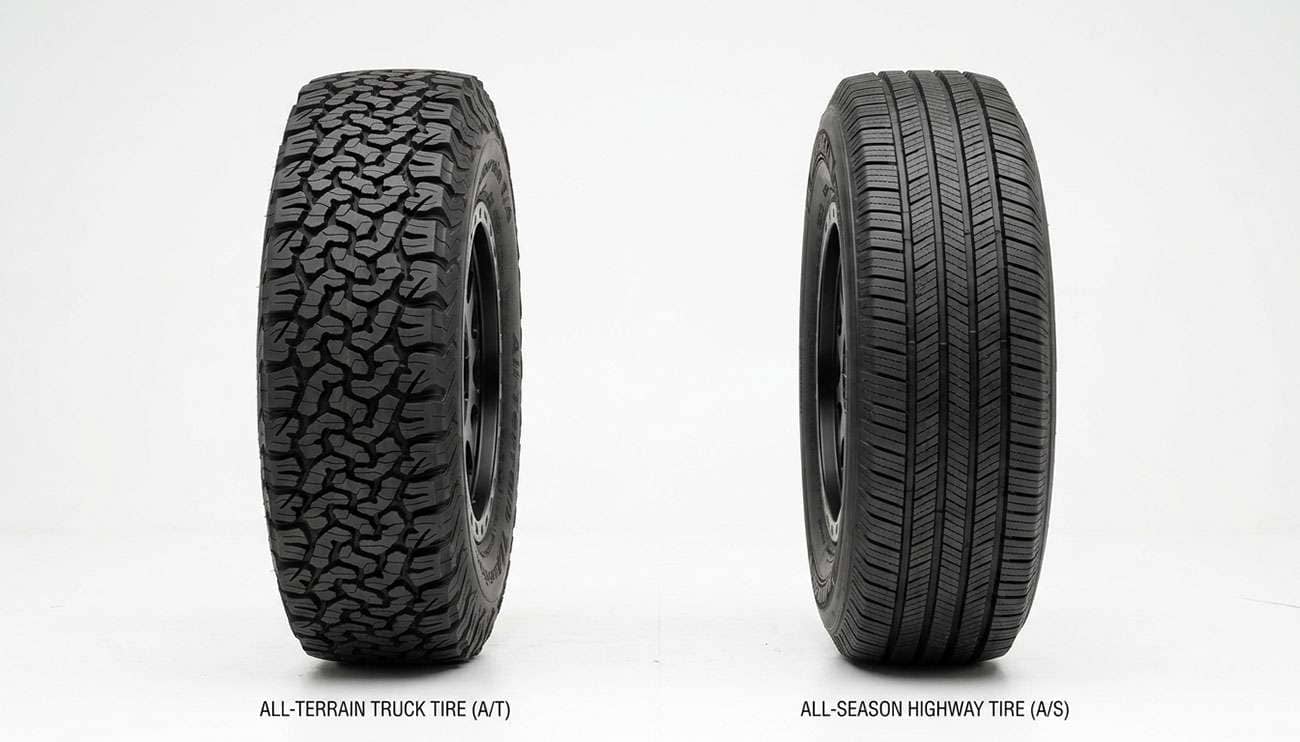
This is the decision that sits in front of nearly every truck, SUV, and crossover owner at some point: do I put all-terrain tires on this thing, or are all-seasons the smarter buy? The aggressive look of an all-terrain is tempting, but tires are an engineering tradeoff, not a fashion choice, and picking the wrong one costs you in fuel, noise, and money you didn't need to spend.
I run these numbers with customers every day, so let me give you the data-driven version. Both tire types are genuinely good at their jobs — the jobs are just different. By the end of this you'll know exactly which one matches how you actually drive, not how you imagine you drive.
If you spend the overwhelming majority of your miles on paved roads and only see the occasional gravel driveway or light snow, all-season tires are the better choice — they're quieter, more fuel-efficient, cheaper, and grip wet pavement better. If you regularly drive on dirt, gravel, sand, or unplowed roads, tow or haul heavy loads, or face real winter conditions, all-terrain tires earn their keep with the traction and durability to handle it. The aggressive tread only pays off if you actually use it.
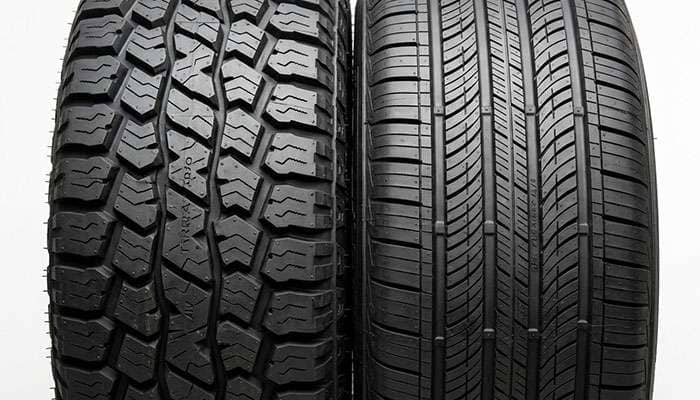
The differences start in the design brief. An all-season tire is engineered for paved roads in moderate conditions, prioritizing low rolling resistance, ride comfort, quiet operation, and dependable wet and dry grip. It uses a shallower, tighter tread pattern, a compound tuned to stay flexible across a normal temperature range, and a lighter, typically two-ply passenger (P-metric) construction.
An all-terrain tire is built to bridge highway and off-road duty. It runs deeper tread with larger, more open tread blocks to bite into loose surfaces and eject stones and mud, a tougher compound, and reinforced — often three-ply or light-truck (LT) — sidewalls to resist cuts and carry heavier loads. That toughness is the same reason all-terrains weigh more and run louder. If you want the broader family tree, our breakdown of HT vs. AT vs. MT tires shows where all-terrains sit between highway and mud tires, and the construction question of P-metric vs. LT tires is a big part of why the two categories behave so differently.
Here's the side-by-side most articles skip. These are typical ranges across popular models; specific tires vary, so treat them as a planning guide rather than absolutes.
Spec |
All-Season |
All-Terrain |
|---|---|---|
Tread depth (new) |
~10–12/32" |
~15–18/32" |
Typical tread life |
~50,000–70,000 mi |
~40,000–60,000 mi |
Highway noise |
Low / quiet |
Noticeable hum |
Fuel economy |
Best (low rolling resistance) |
~1–3 mpg lower |
Wet-road braking |
Shorter / stronger |
Longer |
Dirt / gravel / mud |
Poor |
Strong |
Severe snow (3PMSF) |
Rarely rated |
Many models rated |
Load / towing capacity |
Moderate (P-metric) |
Higher (often LT) |
Relative price |
Lower |
Higher |
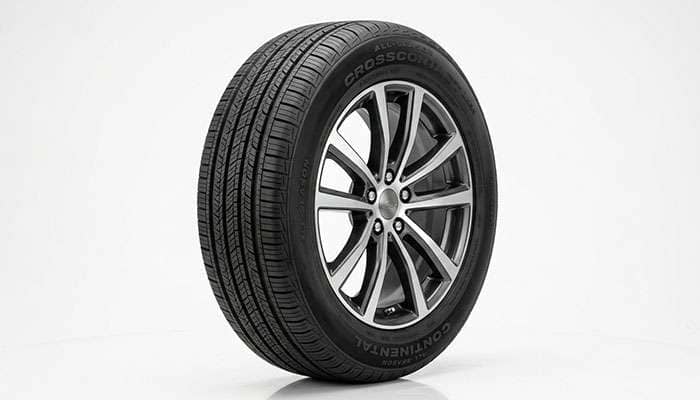
Since most owners drive mostly on pavement, this is where the all-season earns its reputation. The shallow, tightly spaced tread runs quietly, while an all-terrain's big, open blocks generate a hum that grows with speed and gets louder as the tire wears. On comfort, the all-season's lighter construction and lower-profile design soak up road imperfections more smoothly.
Fuel economy is the cost most people underestimate. An all-terrain is heavier and has higher rolling resistance, which commonly trims one to three miles per gallon depending on the vehicle and tire. Over years of driving, that fuel difference can outweigh the price gap between the two tires. And in the rain, the all-season's compound and water-channeling tread generally deliver shorter wet-braking distances — a genuine safety edge for a commuter.
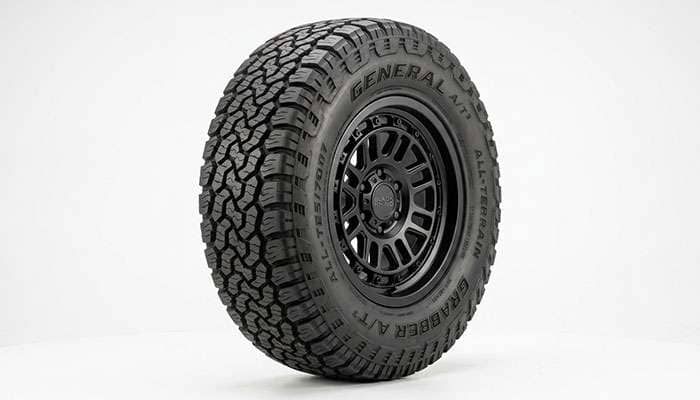
This is where the all-terrain pulls decisively ahead, and where most competing comparisons get vague. On dirt, gravel, sand, and mud, the all-terrain's deep, open tread and tough sidewalls provide traction and cut resistance an all-season simply can't match — which is exactly what all-terrain tires are good for. If your routine includes job sites, trailheads, boat ramps, or unpaved roads, that capability isn't optional.
Winter is the detail worth understanding precisely. Both tire types handle light snow, but many modern all-terrains carry the Three-Peak Mountain Snowflake (3PMSF) symbol, certifying them for severe snow service, while most standard all-seasons do not. If you face real snow, a 3PMSF-rated all-terrain is a meaningful step up — though a dedicated winter tire still wins on ice, as we cover in winter vs. all-season tires. One caution either way: hard use off-road knocks your alignment around, and off-roading can throw your alignment out faster than you'd expect.
People assume the deeper-tread all-terrain lasts longer. It often doesn't. The softer, tougher compound and heavier tread blocks frequently wear faster on pavement than an all-season's harder, efficiency-tuned compound, which is why all-season mileage warranties commonly run higher. To compare honestly, look past the sticker price to cost per mile: factor in the tire's expected life, the fuel-economy penalty, and the price difference together. For a pavement-bound driver, the all-season usually wins that math comfortably. Understanding the wear numbers on the sidewall helps here — our guide on how to read tire treadwear ratings explains what those figures actually predict.
Strip away the marketing and the decision comes down to one honest estimate: what percentage of your miles are actually off pavement or in conditions an all-season can't handle? Here's the framework I give customers. If roughly 90 percent or more of your driving is paved and weather is moderate, buy all-seasons. If it's somewhere around 70 to 90 percent paved with regular gravel, dirt, towing, or snow mixed in, an all-terrain — ideally a 3PMSF-rated one — is the better all-rounder. If you're below that and genuinely working the vehicle off-road, you're into dedicated all-terrain or even mud-terrain territory, which our guide on daily driving off-road tires and our expert guide to choosing off-road tires both dig into. Be honest about that percentage — most people overestimate their off-road miles and overpay in fuel and noise as a result.
Whichever way the math points you, here's what I'd actually recommend, all in stock at Performance Plus Tire.
All-season and highway (best for pavement-focused drivers): the Michelin Defender LTX M/S 2 265/65R18 is the benchmark for quiet, long-wearing truck and SUV all-season performance, the Continental TerrainContact H/T 275/60R20 pairs comfort with solid wet grip, and the Continental CrossContact LX20 265/70R17 is a comfortable, efficient crossover and SUV choice.
All-terrain (best for mixed-surface and winter drivers): the Falken Wildpeak A/T3W 265/70R17 is a 3PMSF-rated standout that balances off-road grip with manners on the road, the BFGoodrich All-Terrain T/A KO3 LT265/65R18 brings true light-truck toughness, and the Cooper Discoverer AT3 4S 265/70R17 is a well-rounded, winter-rated all-terrain. Our Fitment Team can match any of these to your exact vehicle and driving mix.
All-terrain versus all-season isn't about which tire is better — it's about which tire matches your miles. All-seasons win on noise, comfort, fuel economy, wet braking, and cost for the pavement-focused driver. All-terrains win on dirt, gravel, snow capability, load, and durability for anyone who regularly leaves the smooth stuff behind. Run the 80/20 estimate honestly, weigh the cost per mile, and buy for the driving you actually do. When you're ready to spec a set, our team will match the right tire to your vehicle and your real-world conditions.
Only if your daily driving regularly includes dirt, gravel, snow, towing, or rough roads. For a driver who spends almost all their miles on paved roads in moderate weather, all-terrains add noise, reduce fuel economy by roughly one to three mpg, and cost more without delivering capability you'd use. In that case, all-season tires are the better daily choice.
Generally yes. All-terrain tires are heavier and have higher rolling resistance than all-season tires, which typically lowers fuel economy by about one to three miles per gallon depending on the vehicle and specific tire. Over the life of the tires, that fuel cost can exceed the price difference between the two types.
Many modern all-terrains are good in snow, especially models carrying the Three-Peak Mountain Snowflake (3PMSF) symbol that certifies them for severe snow service — an edge most standard all-seasons lack. For ice and the harshest winter conditions, however, a dedicated winter tire still outperforms both.
All-season tires often last longer on pavement despite their shallower tread, because their harder, efficiency-tuned compound resists highway wear better than an all-terrain's softer, tougher compound. That's why all-season mileage warranties commonly run higher. All-terrains trade some tread life for off-road durability and traction.
Yes. The larger, more open tread blocks on all-terrain tires generate a noticeable highway hum that increases with speed and as the tire wears. All-season tires use a tighter, shallower tread pattern that runs quieter and is generally more comfortable on paved roads.
Reviewed by Dennis Feldman, Vice President, Performance Plus Tire