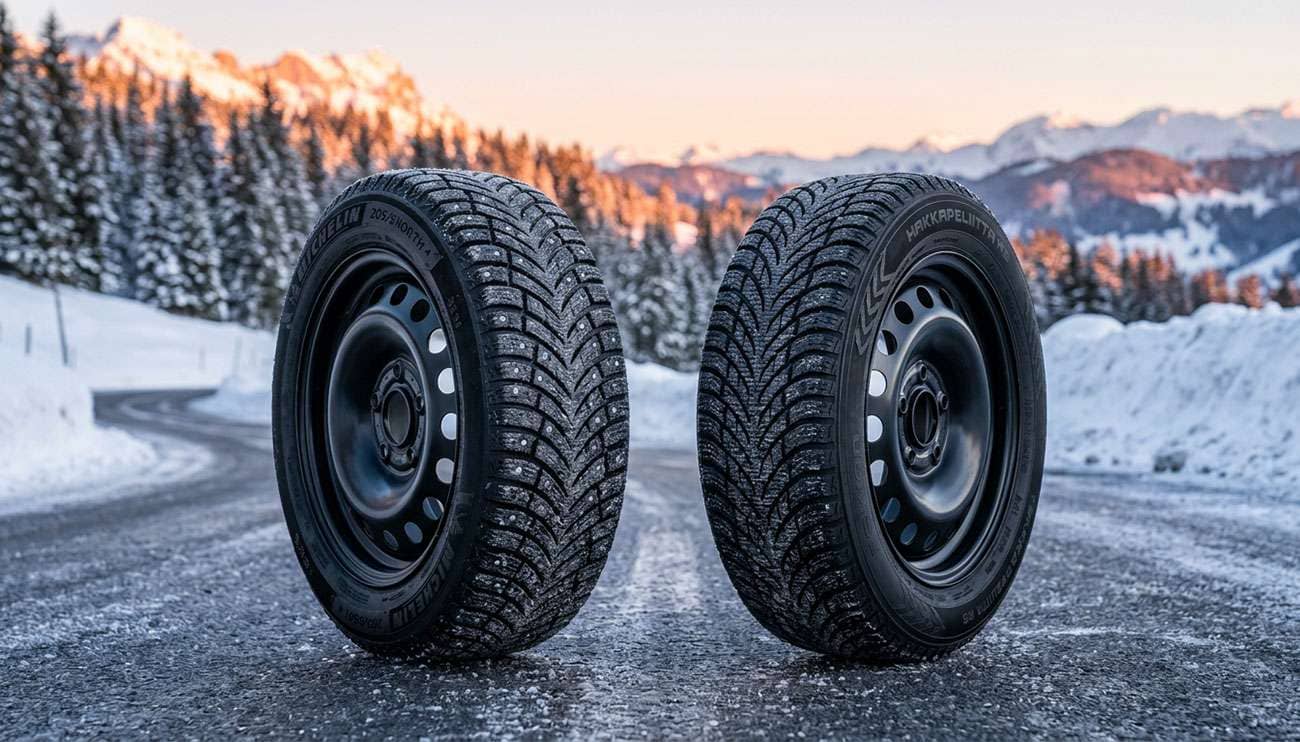
Most of the time, yes. A good studless winter tire ties or beats a studded tire on packed snow, slush, very cold ice and bare pavement. Studs win on one surface: glare ice sitting near 32°F, where a thin film of meltwater turns rubber into a hockey puck. On that ice, factory-studded tires stopped 21 to 29 percent shorter than studless tires in a 2025 test. Most guides answer this question with "it depends" and stop there. It depends on two things: how warm your ice is, and which studded tire you would actually buy.
We've sold tires out of Long Beach since 1971. That sounds like a funny place to talk about snow until you count how many of our customers point their trucks at Mammoth, Big Bear and Tahoe every winter weekend, and how many sets we ship to snow states. Every November somebody asks me whether they need studs. My answer always starts with a question back: what does your ice look like at 7 a.m.?
Studded vs. Studless by Surface and Temperature
Road Surface |
Temperature |
Winner |
What the Testing Shows |
|---|---|---|---|
Glare ice, wet on top |
Near 32°F |
Studded, by a wide margin |
Best studded tire stopped about 44 feet shorter than the best studless tire from 31 mph (2025) |
Hard ice |
About 14 to 28°F |
Studded, by a shrinking margin |
Studs lose effectiveness as ice gets colder and harder (WSDOT 2002 review) |
Cold, dry ice |
Below about 14°F |
Toss-up |
No meltwater film forms in rubber-on-ice tests (SAE 912578); little or no stud gain in Swedish tests |
Very cold ice |
Below 0°F |
Toss-up |
Studded tires performed about like highway tires (1973 Alaska study) |
Packed snow |
Any |
Tie |
All 14 tires within 3 percent in snow braking (2025) |
Fresh snow and slush |
Any |
Tie to studless |
Studless stopped 9 to 13 percent shorter on snow in 1995 Alaska tests |
Bare wet pavement |
Above freezing |
Near tie |
Same tire with and without studs finished 1.4 feet apart from 50 mph (2022) |
Bare dry pavement |
Above freezing |
Studless, slightly |
Unstudded version stopped 2.3 feet shorter from 50 mph (2022) |
Here's the same decision keyed to where you drive instead of what you drive on.
Which Winter Tire Fits Your Winter
Your Winter |
Best Pick |
Why |
|---|---|---|
Plowed, salted roads with ice a few mornings a season |
Studless ice and snow tire |
Ties studs on snow, quieter on pavement, no stud deadline |
Untreated rural roads that glaze over near freezing for weeks |
Factory-studded or new studdable tire with studs |
The one surface where studs pay off, and you drive on it often |
Weekend ski trips from Southern California |
Studless or 3PMSF tire on all four, plus chains |
Studs don't replace chains under Caltrans rules |
State that bans studs |
Studless ice and snow tire |
The strongest legal option for ice |
Mild winter, a handful of snow days |
3PMSF all-weather tire |
Snow-rated grip with no seasonal swap |
Heavy truck or regular towing |
Studless LT winter tire |
Several states limit studs by vehicle weight or tire pressure |
On glare ice near freezing, studs win, and it isn't close. Ice is at its slickest near its own melting point. The weight of the car and the heat from the tire melt a microscopic layer of water on top of the ice, and that water works like grease between the rubber and the road. A stud is a tungsten carbide pin set in a metal jacket, with about 1 mm of the pin standing proud of the tread. That pin punches through the water film and scratches into the solid ice underneath. Rubber alone can't do that.
The best recent numbers come from the Finnish magazine Tekniikan Maailma, which tested seven studded and seven studless Nordic winter tires in size 205/55R16 on a Volkswagen Golf in 2025. Braking on ice from about 31 mph:
That's a 44-foot difference from a speed you drive through a neighborhood. On a 32°F morning, it's the difference between stopping at the crosswalk and stopping in the middle of the intersection.
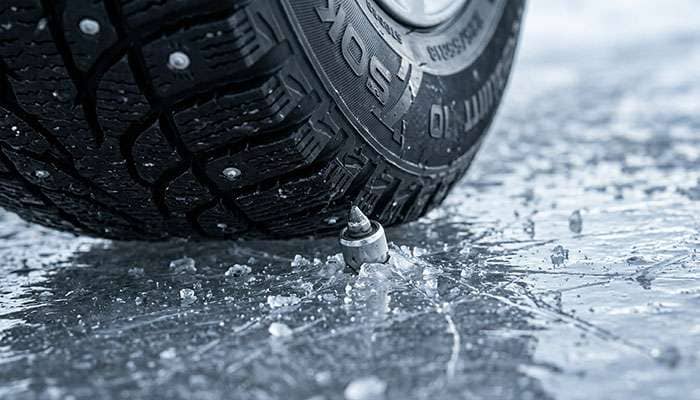
Here's the part most guides leave out. The colder the ice, the thinner that water film gets, and eventually it stops forming at all. SAE technical paper 912578, a 1991 study of studless tire performance, found that in rubber-on-ice friction tests no water formed at the contact surface below about 14°F (minus 10°C). With no water to cut through, a soft studless compound grips cold, dry ice well, and the stud has much less work to do.
The Washington State Department of Transportation reached the same conclusion. Its 2002 research overview of studded and studless traction (report WA-RD 551.1) found that studs work best at or near 32°F and lose effectiveness as ice gets colder and harder. It cites Swedish tests on ice at roughly 14 to 18°F that showed little or no gain from studs, and a 1973 Alaska study where studded tires performed about like ordinary highway tires below 0°F.
Studless tires attack ice differently. The compound stays soft well below freezing, and the tread is cut with thousands of sipes that open into extra biting edges as each block flexes. Some compounds also carry tiny pores or bite particles that wick the water film away. Our guide to how tire siping improves winter grip explains how those edges work. That closes most of the gap on cold, dry ice, but not on wet ice at 32°F.
So the useful question isn't "do I get ice?" It's "what temperature is my ice?" Freezing rain, refrozen slush and black ice at dawn after a thaw all sit right around 32°F. A clear night at 5°F makes a different ice entirely.
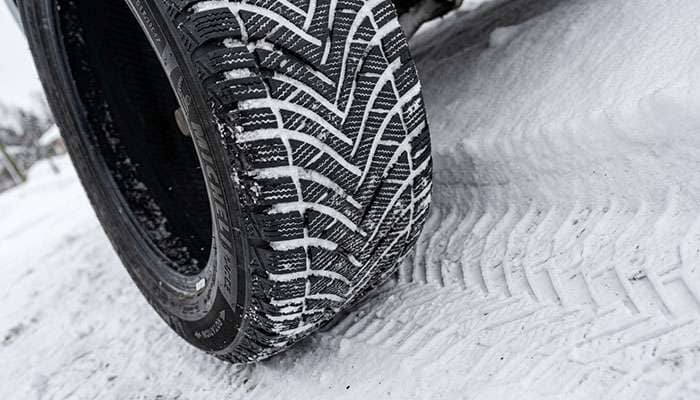
In snow, studs add almost nothing, and the testing is remarkably consistent on this point. A stud sticks out about 1 mm. Snow is soft. There's no hard surface for the carbide to scratch, so the tread pattern, the sipes and the rubber compound do all the work on both tires.
The WSDOT review summed it up this way: in most snow tests, studded tires did as well as or worse than studless tires. Slush is even less friendly to studs. Once ice softens into slush, the review notes, studs lose their effectiveness, and the job falls to tread voids that clear the slop out of the contact patch.
Deep, unplowed snow is a tread-depth and void question, not a stud question. If you live at the end of a long road the county plows last, buy the deepest, most open winter tread that fits your vehicle. Studs won't dig you out.
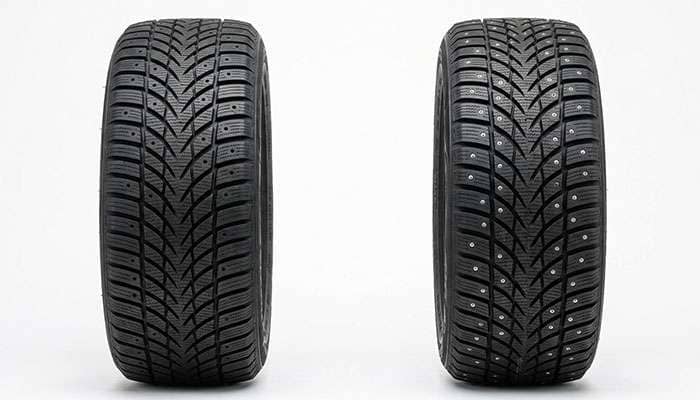
They used to, by a lot. Modern studs cost less than you'd think. The older testing is where the reputation came from:
Newer tests show a much smaller gap. In 2022, Tire Rack tested a studdable General AltiMAX Arctic 12 twice on the same car, once with studs and once without. From 50 mph on dry pavement, the studded version stopped in 101.9 feet and the unstudded version in 99.6 feet. On wet pavement the two finished within 1.4 feet of each other, with the studded tire slightly ahead.
In the 2025 Finnish test, the best studless tire won dry braking by about 2 feet from 50 mph, while the best studded tire stopped about 10 feet shorter on wet pavement, because very soft Nordic studless compounds give up some wet grip above freezing.
The dry-road loss comes from the pin itself: carbide sitting on bare pavement holds a sliver of each tread block off the road. Lighter studs have shrunk that penalty. They haven't removed the bigger costs of studs on bare pavement, noise and stud wear.
Here's why this matters more than the ice numbers: bare pavement is where most winter miles happen. The WSDOT review notes that ice near freezing occurs only about 1 percent of the time in Washington. It also cites figures putting icy pavement at about 13 percent of winter road conditions in Minnesota, 12.4 percent in Alaska and 0.5 percent in Connecticut, and not all of that ice sits near 32°F. Even in hard-winter states, you buy studs for a thin slice of the season and drive on them for all of it.
This is the variable almost nobody puts in front of you, and it can flip the whole answer. "Studded" covers two very different products.
Factory-studded tires leave the plant with studs already in them. The stud count, placement and stud design are engineered for that tread. The Nordic studded tires in the 2025 Finnish test fall in this group, and they're the source of the big ice-braking wins.
Studdable tires are winter tires with stud holes molded into the tread. A shop installs the studs, sized by a TSMI number that matches the depth of the molded hole. One stud manufacturer puts the count at roughly 80 to 120 studs per passenger tire, depending on diameter and hole pattern. Many studdable tires are designed as all-around winter tires first and ice tires second.
That same 2022 Tire Rack test shows what the difference means on ice. It ran the studdable tire with and without studs against a premium studless ice and snow tire:
Tire Setup |
Ice Braking, 12 to 0 mph |
Ice Acceleration, 60 ft |
|---|---|---|
Studdable tire, no studs |
40.0 ft |
4.94 sec |
Same tire, studs installed |
35.4 ft |
4.88 sec |
Premium studless ice and snow tire |
32.7 ft |
4.28 sec |
The studs cut about 11 percent off that tire's ice stop, yet the premium studless tire still stopped 2.7 feet shorter and pulled away quicker. The testers' advice was to buy a good studless ice and snow tire instead. Put the two tests together: the best factory-studded tire beats the best studless tire on wet ice, and the best studless tire can beat a shop-studded studdable tire on that same ice.
A properly installed stud shows about 1 mm of carbide. The WSDOT review found studs keep working at 1.0 to 1.1 mm of protrusion (about 0.04 inch), and their effect becomes negligible around 0.6 mm (0.024 inch). Every dry mile files that carbide down, and Tire Rack notes that high speed wears studs faster and raises the odds of throwing one. A studded set that spent two winters on bare interstate may carry studs that barely reach the ice.
Two more rules from the shop floor. Stud only new tires: stud makers warn that driven tires have holes packed with dirt that won't hold a stud properly. And stud all four. Studs on one axle give you a car with two different ends on ice, and that's the setup that swaps ends on a downhill curve.
Yes, several, and most of them hit you every day instead of a few days a season.
Studless tires carry trade-offs too, and I'd be lying if I left them out. The soft compound wears quickly on warm pavement, so a studless set comes off in spring just like studs. Its ice grip also fades with wear, because shallower blocks open fewer biting edges, and on some designs the ice compound doesn't run the full tread depth. Check what's left every fall with our guide to the tread depth that means it's time to replace tires.
Before any of the testing matters, your state has to allow studs. Minnesota, Wisconsin, Illinois, Mississippi, Louisiana and Hawaii ban them for everyday drivers, with narrow exceptions such as rural mail carriers in Minnesota and Illinois, short visits in Minnesota and Wisconsin, and the Mauna Kea summit roads in Hawaii. Michigan restricts studs tightly, Maryland allows them only in five western counties, and Texas and Florida are gray areas. Most other states allow studs inside a fixed calendar window, and a handful allow them year-round.
The law of the road under your tires is the one that applies, not the state on your plates. We keep a full state-by-state table with dates, protrusion limits and fines in our guide to when you can legally put studded tires on. Check it before you buy, especially if you cross state lines in winter.
No. This one catches a lot of our Southern California customers. Studded tires are legal in California from November 1 through April 30, but Caltrans states plainly that studded snow tires are not traction devices and can't be used in place of chains. At a chain control, studs earn you exactly what any snow tire earns you:
Every vehicle, 4WD included, has to carry chains in a chain control area, and the speed limit with chains on is 25 or 30 mph. For a weekend run up 395 to Mammoth or I-80 to Tahoe, a studded set buys you road noise on the drive up and nothing at the checkpoint that a studless M+S tire wouldn't. That's why I steer most SoCal drivers toward a studless winter tire or a three-peak mountain snowflake all-weather tire, plus a set of chains in the trunk. If the 3PMSF mark is new to you, here's what the snowflake tire symbol means. For the full breakdown of which setups pass each checkpoint, read whether you need chains with 4WD or AWD in California.
Pick the wrong tire for your winter and the bill comes due in stages. Here's how it escalates, from annoying to expensive.
The cheapest stop on that ladder is the first one: putting the right winter tire on before the first freeze.
Here's the order I'd work through it, the same way we'd talk it over at the counter.
Once you've settled on a type, shop our winter tires, including studless ice and snow models and studdable designs, by your size.
Studless snow tires are as good as studded on most of what winter throws at you: snow, slush, very cold ice and bare pavement. Studs pull ahead on wet glare ice near 32°F, and there the best factory-studded tires win big. They pay for it every dry mile in noise, stud wear and deadlines, and a shop-studded studdable tire may not beat a premium studless tire even on ice. Match the tire to the temperature of your ice and how often you drive on it.
On snow, slush, very cold ice and bare pavement, yes. A good studless tire ties or beats a studded one on those surfaces. On wet glare ice near 32°F, factory-studded tires still stop noticeably shorter, so drivers who face that ice often on untreated roads gain real safety from studs.
Minnesota, Wisconsin, Illinois, Mississippi, Louisiana and Hawaii ban studded tires for everyday drivers, with narrow exceptions. Michigan restricts them, Maryland allows them only in five western counties, and Texas and Florida are gray areas. Most other states allow studs between set dates.
Yes, if you see regular snow or ice. A studless winter tire stays soft in the cold and carries far more biting edges than an all-season tire, so it stops and turns better on winter roads. Our look at whether winter tires are worth getting compares them with all-season tires in detail.
They do different jobs. Chains generally give more grip in deep snow and on steep, snow-packed grades, but only at low speed for short stretches. Studs stay on all season and work best on glare ice. In California, studs don't count as traction devices, so chain controls still apply to you.
In winter conditions, yes. Studless tires use compounds that stay flexible below freezing plus dense siping, while most all-season tires stiffen in the cold. On warm, dry pavement the all-season tire wears longer and handles better, which is why studless tires come off in spring.
No. Only studdable tires with molded stud holes can take studs, and only when the tires are new. Driven tires have holes packed with dirt that won't hold a stud properly. Studs should also go on all four tires, not just the drive axle.