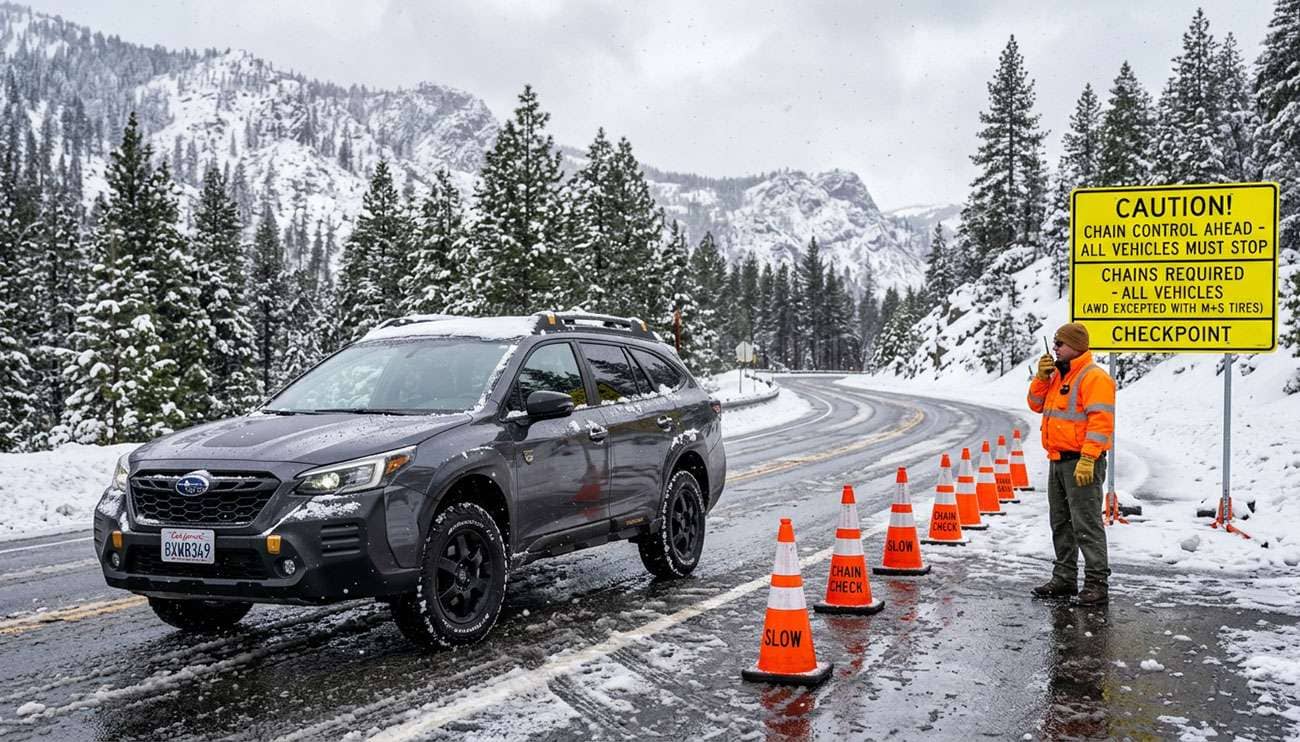
Short answer: sometimes, and the deciding factor is not your drivetrain. It is what is molded into your tire sidewalls. Under California chain control, a 4WD or AWD vehicle skips chains at the R2 level only when all four tires are snow-tread tires marked M+S (or MS, M/S, or MUD AND SNOW). At R1, any light vehicle with snow tires on the drive wheels is exempt. At R3, nobody is exempt. And in every case, a 4WD or AWD vehicle has to carry chains or traction devices in a chain control area. Most guides stop at "it depends." It depends on three things: the R level posted on the sign, the sidewall marking on all four tires, and whether you have a legal traction device in the cargo area.
I am Dennis Feldman, and I spend most of my week on fitment questions. Every October, the same call comes in from customers heading to Big Bear, Mammoth, or Tahoe: "I have AWD. I am fine, right?" Sometimes they are. Often they are one sidewall marking away from being turned around at the checkpoint. Here is how to know which side of that line you are on before you load the skis.
Your Setup |
R1 |
R2 |
R3 |
|---|---|---|---|
2WD car or light truck, no M+S tires |
Chains required |
Chains or traction devices required |
Chains or traction devices required |
2WD car or light truck under 6,000 lbs, M+S tires on drive wheels |
Exempt |
Chains or traction devices required |
Chains or traction devices required |
4WD or AWD, M+S tires on all four wheels |
Exempt (must carry devices) |
Exempt (must carry devices) |
Chains or traction devices required |
4WD or AWD, summer or non-M+S tires |
Chains required |
Chains or traction devices required |
Chains or traction devices required |
4WD or AWD, M+S on only two wheels (mixed set) |
Depends on drive wheels and weight |
Chains or traction devices required |
Chains or traction devices required |
Read the third row twice. That is the only path through R2 without stopping to install anything, and it requires two things at once: driven wheels at all four corners and the right marking on all four tires. Either one alone does not count.
Sidewall Marking |
Counts as Snow-Tread in California? |
How It Actually Performs in Snow |
Who Should Run It |
|---|---|---|---|
None (summer / max performance) |
No |
Compound hardens in the cold; poor grip on snow and ice |
Nobody headed into chain control |
M+S only (most all-seasons and many all-terrains) |
Yes, by marking |
Adequate in light snow when tread is deep; weak on packed snow and ice |
Occasional mountain trips, early or late season |
M+S plus 3PMSF (all-weather) |
Yes |
Passed a standardized snow traction test; usable year-round |
Several trips a season, one set of tires |
3PMSF dedicated winter tire |
Yes |
Best stopping and cornering grip on snow and ice |
Season-pass holders and anyone who lives up the hill |
Caltrans posts chain control at one of three requirement levels. The sign shows the level, and the level tells you who has to stop. Here is what each one means in plain terms, based on how Caltrans defines them.
At R1, chains are required on all vehicles except passenger cars and light-duty trucks under 6,000 pounds gross weight that have snow tires on at least two drive wheels. This is the most common level and the most forgiving. A front-drive sedan with M+S tires on the front axle passes. A rear-drive pickup with M+S tires on the rear axle passes. A 4WD or AWD vehicle on M+S tires passes, as long as it is under the weight line.
Watch the 6,000-pound number if you drive a full-size truck or SUV. That figure is gross weight, not curb weight, and plenty of three-quarter-ton trucks and large SUVs are rated above it. If your door jamb sticker shows a GVWR over 6,000 pounds, do not assume the R1 exception covers you.
R2 is the level this whole question lives at. Chains or traction devices are required on all vehicles except four-wheel or all-wheel drive vehicles with snow-tread tires on all four wheels. The two-drive-wheel exception from R1 disappears. Your front-drive car with great M+S tires now stops and installs.
For a 4WD or AWD owner, R2 is the moment the sidewall marking becomes everything. Four M+S tires: drive through, carrying your devices. Three M+S tires and a spare that is not, or two new winter tires up front and old summer tires out back: you are installing chains with everyone else.
At R3, chains or traction devices are required on all vehicles, with no exceptions. Your drivetrain and your tires no longer matter. In practice, conditions bad enough for R3 often lead Caltrans to close the road outright, so many drivers never see an R3 sign. If you do, plan to install, and plan for the 25 or 30 mph speed limit that applies whenever chains are required.
No. Not by itself. The drivetrain gets you into the exemption conversation; the tires decide whether you are in or out. This surprises a lot of AWD owners, so it is worth understanding why the law is written this way.
Four driven wheels solve one problem: getting the vehicle moving. When you accelerate on snow, an AWD system splits torque across four contact patches instead of two, so each tire asks less of the surface and is less likely to spin. That is a real advantage going uphill from a stop.
Now think about what happens when you brake or turn. Every car, 2WD or 4WD, already brakes with all four wheels and steers with the front two. AWD adds nothing to stopping distance and very little to cornering grip. Those are tire problems, full stop. A heavy AWD SUV on summer tires will accelerate confidently up a snowy grade and then slide straight through the first switchback, because the extra traction to go fooled the driver into a speed the tires cannot stop from.
That is the logic behind R2. Caltrans exempts 4WD and AWD only when the vehicle also has tires that can actually grip snow for braking and turning. The drivetrain without the tires is half the equation. If you want a deeper look at what AWD systems need from their tires in general, our AWD tire requirements guide covers circumference matching and why mismatched tread depths matter.
If your truck or SUV has part-time 4WD, the exemption logic assumes you are actually using it. A truck in 2WD with M+S tires is a rear-drive truck as far as traction goes. Shift into 4-High before you reach the chain control area, not after the rear end steps out on the first curve.
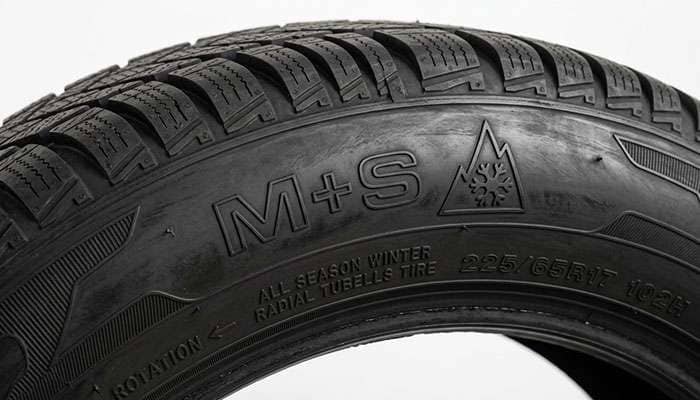
This is the part nobody puts in front of you, and it is the most useful thing in this article. California does not require a dedicated winter tire. Caltrans defines a snow-tread tire as one with a relatively deep and aggressive tread pattern compared with a conventional passenger tread, and it tells you to identify one by the sidewall marking: MS, M/S, M+S, or the words MUD AND SNOW.
That means the all-season tires already on many crossovers, SUVs, and trucks probably carry the marking. Check before you buy anything. Walk around the vehicle and look at the sidewall of each tire, near the size code. You are looking for those letters on all four.
Here is the catch. The M+S marking is based on tread geometry: the percentage of open groove area in the tread face. It does not require the tire to pass any snow traction test. That is why so many all-season tires carry it. It satisfies the California definition, but it says nothing about how well the tire stops on packed snow at 28 degrees.
The three-peak mountain snowflake symbol (3PMSF) is different. A tire earns it by beating a reference tire in a standardized snow traction test. If you want to understand that symbol in detail, read our breakdown of what the snowflake tire symbol means. For chain control in California, 3PMSF is not required, but it is the marking that tells you the tire actually works in the conditions you are driving into.
The difference between the two is not academic. Our M+S vs. winter tires comparison walks through why an M+S all-season and a true winter tire behave so differently once the pavement disappears.
The Caltrans definition talks about a "relatively deep" tread. A worn M+S tire still has the letters on the sidewall, but the grooves that pack and release snow are gone. Snow traction depends heavily on depth: snow packed into the grooves grips the snow on the road, and shallow grooves cannot hold enough of it.
California does not publish a minimum depth for the snow-tread exemption the way some states do for their traction laws. That does not make a bald M+S tire safe. As a working number, plan on replacing tires for winter use well before they reach the general legal limit. Our guide on tread depth to replace tires shows where the snow and wet-traction drop-off begins.
Mountain highways are cold before they are snowy. Summer tire compounds harden as temperatures fall, and all-season compounds start losing grip around 45 degrees F. If you want the numbers, our article on what temperature is too cold for all-season tires lays them out. The short version: the tire that felt fine in Long Beach behaves differently at 6,000 feet in January.
Yes. This is the rule AWD owners miss most often. Caltrans states that four-wheel and all-wheel drive vehicles must carry traction devices in chain control areas, even when the vehicle qualifies for the R2 exemption.
There are two reasons. First, conditions change. R2 can become R3 while you are on the mountain, and at R3 your exemption is gone. Second, the exemption depends on your tires, and a flat or a damaged tire can take you out of compliance in an instant. If you swap on a compact spare without the marking, you no longer have M+S tires on all four wheels.
Carrying devices does not mean you will use them on most trips. It means you have a legal option when the sign changes. Checkpoint personnel may ask to see them. Treat chains or approved traction devices like a spare tire: part of the vehicle whenever you head into the mountains between roughly November and April.
Chains are sized to the exact tire size, not the vehicle. If you have upgraded wheels or switched tire sizes since you bought the car, the chains in your garage may not fit. Check the tire size on the sidewall and match the chain package to it before your trip, not on the shoulder in the dark.
Snow socks, the fabric covers that slip over the tire, can be legal in California, but only when they meet the state's requirements for traction devices under California Vehicle Code Section 605. Mountain communities like Big Bear note that alternative traction devices, including cable chains and fabric socks, are permitted when they meet those requirements.
Caltrans wording at R2 and R3 is "chains or traction devices," which is what opens the door for a compliant sock. The practical rule: buy a product labeled as compliant with California requirements, sized to your exact tire, and keep the packaging or documentation with it.
Socks have real advantages. They install faster than chains, they are lighter, and they need almost no clearance between the tire and the suspension or fender liner. That last point makes them the go-to choice for many modern cars that cannot take conventional chains at all, which we cover in the next section.
They also have limits. Fabric wears quickly on bare pavement, so they are a short-stretch device: install at the control point, remove as soon as you clear the snow. On ice and deep slush, a steel chain still bites harder. Socks are a compliance and emergency tool. They are not a substitute for tires that grip.
One related myth: studded tires are not considered traction devices in California and cannot be used in place of chains. Studs help on ice, and they are legal in California during the winter season, but at R2 and R3 they do not change what the sign requires.
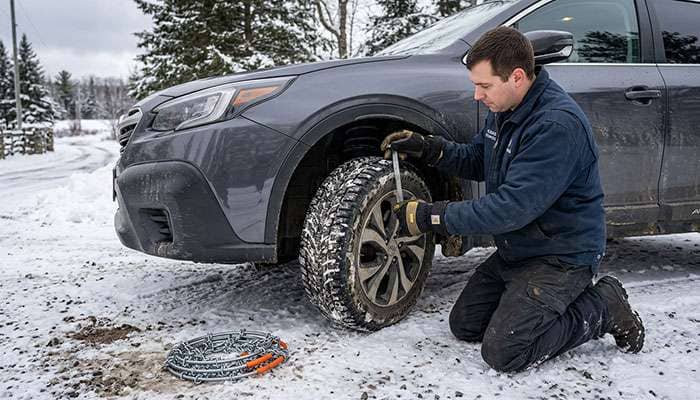
This is the variable that catches the most owners of newer vehicles. Many modern cars and crossovers ride on large wheels with low-profile tires, tight fender liners, and suspension parts very close to the inner sidewall. A conventional link chain needs room to wrap the tire and still clear everything around it while the wheel turns and steers.
The Society of Automotive Engineers (SAE) classifies traction devices by the clearance they need. Class S devices are designed for vehicles with restricted clearance. Many owner's manuals say plainly to use only Class S devices, or to use no chains at all on the factory wheel and tire size. Read the "winter driving" or "tire chains" section of yours before you buy anything.
The mechanism is simple. A chain flexes outward as the wheel spins. If it contacts the strut, the brake hose, the ABS sensor wire, or the fender liner, it strikes that part hundreds of times a minute. A chain that clears while parked can still hit at speed or at full steering lock. The result ranges from a shredded liner to a severed brake line or ABS wire.
If your manual says no chains on the factory size, the cleanest solution is often a dedicated winter set on a smaller diameter wheel with a taller sidewall. That gains clearance, gives you a tire that actually grips snow, and protects your nice wheels from salt and curb damage. Our guide to downsizing for a winter wheel and tire package shows how to pick a smaller wheel that still clears your brakes and keeps the overall diameter correct.
When you do have to chain up, the answer comes from your owner's manual, not from a rule of thumb. Mountain-area guidance commonly says the rear axle is preferred on 4WD vehicles unless the manufacturer recommends otherwise. Many AWD cars and crossovers do recommend otherwise and specify the front axle, because most of their torque and all of their steering live up front.
Here is why it matters. Chains on the front give you steering and braking grip where weight shifts during a stop. Chains on the rear of a front-biased AWD car can leave the front pushing wide in a turn. Chains on only one axle of any vehicle change its balance, so drive slower than the posted chain speed in turns and on descents.
If your manual allows chains on all four wheels and you carry two sets, that is the most stable option on steep, icy grades. Most drivers will carry one set, and that is legal; just put it where the manufacturer says.
Getting this wrong costs more than the price of the right tires. The costs stack up in a predictable order.
1. Your time. At a checkpoint without compliant tires or devices, you get turned around. A ski day becomes a drive home, or a wait in a parking area until conditions change.
2. A citation. Caltrans states that drivers who do not comply with chain requirements can be cited by the California Highway Patrol and fined.
3. The roadside markup. Buy chains at the last gas station before the control point and you pay mountain prices for whatever size is left, which may not be your size. Chain installers at the control point can put on chains you already own, but they are not allowed to sell or rent them.
4. Vehicle damage. Wrong-size chains, or chains on a vehicle without Class S clearance, can damage fender liners, brake lines, and ABS wiring. Running chains on bare pavement also wears them quickly and can mark wheels.
5. A crash. This is the expensive one. An AWD vehicle on non-snow tires climbs fine and then cannot stop or turn on the way down. A slide into a guardrail or another car turns a weekend trip into an insurance claim.
6. The tire purchase you were avoiding. After any of the above, most drivers end up buying the right tires anyway. Buying them first, before the season, is the cheapest point on this list.
Do this in your driveway in October, not at a checkpoint in January.
Step 1: Read all four sidewalls. Look for MS, M/S, M+S, or MUD AND SNOW, and note whether you also see the mountain snowflake. If even one tire is missing the marking, you do not qualify for the R2 exemption.
Step 2: Check your tread depth. Use a depth gauge in the center grooves of each tire. If you are near the replacement point, a winter trip is the time to replace, not to stretch them another season.
Step 3: Check your GVWR. Find the gross vehicle weight rating on the driver door jamb. If it is over 6,000 pounds, the R1 light-vehicle exception may not apply to you.
Step 4: Read your owner's manual on chains. Find out whether your vehicle accepts chains on the factory tire size, whether it requires SAE Class S devices, and which axle the manufacturer specifies.
Step 5: Buy traction devices sized to your exact tire. Chains or compliant socks, matched to the size on your sidewall. Practice installing them once at home so you know the process.
Step 6: Decide on your tire plan. For one or two trips a year, M+S all-seasons with good tread plus devices in the cargo area may be enough. For regular trips, an all-weather 3PMSF tire or a dedicated winter set is the safer setup. Our comparison of all-season vs. all-weather vs. winter tires will help you choose.
Step 7: Check conditions before you leave. Look up current chain controls for your route with Caltrans before you head up the mountain, and leave room in your schedule for a stop.
When you are ready to choose, browse our winter tires and look for the snowflake on the sidewall.
4WD and AWD help you go. They do not help you stop, and California's chain control rules reflect that. The R2 exemption that everyone with AWD hopes for applies only when all four tires carry the M+S marking. You still have to carry chains or compliant traction devices, and at R3 the exemption disappears entirely.
The good news is that compliance is mostly a sidewall check and a purchase you make once. Read the markings, check the tread, confirm what your manual allows, and put the right devices in the cargo area. If you head to the mountains more than a couple of times a season, a set of tires with the mountain snowflake is the upgrade that makes the rest of this easier.
At R1 and R2, an AWD vehicle with snow-tread tires marked M+S on all four wheels is exempt from installing chains, but it must still carry chains or traction devices. At R3, every vehicle must install chains or traction devices, including AWD.
If they are marked MS, M/S, M+S, or MUD AND SNOW on the sidewall, they meet the Caltrans snow-tread tire identification. Many all-season tires carry that marking. Tread depth still matters for real snow traction.
Yes. Caltrans requires four-wheel and all-wheel drive vehicles to carry traction devices in chain control areas, even when they qualify for an exemption.
Snow socks can be used as traction devices in California when they meet the requirements of California Vehicle Code Section 605. Buy a product sized to your exact tire and labeled as meeting California requirements.
Caltrans sets the speed limit at 25 or 30 miles per hour when chains are required. Drive slower than that in turns and on descents.
No. Studded tires are not considered traction devices and cannot be used in place of chains when chain controls require them.