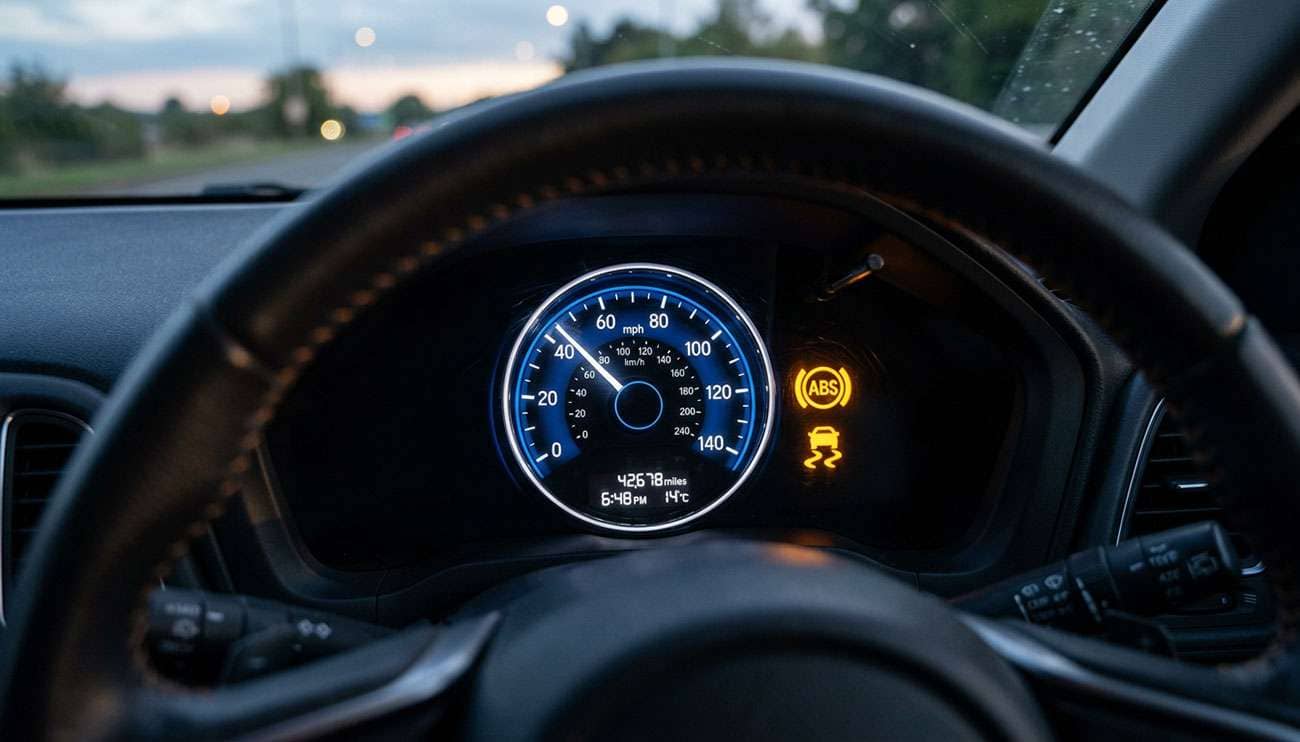
Yes. New tires can switch on the ABS, traction control, or stability control light, and the timing tells you which of three things happened. A light that appears in the first mile and stays on points to a wheel speed sensor or connector disturbed during the install. A light that shows up at highway speed, or flashes in turns, points to a rolling-circumference mismatch between tires. A tire-pressure light with no ABS light is a TPMS relearn. Most answers stop at "it could be the sensors or the tire size." The timing is what sorts them.
Those three causes have three different fixes, and two of them involve the tires themselves. So before anyone replaces a sensor or clears a code, read the light the way the ABS module reads your wheels: by comparison, and by timing.
Find the row that matches your dash and when the light showed up.
What You See |
When It Showed Up |
Most Likely Cause |
First Fix |
|---|---|---|---|
ABS, traction, and stability lights together, solid |
First startup or first mile; back after every restart |
Wheel speed sensor connector or wire disturbed at install |
Return to the installer; scan the ABS module |
Traction light flashing, power cuts or brakes pulse |
Highway speed, hard acceleration, or tight turns |
Rolling-circumference mismatch, or one low tire |
Set pressures; measure tread on all four |
ABS or stability light after miles of steady driving |
Comes and goes trip to trip |
Mismatch large enough to set a wheel speed code |
Compare sizes and models on all four sidewalls |
Tire-pressure light flashes about a minute, then stays on |
Right after the install, every startup |
TPMS sensor not relearned, damaged, or missing |
TPMS relearn or sensor service |
Tire-pressure light solid, no flashing |
After driving a while |
Low pressure, or indirect TPMS not reset |
Inflate to the placard cold, then reset |
Stability or traction light, car drives straight |
Immediately after an alignment |
Steering angle sensor needs calibration |
Steering angle reset at the alignment shop |
Red BRAKE light with the ABS light |
Any time |
ABS fault has shut off brake-force distribution, or a hydraulic problem |
Have the brakes checked before driving further |
The table keys on the light plus the moment it appeared, because the same amber ABS light can come from a bumped connector or a half-inch of circumference difference. A disturbed sensor fails a self-check almost immediately. A mismatch has to build a speed difference over distance before the module believes it.
Anti-lock brakes, traction control, and stability control all run off the same four inputs: one wheel speed sensor at each corner. Each sensor reads a tone ring or magnetic encoder that turns with the wheel and sends the ABS module a signal whose frequency rises with wheel speed. The module converts those signals into four wheel speeds, many times per second, and compares them.
A wheel slowing faster than the others under braking looks like lockup, so ABS releases it. A wheel speeding up under power looks like wheelspin, so traction control cuts throttle and brakes it. Stability control adds steering angle and yaw rate sensors and brakes individual wheels to keep the car pointed where you steer. NHTSA's FMVSS 126 requires stability control, with a malfunction telltale, on every passenger car, SUV, and light truck of 10,000 pounds or less from the 2012 model year on.
Here's where tires come in. The module doesn't know how big your tires are. It counts revolutions and assumes all four tires cover the same distance per turn. A smaller tire turns more times per mile, so it reads faster at the same road speed. Most modules tolerate a small spread. Past a threshold each automaker sets in its own software, and rarely publishes, the module either acts on the difference as slip or decides a sensor is lying and sets a code.
That's also why the lights travel together. One bad signal at one corner disables all three systems, because all three need all four wheels. Three amber lights usually mean one problem.
Yes, and it doesn't take a different size on the sidewall. Tread depth alone changes diameter. Every 1/32 inch of tread worn off takes 2/32 inch off the diameter, because the tread wears on both sides of the circle. Here's what that does on a 225/65R17, a common crossover size that stands about 28.5 inches tall and turns roughly 707 times per mile new.
Tread Depth Difference |
Diameter Difference |
Circumference Difference |
Wheel Speed Difference |
Extra Turns per Mile (Worn Tire) |
|---|---|---|---|---|
1/32 in |
0.06 in |
0.20 in |
0.22% |
1.6 |
2/32 in |
0.13 in |
0.39 in |
0.44% |
3.1 |
4/32 in |
0.25 in |
0.79 in |
0.88% |
6.3 |
6/32 in |
0.38 in |
1.18 in |
1.32% |
9.4 |
8/32 in |
0.50 in |
1.57 in |
1.75% |
12.6 |
Two new tires at 10/32 inch next to two at 4/32 inch is a 6/32 spread. At 60 mph, the worn axle reports a road speed about 0.8 mph faster than the new one, mile after mile. These figures use free-standing geometry; a loaded tire rolls on a slightly smaller radius, but the gap between two tires carries through, and the gap is what the module sees.
Some systems shrug off 1.3 percent. Others flash the traction light on every hard freeway merge or set a code after ten minutes at a steady cruise. That's why this cause shows up later and comes and goes: the module needs distance to build a difference it believes, and a restart often wipes the slate.
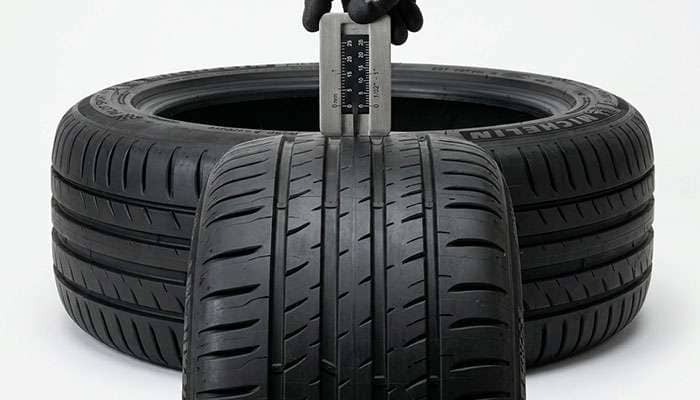
Here's the part nobody puts in front of you: two brand-new tires in the same printed size don't start at the same tread depth. In 225/65R17, most new tires leave the mold between 9/32 and 13/32 inch. Touring tires cluster around 10/32; all-terrains start near 13/32. On a truck size like 265/70R17, a highway tire usually starts around 13/32 and a mud-terrain at 18/32 or deeper. A new touring tire and a new all-terrain on one axle can be 3/32 apart before either turns a mile. That's why the model matters, not just the size, if you mix tire brands.
General Motors service bulletin 16-NA-223, on file with NHTSA, covers 2009 to 2017 GM cars and trucks whose traction light flashes under hard acceleration at higher speeds after a new set of tires. GM traces it to replacement tires that don't share the original tires' treadwear, traction, and temperature ratings, and tells dealers to verify the original-equipment spec or match its type, size, and load and speed rating. A tire with less grip than the system was tuned for really does spin more, and traction control does its job.
A size change does the same thing as tread wear, only bigger, and it's permanent. The same math that throws off your speedometer applies here, and how bigger tires affect your speedometer walks through it. Pressure matters too: a tire well under placard pressure sags into a smaller rolling radius and turns faster than the other three. Set all four pressures before you blame anything else.
It happens, and it's the most common cause when the light comes on before you've left the neighborhood. On most vehicles the wheel speed sensor and its wiring sit just behind the hub, inches from the work.
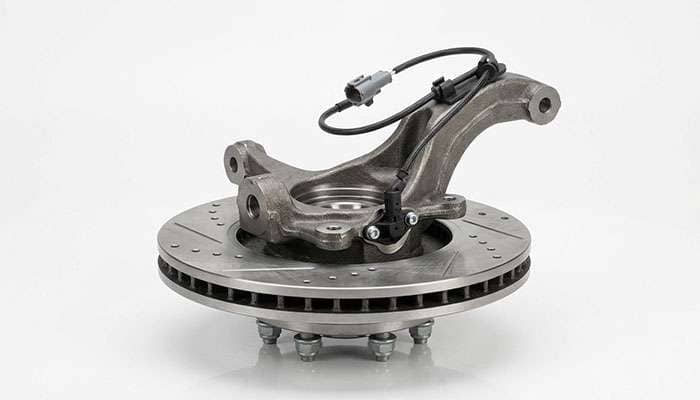
To be fair to the shop, sensors and connectors also fail from age and road salt, and one that was a pothole from failing can let go the first time the suspension moves. The timing still points at the visit, so the installer is your first stop either way.
Most ABS modules check their sensors at startup and again once the car rolls. When three wheels report speed and the fourth reports zero or noise, the module flags it within a few hundred feet. Many systems also run a brief pump self-test at low speed, a short buzz from under the hood just before the light comes on. The signature: all three lights almost immediately, back after every restart, and a car that otherwise drives normally on plain brakes.
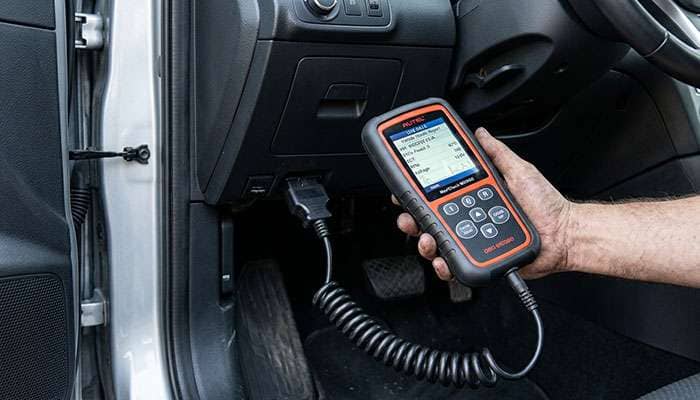
ABS faults store as chassis codes, starting with C, in the ABS module. A basic OBD-II reader that only reads engine codes, starting with P, will usually show nothing. You need a tool that reads the ABS module. The code normally names the corner, and a look at that wheel's connector often finds the problem in minutes.
Often, and it's the most common light after a tire change. But it's a different light: the yellow horseshoe with an exclamation point, or the letters TPMS. On a car with sensors inside the wheels, a TPMS problem won't turn on the ABS light. The fix depends on which system you have.
Most vehicles mount a pressure sensor inside each wheel, usually on the valve stem. Tire service can damage one, or the car may need to relearn sensor positions after a rotation or sensor replacement. Procedures range from a drive cycle to a scan tool, and the Tire Industry Association publishes the reference charts shops use.
The light tells you which problem you have, by federal rule. Under FMVSS 138, a combined low-pressure and malfunction telltale must flash for 60 to 90 seconds when the system detects a fault, then stay on solid, every startup until it's fixed. Flashing then solid means a sensor isn't talking to the car. Solid with no flash means a tire is low. If you're deciding whether to keep driving, driving with the TPMS light on covers the risk.
Some vehicles have no pressure sensors at all. Indirect TPMS uses the ABS wheel speed sensors to spot a tire turning faster than the others, since a low tire has a smaller rolling radius. Audi brought indirect systems back across its lineup starting in 2011, and certain model years of the Honda Accord, Mazda CX-5, and Volkswagen Golf-platform cars use them too.
These systems learn a baseline for your tires. Skip the reset after a new set and the system compares new tires to the old baseline, usually lighting a solid tire-pressure warning a few miles later. The reset is typically a button or menu item, done with all four tires at placard pressure. And because indirect TPMS borrows the ABS sensors, ABS and tire-pressure lights together on these cars point straight back at a wheel speed sensor.
New tires and an alignment often happen on the same visit. Stability control compares where the steering wheel points, read by a steering angle sensor, with where the car is actually rotating, read by a yaw rate sensor. An alignment re-centers the steering wheel. If the steering angle sensor still thinks "straight" is a few degrees off, the system sees a car steering one way and going another.
Many automakers require a steering angle calibration after an alignment for that reason. Some vehicles recalibrate after a few lock-to-lock turns; others need a scan tool. The tell is a stability or traction light right after the alignment while the car tracks perfectly straight. If you're weighing the alignment itself, do you need an alignment with new tires breaks it down.
On many AWD vehicles, yes, and this is where a mismatch stops being a dash light and starts costing money. The usual trigger is one new tire after a puncture or sidewall damage, next to three worn ones.
On a two-wheel-drive car, a mismatch between axles mostly confuses the electronics. On full-time AWD, the axles are tied together through a center differential, viscous coupling, or clutch pack built to allow brief speed differences in turns. A mismatch forces that part to slip every mile you drive straight, like a permanent gentle turn. The dash light is the warning. The heat in the coupling is the bill.
Drivetrain |
Typical Tolerance |
If You're Inside It |
If You're Outside It |
|---|---|---|---|
Front- or rear-wheel drive |
Match size and model across each axle |
Replace in pairs; new pair usually goes on the rear |
If lights persist, confirm size and model on the sidewalls |
Part-time 4WD truck |
Tolerant in 2WD; tight in 4WD with axles locked together |
Replace in pairs and keep rotating |
Expect binding in 4WD; replace all four |
Most full-time AWD crossovers and cars |
2/32 to 4/32 inch of tread depth, per owner's manual |
Replace one or two with the same model |
Replace all four, or shave the new tire to match |
Subaru symmetrical AWD |
1/4 inch of rolling circumference, about 1.3/32 inch of tread |
Only when the other three are nearly new |
Replace all four, or shave the new tire to match |
Look twice at the Subaru row. Subaru states its limit as 1/4 inch of rolling circumference, and the shorthand at tire counters is "2/32 of tread." Run the geometry and 1/4 inch of circumference is about 0.08 inch of diameter, or roughly 1.3/32 inch of tread. The real limit is tighter than the shorthand.
Shaving a new tire down to match the other three is a legitimate fix for one replacement on a tight-tolerance vehicle. Past about 4/32 of wear on the others, you're paying to throw away new rubber to match tires already halfway done. AWD tire requirements covers the drivetrain side, and whether to replace all 4 tires or not works the cost math.
Your regular brakes still work. What you've lost is everything the sensors were doing for you, and here's what that costs while you drive on it, roughly in order.
New tires can turn on the ABS, traction, or stability light, and the question that matters is how. The ABS module doesn't measure tires; it compares four wheel speeds and expects them to agree. A sensor knocked loose at install breaks that comparison immediately. A circumference mismatch bends it slowly until the module acts or gives up. TPMS relearns and steering angle calibrations are separate lights that ride along with the same visit. Read the timing, measure the tread, read the sidewalls, and pull the codes, and you'll know whether the fix is a plug, a reset, or a matched set of tires.
If it came on at startup or in the first mile, a wheel speed sensor connector or wire was most likely disturbed while the wheels were off. If it came on later at highway speed or comes and goes, the tires likely differ in rolling circumference from mixed tread depths, mixed models, or a size difference.
Yes. The ABS module compares all four wheel speeds, and a smaller or more worn tire turns faster at the same road speed. Past the automaker's programmed threshold, the module treats the difference as slip or sets a wheel speed code and lights ABS, traction, and stability warnings.
Fix the cause first, then clear the code with a scan tool that reads the ABS module, or let it clear after a clean drive cycle if your vehicle supports that. Clearing it without correcting a mismatch, a loose connector, or an uncalibrated steering angle sensor only brings it back.
It can happen. Lifting the car and pulling wheels can unplug a brittle connector, pinch a sensor wire, or knock debris onto a sensor tip. Sensors also fail from age and corrosion, but if the light came on right after the visit, the installer is the right first stop.
Sometimes, with a borderline mismatch the module stops seeing after a restart, but it usually returns as the difference builds again. A damaged sensor, unplugged connector, or stored code generally keeps the light on until the fault is repaired and the code is cleared.
Often. Cars with sensors in the wheels may need a relearn after a rotation or sensor replacement, and cars with indirect TPMS need a reset after any tire change. A TPMS light that flashes for about a minute and then stays on means a system fault, not just low pressure.