
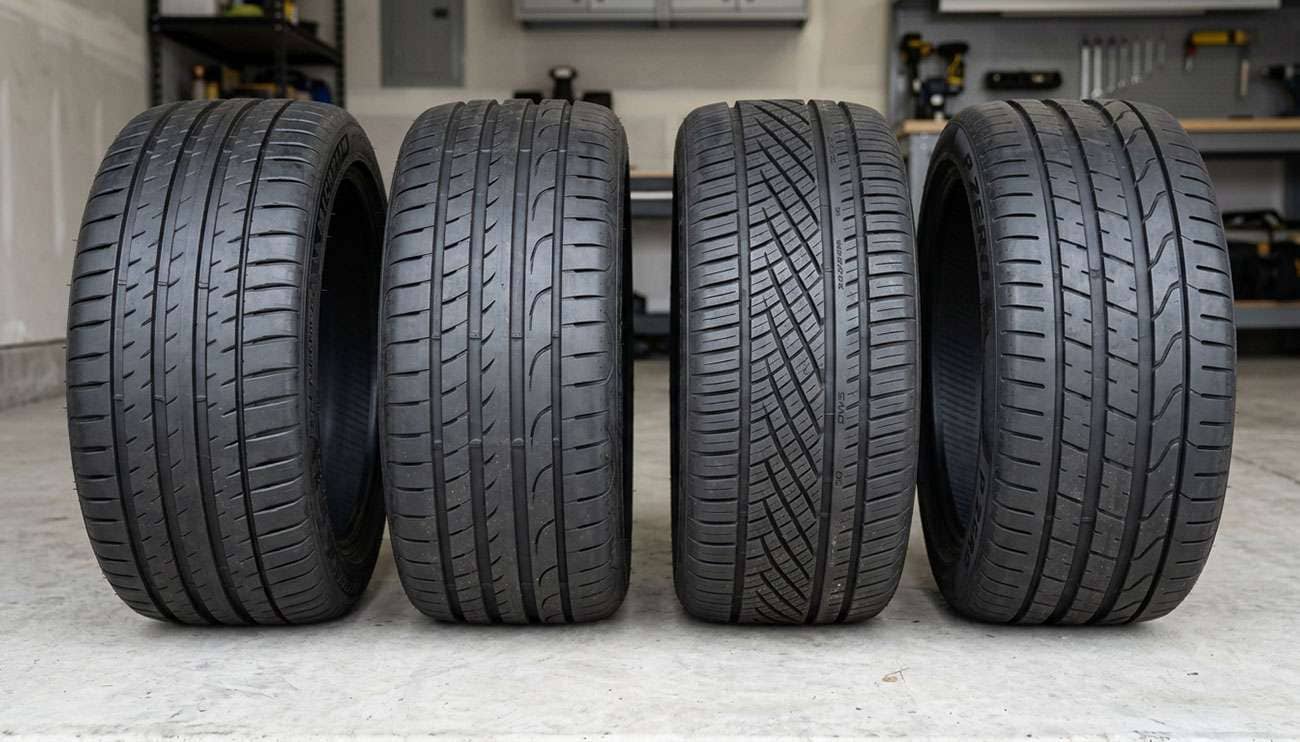
You've got a nail in one tire. Or two tires wore out faster than the others. Or you found a great price on a set of two but need four. Whatever the situation, you're now facing the question that millions of drivers face every year: can you put a different brand of tire on the car alongside the ones already there? It sounds simple. It isn't. The answer depends on what you're mixing, on what vehicle, in what positions, and what those tires are being asked to do. Get it right and you'll be fine. Get it wrong — particularly on an AWD vehicle or by mixing completely different tire types — and you're looking at handling problems, drivetrain damage, and in serious cases, safety risks that show up exactly when you least expect them.
This is the complete breakdown: when mixing is acceptable, when it isn't, what the rules actually are, and how to make the best decision when your budget means you can't replace all four at once.
Mixing different tire brands is not automatically dangerous — but it's also not automatically fine. The safety of mixing tires depends on a hierarchy of factors, starting with what's most critical and working down to what matters least.
What you absolutely must match: tire type. You cannot safely mix summer tires with all-season tires, all-season tires with winter tires, or any combination of seasonal performance categories on the same vehicle. The handling behavior difference between these categories is enormous, and mixing them creates a vehicle that responds completely differently at each corner — exactly the situation that causes skids and crashes in emergency maneuvers.
What you should match but have more flexibility on: tire size, load index, and speed rating. These specs must be consistent across all four tires. A tire with a different overall diameter, a lower load index, or a lower speed rating than its partners creates measurable performance disparities that affect handling, braking, and in AWD vehicles, drivetrain integrity.
What you have the most flexibility on: brand name. Different brands of the same size, same type, and same performance category can coexist on a vehicle without inherent safety problems — though matching brand is always preferable, and mixing brands across axles (front two one brand, rear two another) is significantly better than mixing across corners of the same axle.
That hierarchy is the entire framework. Everything else in this guide fills in the details.
Before getting into specific scenarios, it's worth understanding why matching matters at a physics level — because once you understand the mechanics, the rules become obvious rather than arbitrary.
Your vehicle's handling, stability control, ABS, and traction control systems are all calibrated around the assumption that the four tires on the car behave consistently and predictably relative to each other. These systems measure wheel speed at each corner, compare the readings, and intervene when they detect differences that indicate loss of traction or instability. They were tuned by engineers who assumed matched tires. When you mix significantly different tires — different compounds, different tread patterns, different constructions — the assumptions those systems are built on start to break down.
The result isn't always dramatic or immediately obvious. It can show up as electronic stability control interventions that feel slightly wrong, ABS behavior that's less precise in emergency stops, or handling responses in corners and lane changes that feel subtly unpredictable. None of these changes may be severe enough to cause a problem under normal driving. In an emergency situation — a sudden lane change at highway speed, hard braking on wet pavement, avoiding an obstacle — that's where mismatched tire behavior shows its consequences.
Different tire brands use different rubber compounds, different internal carcass constructions, and different tread designs. These differences produce tires that grip differently, flex differently, build heat differently, and respond differently to cornering loads. Two tires that are nominally the same size and load rating from different brands may behave quite differently at their performance limits.
For everyday driving at moderate speeds on dry roads, these differences are usually imperceptible. As you push toward the limits of adhesion — in a fast corner, in emergency braking, in wet or slippery conditions — the differences between tire behaviors at each corner start to matter. A vehicle whose rear tires break traction before its front tires tends toward oversteer; one whose front tires lose grip first understeers. Mixing tires can shift this balance in ways that aren't obvious until you're in a situation where it counts.
Even if you start with two matched pairs from different brands, those tires will wear at different rates. After 10,000 or 20,000 miles, the diameter difference between the two brands' tires may be measurable — and on an AWD vehicle, any measurable diameter difference between axles puts stress on the drivetrain. On any vehicle, growing tread depth disparity between axles changes handling balance progressively as wear accumulates. The problem compounds over time rather than staying static.
With that context established, here's the practical guidance for when mixing brands falls within acceptable parameters for safety and performance.
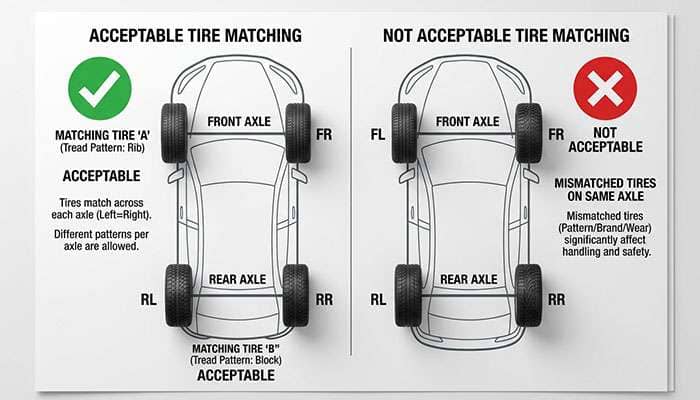
The most commonly acceptable mixing scenario — and the one that meets most industry guidelines — is running a matched pair from one brand on the front axle and a matched pair from a different brand on the rear axle. Both front tires are the same, both rear tires are the same, but the front pair and rear pair are different brands.
This setup is acceptable under several conditions: both brands are the same tire type (both all-season, both summer, both all-terrain), both pairs are the same size, the speed rating and load index of all four tires meet or exceed OEM spec, and the vehicle is not AWD or 4WD (which has stricter requirements explained below). Under these conditions, the front axle behaves consistently and the rear axle behaves consistently — the handling balance is different from a fully matched set but is at least predictable and consistent.
If one tire is damaged or wears out while the others still have significant life remaining, replacing it with a single tire from a different brand is sometimes unavoidable. This is more problematic than the axle-matched scenario above because now one corner of the vehicle behaves differently from its partner on the same axle. The key is to minimize the differences:
Choose the same tire type (all-season for all-season, all-terrain for all-terrain). Match the size exactly — including overall diameter, which can differ slightly between brands even at the same nominal size. Match the tread pattern category as closely as possible — a directional tread replacement on an axle with symmetric tread partners creates handling asymmetry. Match the speed rating and load index. And as soon as possible, replace the tire's partner on the same axle so you're back to a matched pair.
Supply chains for specific tire sizes and models occasionally create availability gaps — a particular tire that your vehicle was specced with is backordered or discontinued. In these cases, running a comparable tire from a different brand on the same axle as an interim solution is acceptable, provided the specs align. Document what you've done, inform any subsequent service technician, and replace with matched tires as soon as the preferred option becomes available.
The scenarios above describe situations where brand mixing is manageable. These scenarios describe where it crosses from acceptable into genuinely problematic.
This is the most dangerous form of tire mixing, and it's the one that causes real accidents. A summer tire's compound becomes hard and loses grip at temperatures below roughly 45°F. An all-season tire maintains reasonable flexibility down to much lower temperatures. If you run summer tires on one axle and all-season on the other when temperatures drop, one end of the car grips normally and the other end is dramatically reduced in traction. The vehicle becomes unpredictable in exactly the situations where predictability matters most.
The same principle applies in reverse: running an all-season tire on one axle and a dedicated summer performance tire on the other creates handling balance that's designed around two very different grip levels. The end with the summer tire will grip more aggressively, which can cause oversteer or understeer depending on which axle has which tire. Neither is safe at the limits of adhesion.
Never mix winter tires with all-season or summer tires on the same vehicle. Winter tires have a dramatically different compound — one specifically engineered to stay pliable in extreme cold and grip snow and ice through unique tread siping and block geometry. Running winter tires on one axle and all-season on the other creates a massive grip differential between front and rear. This is a documented cause of accidents, particularly in skid recovery situations where the end with winter tires maintains traction while the other end lets go — or vice versa. Winter tires must be run as a complete set of four, full stop.
Even within the same brand, running tires with dramatically different tread depths across axles creates handling problems. The tire with more tread has more rubber between the contact patch and the road, making it effectively slightly taller in overall diameter and slightly different in compliance. If the difference is significant — say, 8/32" tread remaining on one axle versus 3/32" on the other — the vehicle's handling balance is noticeably different from front to rear. This is particularly important for AWD vehicles, where even a few millimeters of diameter difference creates continuous drivetrain stress.
Running tires with different load indices or speed ratings across axles or corners creates asymmetric safety margins. The tire with the lower load rating will be the first to become overloaded in a fully-loaded vehicle. The tire with the lower speed rating will be the first to overheat at sustained highway speeds. These situations don't cause immediate failure, but they reduce the safety buffer on specific tires in ways that compound over time and with load. Always confirm all four tires meet or exceed OEM load index and speed rating specifications. Use the tire load index calculator to verify load capacity before purchasing replacement tires.
If you drive an AWD or 4WD vehicle, the mixing question gets significantly more complicated — and the consequences of getting it wrong are more severe and more expensive.
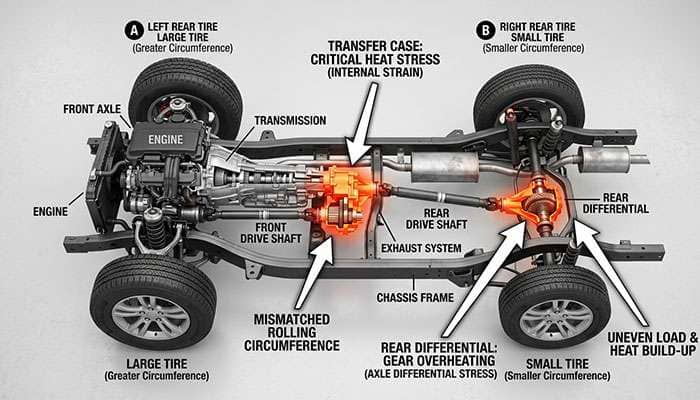
All-wheel drive systems distribute torque between axles and sometimes between individual wheels using differentials, transfer cases, and electronic clutch packs. These systems are designed to operate with all four tires having the same rolling circumference — meaning the same effective diameter during rotation. When one tire has a different rolling circumference from the others, the AWD system detects it as wheelspin and constantly tries to compensate by transferring torque or applying brakes to the faster-spinning wheel.
This constant compensation generates heat in the drivetrain components — the center differential, the rear differential, the transfer case — and over time causes premature wear and failure. AWD differentials and transfer cases are expensive to repair, often running into thousands of dollars. The irony is that the problem develops slowly and invisibly: the vehicle handles fine, there are no warning lights, and the drivetrain is quietly degrading with every mile.
Most AWD manufacturers specify that all four tires must be within a very small tread depth difference from each other — often less than 4/32" of an inch. Some manufacturers, particularly Subaru, have historically specified that all four tires must be replaced together when any one tire is damaged or worn. This isn't excessive caution; it's recognition of how sensitive the AWD system is to rolling circumference differences.
The practical implication: if you have an AWD vehicle and one tire is destroyed by a pothole or road debris while the others have significant tread remaining, you may need to either shave the new tire to match the tread depth of the existing tires (a service that specialized shops offer) or replace all four. Mixing brands is possible on AWD vehicles, but it's a secondary concern to matching tread depth and rolling circumference. Two tires of different brands with the same tread depth create less drivetrain stress than two tires of the same brand with different tread depths.
The compact "donut" spare tire that most vehicles carry as emergency equipment is not meant for AWD vehicles except as an emergency measure for short distances at low speeds. Running a donut spare on an AWD vehicle for any meaningful distance causes the same drivetrain stress as a grossly mismatched tire — the rolling circumference difference is enormous. Get to a proper replacement tire as quickly as possible, and don't use highway speeds with a donut spare on any AWD system.
Mixing brands is a secondary concern compared to mixing tire types — but it's worth understanding all the type-mixing scenarios that cause problems, because some of them are non-obvious.
Virtually all modern road tires are radial construction. Classic and antique vehicles may have run bias-ply tires originally. Mixing radial and bias-ply construction on the same vehicle is never acceptable — the handling difference between the two constructions is so fundamental that the vehicle's behavior becomes genuinely dangerous. This scenario is most relevant for classic car owners who are mixing original and replacement tires, or who are upgrading from bias-ply to radials. Always complete the switch on all four corners simultaneously. Never mix the two on the same vehicle under any circumstances.
Run-flat tires (which can continue operating after a puncture due to reinforced sidewalls) have a fundamentally different construction and ride characteristic from standard tires. Mixing run-flats with standard tires on the same vehicle creates handling asymmetry because the stiffer sidewalls of run-flats respond differently to cornering loads. Most manufacturer guidelines specify running all four run-flat or all four standard — not mixed. This also applies to the spare: vehicles equipped with run-flat tires typically don't carry a spare at all, and a standard tire temporary spare shouldn't be used on a vehicle engineered for run-flats beyond immediate emergency transportation.
Less dramatic than the seasonal mixing issue, but still worth noting: mixing aggressive all-terrain tires with highway tires on the same vehicle creates traction and handling disparities, particularly in off-road or mixed conditions. The tread patterns, compound hardness, and sidewall stiffness are different enough to create asymmetric behavior at the limits of adhesion. If you're upgrading to all-terrain tires, do it as a complete set — not two fronts or two rears while keeping highway tires on the other axle.
If there's one rule to internalize from this entire guide, it's the axle rule: tires on the same axle must always match each other. The front two tires should be identical. The rear two tires should be identical. This is the minimum acceptable standard for safe handling, and it's non-negotiable regardless of budget constraints.
The two tires on the same axle work together to steer (front axle), provide drive traction (driven axle), and resist lateral loads in corners (both axles). If those two tires have meaningfully different grip levels, stiffness, or tread characteristics, the vehicle will track differently in straight-line driving (the vehicle pulls toward the tire with higher rolling resistance or lower pressure), brake unevenly (the ABS has to compensate for different friction levels at each end of the axle), and respond asymmetrically in corners (the axle doesn't load evenly, creating a pull or yaw tendency).
These effects are most pronounced in emergency situations and wet-weather driving — exactly the conditions where predictable vehicle behavior matters most. An axle with mismatched tires is an axle that doesn't behave consistently, and inconsistent behavior kills safety margins.
Matching on the same axle means: same brand, same model, same size, same load index, same speed rating, and approximately the same tread depth. If you're replacing a single tire that was damaged while its partner has significant tread remaining, you're creating a mismatch in tread depth. The less tread the new tire's partner has remaining, the less of a mismatch this is — a new tire paired with a tire at 4/32" remaining is a problem; a new tire paired with a tire at 7/32" remaining on a 10/32" new tire is manageable. Use judgment, but always prioritize getting back to a fully matched pair on each axle as soon as possible.
Budget reality means that sometimes replacing all four tires at once isn't possible. Here's how to handle the two-tire replacement scenario as safely as possible.
This is the universal recommendation from tire manufacturers, safety organizations, and engineers — and it's counterintuitive to a lot of drivers who think the front axle is more critical because it steers. The new tires go on the rear. Every time. Here's why.
The most dangerous loss-of-control scenario is rear-end oversteer — the rear tires losing traction in a turn or emergency maneuver, causing the vehicle to spin or swap ends. This is difficult to recover from even for experienced drivers, and in a sudden emergency situation it happens faster than most drivers can react. New tires on the rear maintain rear traction and keep the vehicle stable. Old tires on the front with new tires on the rear means any traction loss happens at the front — which produces understeer, pushing forward instead of spinning. Understeer is more predictable and more recoverable than oversteer for the vast majority of drivers.
This rule applies regardless of whether your vehicle is front-wheel drive, rear-wheel drive, or all-wheel drive (with the caveats noted above for AWD systems). The new tires always go on the rear axle.
When buying two replacement tires, try to match the brand and model of the tires remaining on the other axle. If the existing tires have significant remaining life, this gives you a predictable transition — the front and rear axles are at least different tread depths but within the same performance envelope. If the existing front tires are nearing end of life, buy two tires you'd want on all four corners eventually — you'll be replacing the fronts soon and can bring the whole car to a matched set at that point.
Replacing tires two at a time costs more over the car's life than replacing them as a set. You pay installation and balancing twice, you may end up with a perpetual mismatch situation, and on AWD vehicles the drivetrain stress from tread depth mismatches can generate repair costs that exceed the savings from not replacing all four. If the other two tires are within 20,000 miles of needing replacement anyway, the financial case for doing all four at once is often stronger than it appears. Spread the cost with tire financing if the upfront cost is the barrier — it's often more economical over the tire lifecycle than the alternative.
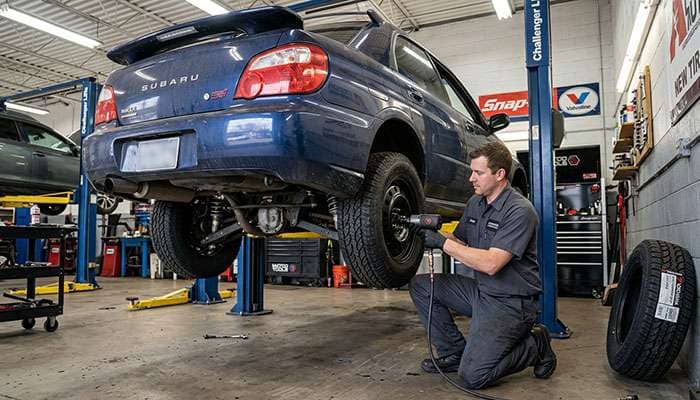
Everything in this guide has been about managing the compromise of not having a full matched set. Here's the positive case for why a matched set of four — same brand, same model, same size, same age — is the baseline you should aim for every time you replace tires.
A vehicle on four identical tires handles the way it was designed to handle. The suspension geometry, steering calibration, and electronic stability systems were all engineered around the assumption of matched tires. You get the full benefit of the vehicle's designed handling balance, and any driving technique or emergency response you've developed for the vehicle applies consistently.
Four matched tires wear at the same rate under the same conditions. Regular rotation — moving tires between positions on a consistent schedule — keeps tread depth consistent across all four, maximizes the life of each tire, and means you'll be replacing all four at approximately the same time rather than managing perpetual partial replacements.
On AWD vehicles, four matched tires with consistent tread depth eliminate the rolling circumference differences that stress differentials and transfer cases. This is the single most cost-effective protection for what is often the most expensive drivetrain system on modern vehicles.
Four matched tires purchased together often cost less per tire than two tires purchased as an emergency replacement. You get better brand selection, better pricing from volume, and a single installation visit. The tires last as long as any individual pair would, and you're not paying for incremental installations that add up over time. Browse the full range of tires at Performance Plus Tire in your size to compare options across the full quality spectrum and find a matched set that fits your budget without compromising on the specs that matter.
If price is the limiting factor, tires now pay later options let you get the complete matched set your vehicle needs today and spread the cost over time — a significantly better outcome than the compromised performance and potential drivetrain costs of a perpetual mismatch situation.
Can you mix tire brands? Sometimes, with the right conditions and the right approach. But the question you should really be asking is: what's the safest and most cost-effective way to handle the tire situation in front of you? The answer is almost always some version of "get as close to a fully matched set as your situation allows, follow the axle rule without exception, and put new tires on the rear when you can only do two."
Mixing brands is the least of your concerns. Mixing tire types, ignoring the axle rule, or running an AWD vehicle with mismatched tread depths — those are the situations that create real risks and real repair bills. Get the type right, get the size right, get the load and speed ratings right. Brand is the last thing to optimize for, and even there, matching is always better than mixing.
When you're ready to replace — whether two or four — Performance Plus Tire has thousands of options across every size, type, and brand. Filter by your vehicle, confirm your specs, and find a matched set that serves your driving conditions and your budget without cutting corners on the safety specs that actually matter.
Here's the complete mixing guide condensed to what you need to remember.
• Tire type mixing is the most dangerous: Never mix summer, all-season, and winter tires on the same vehicle. The handling differences between seasonal tire categories are severe enough to cause loss of control in emergency situations. This is the most important rule on this entire list.
• The axle rule is non-negotiable: Both tires on the same axle must always match — same brand, model, size, load index, and speed rating. A front-to-rear brand difference is manageable. A left-to-right brand difference on the same axle is not acceptable.
• AWD vehicles have the strictest requirements: All four tires should match in brand, model, size, and tread depth on AWD vehicles. Diameter mismatches between axles create drivetrain stress that silently damages differentials and transfer cases — repairs that cost far more than a matched set of tires.
• New tires always go on the rear: When replacing only two tires, mount them on the rear axle regardless of which wheels are driven. Rear traction loss is more dangerous and less recoverable than front traction loss for most drivers.
• A matched set of four is always the right answer: It delivers the handling the vehicle was designed for, protects AWD drivetrains, maximizes tire life through consistent wear, and costs less per mile than managing perpetual partial replacements. Use financing options to make the full set achievable when budget is the limiting factor.
Mixing tire brands can be safe under the right conditions — specifically when both brands are the same tire type (all-season, summer, all-terrain, etc.), the same size, and meet or exceed OEM load index and speed rating requirements. The safest mixing scenario is running a matched pair from one brand on the front axle and a matched pair from a different brand on the rear. Mixing brands on the same axle (different brand on left vs. right) is not acceptable. Fully matched sets of four identical tires are always preferable to any mixing scenario.
No — when replacing only two tires, always put the new tires on the rear axle. This is the universal recommendation from tire manufacturers and safety engineers. Rear tire failure or traction loss is far more dangerous than front traction loss for most drivers. With new tires on the rear, any grip loss occurs at the front first, causing understeer — which is more predictable and recoverable than the oversteer caused by rear traction loss. This applies regardless of whether your vehicle is front-wheel drive, rear-wheel drive, or all-wheel drive.
Most AWD manufacturers strongly recommend replacing all four tires simultaneously, and some require it for warranty protection. AWD systems are sensitive to rolling circumference differences between tires — a difference in tread depth between a new tire and worn tires creates diameter mismatches that force the AWD system to constantly compensate, generating heat and causing premature wear in the differential and transfer case. If you must replace fewer than four on an AWD vehicle, have the new tire shaved to match the tread depth of the remaining tires, or replace in pairs on the same axle while keeping tread depth differences under 4/32" across all four.
No. Mixing all-season and winter tires on the same vehicle is dangerous and should never be done. Winter tires have a dramatically different compound and tread design that provides superior cold-weather traction — but creates a massive grip differential when paired with all-season tires on the same vehicle. This creates a vehicle that behaves very differently at each end, making it unpredictable in emergency maneuvers, particularly on cold or wet roads. Winter tires must always be installed as a complete set of four. Similarly, never mix summer and all-season tires on the same vehicle.
The consequences of mismatched tires depend on what's mismatched. Different brands of the same type in the same size typically produce minor handling differences that are imperceptible under normal driving. Different tire types — summer vs. all-season, winter vs. summer — create serious grip differentials that make the vehicle unpredictable at the limits of adhesion. Tires with different overall diameters on an AWD vehicle cause drivetrain stress that silently damages differentials and transfer cases. Tires with mismatched load indices may be inadequate for the vehicle's actual weight requirements. The risks range from subtle handling quirks to serious safety hazards and expensive mechanical damage depending on what specifically is mismatched.



