
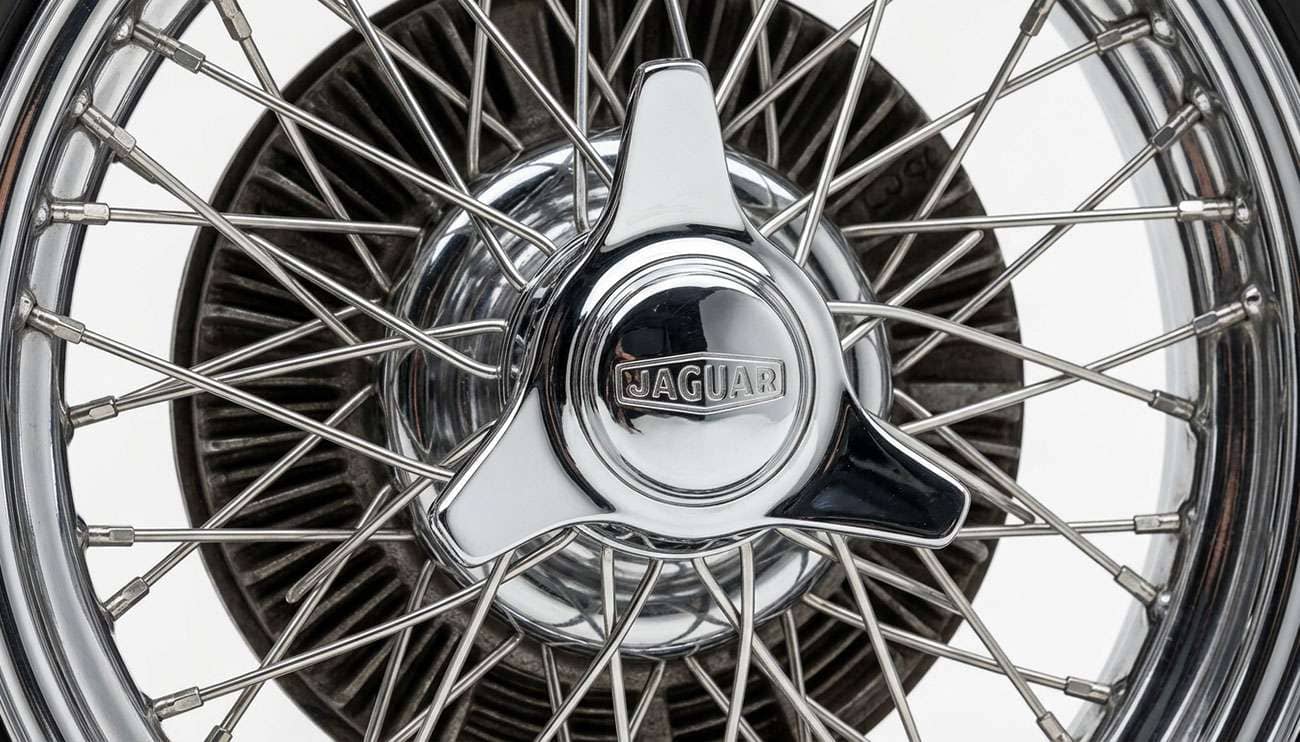
Back in 1965, if you ordered a Corvette with the optional aluminum knockoff wheels, Chevrolet handed you a soft lead hammer along with the keys. Not as a gag. As a tool. Because every time you wanted to rotate the tires, you had to walk out to the garage, grab the hammer, and beat on the wheel of your brand-new Corvette to get it off.
That's the world of knockoff wheels in one image. Equal parts racing pedigree, mechanical ritual, and old-school confidence in things that look like they shouldn't work. They've been on Grand Prix cars since 1913, on Cobras and GT40s through the '60s, and they're back in NASCAR Cup as of 2022. But for most classic car owners today, knockoffs are a question, not an answer. Real ones or decorative? Safe or sketchy? Worth the maintenance, or skip the headache?
Let's get into it.
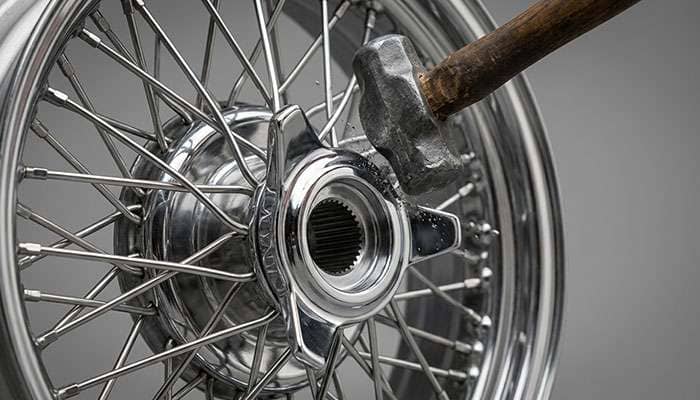
A knockoff wheel is a center-lock wheel — meaning it bolts to the axle with one big nut in the middle instead of four or five lug nuts around the outside. That single nut is called a spinner. You tighten it and loosen it by smacking the ears of the spinner with a heavy soft-metal hammer. That's where the name comes from. You knock the spinner on. You knock it off.
The whole system has five parts: the hub on the axle, the splined shaft sticking out of the hub, the wheel with matching internal splines, the threaded spinner nut, and a tapered seat that locks the wheel against the hub face. No lug nuts. No wheel studs. One nut does all the work.
That's the real definition. The reason it matters is because most "knockoff" wheels you see on classic cars today aren't actually knockoffs at all — they're regular five-lug wheels with a fake spinner glued or bolted on top. We'll sort that out in a minute. First, let's understand how the real ones work.
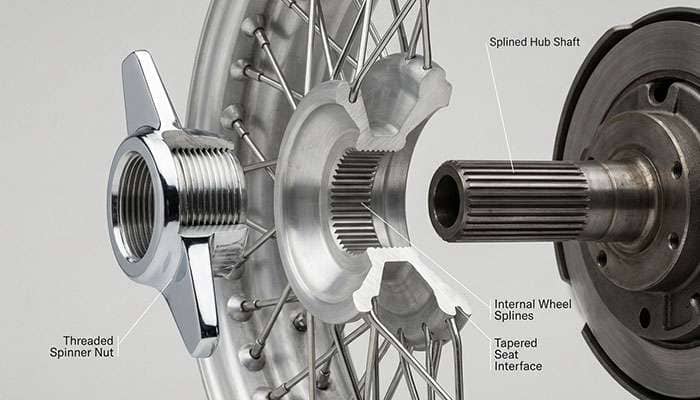
The hub on a knockoff-equipped car looks nothing like a normal axle hub. Instead of five wheel studs poking out, you've got a single threaded shaft with splines cut into it and a tapered cone at the base where it meets the brake drum or rotor. The wheel slides over that shaft, internal splines mating with external splines, and the tapered base of the wheel center seats against the matching taper on the hub. The spinner threads onto the shaft and pulls everything tight.
The splines do two jobs: they center the wheel on the hub, and they transmit drive torque from the axle to the wheel. When you hit the gas, the splines on the hub push against the splines in the wheel. When you hit the brakes, same thing in reverse. Spinning forces and braking forces both go through those splines. They take a beating.
That's why spline wear is the number one killer of knockoff setups. Once the splines round off — on either the hub or the wheel — they no longer fit tight. The wheel walks back and forth a few thousandths of an inch with every acceleration and brake event. That walking eats both surfaces. The wear accelerates. Eventually the spinner can't hold the wheel tight against the taper anymore, and the wheel comes loose. The fix isn't grinding or shimming. The fix is replace the worn part. And if you put a new wheel on a worn hub — or vice versa — you'll wear out the new piece in a hurry.
The spinner is the threaded nut that holds everything together. Early ones had two or three projecting blades, called ears or wings, that you struck with a hammer to tighten or loosen. The blades gave you mechanical advantage and a target. After 1968, U.S. federal safety regulations banned the eared spinner because of pedestrian impact concerns, and manufacturers switched to a large hex nut that required a special spanner wrench. Same internal mechanism. Different exterior.
You don't use a steel hammer on a chrome spinner. Steel chips chrome. The proper tool is a soft-metal mallet — lead, brass, copper, or rawhide-faced. Lead is the gold standard because it deforms before the chrome does. The shop favorite is a five- to six-pound lead hammer, and the legendary "Mutha Thumper" weighs 6.2 pounds. That's not overkill. That's how much weight it takes to seat a spinner properly.
Here's the part that confuses everyone the first time they see it. The spinners on the left side of the car have right-hand threads (counterclockwise to remove). The spinners on the right side have left-hand threads (clockwise to remove). They're handed.
Why? Inertia. When the car accelerates forward, the wheels rotate one way. The mass of the spinner wants to stay still relative to that rotation, which translates into a tightening force on the threads. As long as the threads are oriented correctly for each side, that inertial tightening keeps the spinner snug all day long. Drive forward, the spinners get tighter. Drive backwards, the spinners get looser.
This has two practical implications. First, never flat-tow a knockoff-equipped car backwards. The spinners will work themselves loose, and you'll find one in the weeds behind your tow rig. There's a real story from a Jaguar XK-150 owner whose left front spinner came off the car within minutes of being towed home from a body shop — the only thing that saved them was the wheel was so neglected it had partially seized to the hub.
Second, if hubs ever get installed on the wrong side of the car — easy mistake during a brake job or wheel-bearing service — the spinners will unscrew themselves on the very first drive. There's a published forum account of a Healey owner whose mechanic switched left and right knockoff hubs after a kingpin rebuild. Three miles down the road, the left knockoff was rolling alongside the car. The hubs and adapters are stamped "LEFT" and "RIGHT" for exactly this reason. If you take wheels off, mark which side each one came from. Always.
The center-lock hub was patented by the British company Rudge-Whitworth in 1908. They called it "QD" — short for quickly disconnectable — because the original purpose was fast wheel changes during racing. You could swap a wheel in seconds with one hammer instead of fumbling with multiple lug nuts.
The Rudge design was excluded from the 1908 French Grand Prix over safety concerns, but by 1913 every Grand Prix car on the grid had centerlock wheels. The technology had won the argument.
In 1922, an Italian engineer named Carlo Borrani licensed the Rudge-Whitworth design and started building wheels in Milan. Borrani made one critical change — alloy rims instead of steel — and his wheels became the standard on the great prewar racing teams. Alfa Romeo, Auto Union, Mercedes-Benz, Lancia, Porsche. After the war, Ferrari and Maserati. If it was fast and Italian and had wire wheels, those were probably Borranis.
British sports cars adopted knockoffs as a factory option from the 1950s onward — MGB, Jaguar XKE, Austin-Healey, Triumph TR4. American manufacturers were slower to embrace them, but in 1963 Chevrolet ordered an aluminum knockoff wheel from Kelsey-Hayes for the all-new C2 Corvette. A patent lawsuit between Kelsey-Hayes and Dayton Wheel delayed actual production, so no 1963 Corvettes left the factory with knockoffs — only a handful of pilot cars and race cars got the early two-bar style. Production knockoffs landed in 1964 and ran through 1967, switching from gear-toothed mating to a pin-driven mating partway through. Cobra and GT40 owners ran them too.
Then came 1968. New federal safety regulations in the United States and West Germany banned the eared spinner outright. Manufacturers responded in two ways: most dropped centerlocks entirely and went to lug-nut wheels, while a few — Maserati, Lamborghini — kept the same internal mechanism but switched to a flat hex nut tightened with a large spanner. At the 1970 Targa Florio, Porsche painted black arrows on each fender of their factory race cars so drivers would know which way to turn the hex nuts during pit stops.
For the next forty years, centerlock wheels lived almost exclusively in racing — Formula One, sports car racing, Le Mans prototypes. Then they started creeping back. Porsche put proprietary centerlocks on the 911 Turbo and GT3. NASCAR Cup Series went centerlock for the seventh-generation car in 2022. The wheel that started in 1908 is still solving the same problem, faster pit stops, with the same basic mechanism.
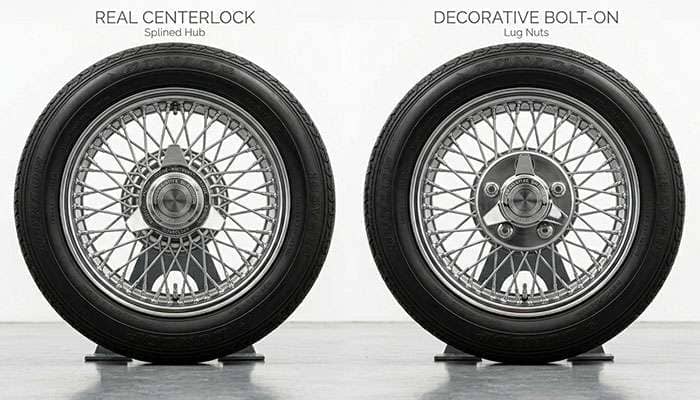
This is where it gets messy. There are three things people call "knockoff wheels" today, and only one of them actually is one.
Feature |
Real Centerlock Knockoff |
Direct-Bolt Knockoff (DBKO) |
Decorative Spinner Cap |
|---|---|---|---|
What holds the wheel on |
Single threaded spinner on splined hub |
Five lug nuts hidden under spinner facade |
Five lug nuts with a glue-on cap |
Special hub required |
Yes, splined adapter or factory hub |
No, standard wheel studs |
No |
Side-specific threads |
Yes (LH on right side, RH on left) |
Spinner is side-marked but cosmetic |
None |
Lead hammer needed |
Yes, every install |
No, regular lug wrench |
No |
Safety wire or pins |
Strongly recommended |
Built into design |
None |
Period correct on |
Pre-1968 sports cars, 1964-67 Corvette, Cobra, GT40 |
Restorations where authenticity is flexible |
Customs, show cars, hot rods |
The DBKO — direct-bolt knockoff — is the smart middle ground. Corvette America developed the design in the early '90s when C2 wheel theft hit a peak. A real centerlock can be removed in 30 seconds with a hammer, and a $3,000 set of original Kelsey-Hayes wheels was a quarter the value of the entire car. The DBKO bolts on with five hidden lug nuts and uses the spinner only as a cosmetic cap. You get the look without the maintenance ritual or the theft risk.
The pure decorative spinner cap is exactly what it sounds like. It's a chromed dust cover with fake blades, screwed or glued onto a regular five-lug wheel. There's no mechanical function. They're fine on a custom or a hot rod where the look is the point, but don't pretend they're authentic on a Cobra restoration. The judges at Pebble Beach are paying attention.
Walk up to a wheel and look for these tells:
If a wheel has none of those tells but has a spinner-looking thing in the middle, it's almost certainly a decorative cap. That's not a problem unless someone's selling it to you as the real deal.
Properly built, properly installed, and properly maintained, knockoff wheels are safe. They've been raced at Le Mans and the Targa Florio for over a hundred years. Cobras ran them flat-out at Daytona. The mechanism works.
The dangerous failures all trace back to one of five mistakes:
A pre-drive check on a knockoff car is standard practice. Walk around with a small hammer or a soft mallet. Tap each spinner. A tight spinner rings solid. A loose one sounds dead. That's a five-second check that catches problems before they become problems.
If you're going to run real centerlocks, here's the routine.
Anti-seize on everything that threads. Splines on hub and wheel, threads on the spinner shaft, threads inside the spinner nut. Skip the tapered seat — that taper needs metal-on-metal contact to grip properly. Anti-seize on the taper makes the wheel slip. Get this distinction right.
Lead hammer, not steel. Five to six pounds is the sweet spot. Soft enough to deform before the chrome does, heavy enough to seat the spinner properly. Some folks wrap aluminum sheet around the spinner ear before striking it for extra protection, especially on show cars.
Safety wire or safety pins. Use 0.032 stainless wire twisted from the spinner blade to a wheel spoke or rim hole. Bend the cut ends over so they don't shred your hands. The loop in the wire is your tell-tale — if it stretches, the spinner has rotated. Some setups use locking pins instead of wire, which is faster but harder to read at a glance.
Re-check after 200-300 miles on any new install. Then check before every drive forever. It's a 30-second visual inspection. It's also the difference between a wheel that stays on and one that doesn't.
Annual deep service. Pull every wheel once a year. Clean the splines with solvent and a brass brush. Inspect for wear. Re-anti-seize. Reinstall. If you live anywhere coastal or in a salt-belt state, twice a year. The penalty for skipping this is finding out the hard way that your hub splines are gone.
Show cars and weekend cruisers, sure — if you've got the discipline. Nothing else looks like a real centerlock with a hand-polished knockoff spinner catching the sun. The aesthetic is unmatched, the racing pedigree is real, and the maintenance is a fair price for a part of automotive history that almost died in 1968.
Daily drivers, probably not. The pre-drive check gets old fast on a car you take to work. Tire shops that won't touch wire wheels won't touch your knockoffs either. And if you live somewhere with potholes or rough roads, the constant impact loads will accelerate spline wear faster than you'll like.
For C2 Corvette, Cobra, Ford GT40, and British sports car restorations where centerlocks were original equipment, the call is between factory-correct and DBKO. Concours judges will spot the difference, but for street-driven restos, the bolt-on direct-bolt knockoff is the smart play. You get the look, you keep the security against theft, and you skip the lead hammer in the trunk.
For restomods, customs, and hot rods where the spinner aesthetic matters but you want modern reliability, you can have your cake and eat it. Our Halibrand Wheels lineup includes the Halibrand Sprint w/Spinner, Sprint w/Bullet Cap, and Indy Roadster — all bolt-on aluminum wheels that capture the salt-flat racing pedigree without the splined-hub headache. The American Racing VN427 Shelby Cobra and the VN401 Silverstone do the same thing for Cobra-style and British sports car looks. Pair them with period-correct rubber from our Classic Tires catalog and you've got a setup that looks like it just rolled off Bonneville without making you keep a copper mallet within arm's reach.
For deeper context on classic wheel design, the classic car wheel styles guide covers how the centerlock fits into the broader story of vintage wheel evolution, and the lug pattern explainer is worth reading if you're thinking about converting a knockoff car to a modern bolt-on setup. If you're working on a Corvette, the Corvette aftermarket wheel guide walks through fitment for every generation including the 1963-67 knockoff cars. And given how much wheel theft drove the original DBKO design, the wheel locks and theft prevention guide is worth a read for any classic car owner.
Eared spinners with projecting wings were banned on new road cars by U.S. federal safety regulations in 1968. Cars manufactured before that date are generally grandfathered, and aftermarket knockoff conversions exist for restorations and customs. Hex-nut centerlocks are legal and are used on modern Porsche 911 GT3 and Turbo models from the factory. State laws vary, so check your local rules before installing eared spinners on a non-period-correct vehicle.
Inertia. When the car drives forward, the rotational mass of the spinner resists the wheel's acceleration, which translates into a tightening force on the threads. By using right-hand threads on the left side and left-hand threads on the right side, both spinners self-tighten while the car moves forward. Reverse the threads or swap the hubs side-to-side and the spinners unscrew themselves within a few miles.
Yes, with the right hardware. Centerlock adapters bolt to a standard five- or six-lug hub and provide the splined shaft and threaded section that real knockoff wheels need. The adapters convert your existing wheel studs into a centerlock setup. Vintage Wheels, Dayton, and a handful of specialty manufacturers sell these kits. Quality matters — cheap adapters wear out splines fast and can fail catastrophically. Buy from a reputable supplier and inspect frequently.
Yes. Use a soft-metal hammer — lead, copper, brass, or rawhide-faced — that won't damage the chrome on the spinner. Lead is the traditional choice because it deforms before the chrome does. A five- to six-pound mallet is standard, with the popular "Mutha Thumper" weighing 6.2 pounds. Never use a steel hammer on a chrome spinner. You'll chip the finish and ruin the wheel's appearance.
A wire wheel has wire spokes connecting the rim to the hub. A knockoff wheel uses a centerlock mounting system. The two often go together — most pre-1968 wire wheels used a knockoff mounting — but they're separate concepts. A solid aluminum wheel can be a knockoff, like the original Halibrand magnesium wheels on Cobras and GT40s. And modern bolt-on wire wheels exist that don't use centerlocks at all.
Tight enough that a sharp whack from a five-pound lead hammer doesn't move it relative to a marked spline. The traditional check is to mark the position of one spinner blade against one spoke, hit the spinner solidly with the hammer, and see if the mark moves. If it doesn't shift, the spinner is properly seated. Overtightening damages the matching tapers on the hub and wheel, leading to spline damage and excess play. There's no torque value to chase — it's a feel and an audible ring of metal that tells you the wheel is locked down.



