
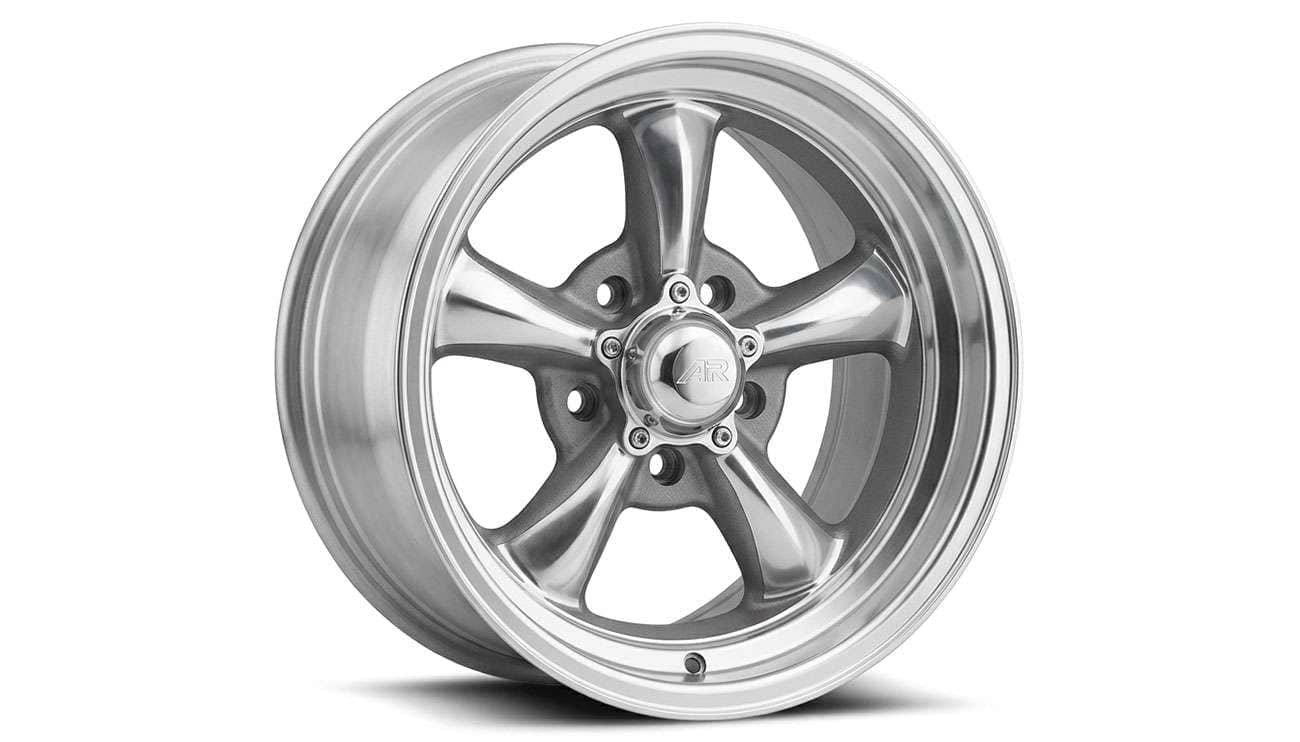
A 14 inch wheel is good on three kinds of vehicle and a bad idea on almost everything else. The spec that decides it is not diameter, it is what sits behind the wheel. On a car that is brake caliper clearance, and the working rule is that a wheel needs to be roughly four inches larger than the brake rotor. A 14 caps you at about a 10 inch rotor. Cars built from the early 1990s forward almost universally run 11 inch front rotors or larger, which means the wheel will not go on, no matter how nice it is.
So: good on a pre-1980 classic still running drums or early single-piston discs. Good on a UTV, where 14 is the standard size. Good on a trailer axle, where load rating matters more than diameter. Wrong on nearly any modern car, and I have watched a lot of people learn that with a wheel in one hand and a caliper in the other.
I have had this conversation across the counter a few hundred times. Somebody wants to put 14s back on a car because the tall sidewall rides better and the wheel looks right. Then we measure the front brakes and the conversation ends.
The industry rule of thumb is that wheel diameter needs to equal rotor diameter plus about four inches. An 11 inch rotor clears most 15 inch wheels. A 12 inch rotor wants a 16. Run that backwards and a 14 inch wheel gives you room for a rotor of roughly 10 inches, plus whatever the caliper stacks on top of it. That is a 1970s brake package.
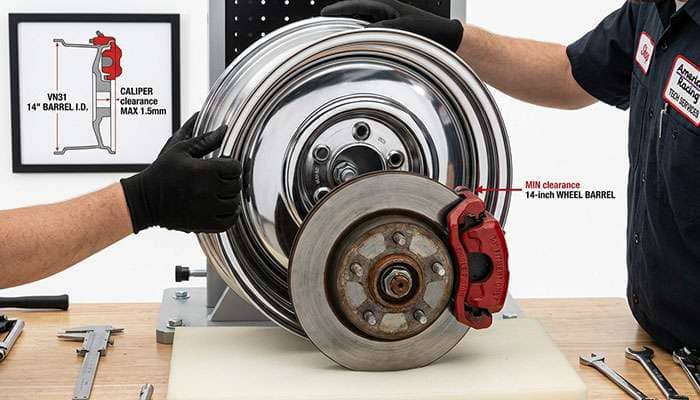
Most guides stop at "small wheels cannot fit big brake kits," which makes it sound like an aftermarket problem. It is not. The part nobody puts in front of you is that this bites on factory brakes. A four-wheel-disc car built in the last thirty years has front rotors sized for modern stopping distances, and those rotors are already past what a 14 can swallow.
There is a second half to it, and it is the half that surprises people who own old iron. Even on a classic, a 14 that fit over drum brakes will often not fit over a disc conversion. The rotor gets bigger and the caliper adds height above the hub, but the wheel also has to have the right inner barrel profile to give the caliper somewhere to live. Original 14 inch steel wheels from the drum era were not shaped for that. Reproduction 14s built specifically for disc-brake clearance exist, and that is what you want if you are keeping the diameter.
Brake Setup |
Typical Rotor or Drum |
Will a 14 Clear |
What to Watch |
|---|---|---|---|
Four-wheel drum, pre-1970 |
9 to 11 inch drum |
Yes, this is the original design case |
Backspacing on wide 14x7 and 14x8 rims |
Front disc, rear drum, 1970s factory |
10 to 11 inch rotor, single piston |
Usually, with the right wheel profile |
Inner barrel shape, not just diameter |
Aftermarket disc conversion on a classic |
10.5 to 12 inch rotor |
Sometimes, kit-dependent |
Buy disc-clearance repro wheels, measure first |
Modern four-wheel disc, 1990s forward |
11 inch rotor and up |
No, in almost every case |
15 inch is the practical floor |
UTV or ATV |
Small hydraulic disc |
Yes, 14 is a standard size here |
Bolt circle and beadlock ring, not clearance |
Trailer axle |
Drum or none |
Yes, 14 is common |
Wheel load rating is the spec that matters |
If you are anywhere near the line on a disc-brake car, measure it properly. Our full walkthrough on why two wheels with identical specs fit different brakes covers the template method and the tolerances to hold.
Here is the thing that reframes the whole question. When you search for 14 inch wheels today, the majority of what comes back was never meant for a car. Roughly two-thirds of the 14 inch wheels currently in production run ATV and UTV bolt circles: 4x156 for Polaris, 4x110 for Honda and Yamaha, 4x137 and 4x136 for Can-Am. The side-by-side boom moved the entire 14 inch category off the highway and into the dirt.
What is left on the car side is almost entirely classic. The dominant bolt patterns are 5x114.3, which covers a huge swath of Ford, Mopar and older imports, and 5x120.65, the GM 5 on 4.75 pattern that shows up under Chevelles, Camaros, Novas and C10s. After that it drops off to 4x100 for older compacts and 4x114.3 for Datsuns and early Japanese cars. The brands still building them are the restoration names: Wheel Vintiques, U.S. Wheel, American Racing, Cragar, Scott Drake, and our own Hot Rod Hanks line.
Widths tell the same story. On the car-pattern side, 14x6 and 14x7 account for most of what exists, with 14x5.5 and 14x5 filling in the narrow end and 14x8 the wide end. Nobody is making a 14x9 for a modern sedan, because there is no modern sedan that would take one.
Application |
Common Bolt Patterns |
Typical Widths |
Verdict |
|---|---|---|---|
Classic and muscle car |
5x114.3, 5x120.65, 5x101.6 |
14x5.5 to 14x8 |
Correct and period-right, if the brakes allow it |
Older import and compact |
4x100, 4x114.3, 4x10⁸ |
14x5 to 14x6 |
Fine on the original car, cheap to run |
UTV and side-by-side |
4x156, 4x137, 4x136 |
14x7 and 14x10 |
The default size, beadlock options widely available |
ATV |
4x110, 4x115 |
14x7 |
Standard, chosen by bolt circle not diameter |
Trailer |
5x114.3, 5x139.7 |
14x5.5 and 14x6 |
Common, but buy on load rating first |
Modern car, 1990s forward |
Various |
Not applicable |
Brakes will not clear it, look at 15 or 16 |
That table is really the answer to the question. A 14 is not universally good or bad. It is right for four of those rows and wrong for one, and knowing which row you are in takes about a minute.
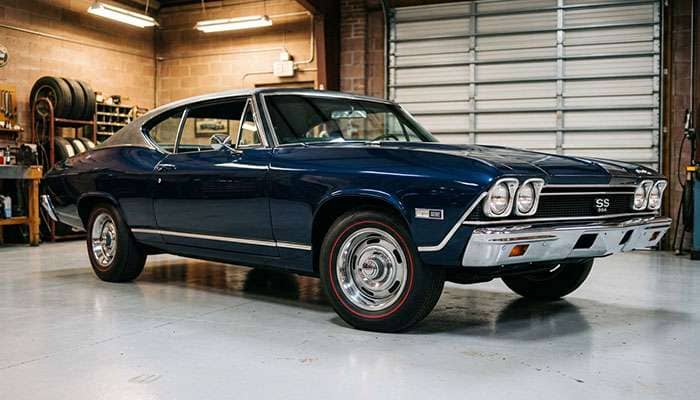
On a pre-1980 American car, a 14 is not a compromise. It is the size the chassis was designed around. The suspension geometry, the spring rates, the steering ratio and the brake proportioning were all set with a 25 to 26 inch tall tire in mind. Put 14s and correct-height tires back under a 1966 Chevelle and it drives the way the engineers meant it to. Put 18s under it and you have changed the effective gear ratio, added rotating mass at the worst possible radius, and asked a manual steering box to fight a wide contact patch it was never meant to see.
The ride is the other half. A 195/75R14 has roughly 5.75 inches of sidewall doing the work. That sidewall absorbs expansion joints and pavement seams the suspension never gets a chance to feel. Anyone who has driven the same car on 14s and then on 18s knows exactly what that trade feels like on a rough road.
Then there is the look, and I am not going to pretend that does not matter. Redlines on a 14x6 Rally wheel, or a set of 14x7 Torq Thrusts with the right backspacing tucked into the fenders, is what a lot of these cars are supposed to look like. Getting the stance right on a classic comes down to backspacing more than anything else, and our step-by-step on how to measure backspacing on classic car rims is the piece to read before you order.
On a UTV, 14 is simply the size the machine came with, and the reason is unglamorous: it leaves room for a tall sidewall on a vehicle that lives on rocks. A 30 inch tire on a 14 inch wheel has eight inches of sidewall to fold and absorb impact. The same 30 inch tire on an 18 would have half that and you would be bending rims all weekend.
On a trailer, diameter is nearly beside the point. What matters is that the wheel is rated for the load on that axle, and trailer wheels are rated individually. Our wheel load rating guide covers how to read that number and why it is the one spec you never guess at.
Anything with modern brakes. That is the short version, and it covers most cars on the road. If the car has four-wheel discs from the factory and was built after roughly 1990, the front rotor alone will be close to or past the 10 inch ceiling a 14 gives you, before you add the caliper.
The other case is a classic that has been modernized. This is the one that catches people. A car that wore 14s from the factory and has since had a front disc conversion, a bigger engine, or a suspension package is now a different vehicle. It may still want the 14 inch look, but the hardware behind the wheel has moved on. Going to a 15 inch reproduction wheel with a period-correct design gets you almost the same appearance with real clearance and a far better tire selection.
Tire choice is the quiet cost. The passenger-car 14 inch tire market has thinned out considerably, and the sizes that remain are weighted toward economy touring compounds. There is no ultra-high-performance 14 inch tire being developed, because there is no market for one. If you want a modern compound with modern wet grip, you need to be at 15 inches or larger.
Two groups, and they are separated by about twenty years.
Classic American, roughly 1955 to 1980. Full-size and intermediate Chevrolets, Chevelles, Novas, Camaros, Impalas, C10 pickups, most Ford intermediates and full-sizes including Fairlanes, Torinos and Galaxies, Mustangs through the first two generations, and a long list of Mopar B-body and A-body cars. This is where 14 was the default passenger size for decades.
Compacts and imports, roughly 1975 to 2010. Older Civics, Corollas, Sentras, Escorts, Cavaliers, Metros and the like, plus Datsun and early Toyota models on the 4x114.3 pattern. Some of these ran into the 2000s on 13s and 14s in base trim, and a handful of budget models kept 14s going well past that, which is where the reputation for 14 as an economy size comes from.
What you will not find is a performance car of any era that came on 14s and stayed there. Even the muscle cars that were factory-delivered on 14s got 15s the moment anybody wanted to go around a corner. The sizing history and the reasons behind it are covered in why classic cars had 14 and 15 inch wheels, and if you are building a period car, the muscle car wheel size guide has the model-by-model sizing.
The most common 14 inch tire size in current production is 185/65R14, followed closely by 175/65R14, 195/70R14 and 185/70R14. Those four cover most of the compact and older-import world. On the classic side you are usually looking at 195/75R14, 205/70R14 or 215/70R14, which land close to the original overall diameters those cars were built with.
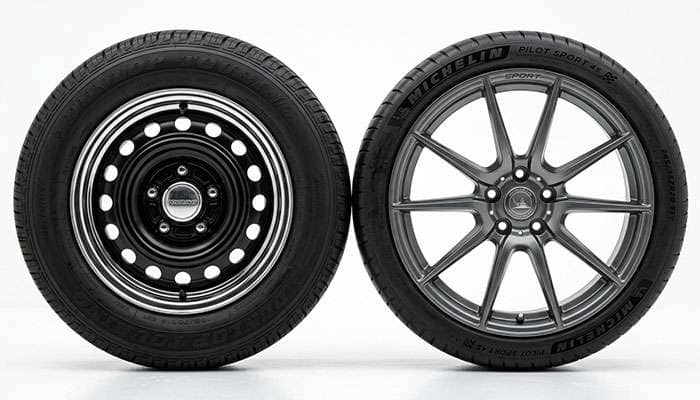
The trailer world runs its own sizes. 205/75R14 is the workhorse, with 215/75R14 above it. These carry an ST designation rather than P, and they are built with stiffer sidewalls and different load tables. They are not interchangeable with passenger tires even when the numbers look similar. We put a set of the common size through a long test in 205/75R14 trailer tires tested.
One more thing worth knowing: rim width dictates which tire sizes are legal on a given wheel. The Tire and Rim Association publishes approved rim width ranges for every tire size, and a 195 wants a 5.5 to 7 inch rim while a 215 wants 6 to 7.5. Mounting a wide tire on a narrow rim pinches the tread and rolls the shoulders under in a corner. It is a real handling problem, not a cosmetic one.
This question has two completely different answers, which is exactly why it keeps getting asked.
On the passenger side, the widest 14 inch tire in current production is a 265/50R14, a genuine wide-oval size that goes on 14x8 rims under drag and street machine builds. The tallest is a 235/75R14, which works out to about 27.9 inches of overall diameter. If you want tall and reasonably common, 225/75R14 gets you 27.3 inches and is far easier to find.
On the UTV side, the answer is much bigger. Flotation sizes on a 14 inch wheel run up to 35x10.00R14, a 35 inch tall tire on a 14 inch rim, and widths go out to 28x14.00-14. That is a foot and a half of sidewall stacked above the bead. Those numbers are not achievable on a car because no passenger chassis has the wheel well or the suspension travel for them, but they are ordinary in the side-by-side world.
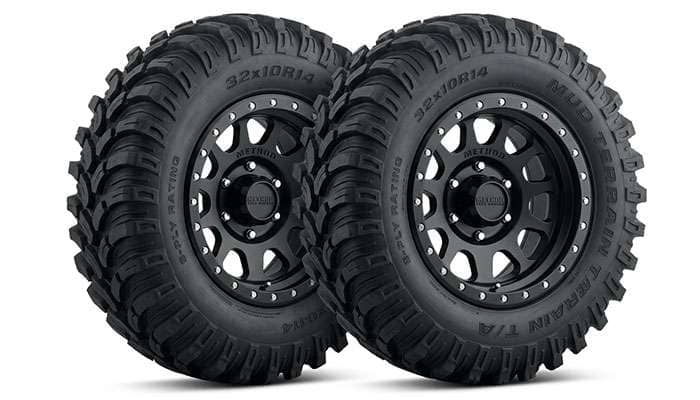
So when somebody says the biggest tire for a 14 is a 35, and somebody else says it is a 265/50, they are both right. They are answering different questions. The common ATV wheel size breakdown covers the off-road side in more detail.
Every list of 14 inch wheel benefits includes lower unsprung weight, and the reasoning sounds airtight: smaller wheel, less mass, less strain on the suspension. It is worth checking, because it depends entirely on what you are comparing.
The comparison people have in their head is a 14 inch steel wheel against a 20 inch cast aluminum wheel with a low-profile tire. In that matchup the 14 wins on weight easily and it is not close. But that is rarely the actual decision. The real decision is usually a 14 versus a 15, or a factory steel 14 versus an aluminum 15, and there the math flips. A 14x6 stamped steel wheel typically runs in the high teens by weight. A 15x7 cast aluminum wheel often comes in at or below that number, because construction material matters more than one inch of diameter.
Where the 14 genuinely wins on unsprung mass is at the tire. A tall-sidewall 14 inch tire has less rubber and less steel belt than a wide low-profile 20 inch tire, and the difference in rotational inertia is real and felt. So the benefit is true, it is just located in the tire rather than the wheel, and it disappears if you compare a steel 14 against an aluminum 15.
The comfort claim, by contrast, holds up completely. More sidewall means more compliance, full stop. That one is physics and nobody argues with it.
When a 14 goes on a car it should not be on, it rarely fails on the driveway. It fails later, and the sequence runs about like this.
Day one. The wheel bolts up but the caliper is close, maybe touching under load. You get a faint tick or scrape at low speed on turns and it is easy to attribute to a rock or a heat shield. Spin the wheel by hand with the car in the air and you will hear it clearly.
First few hundred miles. The caliper starts polishing a witness mark into the back of the spokes or the inside of the barrel. On an aluminum wheel that is removing material from a structural section. On a steel wheel it is removing paint and starting rust.
First hot day or first hard stop. Brake components grow when they get hot, and suspension deflects under cornering load. A gap that measured three millimeters in the shop can go to zero when everything moves at once. That is the point where light contact becomes hard contact.
Somewhere past that. Repeated contact at the same spot is a fatigue crack looking for a place to start. Aftermarket wheels are validated to SAE J2530, which puts them through cornering fatigue, radial fatigue and impact testing at their rated load. None of those tests contemplate a caliper grinding a groove into the spoke face. Once you have created a stress riser there, the certification behind the wheel no longer describes the part you are driving on.
On a trailer, the failure mode is different and faster. Undersizing a trailer wheel on load rating instead of clearance loads the center section past what it was tested for. Trailer wheels fail at the bolt circle, and they usually take the fender and the tire with them.
None of this is dramatic engineering. It is the ordinary consequence of a part touching another part several hundred thousand times.
Once you know your row on that table, browse the 14 inch wheels we stock and filter by your bolt pattern before anything else.
Is a 14 inch wheel good? On the right vehicle it is not just good, it is correct. A pre-1980 classic on drums or early discs was engineered around this diameter, and putting the car back on 14s with proper-height tires restores the ride and the proportions the factory intended. A UTV wants a 14 for sidewall. A trailer axle does not care about diameter at all.
On a modern car, the honest answer is no, and it is not a matter of taste. The front brakes on almost anything built in the last thirty years will not fit inside a 14 inch barrel, and no wheel design gets around that. Fifteen inches is the practical floor, and if you want the classic look at 15 there are reproduction designs that will get you most of the way there.
Measure the brakes, know which application you are in, and the question answers itself.
Two groups. Classic American cars from roughly 1955 to 1980, including Chevelles, Novas, Camaros, Impalas, C10 pickups, Ford Fairlanes, Torinos and Galaxies, first and second generation Mustangs, and Mopar A-body and B-body cars. Then compacts and imports from roughly 1975 to 2010, including older Civics, Corollas, Sentras, Escorts, Cavaliers, Metros, and Datsun and early Toyota models. No modern performance car uses 14 inch wheels, because the brakes will not fit inside them.
185/65R14 is the most common, followed by 175/65R14, 195/70R14 and 185/70R14. Those cover most compacts and older imports. Classic American cars usually run 195/75R14, 205/70R14 or 215/70R14 to land near their original overall diameter. Trailers run 205/75R14 and 215/75R14 in ST designation, which is a different construction from passenger tires and not interchangeable with them.
It depends which world you are in. For passenger tires, the widest current size is 265/50R14 and the tallest is 235/75R14, which is about 27.9 inches in overall diameter. For UTV and ATV flotation tires, 14 inch wheels take sizes up to 35x10.00R14, a 35 inch tall tire, and widths out to 28x14.00-14. The off-road answer is far larger because those chassis have the wheel well and suspension travel for it.
Match the original overall diameter of the vehicle and stay inside the approved rim width range for the size. On a classic running 14x6, a 195/75R14 or 205/70R14 lands close to factory height and fits the rim properly. On a compact with a 14x5.5, 185/65R14 is the usual answer. On a trailer, 205/75R14 in ST construction is the standard. Changing overall diameter changes your speedometer reading and your effective gear ratio, so keeping it close to stock matters more than picking a specific brand.
Sometimes, and it depends on the rotor. A 1970s factory front disc setup with a 10 to 11 inch single-piston caliper will usually clear a 14 built with the right inner barrel profile. A modern four-wheel-disc car will not. An aftermarket disc conversion on a classic is the case to measure, because the rotor and caliper both grew even though the car did not. Original drum-era 14 inch wheels frequently will not clear a conversion kit, but reproduction 14s built specifically for disc clearance are available.
Not necessarily. Construction material matters more than one inch of diameter. A 14x6 stamped steel wheel often weighs as much as or more than a 15x7 cast aluminum wheel. Where the smaller diameter does save weight is at the tire, since a tall-sidewall 14 inch tire uses less rubber and less belt material than a wide low-profile tire on a large wheel. The unsprung mass benefit is real when comparing a 14 to a 20, and much less clear when comparing a 14 to a 15.



