
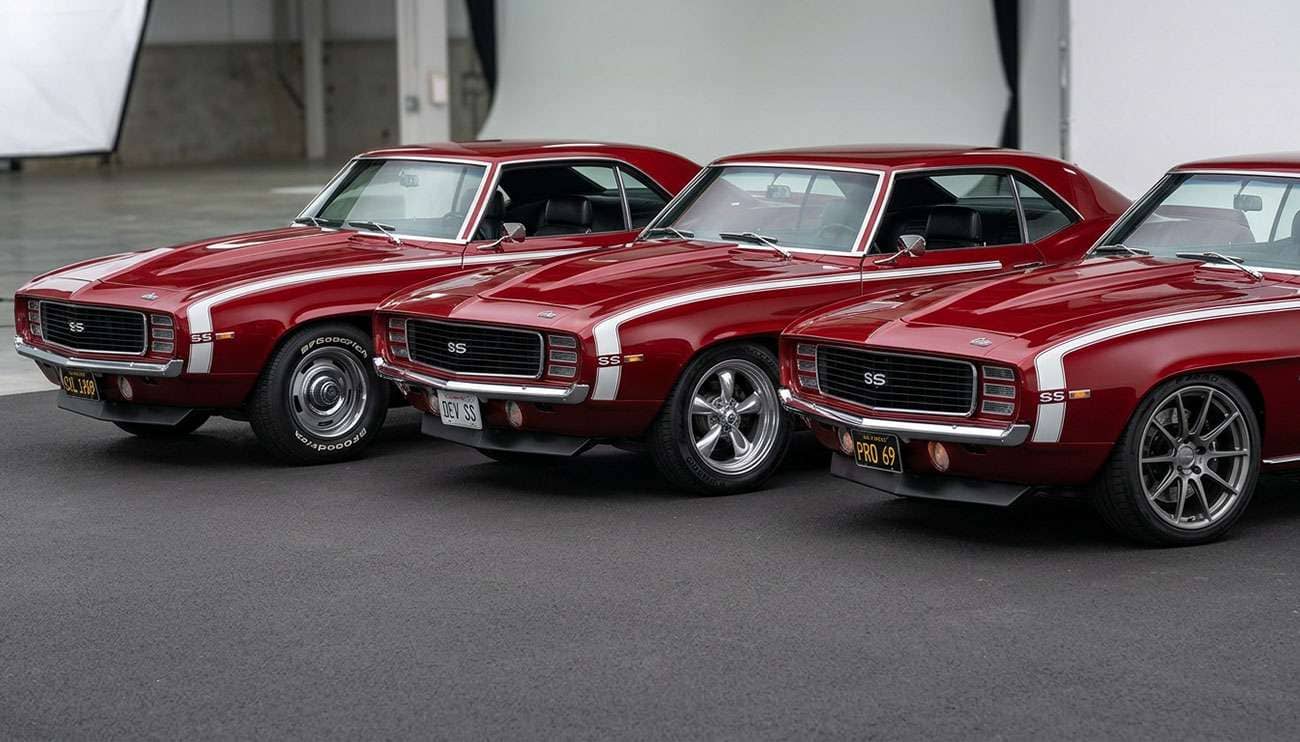
This is the single most common question I get from muscle car owners: what size wheels should I run? And I get it — the difference between 15, 17, and 18 inch wheels on a Camaro or Chevelle isn't just cosmetic. It changes the car's proportions, the way it rides, what tires are available to you, whether you can clear your brakes, and ultimately whether the car looks like it belongs in that era or looks like someone bolted modern wheels onto a classic body.
I've fitted thousands of wheel and tire packages to muscle cars at Performance Plus Tire, and I can tell you there's no single right answer. But there is a right answer for your build — and it depends on what you're building, how you drive it, and what look you're going for. Let me walk you through each size so you can stop guessing and start ordering with confidence.
Classic muscle cars were designed around 14- and 15-inch wheels. The fender openings, the ride height, the visual weight of the car — all of it was proportioned for small-diameter wheels with tall sidewall tires. That matters because when you change the wheel size, the tire sidewall has to shrink to keep the overall diameter close to stock. Go too big on the wheel and you end up with thin, low-profile tires that look out of place on a car designed in the 1960s.
Think of it this way: a stock 1969 Camaro on 15-inch wheels with a 60-series tire has roughly 3.5 inches of sidewall rubber between the wheel lip and the ground. That sidewall is part of the car's visual identity — it gives the tire a meaty, muscular look that matches the wide fenders and aggressive stance. Drop a 20-inch wheel under the same car with a 30-series tire and you've got barely an inch of sidewall. The proportions collapse. The car looks like it's standing on stilts.
The sweet spot is finding the wheel diameter that gives you access to modern tire technology while keeping enough sidewall to maintain that classic muscle car stance. That's the real question behind 15 vs 17 vs 18 — and each size answers it differently.
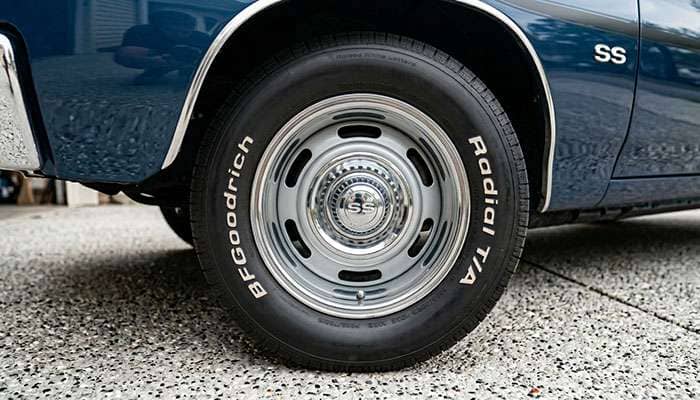
If your goal is a factory-correct restoration or a build that looks like it just rolled out of 1970, 15-inch wheels are the only honest choice. This is the diameter that came on virtually every American muscle car from the mid-1960s through the mid-1970s. Rally wheels, Magnum 500s, Cragar S/S, steel wheels with dog dish caps — all 15 inches. The look is correct because the car was literally designed for it.
The tire that defined the 15-inch muscle car look is the BFGoodrich Radial T/A. Raised white letters, a meaty sidewall, and a tread pattern that screams 1970s American performance. If you're building a Chevelle SS, a Pontiac GTO, a Dodge Challenger, or any classic that deserves to look the way the factory intended, a set of 15×7 or 15×8 wheels wrapped in Radial T/As is the gold standard.
The challenge with 15-inch wheels in 2026 is tire availability. Modern high-performance tire development has shifted almost entirely to 17-inch and larger. If you want a modern ultra-high-performance compound — a Michelin Pilot Sport or a Continental ExtremeContact — in a 15-inch size, your options are extremely limited or nonexistent. You're mostly limited to the BFGoodrich Radial T/A, a handful of all-season options, and drag-specific tires.
Brake clearance is the other issue. If you've upgraded to modern disc brakes with larger rotors and calipers — which many muscle car owners do for obvious safety reasons — a 15-inch wheel may not clear them. Many popular big-brake kits require a minimum of 17 inches.
Front: 15×7 with 225/60R15 or 235/60R15. Rear: 15×8 with 255/60R15 or 275/60R15. This gives you a subtle staggered setup with plenty of sidewall and a period-correct look that wins at car shows.
If I had to pick one diameter for muscle cars, it's 17. It's not 15, which limits your tire options. It's not 18, which starts pushing the proportions on some cars. Seventeen inches hits the middle of the target — you get access to the full range of modern performance tires, you clear most big-brake kits, and you keep enough sidewall to look like a muscle car instead of a sport sedan.
A 17-inch wheel on a classic muscle car is only 2-3 inches larger than stock. That's enough to modernize the stance without overwhelming the car's original proportions. With a 45- or 50-series tire, you still get 3+ inches of sidewall — enough visual rubber to look right under those wide fenders. And the tire selection at 17 inches is massive. You can get everything from sticky autocross rubber to comfortable grand touring tires in sizes that fit muscle cars perfectly.
The wheel selection at 17 inches for classic car styles is also the deepest. American Racing makes the Torq Thrust II, the Salt Flat Special, the Hopster, and dozens of other classic designs in 17-inch. Boyd Coddington offers the Junkyard Dog and several billet designs. US Mags, Ridler, and Foose all have extensive 17-inch lineups specifically designed for muscle cars. You simply have more choices at 17 than at any other diameter.
Cost is another factor. 17-inch wheels and tires run 15-25% less than comparable 18-inch setups. Over a full set of four wheels plus tires, that's $200-$400 in savings — money you can put into suspension, brakes, or just a nicer set of wheels than you'd otherwise afford.
Front: 17×7 or 17×8 with 235/45R17 or 245/45R17. Rear: 17×8 or 17×9 with 275/40R17 or 255/45R17. This is the most popular staggered setup in the muscle car world, and it works on virtually every GM, Ford, and Mopar platform from the 1960s and 1970s. A 275/40R17 on a 17×9 rear fills the wheel well aggressively without rubbing on most cars with stock or mildly lowered suspension.
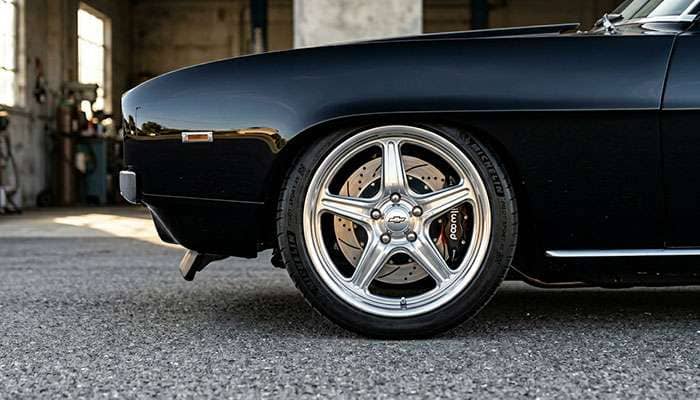
18-inch wheels are where muscle car builds start moving into pro-touring territory. The wheel fills more of the fender opening, the stance gets lower and more aggressive, and the car takes on a decidedly modern-performance personality. If that's your goal — a classic body with modern capability — 18 works.
The biggest advantage of 18-inch wheels is brake clearance. If you're running a serious big-brake kit with 14-inch rotors and six-piston calipers, you may need 18 inches just to clear the hardware. Pro-touring builds that are set up for road courses and autocross events often run 18s for exactly this reason — the performance hardware dictates the minimum wheel diameter.
On some muscle cars — particularly narrower-bodied cars like early Mustangs, Novas, and first-gen Camaros — 18-inch wheels can look oversized. The visual balance tips toward too much wheel and not enough tire. A 40-series sidewall on an 18 is about 2.8 inches tall, compared to 3.4 inches on a 45-series 17. That half-inch of lost sidewall doesn't sound like much, but your eye picks it up instantly. The car starts looking like a modern car wearing a classic costume.
On larger-bodied muscle cars — Chevelles, GTOs, Chargers, and full-size models — 18s look more proportional because the bigger fender wells can absorb the larger wheel diameter without it dominating the visual. If your car has wide, squared-off fenders and a heavy visual presence, 18 can work beautifully.
Front: 18×8 with 245/40R18 or 235/40R18. Rear: 18×9 or 18×10 with 275/35R18 or 285/35R18. These pairings keep sidewall height reasonable while filling the fender opening. Be careful with width on narrower cars — a 10-inch-wide rear wheel may require fender rolling or tubbing on some platforms.
Here's the comparison that actually matters — real numbers across every dimension that affects your build decision:
Factor |
15 Inch |
17 Inch |
18 Inch |
|---|---|---|---|
Typical Sidewall Height |
3.5–4.0 inches |
3.0–3.5 inches |
2.5–3.0 inches |
Period-Correct Look |
Factory authentic |
Subtly modernized |
Noticeably modern |
Performance Tire Selection |
Very limited |
Excellent — widest variety |
Excellent |
Big Brake Clearance |
Often too tight |
Clears most kits |
Clears all kits |
Ride Comfort |
Best — most sidewall cushion |
Good |
Firmest |
Wheel Style Selection |
Classic styles only |
Best — classic and modern |
Good — skews modern |
Cost (Wheel + Tire Set of 4) |
$800–$1,800 |
$1,200–$2,800 |
$1,500–$3,500+ |
Best For |
Restorations, show cars, drag |
All-around best for most builds |
Pro-touring, restomod, big brakes |
This is where the fitment rubber meets the road. Here are the proven front/rear tire combos I recommend for the most popular muscle car platforms. These assume stock or mildly modified fender clearance — if you've tubbed the rears or rolled the fenders, you can go wider.
15 inch: 235/60R15 front / 275/60R15 rear. 17 inch: 245/45R17 front / 275/40R17 rear. 18 inch: 245/40R18 front / 285/35R18 rear.
15 inch: 225/60R15 front / 255/60R15 rear. 17 inch: 235/45R17 front / 275/40R17 rear. 18 inch: 245/40R18 front / 275/35R18 rear.
15 inch: 215/65R15 front / 255/60R15 rear. 17 inch: 225/45R17 front / 255/45R17 rear. 18 inch: 235/40R18 front / 275/35R18 rear.
15 inch: 235/60R15 front / 275/60R15 rear. 17 inch: 245/45R17 front / 295/40R17 rear. 18 inch: 245/40R18 front / 295/35R18 rear.
Need help dialing in the exact offset and backspacing for your specific car? Call us at 888-926-2689 — we do this every day and can confirm clearance before you order. We also build complete wheel and tire packages shipped to your door, mounted and balanced if you need them.
In most cases, yes. The key is choosing the correct width, offset, and backspacing for your specific car and pairing the wheels with tires that maintain a similar overall diameter to stock. A properly spec'd 17×8 wheel with a 245/45R17 tire will bolt directly onto most classic GM, Ford, and Mopar muscle cars without fender modifications. Wider setups or 18-inch wheels may require fender rolling on some cars, particularly at the rear. Always confirm clearance before ordering.
For first-generation Camaros (1967-1969), 17-inch wheels are widely considered the best all-around choice. A 17×8 front and 17×9 rear with 235/45R17 and 275/40R17 tires respectively fills the fender wells without overwhelming the car's proportions. If you're doing a factory restoration, 15×7 with period-correct tires is the right call. If you're running a pro-touring build with a big-brake kit, 18×8 front and 18×9 rear will clear most setups.
Yes, but the degree depends on how far you go. Moving from 15 to 17 inch wheels produces a modest difference that most drivers find acceptable — the sidewall drops by about half an inch, and the ride firms up slightly. Going from 15 to 18 produces a more noticeable change, with less cushion over bumps and expansion joints. Classic muscle cars already have firm suspensions by modern standards, so adding stiffer, lower-profile tires amplifies that. If ride comfort is a priority, 17-inch wheels offer the best balance.
Only if the overall tire diameter changes significantly. When you increase wheel diameter, you compensate with a shorter sidewall tire to keep the total diameter close to stock. For example, a stock 215/70R14 tire has an overall diameter of about 25.9 inches. A 245/45R17 has an overall diameter of about 25.7 inches — close enough that speedometer error is negligible. Stay within 3% of the stock overall diameter and you won't need recalibration. Your tire shop or our fitment team can confirm this for your specific combination.
It depends on the build. A full custom or restomod with tubbed rear fenders, custom suspension, and a modern drivetrain can pull off 20-inch wheels if the proportions are carefully managed. But for most classic muscle cars with stock or mildly modified bodies, 20-inch wheels create a tire sidewall that's too thin to look right. The car loses its muscular stance and starts looking like a modern sedan. We generally recommend staying at 18 inches or below for classic muscle car applications unless the build is specifically designed around larger wheels.
The best value is a set of 17×8 cast aluminum wheels in a classic five-spoke design paired with quality all-season or performance tires. At 17 inches, both wheels and tires cost less than equivalent 18-inch setups, and the selection of affordable classic-style wheels is the largest. A complete set of four wheels and tires in 17-inch can start around $1,200 depending on brand and tire choice. Consider a wheel and tire package from Performance Plus Tire — we mount, balance, and ship to your door so you can bolt them on at home.



