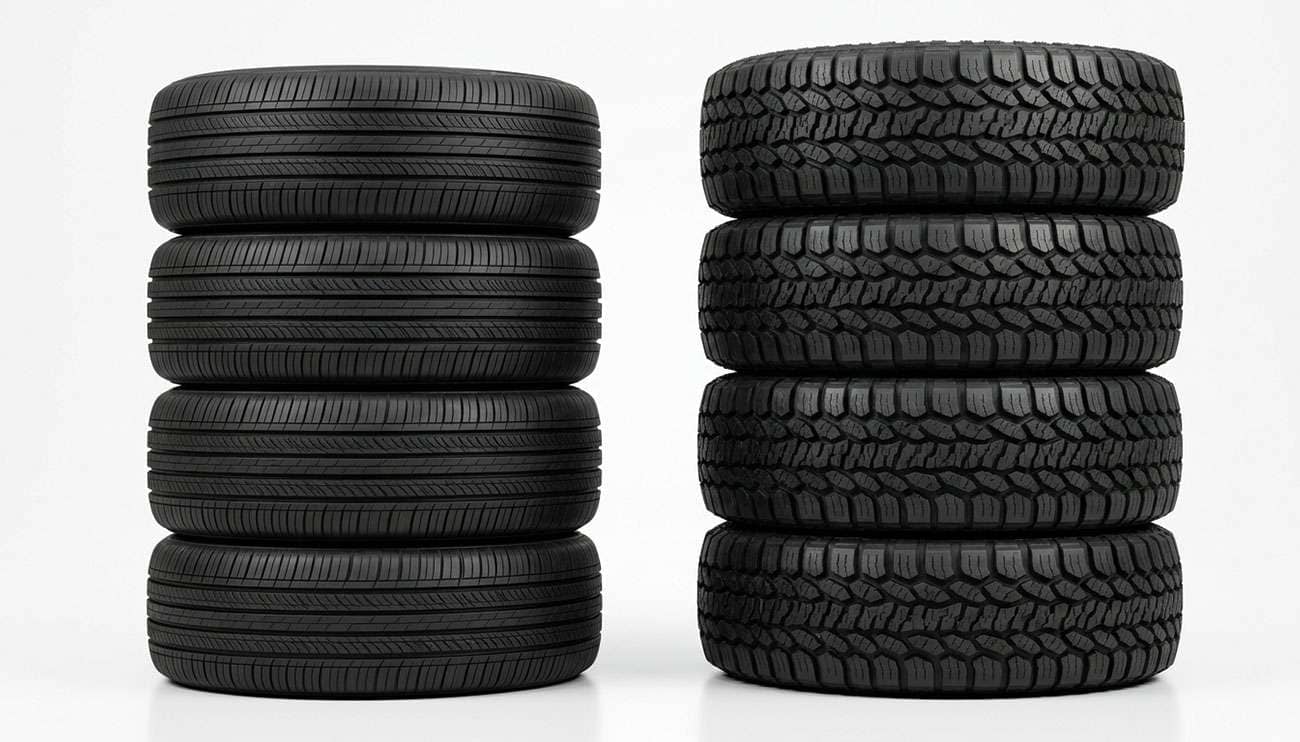
Short answer: $1,000 for four tires is premium money on a compact car or sedan, a fair price on a crossover or half-ton pickup running passenger-type tires, and too little for most heavy-duty trucks and lifted rigs. Everybody tells you it depends on your vehicle. The part that actually swings the answer is the load range. On the same pickup, in the same size, switching from a P-metric tire to an LT Load Range E tire cuts the share of tire lines your $1,000 can buy roughly in half.
I'm Hank Feldman. I opened the doors in Long Beach in 1971, and I've been watching customers react to tire quotes ever since. The person with a Corolla who hears $1,000 thinks somebody's robbing him. The person with a diesel 3/4-ton who hears $1,000 thinks somebody made a mistake. They're both reading the number right for their vehicle. Here's how to read it right for yours.
What $1,000 buys, by vehicle and size (new tires, before installation):
Vehicle and Typical Size |
Typical New Price Per Tire |
Share of Tire Lines at $250 or Less |
Share of Tire Lines at $200 or Less |
Is $1,000 Good? |
|---|---|---|---|---|
Compact car, 195/65R15 |
About $94 |
Nearly all |
Nearly all |
High. Premium money, even installed |
Midsize sedan, 215/55R17 |
About $143 |
96% |
86% |
Generous. Top-tier touring, installed |
Compact crossover, 225/65R17 |
About $155 |
94% |
83% |
Good. Premium all-season or all-weather |
Midsize SUV, 245/60R18 |
About $198 |
87% |
About half |
Fair. Mid-to-premium tier |
Sport sedan, 245/40R19 |
About $238 |
60% |
28% |
Tight. Mid-tier, tires only |
Half-ton pickup, P-metric 275/65R18 |
About $227 |
About 2 in 3 |
About 1 in 3 |
Fair. Mid-tier highway or all-terrain |
Half-ton pickup, LT275/65R18 Load Range E |
About $278 |
37% |
18% |
Tight. Budget-to-mid LT |
3/4-ton pickup, LT275/65R20 Load Range E |
About $349 |
23% |
About 1 in 10 |
Low. Short for most lines |
Lifted truck, 35x12.50R20 |
About $354 |
Under 1 in 10 |
Almost none |
Not enough |
Read the two share columns this way. If somebody quotes you $1,000 for the tires alone, that's $250 apiece, and the first share column shows how much of the market you can shop. If $1,000 is your out-the-door number with installation and tax, figure roughly $155 to $210 per tire for the rubber itself, so read the second column. If you'd like the same breakdown at lower budgets, we covered whether $300 for 4 tires is good and whether $600 for 4 tires is good too.
On a compact car, a sedan, or a small crossover, $1,000 is top-shelf money, and that isn't a bad thing as long as you're getting top-shelf tires for it. The typical tire in these sizes runs about $94 to $155. Even after mounting, balancing, and tax, $1,000 reaches nearly every tire made in your size.
At this budget you shouldn't be choosing between brands you've never heard of. You should be choosing between premium touring tires with long treadwear warranties, quiet ride, and strong wet braking, or an all-weather tire carrying the three-peak mountain snowflake symbol that can save you from buying a separate winter set. Many premium touring lines carry 70,000- to 90,000-mile warranties. Divide the price by those miles and a $1,000 set can actually cost less per mile than a cheaper set that's warrantied for 40,000. Our guide to tire cost per mile walks through the math.
If you drive a 15- or 16-inch economy car and the $1,000 quote is for a budget or no-name tire, walk. Ask the shop for the brand, model, and warranty in writing. Also check whether the quote includes services you didn't ask for. I've seen alignments, nitrogen fills, and road-hazard plans quietly stacked onto a set of $90 tires until the bill crossed four figures. None of those are scams on their own, but you should decide on each one, not find it on the invoice.
Not every car is cheap to shoe. A sport sedan on 245/40R19 runs about $238 a tire in a typical line, and only about 6 in 10 lines come in at $250 or less. Once you add installation, $1,000 out the door covers fewer than 3 in 10. Low-profile sizes like these are built in smaller runs, usually carry a V rating or higher, and fewer budget makers build them. If your car wears 19s or 20s, $1,000 is a fair mid-tier number, not premium money.
This is where the answer splits, and it splits on two letters most people never look at: P or LT. Half-ton pickups and full-size SUVs can often run either a P-metric (passenger) tire or an LT (light truck) tire in the same size. The price difference is bigger than most folks expect.
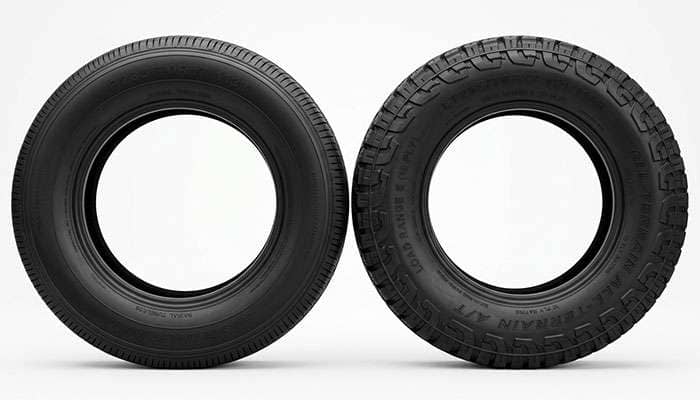
Same truck sizes, two constructions (typical new price per tire and load capacity per tire):
Size |
P-Metric Typical Price |
LT Load Range E Typical Price |
Extra Cost for a Set of 4 |
P-Metric Capacity |
LT Load Range E Capacity |
|---|---|---|---|---|---|
265/70R17 |
About $185 |
About $231 |
About $185 (+25%) |
Load index 115, 2,679 lb |
Load index 121, 3,195 lb (+19%) |
275/65R18 |
About $227 |
About $278 |
About $205 (+23%) |
Load index 116, 2,756 lb |
Load index 123, 3,415 lb (+24%) |
275/60R20 |
About $236 |
About $328 |
About $368 (+39%) |
Load index 115, 2,679 lb |
Load index 123, 3,415 lb (+27%) |
Load figures are the single-tire maximums for the typical load index in each class, from the Tire and Rim Association load tables. On a 275/65R18 half-ton, $1,000 in tires-only money covers about two out of three P-metric lines but only about one in three LT Load Range E lines. In 275/60R20, the LT side shrinks to fewer than one in five. Same truck, same budget, a very different shopping list.
Most full-size SUVs and many half-tons on 20s run sizes like 275/55R20. That size comes in plenty of passenger-type XL tires, typically around $207 each with a load index around 117, which is 2,833 pounds per tire. The LT Load Range E versions run about $274. If your SUV came on passenger tires, $1,000 tires-only covers about 7 in 10 XL lines, so you're shopping the heart of the market. Switch to LT and it drops to about 4 in 10.
Heavy-duty pickups don't get the P-metric option. They need LT tires, almost always Load Range E or higher. In LT275/70R18 the typical E-range tire runs about $281, and in LT275/65R20 about $349. For most 3/4-ton owners, $1,000 tires-only is a budget set, and $1,000 out the door is short. Lifted trucks on 35-inch tires are in another bracket again, typically around $350 a tire before installation.
Maybe not, and that's the biggest money question on a half-ton. The answer is on your door jamb, not on the tire shop's wall.
Every new vehicle carries a Tire and Loading Information placard on the driver's door jamb, required under FMVSS No. 110. It lists the original tire size and the cold inflation pressure the manufacturer engineered around. If your half-ton came from the factory on P-metric tires and you use it the way most people do, a quality P-metric or XL tire that meets or exceeds the original load index is the right tire, and it leaves real money in your $1,000.
Extra Load (XL) passenger tires are built to carry more weight at a higher inflation pressure than a standard-load tire of the same size, without going all the way to LT construction. On a half-ton or full-size SUV that occasionally pulls a small boat or carries a loaded bed on vacation, an XL tire that clears the placard load index is often the smartest use of $1,000. You get extra margin and a ride that still feels like the truck you bought.
Load Range E makes sense when your truck came with LT tires, when you tow near your rating often, when you carry heavy loads in the bed, or when you run rough gravel where a tougher carcass resists punctures. We wrote a whole piece on the right tire load range for towing with a half-ton if that's you.
That big Load Range E number assumes the tire is inflated to the much higher pressure the load tables call for. Put an E-range tire on a half-ton and run it at the 35 psi on a typical placard, and a good part of that extra capacity isn't there. You're paying for strength you're only using if you inflate for it, and you'll feel the stiffer ride either way. Our comparison of P-metric vs. LT tires goes deeper on the tradeoff.
Folks ask me this every week. There's no single villain. It's several honest costs stacked on top of each other.
A 32-inch truck tire carries more rubber and more steel than a 25-inch sedan tire. LT constructions add heavier plies and belts so they can carry more load at higher pressure. All-terrain and mud-terrain tread is often several 32nds of an inch deeper than a passenger tire's, and that rubber costs money.
As rim diameter climbs past 18 inches, fewer budget makers tool up those sizes, so there's less price competition. That's why a midsize SUV on 18s still has plenty of choices around $200, but a 3/4-ton on 20s doesn't.
Highway-terrain tires are usually the cheapest truck tires in a given size. All-terrains cost more, rugged-terrain and mud-terrains more again. If your truck never leaves pavement, a highway-terrain tire can stretch a $1,000 budget a long way.
This one's close to my heart. Classic tires are built in small runs, and many carry a whitewall, which adds extra compounds and extra steps to every tire. So the price math doesn't follow modern cars at all.
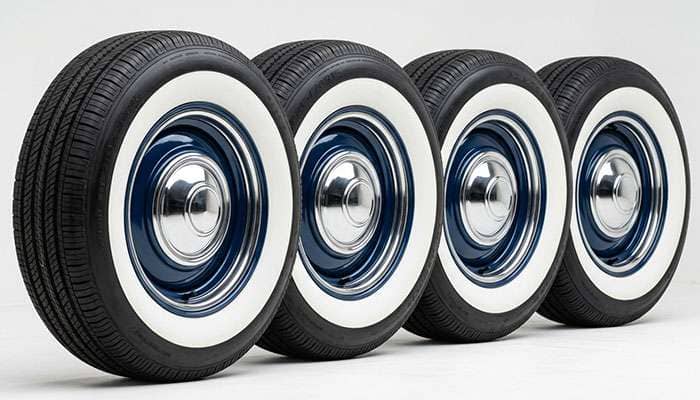
In the 15-inch sizes most classics run, like 205/75R15 through 235/75R15, a whitewall radial typically runs about $265 to $285 a tire, with solid options starting around $170 to $235. So $1,000 usually buys four tires, but often not the installation on top. For a driver that sees real miles, a whitewall radial is the best value in the classic world.
If you want the period-correct look, a 15-inch bias-ply tire typically runs about $395. Four of them is closer to $1,600 than $1,000. A bias-look radial, like our own Autobahn line, gives you the correct tall sidewall and narrow whitewall with radial road manners, and typically lands between those two prices. Since bringing Lucas Classic Tires into the family, we've got more of these period sizes under one roof than ever.
Before you judge any quote, find out whether it's tires-only or out the door. That one question can move the answer by $110 to $320, before sales tax.
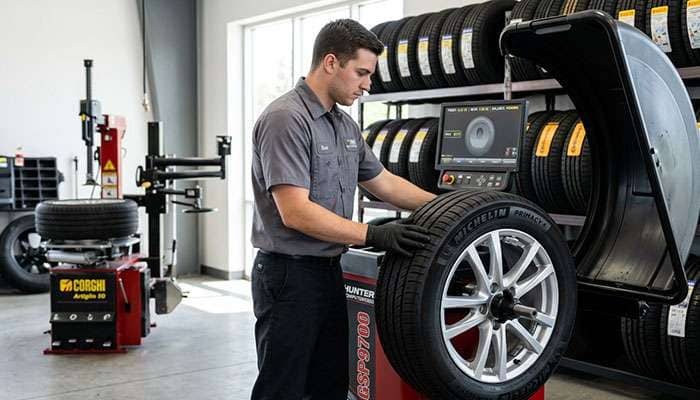
Mounting and balancing typically runs about $15 to $45 a tire, with LT truck tires around $20 to $40. TPMS service runs about $20 to $60 for a set. Valve stems, disposal, and any state tire fees can add another $30 to $80. Then comes sales tax on the tires, which varies by state. Add it up and a typical installed set carries roughly $110 to $320 in extras before tax. Our breakdown of tire mounting and balancing costs covers each one.
An alignment isn't required with new tires, but if your old set wore unevenly, skipping it can eat the new set too. Road-hazard coverage is worth more on trucks that see gravel and job sites than on a sedan that lives on the freeway. Just make sure you choose them on purpose.
The expensive mistake isn't spending $1,000. It's spending it on the wrong load range for the work your vehicle does. Here's how that bill grows, rung by rung.
Put a light-duty tire on a truck that tows or hauls near its limit and the sidewalls flex more with every mile. Flex makes heat, and heat is what breaks down a tire from the inside. You won't see it at first. You'll just notice the truck feels a little loose with the trailer on.
An overloaded or wrong-pressure tire wears its shoulders or center fast. A set that should have gone 50,000 miles might be done at 30,000, which means your $1,000 bought you 60 percent of what you paid for.
A hot, overworked sidewall is easier to cut, bruise, or bulge on a pothole or curb. Once a bubble shows up, the tire is done. Our guide to tire sidewall damage and whether it's safe to drive shows what to look for.
Heat and damage together are how tread separations and blowouts happen, and on a loaded truck that's a danger to you and everybody around you. At that point you're buying the right set anyway, just after paying for the wrong one, a tow, and maybe a fender. Getting the load range right the first time is the cheapest way through.
Here's the same check I'd walk you through at the counter.
So is $1,000 for 4 tires good? On a car, it's generous, and you should expect premium tires installed for it. On a crossover or a half-ton running P-metric tires, it's fair. On a truck that needs Load Range E, a 3/4-ton, or a lifted rig, it's tight to short. The variable that moves your truck from one answer to the other is load range, so read your placard before you read the price.
When you're ready to see what $1,000 really buys in your size, take a look at our current tire deals, and if you're not sure which load range your truck needs, give us a call. We've been answering that question in Long Beach since 1971.
Here's the $1,000 question in five lines.
• It depends on your size class: $1,000 is premium money on 15- to 17-inch cars, fair on crossovers and half-tons in P-metric sizes, and short for most 3/4-ton and lifted trucks.
• Load range is the hidden swing: In 275/65R18, LT Load Range E tires typically cost about 23% more than P-metric, cutting the share of lines $1,000 can buy roughly in half.
• Don't pay for capacity you won't use: If your half-ton came on P-metric tires and doesn't tow or haul heavy, a P-metric or XL tire that meets the placard load is the right buy.
• Tires-only and out-the-door are different numbers: Installation, TPMS service, and fees typically add $110 to $320, and sales tax comes on top.
• Classics follow their own math: $1,000 usually covers four whitewall radials in common 15-inch sizes, but not four bias-ply tires.
It depends on the size. For a compact car or sedan, $1,000 is premium money that should buy top-tier tires installed. For a half-ton truck on P-metric tires it is a fair price, and for heavy-duty trucks on Load Range E tires or lifted trucks on 35-inch tires it is often not enough.
For a half-ton pickup, typical P-metric tires run about $185 to $236 each in common sizes, or roughly $740 to $945 for four before installation. LT Load Range E tires in the same sizes typically run about $231 to $328 each, and 3/4-ton sizes often run $280 to $350 each.
Not always. If the truck came with P-metric tires and you do not tow or haul near its limits, a P-metric or XL tire that meets or exceeds the load index on the door placard is the right choice. LT tires make sense if the truck came with them, or if you tow, haul heavy, or drive rough gravel often.
Not unless the quote says out the door. Mounting, balancing, TPMS service, valve stems, disposal, and state fees typically add about $110 to $320 for a set, plus sales tax on the tires. Always ask for each item listed separately.
LT tires use heavier plies and belts so they can carry more load at higher inflation pressure, and off-road LT treads are often deeper than passenger treads. In common half-ton sizes, Load Range E tires typically cost 23 to 39 percent more than P-metric tires of the same size.
On a car, $1,000 should buy tires with a long treadwear warranty, often 70,000 to 90,000 miles in premium touring lines. On trucks, all-terrain and LT tires usually carry shorter warranties, so compare the price divided by the warranted miles rather than the sticker alone.