
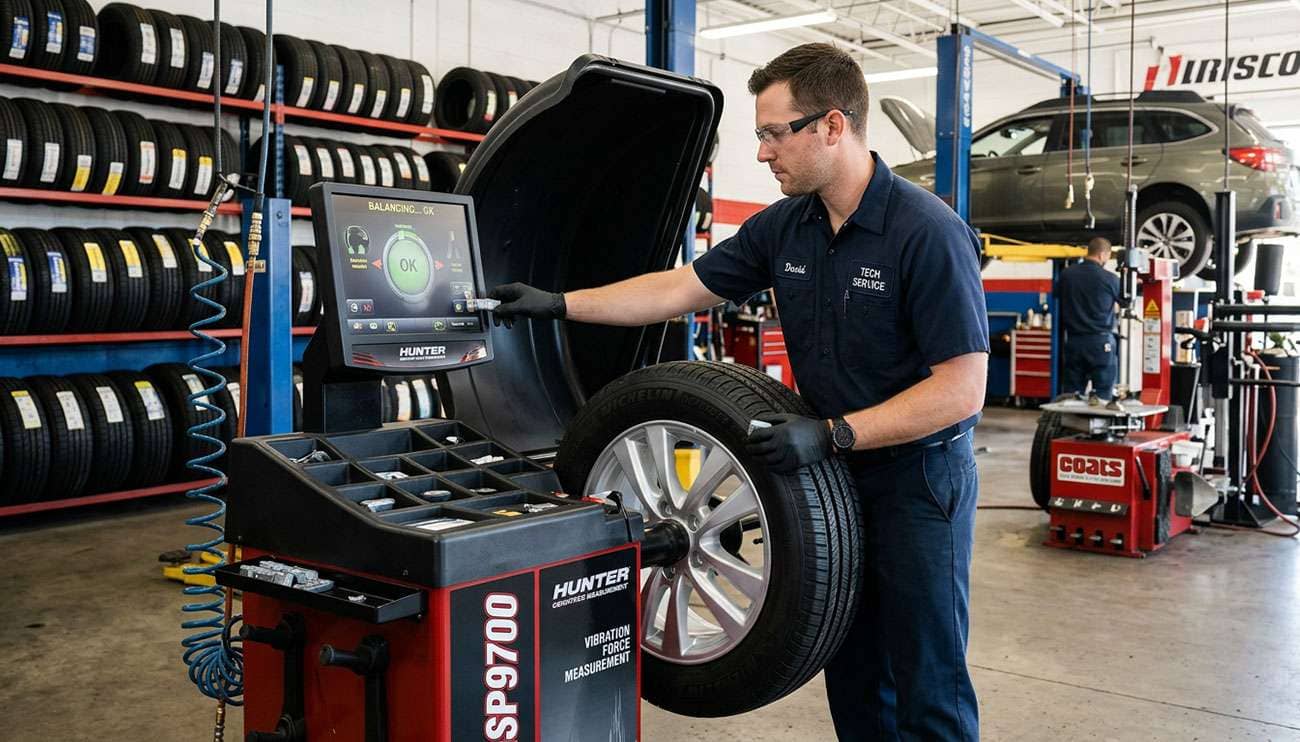
You just bought a set of new tires — or maybe you scored a great deal shopping online — and now you're staring at a mounting and balancing quote wondering if the shop is padding the bill. It's one of the most common questions we hear: how much should mounting and balancing actually cost, and what are you really paying for? There's no single right answer, but once you understand what drives the pricing, you'll know exactly how to evaluate any quote you receive and spot an overcharge before you sign off on it.
Mounting and balancing are two distinct services that always go together when you install new tires. Mounting is the physical process of seating the tire onto the wheel rim. Balancing ensures the entire wheel-and-tire assembly spins evenly — small counterweights eliminate the vibration caused by uneven mass distribution. Skip either one, and you're inviting uneven tread wear, steering shimmy, and early suspension damage. This guide tells you exactly what to expect to pay, what variables move the price up or down, and how to get the best value for your specific vehicle and driving needs.
The national average for mounting and balancing a single tire runs $15 to $45 per tire, putting a full set of four tires at $60 to $180 for this service alone — tires not included. That's a significant spread, and it exists for legitimate reasons. Tire size, wheel type, vehicle class, and shop equipment all pull the price in different directions. Know what's behind that number and you'll never pay more than you should.
When a shop quotes you for mounting and balancing, they're pricing based on measurable factors — and tire diameter is one of the biggest. A standard 16-inch passenger tire mounts quickly and cleanly. A 22-inch low-profile tire on a custom wheel demands more time, more skill, and more careful technique to avoid bead or rim damage. Low-profile tires — those with a sidewall aspect ratio of 45 or below — cost more to mount for exactly that reason.
Run-flat tires add another layer of complexity. Their stiff sidewalls resist compression, so mounting them requires specialized equipment and technique. Budget for 20–40% more per tire on run-flat mounting. TPMS sensors, standard on every vehicle built after 2008, also add a service charge — typically $5 to $15 per wheel — to inspect, reinstall, and relearn the sensors after a tire swap. Here's a breakdown of typical cost ranges by tire type:
Tire/Service Type |
Mount & Balance Cost (Per Tire) |
Full Set (4 Tires) |
|---|---|---|
Standard Passenger (15"–17") |
$15–$25 |
$60–$100 |
Large Passenger / Touring (18"–20") |
$20–$35 |
$80–$140 |
Low-Profile / Performance |
$25–$45 |
$100–$180 |
Run-Flat Tires |
$30–$50 |
$120–$200 |
Truck / SUV (LT tires) |
$20–$40 |
$80–$160 |
TPMS Service (add-on) |
$5–$15 |
$20–$60 |
The biggest mistake you can make is choosing the cheapest quote without asking what it actually covers. Some shops advertise "free mounting and balancing" on tires purchased from them, then charge separately for valve stems, TPMS service, and disposal fees — line items that can add $30 to $80 to your total. Always demand an itemized quote before you commit. Watch out for shops that use a standard spin balancer on performance or luxury vehicles when a road force balancer is the right tool, and for any shop that doesn't torque your lug nuts to manufacturer specs. Both are red flags you don't want to ignore.
Another costly mistake is buying tires online without factoring in installation costs. Four tires at $400 online plus $160 for mounting, balancing, valve stems, and TPMS service puts your real out-of-pocket at $560. That may or may not beat a local shop's all-in package price. Do the math before you commit — the cheaper tire isn't always the cheaper outcome.
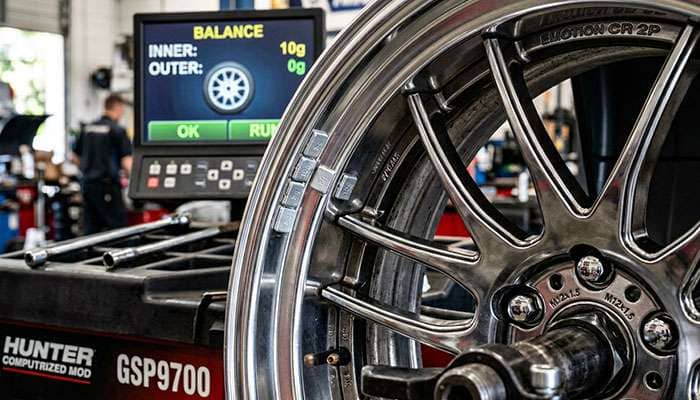
Balancing is measured in grams — specifically, how much counterweight brings the wheel-tire assembly into equilibrium. A properly balanced tire will show less than 0.25 ounces of imbalance across the assembly. Road force balancing goes further by simulating the actual weight of your vehicle on the tire, measuring radial force variation — the stiffness inconsistencies in the tire as it rotates. For your daily driver, standard spin balancing gets the job done. For a performance vehicle or a persistent vibration issue you can't chase down, road force balancing at $20–$50 more per axle is money well spent.
Not every vehicle needs the same level of service, and not every shop is equipped to handle every tire type. Matching the service to your actual requirements matters just as much as finding a fair price. A truck owner installing all-terrain tires has completely different needs than someone fitting ultra-high-performance summer tires to a sports car — and the shop you choose should reflect that difference.
If you're driving a standard passenger car with 15- to 17-inch wheels, virtually any shop with modern equipment can handle the job competently at the lower end of the price range. For an SUV or light truck with 18- to 20-inch wheels, confirm the shop's balancer accommodates larger diameters — not all of them do. Owners of lifted trucks or vehicles with aftermarket wheels in the 22-inch-and-up range should specifically seek out shops experienced with oversized applications. Improper technique on expensive custom wheels is a mistake you'll pay for twice.
Electric vehicles raise the stakes further. EVs are heavier than comparable combustion vehicles, and that extra mass means tire balance needs to be dialed in with exceptional precision to preserve both driving range and the quiet ride EV owners expect. Some shops now advertise EV-specific tire service — ask directly whether precision road force balancing is part of that offering. You can also browse EV performance tires engineered specifically for the demands of electric vehicle platforms.
Highway commuters who regularly drive above 65 mph need to take balance seriously. Imbalance that's barely noticeable at 35 mph produces real steering wheel vibration at highway speeds. Performance drivers pushing their vehicles on canyon roads or track days should treat road force balancing as a baseline requirement, not a premium add-on. The compound and construction of ultra-high-performance tires make them more sensitive to imbalance than standard all-season rubber — precision here directly affects how the tire performs.
If you're running a staggered fitment — wider tires in the rear than the front — make sure your shop understands that staggered setups can't be rotated front-to-back in the conventional way. This detail separates experienced performance shops from generalist chains. Pick the wrong shop for a staggered setup and you may end up paying for mounting twice when you want to adjust your tire configuration later.
Budget-conscious buyers sometimes ask whether they can skip balancing or stretch the intervals. The answer is no — it's a false economy. An out-of-balance tire creates irregular wear patterns that can destroy a $150 tire in under 20,000 miles. Spending $20 per tire on balancing to protect a $600 set is straightforward math. That said, real savings are available if you know where to look: shop package deals that bundle mounting and balancing with tire purchase, take advantage of fall and spring changeover promotions, and consider financing when a full set plus installation stretches your budget. Performance Plus Tire offers flexible tire financing options so you can get the right tires and professional installation now, without waiting.
Understanding what mounting and balancing costs is only part of the equation. The tire itself is the larger investment, and choosing the right one ensures your installation cost delivers maximum return. Here are category picks based on real-world performance, long-term value, and what consistently keeps customers satisfied for the life of the tire.
Daily drivers need tires that deliver ride comfort, all-season traction, and long tread life — in that order. The Michelin Defender line sets the benchmark here, with tread life warranties reaching 80,000 miles on select models. For budget-conscious commuters, Continental and Hankook both offer excellent mid-tier all-season options that balance up-front cost against cost-per-mile with real precision. When a quality all-season tire runs 50,000 to 70,000 miles before replacement, the $20–$30 per tire mounting cost becomes a very small fraction of total ownership expense.
For standard passenger and touring applications, browse the full selection of all-season tires to compare options across every price point. Mounting and balancing for these tires typically lands at the low end of the range — $15 to $25 per tire — because standard sizes and sidewall profiles are the most straightforward to work with.
If you're driving a sports car, a tuner build, or anything with a performance-tuned suspension, you're in a completely different conversation. Low-profile tires in the 35 to 45 aspect ratio range demand careful mounting technique, and road force balancing isn't optional — it's how you extract the crisp steering response and vibration-free ride that a performance chassis is built to deliver. Plan on $30 to $50 per tire for mounting and balancing, and treat road force service as standard, not premium.
Brands worth serious consideration in this segment include Michelin Pilot Sport, Continental ExtremeContact, and Falken Azenis for street-focused performance use. For drivers who occasionally track their vehicles, the selection gets more specialized. Explore the full range of ultra-high-performance tires to find options matched to both your vehicle and your driving intensity.
Budget tires have improved dramatically over the past decade, and legitimate choices exist in the value segment for light-duty use. Be realistic about what you're getting: a budget tire from a reputable value brand handles commuting and light highway driving acceptably, but it won't match a premium tire's wet performance, noise levels, or tread life. Brands like Ironman, Laufenn, and GT Radial consistently represent solid value for buyers prioritizing up-front cost.
One thing you should not compromise on as a budget buyer: installation quality. A set of value tires mounted on a poorly calibrated machine by an inexperienced tech is a direct path to vibration complaints and premature wear — and you'll pay to have it redone. Invest in quality installation and let the tire itself be where you economize. You can find a wide range of value-tier options when you shop all tires at Performance Plus Tire, with detailed specs covering tread life ratings and performance categories so you can compare before you buy.
Tire mounting and balancing cost is easy to overlook when you're focused on finding the right tire at the right price — but it's a real and significant part of your total cost of ownership. Knowing that you'll typically pay $15 to $45 per tire, and understanding exactly what pushes that number up or down, puts you in a stronger position when evaluating any quote. Tire complexity, wheel size, run-flat construction, TPMS requirements, and balancing method all legitimately affect what you'll pay — and now you know why.
The most important thing to take away from this guide: don't let installation cost push you toward skipping or skimping on the service. Proper mounting and balancing protects your tire investment, your wheels, and your suspension. An improperly mounted or unbalanced tire can destroy a perfectly good set in under 20,000 miles. The $20 you save at the cheapest possible shop can cost you $600 in premature tire replacement. That trade is never worth making.
At Performance Plus Tire, we help you make smart, informed decisions on tires and wheels — from selection all the way through installation. Whether you're shopping for a daily driver, a performance vehicle, or a truck and SUV, you can browse our full tire inventory and use our tools to find the right fit for your vehicle and budget. Have questions? Our team is ready to help you get it right the first time.
Here's a quick summary of the most important points from this guide on tire mounting and balancing cost.
• Expect $15–$45 per tire: Standard passenger tires run $15–$25 per tire to mount and balance, while low-profile, run-flat, and oversized tires push toward $35–$50 per tire. A full set of four will cost $60–$200 depending on tire type.
• Always get an itemized quote: "Free mounting" offers often exclude valve stems, TPMS service, and disposal fees. Ask for a complete, line-item breakdown before agreeing to any service.
• Road force balancing is worth it for performance vehicles: Standard spin balancing works fine for most daily drivers, but low-profile and performance tires benefit significantly from road force balancing, which costs $20–$50 more per axle.
• Factor installation into your total tire budget: When comparing online tire prices to local shop packages, always add $60–$180 (plus TPMS service if applicable) to the online price before deciding which option delivers better value.
• Don't cut corners on installation quality: Using an underqualified shop or outdated equipment to save $20–$40 can lead to vibration issues, premature tread wear, and potential damage to expensive custom wheels — all of which cost far more to fix than the savings achieved.
For a standard set of four passenger tires, plan on $60 to $140 total for mounting and balancing. Low-profile, run-flat, or oversized tires on larger wheels can push that total to $160–$200. Add another $20–$60 if your vehicle has TPMS sensors that require servicing during the installation.
Yes, every single time. Every new tire carries minor weight variations from manufacturing, and every wheel has its own imbalance characteristics. Mounting a new tire changes the balance of the entire assembly. Skip balancing and you risk vibration at highway speeds, uneven tread wear, and accelerated wear on your suspension and steering components. Balance every time a tire is mounted, and recheck every 5,000–7,500 miles or any time you notice steering wheel vibration.
Standard spin balancing spins the wheel-tire assembly and identifies where counterweights need to be added to achieve static equilibrium. Road force balancing goes further — it presses a roller against the tire to simulate the actual load of your vehicle and measures radial force variation, the stiffness inconsistencies in the tire as it rotates. Road force balancing catches problems that standard balancing misses entirely, making it the right choice for performance vehicles, luxury cars, and any persistent vibration that standard balancing hasn't resolved.
Practically speaking, no. Tire mounting requires a professional-grade mounting machine, and balancing requires a computerized balancing machine — neither is practical for a home garage. Attempting to mount tires without proper equipment risks damaging the tire bead, the wheel rim, and your TPMS sensors. At $15–$45 per tire, professional mounting and balancing represents a small fraction of your total tire investment — and it's worth every dollar.
Most tire manufacturers and automotive experts recommend rebalancing every 5,000 to 7,500 miles, which aligns naturally with tire rotation intervals. You should also rebalance after hitting a significant pothole or curb, after any tire puncture repair, or any time steering wheel vibration appears at highway speeds. Some premium shops include free rebalancing within the first 30 days after installation — always ask about this when you're getting a quote.



