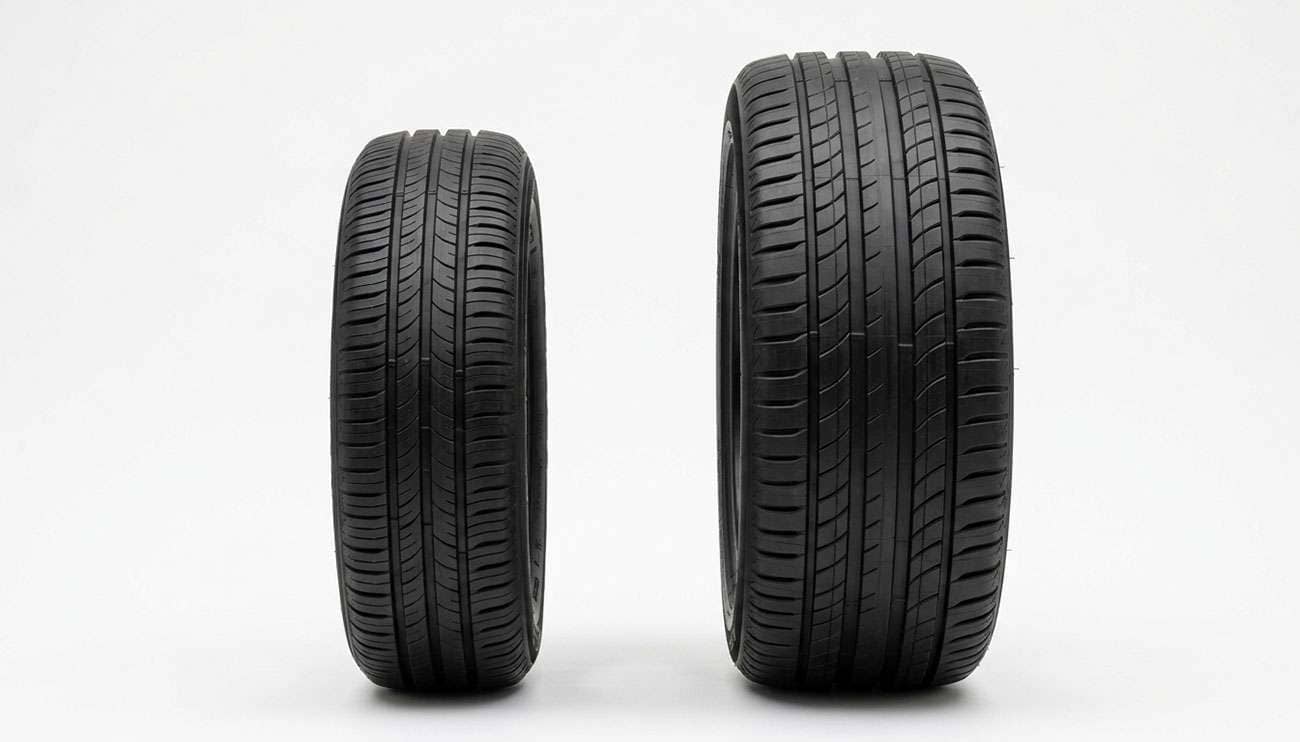
$300 for 4 new tires is a good price in small sizes and close to impossible in big ones. At $75 a tire, you can find a full set of economy tires for most 15-inch and some 16-inch cars. At 17 inches, it gets rare. At 18 inches and up, or on any light truck tire, $300 typically buys one or two tires, not four. The number that decides whether $300 is a deal is not the price. It is the size on your sidewall.
You have probably been told it "depends on whether they're new or used." That matters, and we will get to used tires. But the first thing it depends on is size. Across the new tires sold in 195/65R15, a common compact-car size, about 1 in 5 sell for $75 or less, and the typical tire runs about $99. In 245/45R19, a common performance-car size, none of them do, and the typical tire runs about $268. Same $300. One buyer gets a set. The other gets a single tire.
What $300 buys in your tire size
Tire Size |
Typical Vehicle |
Typical New Price Per Tire |
Tires at $75 or Less |
What $300 Buys |
|---|---|---|---|---|
195/65R15 |
Compact cars |
About $99 |
About 1 in 5 |
A full set of economy tires |
205/55R16 |
Compact and midsize cars |
About $129 |
About 1 in 8 |
A budget set, if you shop hard |
215/55R17 |
Midsize sedans |
About $148 |
About 1 in 20 |
Two typical tires |
235/65R17 |
Crossovers and midsize SUVs |
About $171 |
Almost none |
One or two tires |
235/45R18 |
Sport sedans |
About $200 |
Almost none |
One tire, maybe one and a half |
245/45R19 |
Performance and luxury cars |
About $268 |
None |
One tire |
275/55R20 |
Full-size SUVs and pickups |
About $232 |
None |
One tire |
LT265/70R17 |
Pickups that tow or haul |
About $239 |
None |
One tire |
Classic whitewall |
Collector cars |
About $339 |
None |
Less than one tire |
Prices are typical across the new tires sold online in each size, before installation. I have been selling tires in Long Beach since 1971, and the most common surprise at our counter is not that tires got expensive. It is that the customer's car came from the factory on a size that never had a cheap end to begin with.
Find your size on the sidewall or on the tire placard in the driver's door jamb, then find your row. Here is how the market breaks down.
15-inch and 16-inch cars: $300 is a fair set price. In 195/65R15, about 1 in 5 new tires sells for $75 or less, and the cheapest tenth of the market sells for about $62 or less. That is real choice. You are buying economy all-season tires from budget and second-tier brands, and many of them carry treadwear warranties in the 40,000 to 60,000-mile range. In 205/55R16, the cheap end thins out to about 1 in 8 tires. A $300 set is still possible, but you are picking from what is left, not from what you want.
17-inch cars and crossovers: $300 is a stretch. In 215/55R17, about 1 in 20 tires comes in at $75 or less. In 235/65R17, the size under a lot of midsize SUVs, almost none do, and the typical tire costs about $171. A $300 quote for four in this range should make you ask what brand, how old, and whether the load index matches your vehicle.
18-inch and up: $300 buys one or two tires. In 235/45R18, the typical tire is about $200. In 245/45R19, it is about $268, and there is nothing at $75. If someone offers you four new 19-inch tires for $300, slow down and read the DOT date code before anything else.
Trucks and classics: $300 buys one tire. A Load Range E LT265/70R17 typically runs about $239. A classic whitewall runs about $339, and a bias-ply reproduction tire more than that. For those buyers, the honest answer is that $300 is a down payment on the set.
When a low price is a red flag. A price far below the typical number for your size is not automatically a scam, but it should come with an explanation. Legitimate reasons include closeout models, last season's stock, takeoff tires pulled from a new vehicle with only a few miles on them, and sales events. Bad reasons include tires that have sat in a warehouse for years, a load index lower than your vehicle needs, and tires that were never certified for U.S. roads. Every tire legally sold for highway use in the U.S. carries the letters DOT followed by its Tire Identification Number, with the four-digit date code at the end. No DOT marking, no deal.
If your quote is closer to $600 for four, that is a different bracket, and our breakdown of whether $600 for 4 tires is good walks through what that money buys.
It is not just that a bigger tire has more rubber in it, though it does. Four things push the price up as the size goes up, and they stack.
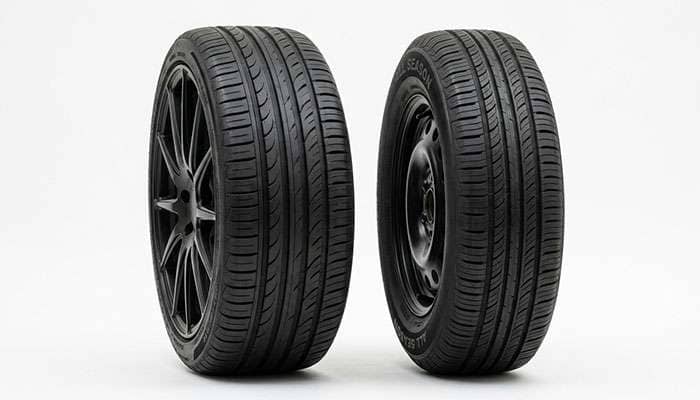
Material. A 20-inch SUV tire carries far more rubber, steel belt, and casing cord than a 15-inch economy tire. Light truck tires go further. Across tires sold in 265/70R17, a typical LT tire starts with about 15.7/32 of an inch of tread, against about 12/32 for a passenger version in the same size. More tread and more casing plies mean more raw material in every tire.
Speed rating. In 195/65R15, most tires are T- or H-rated, good for 118 or 130 mph. In 235/45R18 and 245/45R19, most are V-, W-, or Y-rated, built for 149 to 186 mph. Those higher ratings require stiffer construction, extra nylon cap plies over the belts, and compounds built to shed heat at speed. That engineering costs money in every tire, whether you ever drive fast or not.
Low-profile construction. A short sidewall has to do the same job a tall one does with less room to flex. That means stiffer sidewall compounds and tighter manufacturing tolerances.
Volume. The tire business runs on volume. Sizes that sit on millions of commuter cars get made by dozens of brands at every price point. Sizes that came on a handful of luxury models get made by fewer brands, in smaller runs, mostly at the premium end. Fewer competitors means fewer cheap options.
Put those four together and you can see why the same $300 stretches so differently. It also explains a trend I have watched for decades. A midsize sedan of twenty years ago commonly rolled on 15- or 16-inch tires. Plenty of today's sedans and crossovers come on 18s and 19s, which look great on the showroom floor and cost real money at replacement time. If you are shopping for your next car, the tire size on the window sticker is a running cost worth checking before you sign.
A new $75 tire sold in the U.S. has to meet the same federal minimum as a $275 tire. NHTSA's FMVSS 139 sets the baseline for new passenger and light truck radial tires: strength, endurance, high-speed performance, and low-pressure performance. A budget tire is not an unsafe tire by default.
Where budget tires usually give ground is above that floor. Wet braking distance, tread life, road noise, and ride comfort are where the gap between economy and premium tires shows up. The UTQG traction grade molded on the sidewall gives you a rough read on wet straight-line stopping, and the treadwear warranty tells you how long the maker expects the tread to last. Our article on whether budget tires are good covers what testing shows.
Here is the catch most price-shoppers miss. The cheapest tire in your size may not carry the load index your vehicle needs. Plenty of crossovers and SUVs call for an XL, or extra load, tire. A standard load tire in the same size can cost less precisely because it carries less. Before you buy any tire on price, match its load index and speed rating to your door placard. If it falls short, it is not a deal at any price.
If you are choosing between two tires at about the same budget price, compare three things in this order. First, the load index and speed rating, which have to clear your placard. Second, the UTQG traction grade: an A or AA stops shorter on wet pavement than a B in testing, and at this price point that is the grade that matters most. Third, the treadwear warranty. A tire with a 60,000-mile warranty at $80 can cost less per mile than a 40,000-mile tire at $65, which means the cheaper tire on the shelf is not always the cheaper tire on the car.
One more thing from the shop floor. A budget tire on a well-aligned car with correct pressure will usually outlast a premium tire on a car that is out of alignment and running 8 psi low. Before you spend extra money on tires, spend five minutes with a pressure gauge.
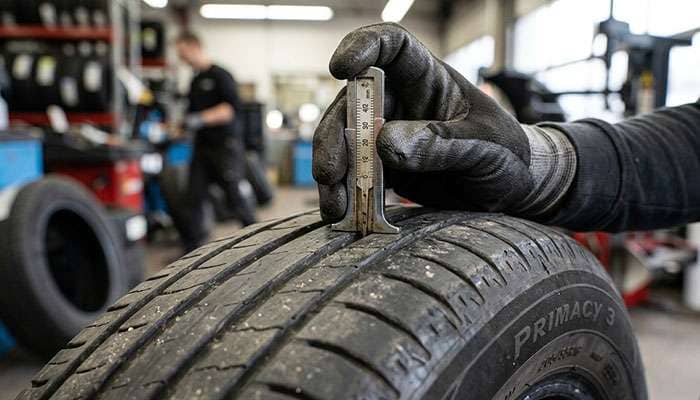
Usually not, and the math shows why. What you are really buying with a tire is usable tread, the rubber between its current depth and the legal minimum of 2/32 of an inch. Price that tread out and a cheap-looking used set often costs more than a new budget set.
The $300 Set |
Starting Tread |
Usable Tread to 2/32 |
Cost Per 32nd of Usable Tread |
What You Know About Its History |
|---|---|---|---|---|
New economy tires |
10/32 |
8/32 |
$37.50 |
All of it, plus a warranty |
Used, lightly worn |
8/32 |
6/32 |
$50.00 |
Only what the seller tells you |
Used, half worn |
7/32 |
5/32 |
$60.00 |
Only what the seller tells you |
Used, well worn |
5/32 |
3/32 |
$100.00 |
Only what the seller tells you |
New economy tires in 195/65R15 typically start right around 10/32 of an inch, which is where the first row comes from. If you replace at 4/32 instead of 2/32, which is smarter for wet roads, the gap gets even wider: the new set gives you 6/32 of usable tread and the 7/32 used set gives you 3/32, so the used set costs twice as much per 32nd.
Then there is the part the tread gauge cannot tell you. A used tire's age, repair history, and how long it ran underinflated are all unknown. Check the four-digit DOT date code before you hand over a dollar, and our guide on how to tell how old your car tires are shows you where to find it. Look for plugs near the shoulder, uneven wear, and any cut, bulge, or bubble in the sidewall. If you spot sidewall trouble, read our guide on tire sidewall damage before you go any further.
Used tires make sense in a narrow case: you need one tire to match three good ones with the same tread depth, or you need a cheap set for a car you are selling next month. For a daily driver in a size where new economy tires exist, our take on buying used tires comes down to this: the savings are smaller than they look.
Almost no $300 tire price is an out-the-door price. Here is what usually gets added.
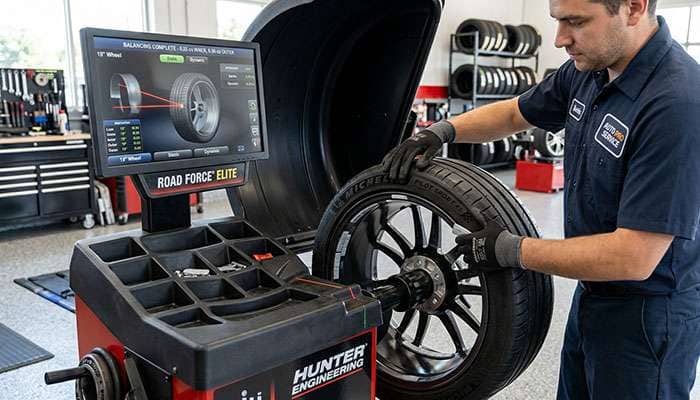
Add it up and a $300 set of tires typically lands somewhere around $385 to $550 installed, before sales tax. Our breakdown of tire mounting and balancing costs goes line by line. When you compare quotes, always ask for the out-the-door number. A shop that quotes $340 installed can beat one that quotes $300 for the tires alone.
The wrong cheap tire does not cost you at the register. It costs you over the next 30,000 miles, one rung at a time.
Every one of those rungs costs more than the fix: a new set in your exact size, with the load index and speed rating your placard calls for, at the best price that size allows.
Is $300 for 4 tires good? On a compact car with 15-inch tires, yes. That is a fair price for a set of new economy tires, and you have real choices at that number. On a crossover, it is a stretch. On a 19-inch sedan, a full-size truck, or a classic, $300 buys one or two tires, and a quote for four at that price deserves a hard look at the brand, the load index, and the date code.
After more than fifty years at the counter, my advice is the same for every customer. Start with your size, not your budget. The size tells you what a fair price looks like. Then make sure the tire you buy at that price is rated to carry your car.
It depends on your tire size. In common 15-inch sizes, $300 buys a set of new economy tires. At 17 inches it gets hard to find, and at 18 inches and up, $300 typically buys one or two tires.
Price used tires by the tread they have left. Divide the price by the number of 32nds above 2/32 of an inch. A new economy set at $300 with 10/32 of tread costs about $37.50 per usable 32nd, so a used set should come in well under that figure to be worth the unknown history.
They can be, in the right size and with the right load index. New budget tires meet the same federal safety minimum as premium tires. They usually give up some wet braking, tread life, and quietness, so they make the most sense on a commuter car driven at normal speeds.
Usually not. Mounting and balancing commonly add $15 to $45 per tire, plus valve stems or TPMS kits, disposal, state tire fees, and sales tax. Always ask for the out-the-door price when you compare quotes.
Larger diameters, low-profile sidewalls, higher speed ratings, and light truck construction all add cost, and sizes made in smaller volumes have fewer budget options. A 19-inch performance tire or a Load Range E truck tire typically costs two to three times as much as a 15-inch economy tire.
Many economy tires in common 15-inch sizes carry treadwear warranties of 40,000 to 60,000 miles. Real life depends on alignment, inflation, and driving style, so treat the warranty as a ceiling and rotate the tires every 5,000 to 7,500 miles to get close to it.