
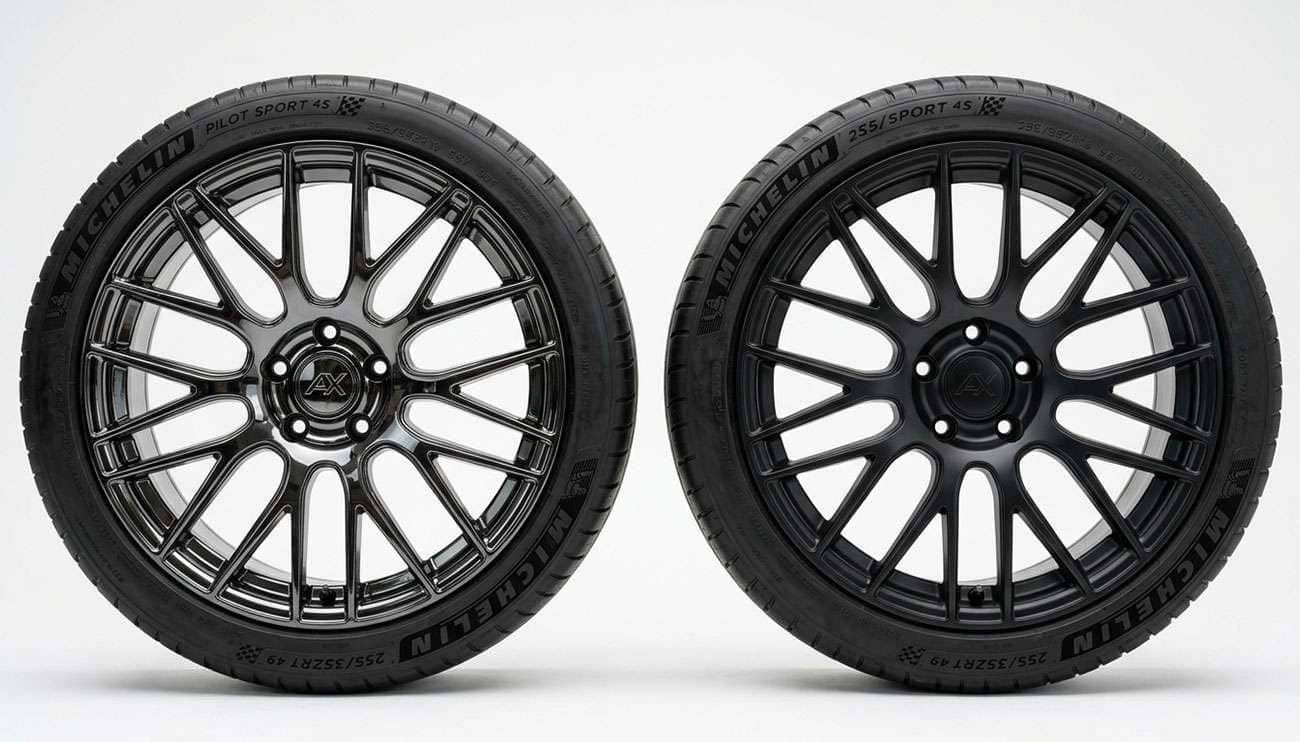
Neither is better. They are two different contracts. Gloss demands regular attention and forgives every mistake you make: swirl marks polish out, curb rash spot-repairs invisibly, any wax or sealant on the shelf is safe. Matte demands almost nothing and forgives absolutely nothing: it cannot be polished, cannot be waxed, and cannot be spot-repaired, ever. Every article on this question tells you it comes down to style. It does not. It comes down to how you handle mistakes, because the sheen you buy determines whether your mistakes are reversible. That is the variable, and once you see it, the choice takes about a minute.
It is worth saying plainly that the answer currently sitting at the top of the search results gets the mechanism backwards. It claims matte wheels are easier to clean thanks to their smooth surface, then says in the next line that they are more difficult to clean. Both cannot be true, and the first one is not: a matte finish is not smooth. Its texture is the entire point, and that texture is precisely why matte gets dirty differently, cleans differently, and fails differently than gloss. So let us start with what a matte finish physically is, because everything else in this comparison follows from it.
How You Actually Operate |
Your Sheen |
Why |
|---|---|---|
Wash weekly, enjoy detailing, own a polisher |
Gloss |
You will use its one advantage: everything is correctable |
Wash monthly at best, want wheels that shrug it off |
Satin |
Hides neglect like matte, tolerates cleaning like gloss |
Committed to the flat look, will follow the care rules |
Matte |
Lowest weekly effort of the three, if you never break its rules |
Park by touch, tight garage, curbed a wheel before |
Gloss |
The only sheen a repair shop can make perfect again |
Automatic car washes, drive-through brushes |
Gloss, reluctantly |
Brushes scar matte permanently; gloss swirls can be polished out |
Hand the car to detailers, valets, tire shops often |
Gloss or satin |
Matte is ruined by other people's good intentions |
A matte wheel is not a wheel with different paint. In nearly every quality wheel, powder coated or wet painted, the color layer underneath is the same. The difference lives entirely in the clear coat on top, and it is a difference of texture, not chemistry alone.
A gloss clear coat cures smooth at a microscopic level. Light hits it and reflects in one coherent direction, which your eye reads as depth, wetness, and shine. A matte clear coat is the same resin loaded with flattening agents, microscopic particles, typically silica-based, that rise to the surface as the coating cures and leave it microscopically rough. Light hits that roughness and scatters in every direction instead of reflecting in one, and the scattered light is what your eye reads as flat. Satin sits between the two, with fewer flattening agents and a soft sheen, which is why the coatings industry measures all of this on a single scale: gloss units, measured at a 60-degree angle. Full gloss reads above 70 on that scale, satin lands roughly between 20 and 45, and matte sits below 15. One variable, one dial.
Here is the consequence that drives this entire article: on a matte wheel, the texture is the finish. The flat appearance does not come from the color. It comes from that microscopic roughness scattering light. Anything that changes the roughness changes the sheen, permanently and locally. Abrade it, and the flattened peaks reflect coherently again: a shiny scar. Fill it with wax or an oily dressing, and the valleys level out and start reflecting: a greasy-looking gloss patch. This is why every rule of matte ownership, and every horror story, traces back to one sentence: you cannot touch the texture. Gloss has no such rule, because on a gloss wheel the texture is already flat and smooth, and there is nothing to disturb. That single physical fact, texture versus no texture, generates every practical difference between these two finishes, and it is the fact the top-ranking answer got exactly backwards.
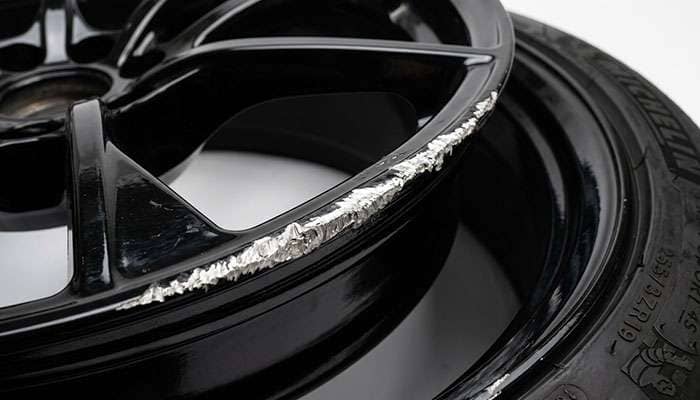
Every event in a wheel's life, a wash, a scratch, a curb, a well-meaning detailer, produces a different outcome depending on sheen. Lay them side by side and the pattern is unmistakable.
Event |
On Gloss |
On Matte |
What You End Up Buying |
|---|---|---|---|
Wash-induced swirl marks |
Visible in sunlight, polish out completely |
Invisible. Scattered light hides micro-marring. |
Gloss: occasional polish. Matte: nothing. |
Deeper scratch or scuff |
Shows readily, can be wet-sanded and polished away |
Hidden at first, but any repair attempt leaves a shiny scar |
Gloss: one repair visit. Matte: a full recoat. |
Curb rash |
Fill, sand, color-match, re-clear. Invisible when done. |
Cannot be blended. Sheen mismatch always shows. |
Gloss: one wheel refinished. Matte: often all four. |
Someone waxes the wheels |
Adds shine and protection. Intended outcome. |
Wax fills the texture. Blotchy gloss patches that resist removal. |
Gloss: nothing. Matte: specialty cleaner, sometimes a recoat. |
Automatic wash brushes |
Swirls that a polish removes |
Permanent burnished shiny streaks |
Gloss: a polish. Matte: a recoat. |
Years of UV and brake heat |
Dulls slowly, machine polish restores depth |
Sheen drifts unevenly, no restoration possible |
Gloss: a detail. Matte: acceptance, or a recoat. |
Read the last column top to bottom and the contract is explicit. Gloss charges you in small, frequent installments: it shows swirls, it shows dust, it wants washing and the occasional polish, and in exchange, no mistake is ever final. Matte charges you nothing weekly, hides your neglect beautifully, and then presents one catastrophic bill the first time anything goes wrong, because the only repair matte accepts is starting over. And since a freshly recoated matte wheel rarely matches three aged ones, sheen drifts with UV and heat in a way color does not, starting over frequently means all four corners. The full cost picture, do-it-yourself versus professional, is in our curb rash repair cost guide, and the pattern there is consistent: the sheen of the wheel moves the repair bill more than the size of the scrape.
This is why I push back when the choice is framed as style. Style is real, but it is the last question, not the first. The first question is: when something goes wrong, and over years of ownership something always goes wrong, do you want the finish that can be made perfect again, or the finish that cannot? Answer that honestly and the sheen picks itself.
No, and this surprises people: week to week, matte is the easiest finish in the catalog to live with. The texture that scatters light also scatters the evidence. Micro-swirls from washing do not show, light dust does not glare the way it does against a deep gloss reflection, and a matte wheel that missed two washes looks far more presentable than a gloss wheel that missed one. If the question is how much time the wheels demand from you on an ordinary Saturday, matte wins outright.
The honest answer has a second half, though. Matte is easy to clean and easy to ruin while cleaning, because the difficulty was never effort. It is product discipline. The texture that hides your swirls will hold anything you put into it, so the rules are short but absolute. A pH-neutral wheel cleaner and nothing stronger, because harsh alkaline or acidic chemistry attacks the flattening agents unevenly and mottles the sheen. No wax, no paint sealant, no tire-shine overspray, because anything that fills texture creates gloss patches. No polish and no rubbing compound of any kind, ever, because polishing is controlled abrasion and abrasion is exactly the one thing the finish cannot survive. Soft microfiber, straight-line strokes, blot dry.
None of that is hard. All of it is unusual, and that is the real risk of matte ownership: not your own habits but everyone else's. The quick-lube tech who dresses your tires, the drive-through wash, the detailer who has waxed ten thousand gloss wheels on autopilot: matte gets ruined by other people's good intentions more often than by neglect. If the car passes through other people's hands regularly, that alone is an argument for gloss or satin. We keep a finish-by-finish product list in how to clean aftermarket wheels by finish, and the matte column is the shortest and strictest on the page.
Black rims do not scratch more easily than any other color. They show scratches more honestly, and how honestly depends almost entirely on sheen, which is why this question belongs in a gloss-versus-matte article rather than a color article.
Scratch resistance is a property of the coating system, not the pigment. A quality powder coat is a quality powder coat whether the color underneath is black, bronze, or white, and powder's thicker, cross-linked film is the most chip-resistant conventional finish you can put on a wheel; the full breakdown is in powder coating wheels explained. What changes with color is the reveal. Nearly every wheel is aluminum, and aluminum is bright silver. Scratch a black wheel deep enough to reach metal and you get the highest-contrast damage in the business: a bright silver line through a dark field. The same scratch on a silver wheel is silver-on-silver and disappears at ten feet.
Sheen then decides what you can do about it. On gloss black, that dramatic silver line is also the most repairable damage in the industry, filled, color-matched, and re-cleared to invisible, because black is the easiest color to match and gloss is the easiest sheen to blend. On matte black, the same scratch is a one-way event: the damage shows less at first, since the flat finish does not telegraph fine lines the way a mirror does, but the moment you try to fix it you trade a thin silver line for a shiny repair scar, and the only clean exit is recoating the wheel. So the finish that hides the scratch is the finish that cannot fix it, and the finish that flaunts the scratch is the finish that erases it. That inversion is the entire gloss-versus-matte decision in miniature.
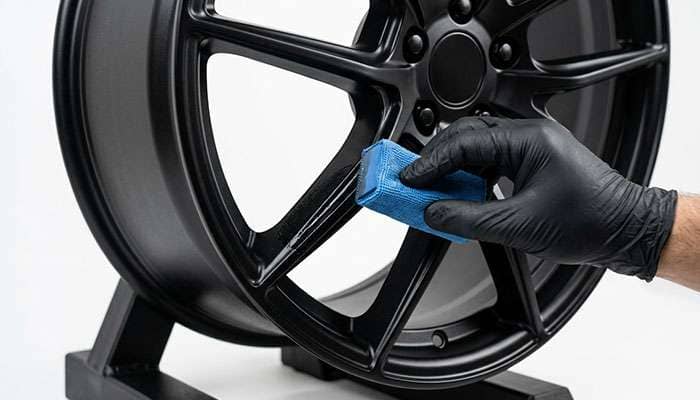
Yes, and it is not merely allowed. It is the only protection a matte wheel can take, which makes it close to mandatory for matte ownership done right.
The reason comes straight back to texture. Waxes and polymer sealants protect by depositing a film thick enough to level microscopic valleys, which is exactly how they add gloss to paint, and exactly why they destroy a matte finish: leveling the texture is glossing the texture. A true ceramic coating works differently. It is a silica-based resin applied in a film measured in microns that cross-links to the surface and follows the existing topology instead of filling it. The peaks and valleys that scatter light remain peaks and valleys, so the sheen survives, and the wheel gains the two things matte desperately needs: a sacrificial barrier against hot brake dust, which etches unprotected clear coats over time, and slickness that keeps contaminants from anchoring in the texture, so your pH-neutral wash actually releases the dirt.
Two provisos, because this is where it goes wrong in practice. First, use a coating rated matte-safe. Most quality ceramics are texture-neutral, but some gloss-enhancing formulas include leveling resins on purpose, and those will sheen-shift a matte wheel a few gloss units toward satin, subtly and permanently. The label matters. Second, preparation on matte is unforgiving in a way gloss owners never experience: on gloss, you polish before coating to perfect the surface, and on matte, polishing is prohibited, so whatever the coating locks in, stains, wax blotches, burnish marks, stays locked in with no correction step available afterward. Coat matte wheels when they are new and flawless, or have them professionally decontaminated first. On a fresh set, though, ceramic coating converts matte from the fragile choice into a genuinely durable one, and it is the single best answer to almost every maintenance objection in this article.
Here is something no comparison article has, because it comes out of our own warehouse. Before writing this, I ran the finish descriptions across our entire current inventory, more than 133,000 wheels, and counted the sheens. Among wheels explicitly labeled for sheen, gloss takes 52 percent, matte 34 percent, and satin 14 percent. Gloss is still the majority choice, but a third of the sheen-labeled market has gone flat, which is not a fad number. It is an established second standard.
The finding worth your attention, though, is what happens when you split those sheens by color, because the market has quietly paired them, and the pairings run in opposite directions. In black, gloss outsells matte 1.7 to 1: the deep, wet, reflective look is most of why people buy black wheels at all. In silver, gloss outsells matte five to one, and matte silver barely exists as a category, roughly 265 wheels in the entire count, because flattening a bright reflective color deletes the one thing it does well. But cross into the warm and gray tones and the ratio flips. Matte bronze outsells gloss bronze better than four to one, and matte leads gloss in gunmetal as well. Bronze and gunmetal earn their keep through tone and contrast rather than reflection, and the flat sheen is what makes bronze read as magnesium-alloy motorsport hardware instead of costume gold; it is a large part of why bronze wheels got so popular.
So the market's own answer to "glossy or matte" is: it depends which color you are asking about. Reflective colors go gloss, tonal colors go matte, black splits the difference and sells mountains of both. If you are choosing a sheen against the grain of that table, matte silver, gloss bronze, you are not wrong, but you should know you are ordering against the pairing the entire industry converged on, and the resale market will treat it as an acquired taste. And if the bright end of the spectrum is where you are headed anyway, the sheen conversation changes entirely: chrome versus polished is its own comparison with its own rules.
There is no best finish, but there is a best finish for a given owner, and after everything above, it resolves to three questions asked in order.
First: who touches this car? If the answer includes automatic washes, quick-lube bays, valets, or a rotation of detailers, gloss or satin. Matte's rules are simple, but they only protect you if everyone who touches the wheels knows them, and strangers do not.
Second: how do you handle damage? If a curbed wheel gets fixed, gloss, because gloss is the only sheen a shop can return to perfect, and gloss black specifically is the cheapest repair in the industry. If a curbed wheel would sit until it bothers you, matte actually serves you fine, because matte hides the damage it cannot fix, and satin hides it nearly as well while tolerating far more cleaning chemistry.
Third, and only third: what does the build want? Deep reflective drama, gloss. Tactical, tonal, motorsport flat, matte, ideally ceramic coated on day one. Genuinely torn, satin, which is the compromise the industry built for exactly this conversation, most of matte's forgiveness with a fraction of its fragility. Our full field guide, why custom wheel finishes make or break your car's look, covers where each one shines, and if the wheels in question are black, the black-specific deep dive is gloss versus matte versus satin black wheels.
Then, whichever sheen wins, protect it like you mean to keep it: sealant or ceramic on gloss, matte-safe ceramic on matte, and the right bucket chemistry for each. When you are ready to shop by sheen and see what each finish family actually looks like across brands, our custom wheel finish guide is built for exactly that comparison.
Is glossy or matte better for rims? Strip away the style talk and you are choosing between two maintenance contracts. Gloss is the high-attention, full-recovery contract: it shows every swirl and every fleck of dust, it wants regular washing, and in exchange, nothing that ever happens to it is permanent. Matte is the low-attention, zero-recovery contract: it hides dust, hides swirls, hides your missed washes, and in exchange, the first real mistake, a wax, a brush wash, a curb, a polish, is forever. Satin is the industry's negotiated settlement between the two, and the sales data says a lot of buyers have figured that out.
The texture explains all of it. Gloss has none to protect, so nothing is final. Matte is its texture, so everything is. Decide who touches your car and what happens when a wheel gets hurt, and the sheen decides itself, before you ever get to which one looks better in the driveway. Although, for what it is worth, they both look right when they are matched to an owner who understood the contract.
Neither is better outright. Gloss requires more frequent care but every kind of damage, swirls, scratches, curb rash, can be repaired to invisible. Matte requires far less weekly attention but cannot be polished, waxed, or spot-repaired, so its first real mistake is permanent. Choose gloss if you fix things and other people handle your car. Choose matte if you will follow its care rules strictly. Satin splits the difference.
A matte wheel has the same color layer as a gloss wheel under a different clear coat. The matte clear is loaded with microscopic flattening agents that leave the cured surface slightly rough, so light scatters instead of reflecting, which reads as a flat, non-reflective finish. Because the flat look comes from that texture, anything that abrades or fills the texture, polishing, waxing, brush washes, permanently changes the sheen in that spot.
Day to day they are the easiest wheels to keep presentable, because the flat finish hides dust, swirls, and missed washes better than gloss. The difficulty is discipline, not effort: only pH-neutral cleaners, no wax or sealant, no polish or compound, no automatic wash brushes, and no tire-shine overspray. Break any of those rules and the finish glosses or scars permanently. A matte-safe ceramic coating makes routine cleaning dramatically easier.
The most durable conventional finish is quality powder coat, in any sheen. Among sheens, gloss is best for owners who maintain and repair their wheels, because it is the only sheen that can be fully corrected. Matte is best for owners who want minimal weekly upkeep and will follow strict product rules. Satin is the best all-around compromise, and it is the answer for anyone genuinely torn between the other two.
Yes, and you should. A true ceramic coating cures in a film thin enough to follow the matte texture instead of filling it, so the flat sheen survives while the wheel gains protection from hot brake dust and easier dirt release. Use a coating explicitly rated matte-safe, since gloss-enhancing formulas will shift the sheen, and coat the wheels while they are new and flawless, because matte cannot be polished before or after coating.
No more easily than any other color. Scratch resistance comes from the coating system, and a quality powder coat protects equally in every color. Black shows scratches more because wheels are bright aluminum underneath, and a scratch deep enough to reach metal leaves a silver line against a dark field. On gloss black that damage repairs to invisible. On matte black it cannot be blended, which is the real risk of dark matte wheels.



