Title= How to Fix Curb Rash on Wheels: DIY vs. Professional Repair Costs — The Ultimate Guide Description= Expert guide to fixing curb rash on alloy wheels. Compare DIY repair costs vs professional services, learn repair techniques, and discover when to replace vs repair damaged rims. URL= how-to-fix-curb-rash-on-wheels-diy-vs-professional-repair-costs-the-ultimate-guide
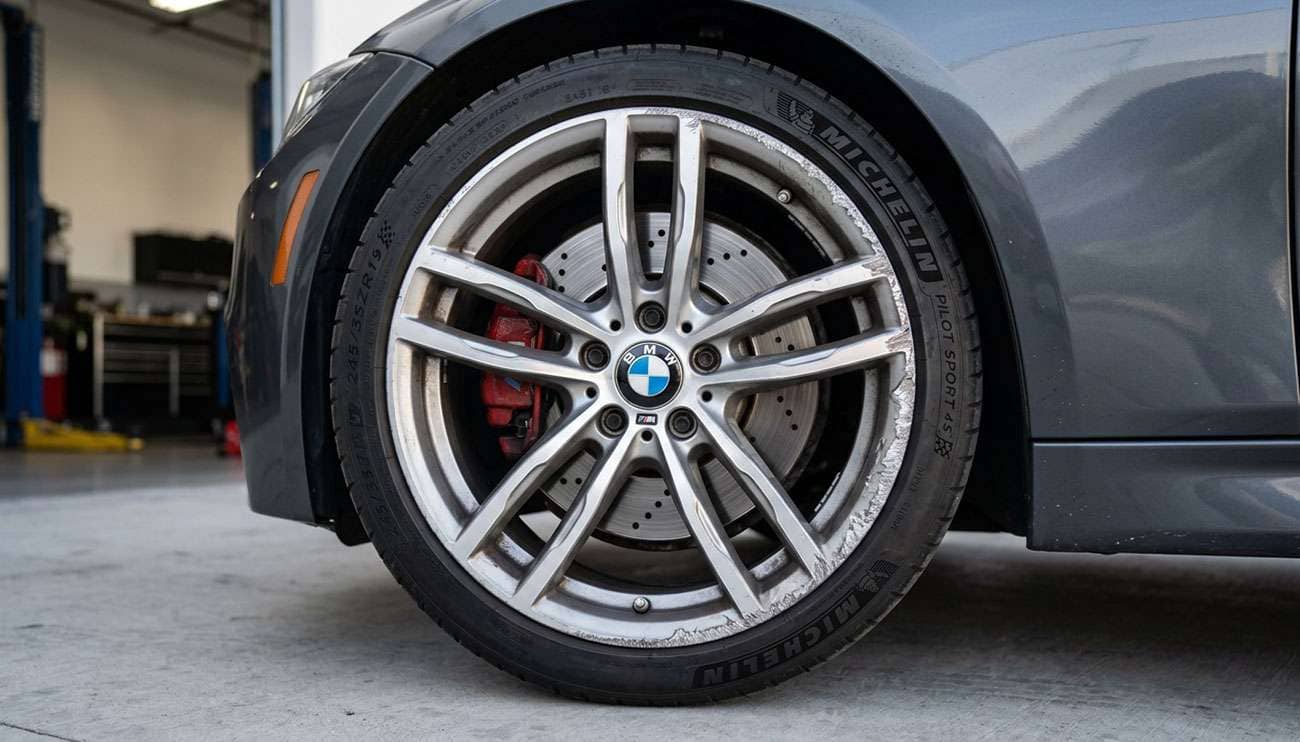
You know that sickening scrape when your wheel meets a curb. Every driver dreads it. Curb rash — those scratches, scuffs, and gouges along your rim edge — damages millions of vehicles every year. You clipped a parking barrier or misjudged a tight turn, and now you're facing a decision: fix it yourself or pay a professional.
Most curb rash is repairable, and you've got options for every skill level and budget. The catch? A botched repair actually tanks your wheel's value and structural integrity. Professional curb rash repair runs $75 to $300+ per wheel. DIY kits start around $30. Understanding which route fits your situation saves you money and headaches.
This guide breaks down everything you need to know about fixing curbed wheels. You'll learn exactly when DIY repairs work, when professional restoration pays off, and how to avoid the mistakes that turn minor cosmetic issues into expensive problems. Light scuffs on your daily driver or deep gouges on custom wheels — you'll make the smartest repair decision for your situation.
You need to understand what curb rash actually is before you grab any repair kit. Curb rash happens when your wheel's outer edge or face contacts a curb, parking block, pothole edge, or road obstacle. The damage shows up primarily on alloy wheels — aluminum, magnesium, and composite materials — rather than steel wheels with hubcaps.
Curb rash damage breaks into four severity levels. Each level demands different repair approaches and investment. Understanding your damage level is step one in choosing between DIY and professional repair.
Level 1 damage is surface scratches and scuffs that haven't penetrated your wheel's clear coat. These cosmetic marks measure less than 1/16 inch deep and only affect the outermost finish layer. You can feel them with your fingernail but they don't catch or snag. This accounts for roughly 40% of all curb rash incidents and offers the best DIY opportunity. Repair costs run $30-$60 for DIY kits or $75-$125 per wheel professionally.
Level 2 damage breaks through the clear coat into the paint layer and exposes bare metal in small areas. Scratches measure 1/16 to 1/8 inch deep. You'll see silver or gray aluminum showing through darker finishes. This represents about 35% of curb rash cases. The exposed metal oxidizes if you leave it untreated, spreading corrosion beneath surrounding paint. DIY repair gets more challenging here but remains doable for patient owners. Expect $50-$100 for quality DIY materials or $125-$200 for professional correction.
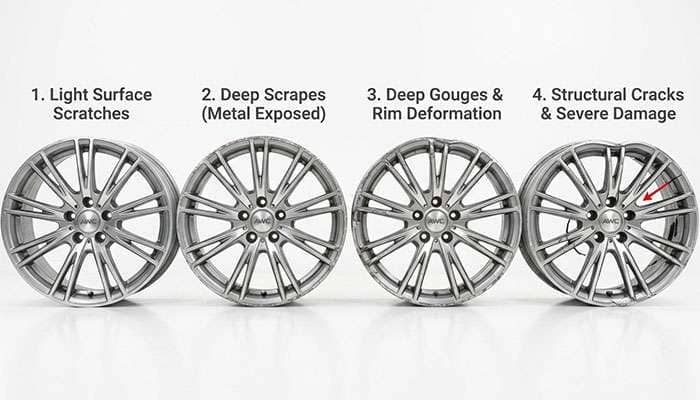
Level 3 damage means deep gouges exceeding 1/8 inch that deform your rim edge. You see and feel the displaced or bent metal. This serious damage affects about 20% of curb rash incidents and may compromise wheel balance and tire seal integrity. We don't recommend DIY repair unless you have metalworking experience. Professional repair costs $200-$300 per wheel and may require specialized equipment to reshape the rim.
Level 4 damage represents structural compromise — cracks, significant bends beyond the rim edge, or missing chunks of material. This severe damage occurs in approximately 5% of curb incidents, typically from high-speed impacts or hitting obstacles at severe angles. These wheels need professional assessment to determine if they're safely repairable or should be replaced entirely. Repair costs $300-$500 per wheel when possible, but replacement often makes more financial and safety sense.
The biggest mistake wheel owners make is underestimating damage severity and attempting DIY repairs on wheels that need professional attention. We've seen countless wheels where home repair attempts made the damage worse — uneven surfaces, poor color matches, and rough texture that looks worse than the original curb rash. What started as a $50 professional fix becomes a $200+ restoration after failed DIY efforts.
Another critical error is using incorrect materials for your wheel finish type. Modern wheels come in dozens of finish varieties: painted, powder-coated, machined, polished, chrome, hyper-silver, and various specialty coatings. Each demands specific repair products and techniques. Applying standard spray paint to a machined wheel face or powder-coat finish to a polished rim creates obvious mismatches that scream "botched repair job." Always identify your exact wheel finish before purchasing any repair materials.
Many DIYers also skip proper surface preparation, which is absolutely crucial for durable repairs. Rushing through cleaning, sanding, and degreasing steps leads to poor adhesion where new filler or paint simply peels off within weeks. Professional wheel refinishers spend 60-70% of repair time on surface prep because it determines the repair's longevity. If you're going the DIY route, patience during preparation becomes your most valuable tool.
Ignoring structural damage is perhaps the most dangerous mistake. Some wheel owners focus solely on cosmetic appearance and paint over cracks, severe bends, or deep gouges that affect wheel integrity. A structurally compromised wheel can fail catastrophically at highway speeds, causing loss of vehicle control and serious accidents. If you see any cracks, if the rim edge is bent more than 1/8 inch, or if the wheel won't hold air pressure properly, skip cosmetic repairs and have the wheel professionally inspected immediately.
Understanding curb rash repair costs requires breaking down what you're actually paying for in both DIY and professional scenarios. These numbers help you make informed decisions based on your specific situation, skill level, and expectations.
DIY curb rash repair kits range from $25-$150 depending on damage severity and kit quality. Basic kits ($25-$40) include sandpaper, filler putty, primer, and spray paint — sufficient for Level 1 surface scratches. Mid-range kits ($50-$80) add multiple grit sandpapers, better quality fillers, clear coat, and sometimes color-matching guides for common wheel finishes. Premium kits ($100-$150) include specialty tools like flexible sanding blocks, professional-grade fillers, multiple primer and paint options, and detailed instruction guides with video access.
The material cost represents only part of your DIY investment. You'll also invest 2-6 hours per wheel depending on damage severity and your experience level. First-time repairs typically take 50-75% longer than subsequent wheels as you learn techniques and correct mistakes. Factor in your time value when comparing DIY versus professional repair costs.
Repair Method |
Level 1 Damage |
Level 2 Damage |
Level 3 Damage |
Time Required |
|---|---|---|---|---|
DIY Basic Kit |
$30-$60 |
$50-$100 |
Not Recommended |
3-6 hours |
DIY Premium Kit |
$75-$100 |
$100-$150 |
$150-$200 |
4-8 hours |
Mobile Repair Service |
$75-$125 |
$125-$175 |
$175-$250 |
1-2 hours |
Shop Professional |
$100-$150 |
$150-$225 |
$225-$350 |
2-5 hours |
OEM Refinishing |
$175-$250 |
$250-$350 |
$350-$500 |
3-7 days |
Professional mobile wheel repair services have gained popularity because they offer convenience at moderate prices. These technicians come to your location with portable equipment and complete repairs while you work or shop. Mobile service typically costs 20-30% less than shop-based professional repair because of lower overhead, but results vary significantly based on technician skill and equipment quality. Mobile repairs work best for Level 1 and Level 2 damage on standard painted or powder-coated wheels.
Traditional shop-based professional repair delivers the highest quality results because refinishers have access to full equipment suites including spray booths, curing ovens, and precision machining tools. These shops can perfectly match factory finishes, handle complex multi-stage coatings, and repair severe damage that mobile services can't address. The higher cost reflects superior equipment, controlled environment, and typically greater technician expertise.
Geographic location significantly affects professional repair pricing. Urban markets with higher operating costs see prices 30-50% above rural areas. Coastal cities like Los Angeles, New York, and Miami command premium rates ($150-$300 per wheel for Level 2 damage) while mid-sized Midwest cities average $100-$200 for equivalent repairs. Luxury wheel specialists serving high-end vehicles charge even more — $200-$500 per wheel — but deliver factory-quality refinishing that maintains vehicle value.
Selecting between DIY and professional curb rash repair isn't just about cost. You're matching repair complexity to your skill level, understanding how wheel value affects repair investment, and knowing when cosmetic appearance matters versus basic functionality. Your vehicle type, wheel finish, damage severity, and personal expectations all factor into making the smartest repair decision.
Your vehicle category and wheel specifications should heavily influence your repair approach. Daily driver sedans, crossovers, and family SUVs with standard painted or powder-coated wheels represent ideal DIY repair candidates, especially for Level 1 and Level 2 damage. These wheels typically cost $150-$400 to replace, making $50-$100 DIY repair economically sensible even if results aren't perfect. The risk-reward ratio favors DIY attempts because you're not dealing with ultra-expensive specialty finishes or ultra-luxury vehicle aesthetics where imperfection significantly impacts value.
Performance vehicles and luxury cars demand more careful consideration. High-performance wheels often feature specialized finishes — machined faces, multi-piece construction, or forged alloy — that demand professional expertise to repair correctly. A poorly executed DIY repair on BMW M-series wheels, Porsche forged alloys, or Mercedes AMG wheels looks obviously amateurish and can decrease vehicle resale value by $2,000-$5,000. When individual wheel replacement costs $800-$2,500, investing $200-$350 in professional repair makes strong financial sense.
Truck and SUV wheels present unique repair challenges due to their larger diameters and exposure to off-road conditions. Modern trucks increasingly feature 20-inch, 22-inch, and even 24-inch wheels that cost $400-$1,000+ each to replace. These larger wheels require more repair materials and time for DIY fixes, but the higher replacement cost makes professional repair ($175-$300) relatively attractive. Off-road wheels with exposed damage on multiple wheels might benefit from DIY touch-up to prevent corrosion, with plans for professional refinishing when selling the vehicle.
Classic and collector vehicles deserve special attention. Vintage wheels — especially original equipment on collectible cars — should always receive professional restoration to maintain vehicle authenticity and value. These wheels often require period-correct finishes that DIY kits can't replicate. Finding the right professional who understands classic wheel finishes is crucial. Even minor cosmetic work that preserves original material beats aggressive DIY repairs that alter the wheel's vintage character.
How and where you drive directly impacts whether curb rash repair makes sense and which approach fits your situation best. Urban drivers who parallel park frequently face ongoing curb rash risk. If you've damaged wheels multiple times and expect future incidents, investing in expensive professional repair may not be practical. DIY touch-up repairs that prevent corrosion and maintain basic appearance make more sense until you've mastered parking skills or are ready to sell the vehicle.
Highway commuters and rural drivers experience curb rash less frequently but may encounter more severe damage when incidents occur — deep gouges from pothole edges, concrete barriers, or road debris. These single severe incidents often warrant professional repair because the damage exceeds DIY capability and you're less likely to repeat the damage pattern. Professional restoration returns wheels to excellent condition that should last for years in lower-risk driving environments.
Enthusiast drivers who participate in track days, autocross, or spirited driving should prioritize wheel structural integrity over cosmetic appearance. Any curb damage that affects the wheel rim edge, even cosmetically minor, should receive professional inspection to rule out structural compromise. The forces experienced during hard cornering and braking can propagate cracks from existing damage points. For performance driving, either replace damaged wheels or invest in complete professional restoration that includes structural assessment.
Fleet and commercial vehicle operators face different cost-benefit calculations. Multiple damaged wheels across several vehicles make professional repair services with volume discounts attractive. Many professional shops offer fleet rates of $75-$125 per wheel for basic repairs when servicing 10+ wheels. However, older fleet vehicles near end-of-service might receive DIY touch-ups solely to prevent corrosion and maintain professional appearance until vehicle retirement.
Understanding where to invest your repair budget requires honest assessment of your expectations and the wheel's role in your vehicle's overall value and appearance. The "good enough" principle applies here — repair quality should match your needs without over-spending or under-delivering.
For budget-conscious drivers on vehicles worth under $15,000, DIY curb rash repair makes strong financial sense for Level 1 and Level 2 damage. Your primary goals are preventing corrosion, maintaining basic appearance, and avoiding the expense of replacement. A $50 DIY repair that achieves 70-80% of professional results satisfies these objectives. Perfect color matching and factory-quality finish aren't necessary on an older daily driver. Focus on competent execution that protects your wheels and looks presentable from 10 feet away.
Mid-market vehicle owners ($15,000-$40,000 value) face the trickiest decisions. Your wheels significantly impact curb appeal and resale value, but you're not dealing with ultra-luxury expectations. Hybrid approaches work well here: DIY repair for minor damage on less-visible wheels (like passenger-side rear), but professional repair for severe damage or driver-side wheels that face viewers most often. This balanced approach controls costs while maintaining the appearance standards that matter for your vehicle class.
Luxury and performance vehicle owners should default to professional repair for all visible damage. Your vehicle's market position demands excellence, and wheel condition directly affects buyer perception and resale value. The $200-$350 professional repair cost represents just 0.3-0.5% of your vehicle's value but can influence selling price by thousands of dollars. Poor DIY repairs on luxury wheels broadcast neglect and decrease buyer confidence in the entire vehicle's maintenance history.
Time value calculations also matter in budget decisions. If you earn $50+ per hour professionally, spending 6 hours on DIY wheel repair costs $300 in lost income opportunity — more than professional repair for most damage levels. For higher earners or busy professionals, professional repair isn't just about quality results; it's actually the more economical choice when you factor time investment. Conversely, if you enjoy hands-on projects and have free weekend time, DIY repair provides satisfaction beyond just cost savings.
After assessing hundreds of curb rash repairs over decades in the tire and wheel industry, these category-specific recommendations will help you achieve the best results for your specific situation. Each category addresses different priorities — convenience, quality, cost-efficiency, or restoration standards — so you can match the repair approach to your needs.
Daily drivers need curb rash solutions that balance appearance, cost, and durability without requiring extensive time investment or advanced skills. For these practical needs, we recommend a tiered approach based on damage severity and when you plan to address repairs.
For fresh Level 1 surface scratches, the best immediate option is basic touch-up using wheel-specific repair pens or markers. These $15-$25 products work like paint pens and take just 10-15 minutes per wheel. They won't deliver perfect results, but they seal exposed metal against corrosion and dramatically improve appearance from even 5 feet away. Brands like Dupli-Color Perfect Match and Turtle Wax offer shade-matched options for common wheel colors. This quick fix lets you address damage immediately after an incident, preventing oxidation while you decide on more comprehensive repair later.
For Level 1-2 damage where you want better results, mid-range DIY repair kits from brands like Chemical Guys or Mothers provide excellent value for daily drivers. These $50-$80 kits include proper surface prep materials, quality fillers, and paint that closely matches common wheel finishes. Budget 3-4 hours for your first wheel, dropping to 2 hours once you've practiced the technique. The results typically achieve 75-85% of professional quality — not perfect color matching or flawless surface texture, but very acceptable for a daily driver. These repairs hold up well for 2-3 years before potentially needing touch-up.
When dealing with multiple damaged wheels or Level 2-3 damage, mobile professional repair services offer the best value proposition for daily commuters. Mobile technicians charge $100-$175 per wheel and come to your home or workplace, eliminating the hassle of removing wheels or dropping off your vehicle. The quality exceeds DIY results, especially for color matching and finish texture. Most mobile services complete repairs in 1-2 hours while you continue your day. The convenience factor makes this option particularly attractive for busy professionals who value time over maximum cost savings.
Performance-oriented drivers need curb rash repair solutions that prioritize wheel integrity, weight considerations, and finish durability under aggressive driving conditions. Cosmetic appearance matters, but structural soundness and performance characteristics are paramount.
For any performance vehicle wheel with curb damage, your first step should always be professional structural inspection before considering cosmetic repair. Many performance wheel specialists offer free or low-cost ($25-$50) crack detection and integrity testing using methods like dye penetrant inspection or x-ray analysis. This inspection determines whether the wheel remains safe for performance driving or requires replacement. Never drive spiritedly on wheels with uncertain structural condition — the liability and safety risks far exceed any repair cost savings.
Once structural integrity is confirmed, lightweight forged or flow-formed performance wheels with Level 1-2 curb damage deserve professional refinishing rather than DIY attempts. These wheels often cost $500-$2,500 each, and their specialized manufacturing and finishing processes require professional replication. Shops that specialize in performance wheel restoration — like Wheel Enhancement in California or various local performance wheel specialists — use techniques that maintain original wheel weight and balance characteristics. Expect to invest $200-$400 per wheel for proper restoration, but understand this expense protects your much larger wheel investment.
Track-dedicated wheels present different repair economics. If you run separate wheel sets for street and track use, track wheels with cosmetic curb damage that doesn't compromise structure don't necessarily need repair at all. Many track enthusiasts simply clean curb rash to bare metal and apply clear protectant to prevent corrosion, leaving the battle scars visible. This approach saves weight (repair filler adds 2-4 ounces per wheel) and money while keeping fully functional track wheels in service. Reserve your repair budget for street wheels where appearance matters.
For performance drivers who want to attempt DIY repairs on less critical wheels, only consider this for Level 1 surface scratches on cast aluminum wheels, never on forged or flow-formed wheels. Use minimal filler material to avoid adding weight, and select high-temperature resistant paint products designed for brake-adjacent components. Performance driving generates significant wheel heat that can cause standard repair paints to discolor or fail prematurely. Specialty high-temp wheel paints from brands like VHT or Eastwood provide better durability under performance conditions.
When cost minimization is your primary concern — whether due to financial constraints, older vehicle value, or multiple damaged wheels — these strategies deliver maximum value while maintaining acceptable appearance and preventing long-term damage.
The absolute cheapest effective approach for Level 1 damage is the sandpaper-and-rattle-can method using automotive-grade products from your local auto parts store. For under $25 total investment, purchase 400-grit and 1000-grit wet-dry sandpaper, automotive wheel cleaner, degreaser, and color-matched wheel spray paint with integrated primer. Clean thoroughly, sand smooth, and apply 3-4 light paint coats following can instructions. This bare-bones approach won't win any beauty contests, but it stops corrosion and improves appearance significantly from the damaged state. It's perfect for winter wheel sets, older vehicles, or situations where you simply need functional improvement on a minimal budget.
For budget shoppers willing to invest slightly more ($40-$60), complete all-in-one repair kits from brands like 3M or Permatex offer better results than piecing together individual products. These kits include properly sized materials that work together as a system — compatible primer, filler, paint, and clear coat that bond well to each other. You avoid the trial-and-error of product matching and typically get better durability. The comprehensive instructions included with quality kits significantly improve DIY success rates, especially for first-timers.
The smartest budget strategy often involves selective repair rather than addressing all damage simultaneously. Prioritize the most visible wheels — driver's side front and rear — for proper repair while applying basic corrosion prevention to less-visible passenger-side wheels. This approach cuts repair costs in half while ensuring the wheels that face viewers during normal parking look presentable. You can always repair remaining wheels later when budget allows, knowing you've prevented corrosion damage in the meantime.
Another budget-friendly option is timing professional repairs strategically during shop slow seasons or promotional periods. Many wheel repair shops run winter specials (November-February) offering 20-30% discounts when business is slow. Others provide multi-wheel package pricing — repair 3 wheels, get the 4th discounted or free. If you're not facing immediate corrosion risk, waiting for promotional periods can reduce professional repair costs from $600 for four wheels to $400-$450, approaching DIY material costs while delivering professional results.
For vehicles near end-of-life or with minimal resale value, consider whether curb rash repair makes financial sense at all. If you plan to drive the vehicle for 1-2 more years before scrapping or trading for minimal value, basic corrosion prevention might be sufficient. Clean damaged areas to bare metal, apply rust-preventing primer, and skip cosmetic finishing entirely. This maintenance-focused approach costs under $15 per wheel and prevents damage from worsening while acknowledging that extensive repair doesn't align with the vehicle's remaining value.
Fixing curb rash on your wheels doesn't have to be complicated or expensive when you match the repair approach to your specific situation. The key is honest assessment — of damage severity, your skill level, your vehicle's value and role, and your expectations for results. DIY repairs work wonderfully for Level 1-2 damage on standard wheels when you have patience and follow proper techniques, potentially saving you $100-$200 per wheel compared to professional services. Professional repair becomes the smarter investment for severe damage, specialty wheel finishes, luxury vehicles, or when you value time over cost savings.
Curb rash repair isn't just about aesthetics — it's about protecting your wheel investment from corrosion and maintaining your vehicle's value. Even basic DIY touch-ups that seal exposed metal serve an important function beyond appearance. Whether you choose the $30 DIY route or invest in $200+ professional restoration, taking action to address wheel damage pays dividends in preserved wheel life and vehicle resale value.
At Performance Plus Tire, we understand that wheels represent a significant investment in your vehicle's performance, appearance, and safety. While we specialize in helping you select the perfect wheel and tire combinations for your needs, we also recognize that maintaining those wheels through their service life matters just as much as the initial purchase. Whether you're ready to explore replacement wheels that eliminate curb rash concerns or need guidance on wheel care and maintenance, our team brings decades of expertise to help you make informed decisions that protect your automotive investment.
Here are the essential points to remember about fixing curb rash on wheels:
• Assess damage severity first: The four-level damage classification system (surface scratches to structural compromise) determines whether DIY repair is appropriate or professional service is necessary. Level 1-2 damage suits DIY attempts, while Level 3-4 requires professional expertise or wheel replacement.
• DIY saves money but requires time and patience: Quality DIY curb rash repair costs $30-$150 in materials but demands 3-6 hours per wheel for proper execution. Results typically achieve 70-85% of professional quality when done correctly, making this approach ideal for budget-conscious owners of mid-market vehicles.
• Professional repair pricing varies by damage and location: Expect to pay $75-$150 for Level 1 repairs, $150-$225 for Level 2, and $225-$350 for Level 3 damage at professional shops. Mobile services offer convenience at slightly lower rates, while urban markets charge 30-50% more than rural areas.
• Match repair quality to vehicle value and role: Daily drivers benefit from practical DIY or mobile repair approaches, while luxury and performance vehicles deserve professional restoration that maintains resale value and cosmetic standards. Classic vehicles require specialty professional work to preserve authenticity.
• Prevention and prompt treatment minimize long-term costs: Addressing curb rash quickly — even with temporary touch-ups — prevents corrosion that can spread beneath surrounding finish and complicate later repairs. Simple corrosion prevention adds years to wheel life regardless of when you complete full cosmetic restoration.
Yes, you can safely drive with cosmetic curb rash (Level 1-2 damage) that only affects your wheel's finish and doesn't compromise structural integrity. However, you should repair even minor curb rash relatively soon because exposed aluminum oxidizes quickly, and corrosion can spread beneath the surrounding finish. Severe curb rash (Level 3-4) that involves deep gouges, bends exceeding 1/8 inch, cracks, or air pressure loss requires immediate professional inspection before continued driving, as structural compromise can cause wheel failure at highway speeds.
Quality DIY curb rash repairs using proper products and techniques typically last 2-3 years before showing signs of wear like paint fading or clearcoat deterioration, especially when you regularly wash and wax your vehicle. Professional repairs generally last 4-6 years or longer because refinishers use industrial-grade materials, controlled spray environments, and curing processes that create more durable bonds. The longevity difference primarily reflects equipment quality and technique precision rather than fundamental capability — meticulous DIYers using premium materials can approach professional durability, while rushed DIY jobs might fail within months.
Cosmetic curb rash repair adds minimal weight (typically 1-3 ounces of filler and paint material) that rarely affects wheel balance noticeably. However, severe repairs involving heavy filler application or rim reshaping can add enough weight to require rebalancing. If your repair involves more than light surface work, you should have the wheel rebalanced after repair completion — this $15-$25 service ensures smooth operation and prevents vibration. Professional wheel refinishers typically include balancing in their service, while DIY repairs may require a separate trip to a tire shop for balance verification.
Yes, powder coating is actually an excellent option for repairing curbed wheels and often provides more durable results than traditional paint repairs. Powder coating involves applying dry powder electrostatically then curing at 400°F, creating an extremely hard finish that resists chips, scratches, and corrosion better than liquid paint. However, powder coating requires stripping the wheel to bare metal and accessing a powder coating facility, making it more expensive ($125-$250 per wheel) than spot repair. This approach makes most sense when you're dealing with severe damage on multiple wheels or want to change your wheel color entirely while addressing curb rash.
Standard auto insurance policies typically do not cover curb rash repair because insurers consider it cosmetic damage resulting from driver error rather than a covered incident like collision or comprehensive claims. However, if curb damage occurs during a covered accident (collision with another vehicle, hitting a deer, etc.), wheel repair or replacement may be included in that claim. Some premium insurance policies and specialized wheel/tire protection plans do cover cosmetic wheel damage, but these optional coverages cost $200-$500 annually and may include deductibles that exceed repair costs. Review your specific policy or contact your insurance agent to understand your coverage, but most drivers pay curb rash repair costs out-of-pocket.