Your wheels take a beating every single day — road salt, brake dust, gravel chips, UV exposure, and the occasional curb rash. If you've watched a crisp, clean set of wheels slowly turn dull, chipped, and flaking, you already know the problem. The question is what to do about it. Powder coating has become one of the most popular wheel finishing and refinishing solutions in the US, and the reason is simple: it works. It delivers a tough, attractive, long-lasting surface that outperforms traditional liquid paint in almost every measurable way.
But there's a lot of noise out there — inflated claims, confusing cost estimates, and plenty of shops happy to take your money without delivering the result you're paying for. This guide cuts through all of it. You'll learn exactly what powder coating is, how the process works, what it costs, how it stacks up against paint, and how to make the right call for your specific vehicle and budget. Whether you're refinishing a set of custom wheels or weighing a full wheel upgrade, this is the information you need before you spend a dime.
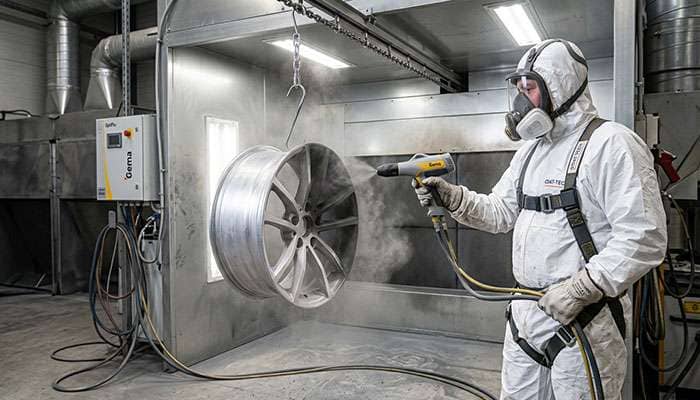
Powder coating is a dry finishing process that uses electrostatically charged powder particles — typically polyester, epoxy, or a polyester-epoxy hybrid — sprayed directly onto a metal surface. The coated wheel goes into a curing oven at 350°F to 400°F, where the powder melts, flows, and chemically bonds into a single continuous hard film. The result is a finish that is significantly thicker, more chemically resistant, and more impact-resistant than conventional liquid paint. This isn't a gimmick — it's a fundamentally different manufacturing process, and the durability difference shows up in real-world data. A properly applied powder coat can last 15 to 20 years on a well-maintained wheel. A quality paint job in the same conditions? Five to seven years, tops.
When you're evaluating a powder coating shop or buying wheels that come factory powder coated, a few key specs separate a quality job from a mediocre one. Film thickness is the first number to know — a proper powder coat application on a wheel should measure between 2 and 4 mils (thousandths of an inch). Go too thin and you lose the protective benefits. Go too thick and you risk compromising the wheel's dimensional accuracy, which can create fitment issues with weights and TPMS sensors. Cure temperature and time matter just as much. A correct cure runs about 20 minutes at 380°F to 400°F — undercuring produces a finish that looks fine but turns brittle and chips prematurely. Gloss level runs on a scale from 0 (dead matte) to 100 (full mirror gloss); most automotive wheels fall between 70 and 90 gloss units for a standard finish.
Powder type matters more than most buyers realize. Polyester powders are the industry standard for wheels — they deliver excellent UV resistance and flexibility, which is critical for a component that flexes under load and thermal cycling. Epoxy powders are tougher and more chemically resistant, but they chalk and fade outdoors because they have zero UV stability. Hybrid powders split the difference. For any exterior wheel application, polyester or a polyester-epoxy hybrid is the right call, every time, no exceptions.
The single most common powder coating mistake is skipping proper surface preparation. It doesn't matter how good the powder is or how skilled the applicator — if the wheel surface isn't properly stripped, blasted, and cleaned, the coating will fail at the adhesion layer. Reputable shops chemically strip old coatings, media blast down to bare metal, and apply a phosphate or chromate conversion coating as a primer adhesion layer before any powder touches the wheel. If a shop quotes you a price that seems impossibly low and gets vague when you ask about their prep process, walk away.
The second big mistake is leaving TPMS sensors in the wheel during coating. Cure oven temperatures will damage or destroy your sensors if they're not removed beforehand. A quality shop pulls them, coats the wheel, and reinstalls — factor that labor into your budget upfront. The third mistake is committing to a color or finish based solely on screen photos. Request a physical sample chip from your shop and evaluate it next to your vehicle in natural daylight before you sign off. Screen calibration and shop lighting can make a color look dramatically different than it will on a finished wheel in the real world.
Here's what powder coating wheels actually costs in today's market. For a standard passenger car wheel in the 17-to-19-inch range, most reputable shops charge $75 to $150 per wheel for a single color — putting a full set of four between $300 and $600. Larger wheels at 20 inches and up typically run $100 to $200 each, driven by greater surface area and longer prep time. Multi-color or two-tone finishes, candy coats, and specialty textures like wrinkle or hammertone add 20 to 50 percent on top of the base price. Wheels with significant prep needs — stripped chrome, pitting, or corrosion — add another $25 to $75 per wheel before coating even starts.
Wheel Size |
Single Color Powder Coat |
Multi-Color / Specialty |
Set of Four (Single Color) |
|---|---|---|---|
15–16 inch |
$60–$100 per wheel |
$80–$150 per wheel |
$240–$400 |
17–19 inch |
$75–$150 per wheel |
$100–$200 per wheel |
$300–$600 |
20–22 inch |
$100–$175 per wheel |
$130–$250 per wheel |
$400–$700 |
24 inch and up |
$150–$225 per wheel |
$200–$325 per wheel |
$600–$900 |
Picking a powder coat finish isn't just a matter of choosing a color you like. The right finish depends on how you drive, what conditions your wheels face, your wheel size and construction, and your budget. There's also a meaningful difference between refinishing wheels you already own and evaluating a new set that comes factory powder coated — those two scenarios have different decision points. Here's how to think through each one intelligently.
Fitment is the most fundamental consideration — you need a finish that doesn't compromise your wheels' structural integrity or dimensional specs. For passenger cars and daily drivers running 16-to-19-inch wheels, a standard polyester powder coat is the right choice in virtually every situation. It's durable, cost-effective, and available everywhere. For trucks and SUVs with larger diameter wheels — especially those that see off-road use — you want a powder rated for higher impact resistance. That typically means a thicker film build closer to 4 mils, and potentially a two-coat system with a zinc-rich primer for maximum corrosion protection.
Performance vehicles with large brakes deserve extra attention. Operating brake temperatures in performance applications can reach 500°F to 700°F near the caliper — well above standard powder coat ratings for sustained exposure. In those zones, either specify a high-temperature rated powder or accept that standard polyester powder may discolor over time. If you're running off-road wheels in harsh environments, a textured or matte finish is far more forgiving of minor scratches and scuffs than a high-gloss coat — and it'll keep looking good a lot longer between touch-ups.
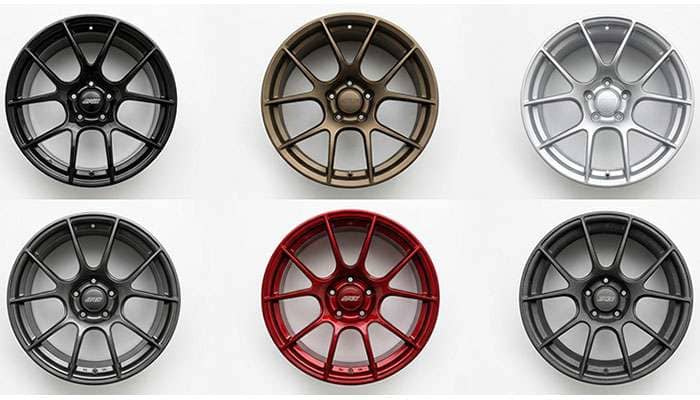
High-mileage daily commuters need to prioritize durability and easy maintenance above everything else. Matte and satin finishes look great, but they demand more careful cleaning — they trap brake dust and road film more readily than high-gloss finishes, which you can safely clean with most automotive wheel cleaners. If you're putting 20,000 or more miles per year on your vehicle, a satin or semi-gloss polyester coat in gunmetal, dark bronze, or black is the practical sweet spot. Dark colors hide brake dust buildup and minor road debris marks far better than lighter finishes, buying you more time between washes.
Track-day and performance drivers have a different priority set. Thermal performance near the braking system matters as much as aesthetics. If you're running a dedicated track setup, seriously consider masking the inner barrel of the wheel and either leaving it uncoated or applying a heat-resistant ceramic coating in that zone instead of standard powder coat. Street-driven autocross and canyon cars can run standard powder coat safely — just inspect the inner barrel periodically for heat-related discoloration, which is an early warning sign of thermal stress you don't want to ignore.
When you're forced to prioritize, always spend money on preparation rather than on a premium specialty finish. A well-prepped wheel with a standard polyester coat will outlast a poorly prepped wheel with an expensive candy or chrome-look finish — every single time. The coating is only as durable as what it's bonded to. That said, if your budget allows it and you want a finish that genuinely transforms your vehicle's appearance, chrome-look powder coats have improved dramatically. They can deliver a near-mirror finish at a fraction of the cost of real chrome plating, which carries its own significant environmental and durability drawbacks.
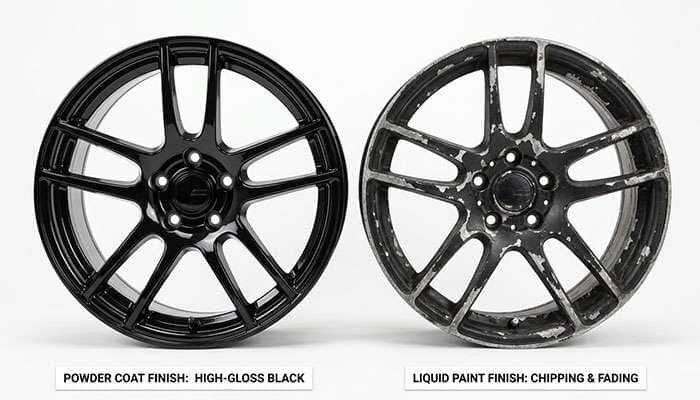
When you compare powder coat versus paint head-to-head for wheel applications, the data consistently favors powder coat. Paint offers more precise color matching and easier spot repairs, but it's thinner, less impact-resistant, and far more vulnerable to chipping from road debris. The table below breaks down the key differences:
Attribute |
Powder Coat |
Liquid Paint |
|---|---|---|
Typical Lifespan |
15–20 years with proper care |
5–7 years |
Impact Resistance |
High — resists chipping |
Moderate — chips more easily |
Chemical Resistance |
Excellent |
Good with clear coat |
UV Resistance |
Excellent (polyester) |
Good with UV-stable clear |
Spot Repairability |
Difficult — full strip/recoat needed |
Easier — spot repair possible |
Color/Finish Options |
Extensive — hundreds of options |
Virtually unlimited mixing |
Environmental Impact |
Low — no VOCs, minimal waste |
Higher — VOC emissions |
Cost (per wheel) |
$75–$175 |
$50–$150 |
The wheel you start with matters just as much as the finish you put on it. A quality powder coat on a poorly made wheel is still a poorly made wheel. Across three common buyer profiles, here's how to pair the right wheel type with the right finishing approach. And if you're buying new wheels to coat — or buying wheels that come factory finished — your starting point sets the ceiling on your final results.
Daily driver priorities are simple: durability, easy maintenance, and value. Cast aluminum wheels in the 17-to-18-inch range finished in a satin or semi-gloss black or gunmetal powder coat consistently hit all three. Cast aluminum is more affordable than forged and delivers more than enough strength for everyday road use. The satin finish hides minor brake dust and water spots better than high gloss between washes, while still looking sharp. At Performance Plus Tire, several wheel lines we carry come factory powder coated with quality polyester finishes — always ask about the specific coating type before you buy, not just the color.
Turnaround at a quality shop for a daily driver set runs 3 to 5 business days once you drop the wheels off. Add a day or two if your wheels need significant prep. Many shops offer loaner wheels or can coordinate with the timing of your next tire rotation to minimize your time off the road — worth asking about upfront.
Performance drivers need to think about weight before anything else. Powder coat adds a small but real amount of mass — typically 0.1 to 0.3 pounds per wheel. Negligible for most applications, but worth knowing if you're chasing every gram on a dedicated track build. For performance applications, flow-formed or forged wheels give you the right foundation. A high-gloss or candy finish in a single color maximizes the visual impact of the wheel's machined or forged lines. Two-tone finishes — machined face with a powder coated barrel — are extremely popular in this segment and look exceptional when executed by an experienced shop.
If you're building a performance setup and need quality rubber to match, Performance Plus Tire's high performance tires selection includes options from Michelin, Continental, Pirelli, and other top-tier brands engineered for the larger, wider wheels that benefit most from a professional powder coat finish. Getting wheels and tires right as a system always beats optimizing either one separately.
When budget is the primary constraint, refinishing a quality set of existing wheels beats buying cheap new ones — every time. A set of OEM factory wheels in solid structural condition, properly stripped and powder coated in a clean single color, will outperform a bargain-priced aftermarket wheel with an unknown factory finish. You'll spend $300 to $500 on a four-wheel refinish and end up with wheels that look new and stay protected for years — significantly better value than a cheap new set using inferior alloys and thin spray paint that starts failing within a year or two.
If you're shopping new budget-friendly wheels that come powder coated, stick to reputable brands with stated coating specs and a warranty. Any listing that describes the finish only as "painted" without specifying powder coat is a red flag — that often means liquid spray paint over inadequate prep, which is the worst outcome of all. Use our tire size calculator to confirm proper fitment before you buy any new wheel, regardless of price point.
Powder coating is one of the smartest investments you can make in your wheels — whether you're refinishing a set that's seen better days or choosing a finish for a brand-new set of aftermarket wheels. Done correctly by a reputable shop with proper prep, quality polyester powder, and a correct cure cycle, a powder coat finish can easily outlast the vehicle itself. The variables that determine your outcome are preparation quality, powder type, and matching the right finish to your driving environment and maintenance habits.
The $300 to $600 cost range for a standard four-wheel refinish is genuinely reasonable when you factor in the lifespan and performance you're getting in return. Just don't cut corners on shop selection. Get references, ask specific questions about their prep process, and confirm they're pulling your TPMS sensors before anything goes in the oven. A $400 powder coat job done right is worth ten times a $200 job done wrong.
If you're in the market for new wheels to go with that fresh finish — or quality tires to complete the package — browse the full selection at Performance Plus Tire. We carry a wide range of wheel and tire options for every vehicle type and budget, and our team is ready to help you put together the right combination for your specific application.
Here are the five most important things to take away from this guide on powder coating wheels.
• Preparation is everything: No powder coat performs better than the surface prep beneath it. Choose a shop that chemically strips, media blasts, and applies a conversion coating before any powder goes on — this is non-negotiable for a finish that actually lasts.
• Expect to pay $75–$175 per wheel: A quality single-color powder coat on a 17-to-19-inch wheel runs $300 to $600 for a full set of four. Prices significantly below that range almost always mean corners are being cut on prep or powder quality.
• Powder coat outperforms paint on wheels: A 15-to-20-year lifespan versus 5 to 7 for liquid paint, superior impact and chemical resistance, and zero VOC emissions during application — powder coat wins the head-to-head comparison for wheel applications in almost every category.
• Polyester powder is the right choice for exterior wheels: Epoxy powders are tougher but have no UV resistance and will chalk and fade outdoors. Always confirm your shop is using polyester or a polyester-epoxy hybrid for any exterior wheel application.
• Protect your TPMS sensors: Cure oven temperatures of 380°F to 400°F will damage or destroy TPMS sensors left in the wheel during coating. Make sure your shop removes and reinstalls them — and factor that labor into your budget from the start.
For a standard 17-to-19-inch wheel, expect to pay $75 to $150 per wheel for a single-color powder coat from a reputable shop, putting a full set of four between $300 and $600. Larger wheels at 20 inches and up run $100 to $225 per wheel. Multi-color or specialty finishes add 20 to 50 percent to the base price. Heavily corroded or damaged wheels requiring significant prep work will add $25 to $75 per wheel on top of the base coat price.
A properly applied powder coat on wheels can last 15 to 20 years with routine maintenance. The key factors are preparation quality (proper stripping, blasting, and conversion coating), powder type (polyester or polyester-epoxy hybrid for exterior applications), correct cure temperature and time, and ongoing care. Regular cleaning with a pH-neutral wheel cleaner and avoiding harsh chemical degreasers will significantly extend the life of any powder coat finish.
For wheel applications specifically, yes — powder coating is generally superior to liquid paint in most practical categories. It is more impact-resistant, more chemically resistant, more UV-stable (using polyester powder), and significantly longer-lasting. The main advantage of liquid paint is repairability: small chips and scratches in paint can be touched up in place, while powder coat damage typically requires a full strip and recoat. For daily driver and performance applications, the durability advantage of powder coat makes it the better long-term value in almost every scenario.
Powder coating cannot be spot-repaired the way liquid paint can. Because the finish is applied as a continuous film and cured as a single chemical bond, adding new powder to a small damaged area doesn't integrate seamlessly — you'll see a visible seam or color variation. The correct repair process is to strip the entire wheel back to bare metal, re-prep, and apply a fresh full coat. Factor this into your decision, particularly if your wheels take regular abuse from tight parking or rough roads. For curb rash-prone environments, a matte or textured finish will disguise minor surface damage far better than a high-gloss coat.
Start by asking for references and looking at completed work — specifically wheels that have been coated and in service for at least a year or two. Ask the shop directly about their prep process: do they chemically strip old coatings, media blast to bare metal, and apply a conversion coating primer? Do they remove TPMS sensors before curing? What type of powder do they use, and what film thickness do they target? A shop that answers these questions clearly and specifically knows what they're doing. Avoid any shop that gets vague about prep, prices significantly below market rate, or can't show you examples of their recent work.