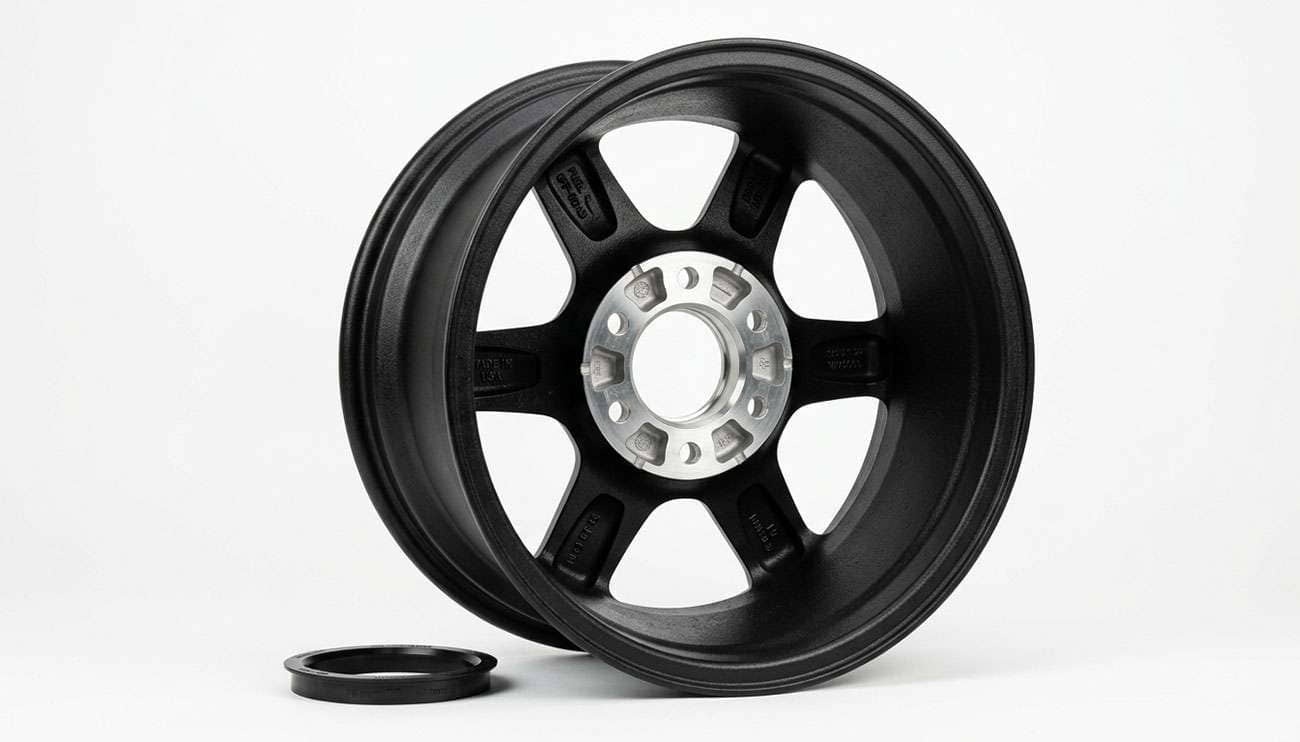
Sometimes, and one number decides it: the gap between the center bore on the exact Fuel wheel you bought and the hub on your truck. Fuel cuts a different bore for each bolt pattern. On a Ford Super Duty, Fuel's 8x170 bore is 125.1 mm against a 124.9 mm hub, so you don't need a ring, and nobody makes one that thin. On a Silverado 1500, nearly every Fuel 6x139.7 wheel is bored 106.1 mm or larger against a 78.1 mm hub. That one needs a ring.
Most answers to this question stop at "it depends" and never say what it depends on. Here it is for your truck: the bore Fuel actually machines for your bolt pattern, your factory hub, and the gap between them in millimeters. If you're still deciding on the brand, start with our look at whether Fuel wheels are good. If you already have a set, find your truck below.
Your Truck |
Factory Hub |
Most Common Fuel Bore |
Gap |
Hub Ring? |
|---|---|---|---|---|
Ford F-150 (2004+), Expedition |
87.1 mm |
87.1 mm single-drilled, or 106.1 mm dual-drilled |
0 mm or 19.0 mm |
No on 87.1; yes on 106.1 (106.1 to 87.1) |
Silverado / Sierra 1500, GM full-size SUVs |
78.1 mm |
106.1 mm |
28.0 mm |
Yes (106.1 to 78.1) |
Ram 1500 (2019+) |
77.8 mm |
106.1 mm |
28.3 mm |
Yes (106.1 to 77.8) |
Ram 1500 (2012-2018) and Ram 1500 Classic |
77.8 mm |
110.1 mm dual-drilled |
32.3 mm |
Yes (110.1 to 77.8) |
Tacoma (2005-2023), 4Runner (2003-2024) |
106.1 mm |
106.1 mm |
0 mm |
No |
Tundra (2022+), Sequoia (2023+), Tacoma (2024+), 4Runner (2025+) |
95.1 mm |
106.1 mm |
11.0 mm |
Yes (106.1 to 95.1) |
Tundra (2007-2021), Sequoia (2008-2022) |
110.1 mm |
110.1 mm |
0 mm |
No |
Bronco (2021+), Ranger (2019+) |
93.1 mm |
106.1 mm |
13.0 mm |
Yes (106.1 to 93.1) |
Wrangler JK / JL, Gladiator |
71.5 mm |
71.5 mm, or 78.1 / 87.1 mm dual-drilled |
0, 6.6, or 15.6 mm |
No on 71.5; yes on the dual-drilled bores |
Ford Super Duty F-250 / F-350 (1999+) |
124.9 mm |
125.1 mm |
0.2 mm |
No |
Silverado / Sierra 2500HD-3500HD (2011+) |
124.1 mm |
124.2 mm |
0.1 mm |
No |
Ram 2500 / 3500 (8x165.1) |
121.3 mm |
125.1 mm |
3.8 mm |
Yes (125.1 to 121.3), or buy the 121.5 mm bore |
Silverado / Sierra 2500HD-3500HD (2001-2010) |
116.7 mm |
125.1 mm |
8.4 mm |
Yes (125.1 to 116.7), or buy the 117 mm bore |
How to read the gap column: a hub-centric wheel needs a little clearance to slide on and off, so a few tenths of a millimeter counts as a match. At about a millimeter, the hub stops centering the wheel and your lug nuts take over. A hub ring hands the job back to the hub. Ring sizes are written outside diameter first, so a "106.1 to 78.1" ring presses into a 106.1 mm bore and slides over a 78.1 mm hub.
Both. The same Fuel model can be either one depending on the truck it's bolted to, which is why forum answers never agree.
Fuel's cast wheels use a 60-degree conical lug seat, and that taper is a centering device. As each cone-shaped nut draws into its tapered hole, it pushes the wheel toward the center of the stud circle. Six or eight cones pulling evenly will center a wheel by themselves. That's lug-centric: the lug seats locate the wheel, not the hub.
Now add the bore. When Fuel machines a bore within a few tenths of a millimeter of a truck's hub, the hub pilot locates the wheel before a single nut is snug. On that truck the wheel is hub-centric, and the cones just clamp. Bolt the same model to a truck with a smaller hub and the bore floats, so the cones do all the centering. Our breakdown of hub-centric vs. lug-centric wheels covers the general theory. What follows is how Fuel builds its lineup.
A big share of Fuel's lineup is dual-drilled, with two bolt patterns in one wheel. Close to half of Fuel's 6x135 wheels are also drilled for 6x139.7. A dual-drilled wheel needs a bore that clears the largest hub of every truck it can bolt to, and on 6x139.7 that's Toyota's 106.1 mm hub. Put that wheel on an F-150 and you get 19 mm of daylight around an 87.1 mm hub. The same logic produces 110.1 mm bores on wheels drilled for 5x139.7 and 5x150, an exact fit on a Tundra and a 32 mm gap on a Ram 1500.
Single-drilled wheels are usually cut to the truck that owns the pattern: 87.1 mm on 6x135, 125.1 mm on 8x170, 124.2 mm on 8x180, and 71.5 mm on 5x127. The exception is 6x139.7, the most crowded 6-lug pattern on the road. Roughly nine in ten Fuel wheels drilled for it are bored 106.1 mm or larger, because Toyota's hub is the biggest in the family.
Fuel Wheel Type |
How the Bore Is Cut |
Ring Odds |
What to Check Before You Buy |
|---|---|---|---|
Single-drilled cast |
One bore, usually matched to the truck that owns that bolt pattern |
Low on that truck; high on other trucks sharing the pattern |
The CB number against your factory hub |
Dual-drilled cast (6x135/6x139.7, 5x139.7/5x150, 5x114.3/5x127, 5x127/5x135) |
Sized to clear the largest hub across both bolt patterns |
High; at least one truck family always gets a gap |
Whether a single-drilled version exists in your size |
Fuel Forged |
Machined in more bore options per pattern, including truck-specific cuts |
Lowest, when the bore is specified for your hub |
That the bore on the order matches your hub, not just the bolt pattern |
Fuel 2-Piece |
Same bore logic as the cast lineup for each pattern |
Same as cast |
The CB number against your factory hub |
You don't have to guess. Every Fuel wheel listing at Performance Plus Tire shows the center bore in the product title as the number in front of "CB." When your style and size comes in both a matched bore and an oversized dual-drilled bore, the matched one takes the ring out of the build.
Only if you bought the dual-drilled version. The 2004-and-newer F-150, the Expedition, and the Navigator all run 6x135 with an 87.1 mm hub. Fuel's 6x135 lineup splits close to down the middle:
The dual-drilled wheels are easy to spot because both patterns appear in the size string, written as "6x135/6x139.7." If you see that, plan on rings. If the listing says 6x135 alone with 87.1 CB, you're done.
Almost always, yes. GM and Ram half-tons have the smallest 6-lug hubs on the road and get the biggest gaps in the Fuel lineup, which makes them the setup most likely to show up with a vibration complaint.
GM's half-ton trucks and its full-size SUVs share 6x139.7 with a 78.1 mm hub. Only about one Fuel 6x139.7 wheel in twenty is bored 78.1 mm. The rest are 106.1 mm or larger, which leaves 28 mm of air around your hub. Use a 106.1 to 78.1 ring, or 108 to 78.1 if your wheel is one of the 108 mm bores.
The DT-generation Ram 1500 shares GM's 6x139.7 bolt pattern but not its hub: Ram's is 77.8 mm. On a 106.1 mm Fuel bore you need a 106.1 to 77.8 ring. Don't accept a 78.1 ring because "it's the same pattern as a Chevy"; it won't seat. On the uncommon 78.1 mm Fuel bores, the 0.3 mm gap is a slip fit, effectively hub-centric.
The 5-lug Rams run 5x139.7 with the same 77.8 mm hub. About half of Fuel's 5x139.7 wheels are dual-drilled for 5x150 and bored 110.1 mm to fit a Tundra, which puts a 32.3 mm gap around a Ram hub. That's the largest gap in this article, and it calls for a 110.1 to 77.8 ring. About one Fuel 5x139.7 wheel in five is bored 78.1 mm instead. On a Ram, that's a 0.3 mm slip fit, so no ring.
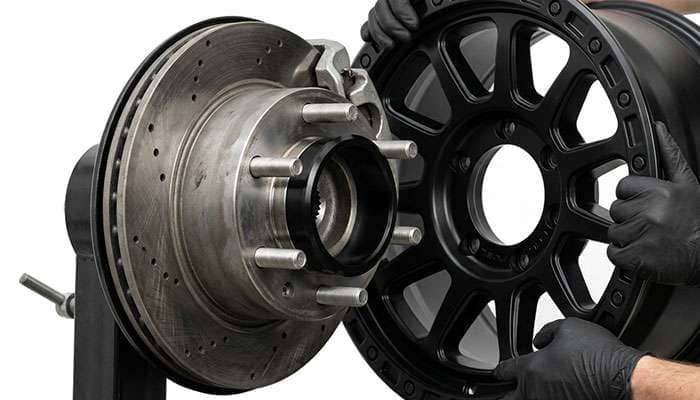
It depends on the model year, because Toyota changed hub sizes when it moved its body-on-frame trucks to a new platform.
These trucks have the 106.1 mm hub that 6x139.7 Fuel wheels are sized around. The common 106.1 mm bore is an exact match, and the occasional 106.4 mm bore is still a slip fit. No ring. The exception is the 108 mm bore Fuel uses on some 6x139.7 wheels. That leaves a 1.9 mm gap, enough to make the wheel lug-centric, and a 108 to 106.1 ring closes it.
These trucks kept 6x139.7 but went to a 95.1 mm hub. Fuel's cast 6x139.7 wheels aren't cut to 95.1, so a 106.1 mm bore leaves an 11 mm gap. You need a 106.1 to 95.1 ring (some ring makers label it 95.2). If you want to skip the ring entirely, Fuel Forged offers 95 mm bores on some 6x139.7 styles. We cover the cross-generation trap in detail in will Tundra wheels fit a Tacoma.
These run 5x150 with a 110.1 mm hub, and virtually every Fuel 5x150 wheel is bored 110.1 to 110.3 mm. Hub-centric, no ring.
On most factory Toyota alloy wheels, the lug nut is a flat "mag" seat with a washer. Fuel's cast wheels need 60-degree conical nuts. Run flat-seat nuts on a Fuel wheel and they can't center anything, ring or no ring, and the clamp load won't stay where you set it. It's one of the most common Toyota install mistakes, and it's covered in our guide to lug nut seat type mismatch.
Yes, in almost every case. The 2021-and-newer Bronco and the 2019-and-newer Ranger use 6x139.7 with a 93.1 mm hub. Fuel does cut a handful of wheels to 93.1 mm, but they're the exception. The typical 106.1 mm bore leaves a 13 mm gap, so you need a 106.1 to 93.1 ring.
Bronco owners have one more reason to care. Many run 35- and 37-inch tires, a lot of rotating mass on a short wheelbase, and that's where a fraction of a millimeter off-center turns into a shake at 60 mph. A ring costs far less than chasing that vibration later.
Only if your wheels are dual-drilled. The Wrangler JK, Wrangler JL, and Gladiator share 5x127 with a 71.5 mm hub, and so do recent Grand Cherokees. Fuel wheels that fit a Jeep come in three bores:
Check the CB number before you order. Two wheels can share the same style and size and still have different bores.
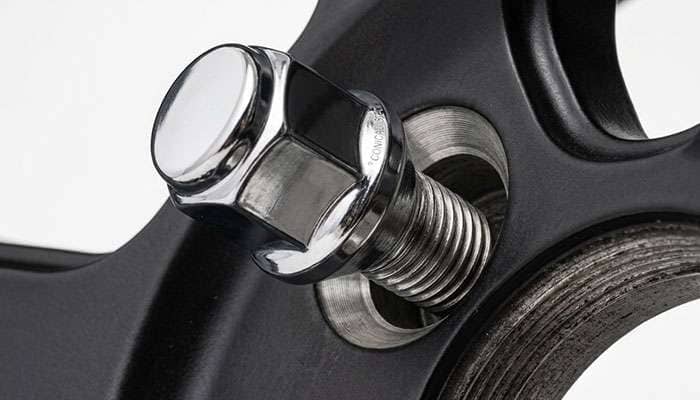
On Ford and late-model GM heavy duty trucks, no. On Ram and older GM heavy duty trucks, usually yes.
The Super Duty hub is 124.9 mm, and essentially every Fuel 8x170 wheel is bored 125.1 mm. That 0.2 mm gap works out to one-tenth of a millimeter per side. That's the slip-fit clearance a hub-centric wheel needs to go on and come off. No ring is made that thin, and none is needed.
This one comes up because some service counters see an aftermarket wheel and assume it needs rings. Super Duty owners have reported being turned away from tire rotations for "missing hub rings" on 8x170 Fuel wheels. If that happens to you, the numbers are on your side: 125.1 against 124.9 is a hub-centric fit.
The GM heavy duty hub is 124.1 mm. About nine in ten Fuel 8x180 wheels are bored 124.2 or 124.3 mm, a gap of 0.1 to 0.2 mm, so they're hub-centric and need no ring. The rest are 125.1 mm, which leaves a 1.0 mm gap. That's big enough to make the wheel lug-centric. If you have a choice in your size, take the 124.2.
Ram's heavy duty hub is 121.3 mm, and roughly 85 percent of Fuel's 8x165.1 wheels are bored 125.1 mm, which leaves a 3.8 mm gap. Use a 125.1 to 121.3 ring, or look for the 121.5 mm version. About one Fuel 8x165.1 wheel in ten is cut that way, and it's hub-centric on a Ram.
The older GM heavy duty trucks share Ram's 8x6.5-inch bolt pattern but have a smaller 116.7 mm hub. On a 125.1 mm Fuel bore that's an 8.4 mm gap, so use a 125.1 to 116.7 ring. Fuel also cuts a small run of 8x165.1 wheels to 117 mm specifically for these trucks, and those fit without a ring.
If the install goes right, nothing. The conical seats center the wheel and it runs true. The catch is that a lug-centric install has to go right every time the wheel comes off: every rotation, tire repair, and brake job.
A truck wheel with a 35-inch tire weighs over 100 pounds. Hanging on the studs, it sags against the top studs, and if the bore floats around the hub, nothing holds it up in the middle. The first nut run down with an impact gun can pin it there before the other cones pull it back to center. A ring removes that problem, because the bore rides on the hub pilot while you start the nuts.
The clearance between the studs and the lug holes, not the size of the bore gap, limits how far off-center the wheel can land. That's a small number, and a small number is enough. If the wheel's center sits 0.25 mm off the hub axis, one side of the rim rises 0.25 mm and the other drops 0.25 mm: 0.5 mm (0.020 inch) of radial runout before the tire adds any of its own.
Then the mass adds up. Shift a 110-pound assembly, a 20-inch wheel on a 35-inch mud-terrain, a quarter millimeter off the axis it spins on, and you get roughly 1.75 ounces of imbalance at the rim. No shop would let a tire leave that far out of balance.
Rebalancing won't fix it. The balancer centers the wheel on its own bore with a cone, so on the machine the assembly is balanced around its true center. Bolted to your truck off-center, it spins around a different axis the balancer never saw. Rebalance it three times and the shake comes back three times.
Stage |
What You Notice |
What It's Costing You |
|---|---|---|
1. Off-center mount |
A shake at 55 to 75 mph, in the steering wheel or the seat |
A balance that doesn't fix it, then a second one that doesn't either |
2. Moving target |
The shake changes or moves after every rotation or tire service |
Repeat shop visits chasing alignment, tires, or bearings that aren't the cause |
3. Irregular tread wear |
Cupped or scalloped wear across the tread |
Heavy LT tires that wear out early and get loud |
4. Uneven seat contact |
Lug nuts that read low at the next torque check |
Clamp load bleeding off, with studs taking stress they weren't designed for |
5. Damaged seats |
Wallowed or shiny, uneven tapered seats in the lug holes |
A replacement wheel, plus new studs and lug nuts |
Stage one is where most people catch it, and where they start blaming the wrong part. If you're chasing a shake now, work through our diagnostic on steering wheel vibration from tires or wheels first. If it started the day you mounted oversized-bore Fuel wheels and two balances haven't touched it, check the mount before you replace parts.
Keep one thing straight: a hub ring doesn't hold the wheel on or carry the truck's weight. Clamp force from torqued lug nuts presses the wheel's mounting face against the hub face, and friction between those faces carries the load. The fatigue testing in SAE J2530, the SAE recommended practice for aftermarket passenger car and light truck wheels, is about the wheel's structure, and a plastic ring plays no part in it. The ring makes centering repeatable, so the clamp goes on straight every time.
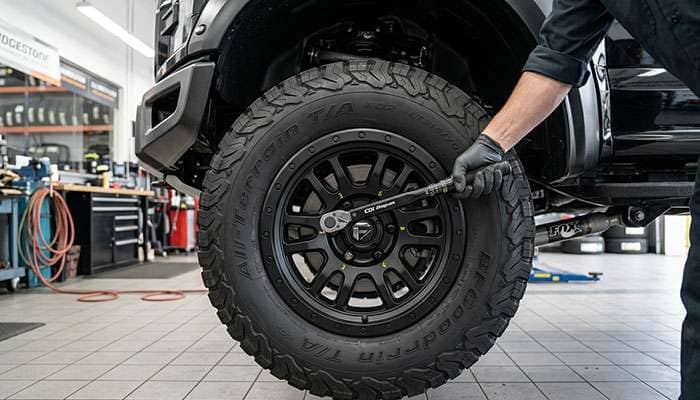
Ring or no ring, these steps get Fuel wheels on straight and keep them there.
One more habit: when a wheel comes off, make sure the ring came with it. A ring left on the hub pilot keeps the next wheel from seating flat and causes the same shake you were trying to prevent.
Fuel wheels need hub centric rings when the bore on your specific wheel is larger than your truck's hub by more than a few tenths of a millimeter. Super Duty, late-model GM heavy duty, 2007-2021 Tundra, and pre-2024 Tacoma and 4Runner owners usually get a hub-centric fit. Silverado 1500, Ram 1500, Bronco, Ranger, new-generation Toyota, Ram heavy duty, and older GM heavy duty owners usually need a ring. F-150 and Jeep owners need one only on the dual-drilled versions.
The easiest ring is the one you never need, so pick the bore before you pick the finish. Browse Fuel wheels at Performance Plus Tire, read the CB number, and take the matched bore when your size offers one. If it only comes oversized, our fitment team will spec the correct ring and lug seat with your order.
Yes, if the wheel uses conical lug seats and the nuts were torqued correctly in a star pattern. The cones center the wheel and the clamp load holds it. The risk is an off-center install, which shows up as a vibration at highway speed that balancing won't fix. Rings take that risk out of every future install.
No. The load passes through friction between the wheel's mounting face and the hub face, held together by lug nut clamp force. A hub ring only centers the wheel during installation. Once the nuts are torqued, its job is done.
Either works, since the ring isn't load-bearing. High-grade polycarbonate rings won't corrode or seize to the hub, which makes them the easy choice for most trucks. Aluminum rings hold their shape well but can corrode onto the hub in salted-road states, so pull and clean them at every rotation.
The outside diameter matches your wheel's center bore and the inside diameter matches your truck's hub. A 106.1 mm Fuel wheel on a Silverado 1500 takes a 106.1 to 78.1 ring; the same wheel on a 2019+ Ram 1500 takes a 106.1 to 77.8 ring. Size it to the tenth of a millimeter.
Fuel wheels are sold by bolt pattern and bore, and a ring depends on your truck, so plan on sourcing it with the order rather than expecting one in the box. When you order through Performance Plus Tire, our fitment team specs the correct ring and lug seat for your truck.
Only when something is wrong with them: the wrong inside diameter, a ring that isn't fully seated, or an old ring left on the hub that keeps the wheel from sitting flat. A correctly sized, fully seated ring removes vibration rather than causing it.