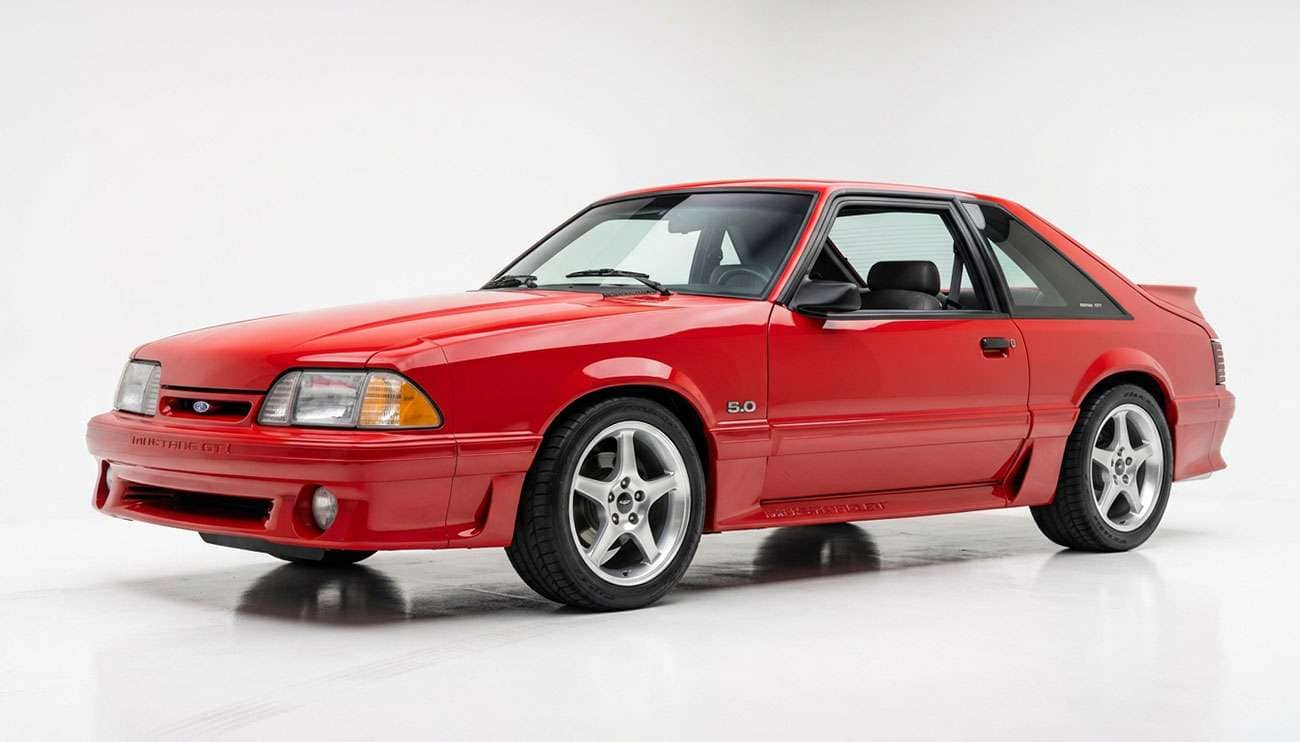
Most Fox body Mustangs (1979-1993) use a 4x108mm bolt pattern, also called 4 on 4.25 inches, with a 63.4mm hub bore. The 1984-86 SVO and the 1993 SVT Cobra came from the factory with 5x114.3mm, or 5 on 4.5 inches, on a 70.5mm hub. But the bolt pattern is only the first number. When you go from 4-lug to 5-lug, the hub bore, the track width, and the minimum wheel diameter change with it, and those three decide whether the wheel you just bought actually fits.
I have been bolting wheels on Fox bodies since they were new cars on the showroom floor, and I can tell you the question almost never ends at "4 or 5." Most answers give you the two bolt patterns and stop. The guy standing in my shop with a new set of 17s wants to know why they rub, why they wobble, or why they won't clear his brakes. Here is how the whole thing actually works.
Your Fox Body |
Bolt Pattern |
Hub Bore |
What Bolts On |
|---|---|---|---|
1979-1993 base, LX, GT (stock) |
4x10⁸ (4 on 4.25") |
63.4mm |
4x10⁸ wheels with correct offset; hub rings for oversize bores |
1984-1986 Mustang SVO |
5x114.3 (5 on 4.5") |
70.5mm |
5-lug wheels that clear its factory 4-wheel disc brakes |
1993 SVT Cobra |
5x114.3 (5 on 4.5") |
70.5mm |
17-inch and larger 5-lug wheels in Fox-friendly offsets |
Converted with 1994-95 spindles and Fox-length axles |
5x114.3 |
70.5mm |
Offsets close to a factory 5-lug Fox; track stays near stock |
Converted with 1996-04 spindles and SN95 axles |
5x114.3 |
70.5mm |
Wider track; needs more offset to stay inside the fenders |
Stock 4-lug with 4x10⁸-to-5x114.3 adapters |
5x114.3 at the adapter face |
Set by the adapter |
5-lug wheels, but the adapter thickness pushes every wheel outward |
A stock Fox body Mustang, 1979 through 1993, runs four lugs on a 108mm circle. In inches, that is 4 on 4.25. The hub bore, the hole in the center of the wheel that pilots on the hub, is 63.4mm, and the studs are 1/2-20. Ford carried the same pattern over from the Mustang II, so the setup was already a little dated when the Fox launched.
Every trim used it. The base coupe, the LX notch, the 5.0 LX hatch, the GT with its turbine wheels, all four lugs. The late GT and LX 5.0 cars rode on 15x7 factory wheels, and the brakes behind them, front discs and rear drums, were small enough that a 15-inch wheel had room to spare.
If you want the full list of what else shares this pattern and why it matters when you shop, we cover it in our 4x10⁸ bolt pattern guide. And if you are not sure what your car has right now, because plenty of Fox bodies have been swapped by a previous owner, count the lugs and then measure the bolt pattern before you order anything. Do not trust the title or the badge.
Two of them, and both are special cars.
The 1984-1986 Mustang SVO. The turbocharged 2.3-liter SVO was Ford's European-style Mustang, and it got real hardware to match. Five lugs, 16x7 aluminum wheels, and four-wheel disc brakes, the first Mustang to have discs at all four corners. That is why the SVO went to five lugs: bigger brakes and more wheel. Ford only built a little under ten thousand of them, so if you are looking at a Fox with five lugs, odds are it is not an SVO.
The 1993 SVT Cobra. The last-year Fox Cobra got 17x7.5 wheels on 5x114.3, with rear disc brakes. Those 17s were a big deal in 1993. Today, the Cobra's five-lug hardware is the template a lot of Fox owners are trying to copy with a conversion.
Everything else from the factory is four-lug. Here is the thing I tell people who buy a "5-lug Fox" off a classified ad: somebody did a conversion, and you need to find out which one. Two converted Fox bodies can both be 5x114.3 and still need different wheels, because the parts used in the swap change the track width. More on that below.
This is the real reason most Fox owners end up asking about five lugs. The 4x10⁸ pattern is uncommon in the U.S., and most of the modern aftermarket wheels built in it are designed for small European cars. That creates two problems for a Fox.
First, selection. 5x114.3 is one of the most common bolt patterns on the market, with wheels in almost every size, finish, and style you can think of. 4x10⁸ is a narrow slice by comparison, concentrated in 15-inch and 17-inch sizes. You can still find good ones, especially the classic five-spoke and mesh designs that look right on a Fox, but you will not have the pick of the catalog. The 5x114.3 bolt pattern guide shows just how many cars share that pattern, which is exactly why the aftermarket builds so much for it.
Second, offset. Most 16-inch and 17-inch 4x10⁸ wheels are built for front-drive European compacts, and those cars want a lot of positive offset, often around +35 to +40mm. On a rear-wheel-drive Fox, that tucks the wheel deep into the wheel well and can put the inside of the wheel or tire close to the strut and suspension. The 15-inch 4x10⁸ wheels built for the American muscle market sit much closer to zero offset, which is a different problem in the other direction.
Then there is the hub bore. The Fox hub is 63.4mm, and many 4x10⁸ aftermarket wheels have a larger center bore so they can fit more cars. That wheel will still bolt on, but it is centered by the lug nuts, not the hub. A set of hub rings takes up the gap. We walk through the difference in hub-centric vs. lug-centric wheels, and on a car you plan to drive hard, it is worth the few bucks.
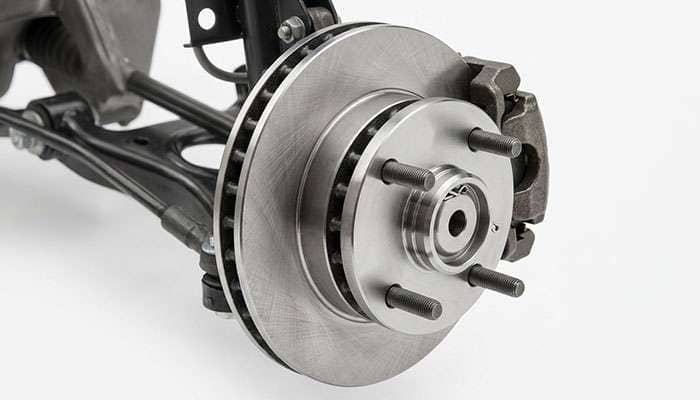
They work, and they are the cheapest way to put 5-lug wheels on a 4-lug Fox. An adapter bolts to your factory 4x10⁸ studs and gives you a new face with five 1/2-20 studs on the 5x114.3 circle. No brake work, no axle work, done in an afternoon.
Here is what the ads leave out. An adapter has thickness, usually around an inch or more. Every millimeter of that thickness pushes the wheel outward, exactly like a spacer. A 17x8 wheel with +35 offset on a one-inch adapter behaves like a wheel with roughly +10 offset bolted straight to the hub. Pick your wheels with that math in mind or the tires will be hanging out of the fenders.
Quality matters more than anything here. A good adapter is machined from billet aluminum, hub-centric on both sides, and uses quality pressed-in studs. A cheap one that centers on the studs and uses soft hardware is the kind of part I do not want on a customer's car. Torque the adapter to the hub first, then the wheel to the adapter, and recheck both after the first hundred miles. We cover the good and the bad of these parts in our look at the benefits of wheel spacers and adapters.
My honest take: adapters make sense if you want 5-lug wheels on a street car and you are not upgrading the brakes. If bigger brakes or more power are coming, skip the adapters and do the conversion once.
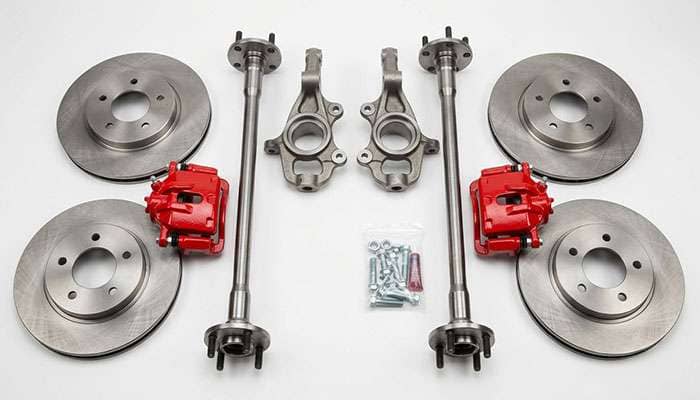
A real conversion replaces the hub hardware at all four corners. Front and rear, you end up with five lugs on 4.5 inches and a 70.5mm hub, the same as a factory SN95 Mustang. What you get beyond that depends on which parts you use, and this is the part nobody explains up front.
Front: spindles decide your track width. The most common route uses later-model SN95 front spindles with 5-lug rotors and brakes. The 1994-95 spindles keep your front track close to stock. The 1996-2004 spindles push each front wheel out by about 8mm. That is not much on paper, but it changes which offset looks and fits right.
Rear: axle length decides the rest. You can use 5-lug axles built to Fox length, or you can use SN95 axles. SN95 axles are about 0.75 inch longer per side than Fox axles, so the rear track grows by about an inch and a half. On an 8-inch-wide wheel, that is usually no problem. On a 9-inch or wider wheel, you need more offset to keep the tire inside the fender.
Brakes: they set your minimum wheel size. Most people convert because they want bigger brakes, and bigger brakes mean bigger wheels. As a general rule, 12-inch front brakes need at least a 16-inch wheel, and 13-inch Cobra-style brakes need a 17-inch wheel or larger. Even then, the spoke shape has to clear the caliper. Our guide to brake caliper wheel clearance shows how to check it before you buy.
Supporting parts. Brake lines, a master cylinder sized for the new calipers, and rear disc brackets if you are going to rear discs. And one thing every customer forgets: your spare tire no longer fits. Plan for a 5-lug spare.
The offset of the wheel does not change. What changes is where the mounting face sits. That is the whole point of the section above: longer spindles and longer axles move the mounting surface outward, so the same wheel sits farther out on a converted car.
That is why two Fox bodies with the same bolt pattern can need different wheels. A Fox converted with 1994-95 spindles and Fox-length axles fits much like a factory 1993 Cobra. A Fox converted with 1996-plus spindles and SN95 axles acts wider at both ends, and it wants more positive offset, especially in the rear.
Here is a real-world example of how tight this gets. One popular factory Mustang wheel style was built in two offsets for the same 17x9 size. The lower-offset version fits the front of a Fox well. For the rear of a Fox running SN95 axles, owners use the higher-offset version, because those longer axles have already pushed the wheel out.
Before you shop, write down three things: which spindles are on the car, which axles are in the rear, and whether you are running spacers or adapters. With those three answers, picking an offset stops being a guess.
The most common 5-lug Fox setups I see are 17-inch wheels, either square or staggered. These are starting points, not guarantees, because your spindles, axles, ride height, and tire size all move the target.
Setup |
Common Wheel Sizes |
Offset Direction |
Watch For |
|---|---|---|---|
Stock 4-lug, factory look |
15x7, 16x7, 17x8 |
Low positive; avoid Euro-spec high offset |
Hub rings on oversize bores |
4-lug with 5-lug adapters |
17x8 square |
Higher positive to offset adapter thickness |
Fender lip clearance, adapter quality |
5-lug, 1994-95 spindles, Fox axles |
17x8 front, 17x9 rear |
Similar to a factory 1993 Cobra |
Caliper clearance with 13-inch brakes |
5-lug, 1996-04 spindles, SN95 axles |
17x8 or 17x9 square, 18x9 |
More positive, especially in the rear |
Rear tire poking past the quarter panel |
Street/strip drag setup |
15x3.5 to 17x4.5 front, 15x8 to 15x10 rear |
Rear backspacing matched to the tire |
Front brake clearance on skinnies |
A couple of shop notes. Going wider in the rear than the front is a common Fox look, and it helps put power down, but it also means you cannot rotate front to rear. We break down that tradeoff in our muscle car staggered setup guide. And when you mount aftermarket wheels, use the lug nut seat the wheel calls for. Most aftermarket wheels take a 60-degree conical seat, but not all, and the wrong seat is how wheels come loose. Our rundown on lug nut seat types shows you what to look for.
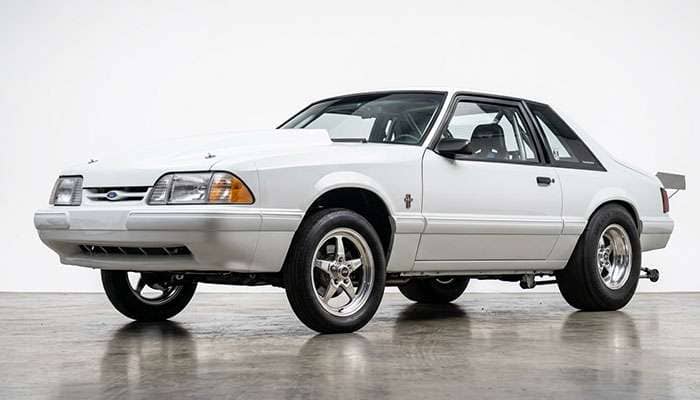
Yes, and at the drag strip it is common. A lot of Fox drag cars upgrade the rear axle shafts for strength, and the heavy-duty aftermarket axles are often built as five-lug. The front stays four-lug with lightweight skinny front runners, because the front wheels on a drag car do not need big brakes or big grip. They need to be light.
That setup makes perfect sense for its job. It just comes with a couple of rules. You now need two different spares, or none. And a 4-lug front, 5-lug rear car is a purpose-built car. If you drive it on the street every day, you will eventually want brakes and wheels that match at both ends.
For a street car, split patterns rarely make sense. If you are going to the trouble of converting, convert all four corners.
I have seen every version of a half-finished Fox conversion roll into our shop. Here is how the cost builds while you keep driving on it.
Every one of those ends the same way: the right wheel, in the right offset, for the hardware you actually have.
Here is the order I walk customers through at the counter.
To see what fits a stock car, start with our 1990 Ford Mustang wheel and tire fitment page and choose GT or LX.
Fox body Mustang wheels come down to more than 4-lug vs. 5-lug. Stock Fox bodies run 4x10⁸ with a 63.4mm hub, and only the SVO and the 1993 Cobra came from Ford with 5x114.3 and a 70.5mm hub. Once you convert, the spindles and axles you choose set the track width, the brakes set the minimum wheel diameter, and those two together decide the offset that fits. Get those three answers first and the wheel choice gets easy.
I have been fitting wheels on these cars for a long time, and the owners who are happiest are the ones who planned the whole corner, not just the bolt pattern. Start with your car on our 1990 Mustang fitment page, then match the offset to the hardware you actually have.
Stock 1979-1993 Fox body Mustangs use a 4x108mm bolt pattern, also called 4 on 4.25 inches, with a 63.4mm hub bore. The 1984-86 SVO and 1993 SVT Cobra used 5x114.3mm, or 5 on 4.5 inches, with a 70.5mm hub bore.
Not on a stock 4-lug Fox. After a 5-lug conversion, or with 4-to-5-lug adapters, SN95 wheels bolt on, but offset and brake clearance still decide whether they fit without rubbing.
It is worth it if you plan to upgrade brakes, add power, or want the widest wheel selection. If you are keeping stock brakes and like the factory look, staying 4-lug or using quality adapters costs far less.
Quality hub-centric billet adapters with good studs, torqued correctly and rechecked after the first hundred miles, are widely used on street cars. Cheap stud-centered adapters are the ones to avoid.
Stock 4-lug cars commonly run 15x7 to 17x8. Converted 5-lug cars commonly run 17x8 front and 17x9 rear, or 17x9 square, with offset chosen for the spindles and axles installed.
Yes. The 1984-1986 Mustang SVO and the 1993 SVT Cobra came from the factory with 5-lug wheels and four-wheel disc brakes. Every other Fox body Mustang was 4-lug.