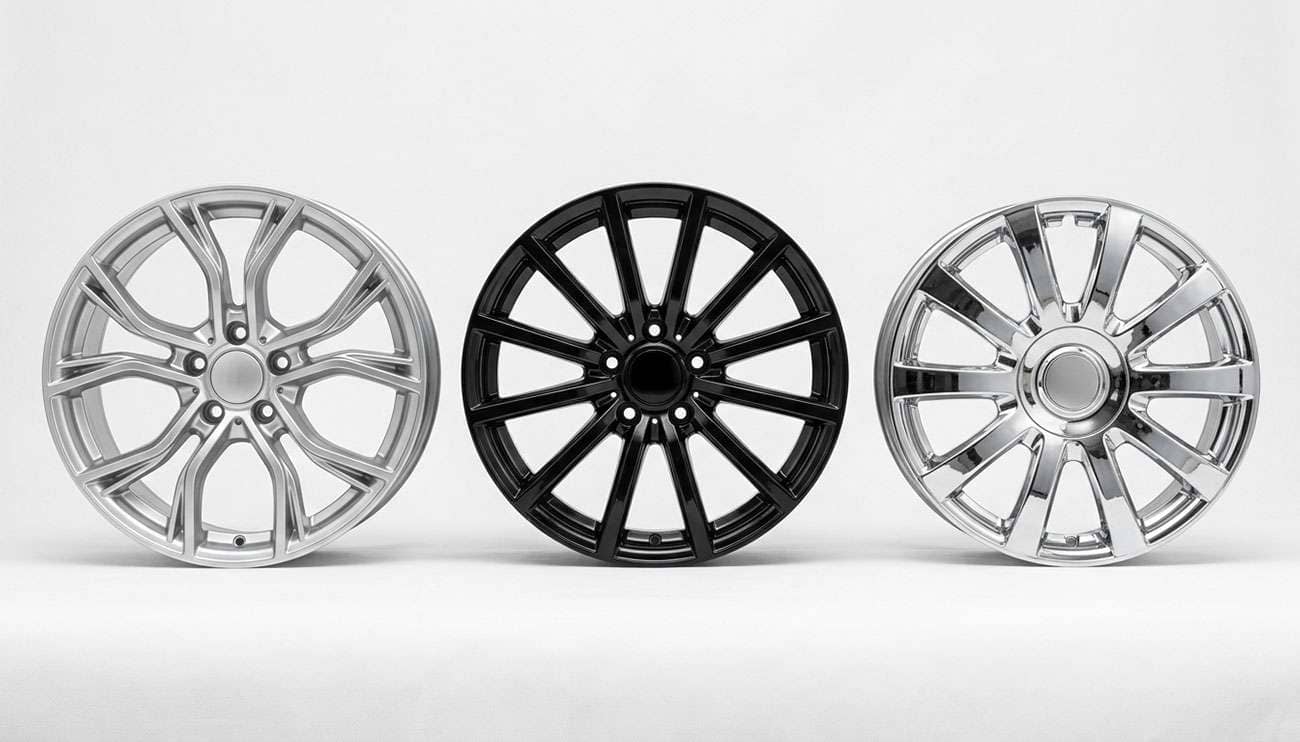
Fake rims go by three different names, and the right one depends on what is fake. A wheel that copies a factory or designer wheel's look under its own maker's name is a replica, or "rep." A wheel that copies the brand itself, logo and all, is a counterfeit, usually called a knockoff or a fake. And a cover that makes a plain steel wheel look like an alloy is not a rim at all. That is a hubcap, wheel cover, rim skin, or wheel simulator.
Here is the part nobody puts in front of you: none of those names tells you whether the wheel is safe to bolt on. The name describes what was copied. The numbers cast into the back of the wheel describe what it can carry and how it fits. A legitimate OE replica for a GM half-ton is built to the factory's 78.1 mm hub bore and a +24 to +31 mm offset. Most aftermarket wheels in the same 6x139.7 bolt pattern run a 106.1 mm bore and an offset near 0 mm. Same bolt pattern, very different fit. Start with which case you have.
What your "fake rim" is actually called
What You Have |
What It's Called |
Legal to Sell? |
What to Check |
|---|---|---|---|
A wheel that copies a factory design under another maker's name |
OE replica, OE-style, or reproduction wheel |
Generally yes, with no automaker logos |
Load rating, test mark, factory hub bore and offset |
A wheel that copies a premium aftermarket design under another name |
Rep wheel or replica |
Generally yes without logos; design patents can apply |
Load rating, test mark, and any construction claim |
A wheel with a brand's name or logo that did not come from that brand |
Counterfeit, knockoff, or fake |
No; it is trademark counterfeiting |
Missing load rating, part number, or traceable maker |
A plastic or steel cover over a steel wheel |
Hubcap or full wheel cover |
Yes |
Diameter match and retention clips |
Chrome-look plastic bonded or clipped over a wheel face |
Chrome-clad wheel, rim skin, or wheel skin |
Yes |
Lifting edges, cracks, and trapped moisture |
A stainless shell bolted over a dually or commercial wheel |
Wheel simulator or wheel liner |
Yes |
Valve stem access and lug nut retention |
A bolt-on wheel with a decorative spinner |
Knock-off style wheel |
Yes |
Whether the spinner is decorative or a real center-lock |
I spend most of my day checking fitment numbers, and the question I hear behind "what are fake rims called" is usually a different one: did I buy the real thing, and does it matter? It matters for exactly two reasons, capacity and fit. Everything below is organized around those two.
A replica wheel is a newly manufactured wheel that copies the design of another wheel but is sold under its own maker's name. Enthusiasts shorten it to "rep." The category splits three ways, and each one exists for a different reason.
OE replicas. These copy factory wheels from Chevrolet, Ford, Toyota, BMW, Mercedes-Benz, and others. Buyers use them to replace a curbed factory wheel without paying dealer prices, to add a trim-level look to a base model, or to build a winter set that looks stock. The good ones are engineered to factory fitment: same bolt pattern, same hub bore, same offset range, same lug seat. They are sold as "OE-style" or "OE replica" wheels, never as genuine OEM.
Reproduction wheels. These are replicas of classic and muscle car wheels, built for restorations where the originals are scarce, damaged, or too valuable to drive on. The same rule applies. The design is copied. The manufacturer's identity is not.
Reps of aftermarket designs. These copy the look of premium aftermarket and forged wheels at a cast-wheel price. This is the corner of the market where the name "rep" gets used most, and where quality varies the most. Some are tested and load rated. Some carry nothing on the back at all.
The name "replica" says nothing about strength. It tells you the wheel looks like another wheel. Whether it is built to carry your vehicle is a separate question, answered by the load rating and the test mark. For a deeper look at the testing side, our guide on whether replica wheels are safe breaks down each certification.
In everyday use, "knockoff" and "counterfeit" both mean a fake. In the wheel business, the line that matters is the logo. A replica copies a design. A counterfeit copies a brand: it carries the original company's name, logo, or center cap, and it is sold as if it came from that company.
That distinction is not academic. Counterfeits are built to pass a glance, not a test. In 2020, U.S. Customs and Border Protection officers in San Juan seized 844 counterfeit alloy wheels with an estimated value of about $238,000 had they been genuine. CBP's announcement noted that counterfeit wheels often fail industry safety standards and that the seized wheels reportedly could not pass pothole impact testing.
There is one more wrinkle that trips up search results. "Knock-off" is also the real name for a center-lock wheel held on by a single spinner nut that you knock loose with a hammer. Those wheels have nothing to do with counterfeiting. If you are shopping for that style, our knockoff wheels guide explains how real center-locks differ from bolt-on wheels with decorative spinners.
Replica rims are generally legal to sell and buy as long as they do not carry another company's trademarks. Counterfeit rims are not. Selling wheels with an automaker's or wheel brand's logo, without permission, is trademark counterfeiting under federal law, and imported counterfeits can be seized at the border, as the San Juan case shows.
Design is the gray area. Automakers and wheel companies can protect a wheel's appearance with a design patent, and disputes over design patents on replacement auto parts have reached federal court. A reputable replica maker manages that risk on its side. Your job as a buyer is simpler: buy from a seller who identifies the actual manufacturer and does not claim the wheel is genuine OEM. This is general information, not legal advice.
A lot of people searching for "fake rims" are not looking at a wheel at all. They are looking at a cover that makes a steel or worn wheel look like a styled alloy. Each type has its own name.
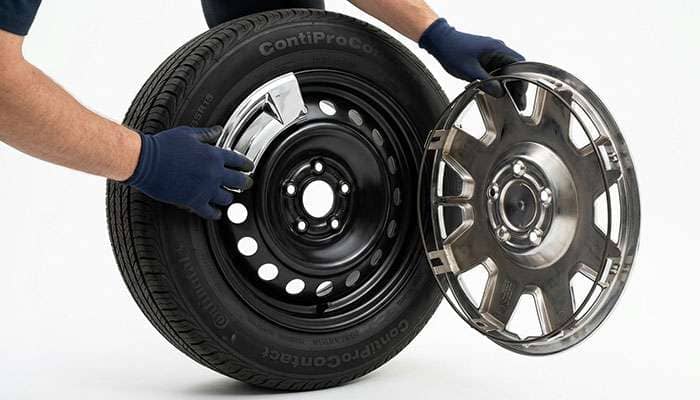
Hubcap. Strictly, a small cap that covers only the center of the wheel. In everyday speech, people use it for any wheel cover.
Full wheel cover. A plastic or steel disc that covers the entire face of a steel wheel and snaps into the rim with a wire retention ring or spring clips. Wheel covers are sized by wheel diameter, so a 16-inch cover only fits a 16-inch steel wheel. They are designed for steel wheels and generally will not mount on alloys. Our guide to installing wheel covers covers fitment and retention.
Chrome-clad wheel. The fake rim many truck owners own without knowing it. A chrome-look plastic shell is permanently bonded to the face of an aluminum wheel at the factory. GM and Chrysler used clad wheels on trucks and SUVs. They look like chrome and avoid the pitting of plated chrome, but the cladding cannot be rechromed or repaired, and a hard curb hit can crack it.
Rim skins or wheel skins. Aftermarket chrome or painted shells that clip or bond over an existing wheel face. They hide curb rash or change the look, but they add a layer where moisture and debris can collect if the edges lift.
Wheel simulators. Polished stainless shells that bolt over dually and commercial steel wheels, retained by the lug nuts or a mounting ring. They are standard equipment on many work trucks. The check is valve stem access, because you still need to set pressure on the inner dual.
None of these carry load. The steel or aluminum wheel underneath does all the work, so the questions about load rating and fitment apply to that wheel, not to the cover.
Turn it over. The face of a wheel is where the copying happens. The back is where a legitimate manufacturer identifies itself, because traceability is part of building a wheel you are willing to stand behind.
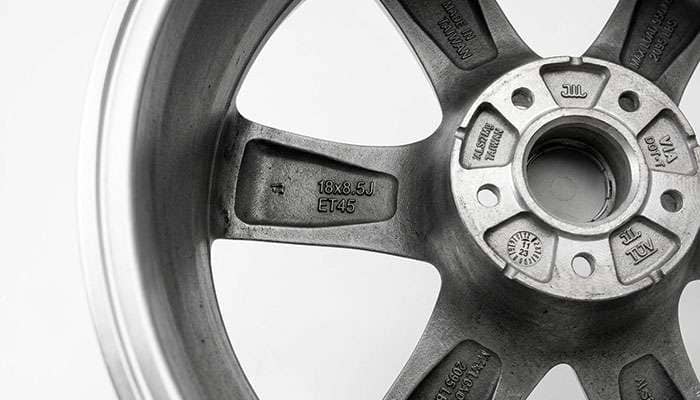
Here is what I look for on the back of any wheel, in order:
Two cautions. First, there is no federal performance test an aftermarket passenger car wheel has to pass before it is sold in the U.S. SAE J2530, which covers cornering fatigue, radial fatigue, and impact testing, is the industry standard, and it is voluntary. Second, a stamped mark is not proof. Counterfeiters copy test logos too. A mark only means something when the manufacturer behind it is identifiable and the part number checks out.
The front tells you something as well. An automaker or premium brand's logo on a wheel sold by someone who is not an authorized dealer for that brand is a counterfeit, full stop. Legitimate replicas use their own center caps or plain ones.
This is where a legitimate OE replica separates itself from a generic aftermarket wheel, and it is the comparison most guides leave out. A true OE replica is built to the factory's fitment numbers. Most aftermarket wheels are built to fit as many vehicles as possible.
Here is what the market looks like in four common fitments. Replica figures are typical across OE replica wheels sold for these vehicles. Aftermarket figures are typical across all other wheels sold in the same bolt pattern and diameter.
Vehicle |
Bolt Pattern |
Factory Hub Bore |
Typical OE Replica |
Typical Aftermarket Wheel |
|---|---|---|---|---|
GM half-ton pickups and SUVs, 20-inch |
6x139.7 |
78.1 mm |
78.1 mm bore, +24 to +31 mm offset |
106.1 mm or larger bore, offset near 0 mm |
Ford F-150, 20-inch |
6x135 |
87.1 mm |
87.1 mm bore, +20 to +44 mm offset by generation |
87.1 mm bore common, offset near 0 mm |
Toyota and Lexus cars, 17- to 18-inch |
5x114.3 |
60.1 mm |
60.1 mm bore |
72.6 mm or larger bore; hub ring needed |
Mercedes-Benz sedans, 19-inch |
5x112 |
66.6 mm |
66.6 mm bore, about +35 mm offset |
66.6 mm on about two-thirds; larger on the rest |
The GM row tells the story. Only about one in nine aftermarket 20-inch 6x139.7 wheels uses the 78.1 mm GM bore. Most are bored to 106.1 mm or larger so the same wheel also fits Toyota and Nissan trucks. And the middle of the aftermarket offset range runs from about -18 to +12 mm, while the factory sits around +24 to +31 mm.
Here is why those two numbers matter. Hub bore decides what centers the wheel. A wheel bored to the hub is hub-centric: the hub carries the weight and the lugs only clamp. An oversized bore is lug-centric unless you add a hub ring, and a lug-centric wheel that is slightly off-center causes a vibration that no amount of balancing cures. Our guide on hub-centric vs. lug-centric wheels walks through the fix. Offset decides where the wheel sits. Moving from +27 mm to 0 mm pushes the wheel out about 27 mm, a little over an inch, which changes scrub radius, adds leverage on the wheel bearings, and can bring the tire into the fender liner at full lock.
Check the lug seat too. Factory Honda and Mercedes-Benz hardware uses a ball, or radius, seat. A wheel machined for conical lugs will not seat that hardware correctly, and the reverse is also true.
Not as a rule. Legitimate replicas are load rated for the vehicles they copy, and in some sizes they carry more than the aftermarket average. Across 19-inch 5x112 wheels, Mercedes-style replicas typically carry about 2,000 lbs per wheel, while the common rating for other aftermarket wheels in that size is about 1,600 lbs. Across 20-inch 6x139.7, GM-style replicas typically run 2,100 to 2,500 lbs. Aftermarket wheels in that pattern commonly carry 2,500 lbs, because many of them are built for heavier trucks.
The real risk is not "replica." It is "unrated." A counterfeit or an untraceable rep with no load rating cast into it gives you nothing to check against your vehicle.
The math takes 30 seconds. Find the gross axle weight ratings (GAWR) on the certification label in the driver's door jamb. Divide the higher of the two by two. That is the minimum load rating each wheel needs. A truck with a 4,000-lb rear GAWR needs at least 2,000 lbs per wheel. If you tow or haul near your limits, build in margin. Our wheel load rating guide covers the details, including how to convert ratings cast in kilograms.
An untested wheel rarely fails on the first drive. It costs you in stages, and each stage costs more than the one before it.
Every rung costs more than the fix at the top: a set of wheels with a traceable maker, a load rating that covers your axle, a recognized test mark, and the right bore and offset for your vehicle.
Fake rims are called replicas, counterfeits, or covers, depending on what is being faked: the design, the brand, or the wheel itself. Replicas are a legitimate, legal way to get a factory or designer look for less. Counterfeits are not. Covers are not wheels at all.
The name will not tell you whether a wheel belongs on your vehicle. The back of the wheel will. Read the maker, the load rating, the test mark, the bore, and the offset. If those numbers match your vehicle, the wheel is the real thing where it counts, no matter what it looks like from the front.
Rep wheels are replica wheels: new wheels that copy the design of a factory or premium aftermarket wheel and are sold under their own manufacturer's name. Quality ranges widely, so check the load rating and test mark on the back before you buy.
Replica rims without another company's logos are generally legal to buy. Counterfeit rims that carry a brand's trademark without permission are illegal to sell, and imported counterfeits can be seized by U.S. Customs and Border Protection. This is general information, not legal advice.
A cover over the whole face of a steel wheel is a full wheel cover, often called a hubcap. A shell that clips or bonds over an existing wheel is a rim skin or wheel skin. A factory-bonded chrome plastic face is chrome cladding, and a stainless shell for a dually wheel is a wheel simulator.
A legitimate replica built to a recognized standard such as SAE J2530 and load rated for your vehicle can match the job a factory wheel does. An untested replica with no load rating cannot be assumed to. Compare the cast load rating to half of your vehicle's higher gross axle weight rating.
Generally no. Full wheel covers are designed to clip into the rim of a steel wheel of the same diameter. Alloy wheels have a different face profile, so a wheel cover will not retain properly and can come off at speed.
OE style means the wheel copies the look of an original equipment factory wheel but was made by an independent manufacturer. A well-built OE-style wheel also matches the factory bolt pattern, hub bore, and offset range, so it fits like the original.