
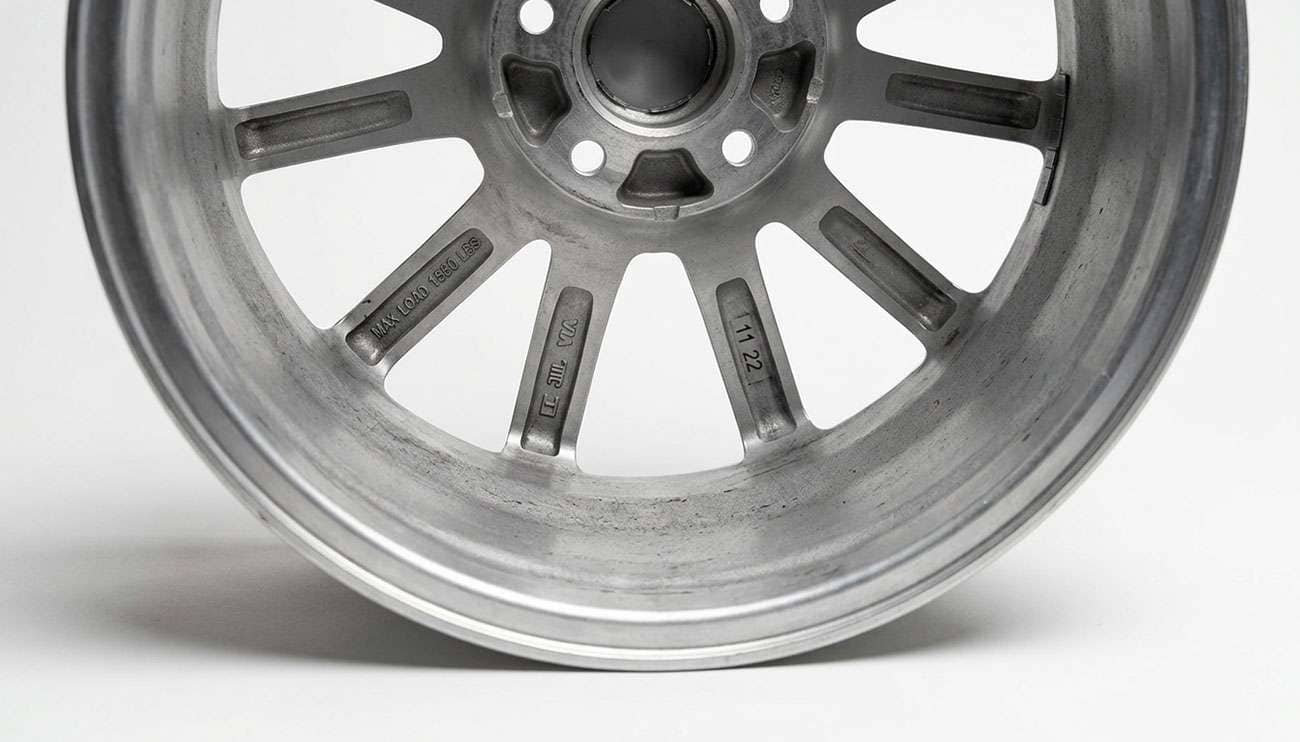
Yes, a replica wheel is safe when two things check out: it carries a recognized test mark (SAE J2530, JWL, VIA, or TUV), and its stamped load rating is at least half of your vehicle's heaviest gross axle weight rating. The word "replica" tells you nothing about safety. It only describes the styling: a wheel designed to look like a factory OE wheel. A replica from an established maker that tests to these standards can be every bit as safe as the original. A wheel with no test mark and no load rating cannot show you that, no matter what it costs or whose design it copies.
I am Dennis Feldman, and fitment and spec verification is most of my job. "Are replicas safe?" comes up constantly, usually from someone who wants the look of a BMW M wheel or a Mercedes AMG wheel without the dealer price. The honest answer is that the question is aimed at the wrong thing. You do not judge a wheel by what it looks like. You judge it by what is stamped on the back and what it was tested to carry. Here is how to read both.
What You Find |
What It Tells You |
Verdict |
|---|---|---|
Test mark (SAE J2530, JWL, VIA, or TUV) plus a load rating at or above half your GAWR |
Tested to a recognized standard and rated for your vehicle's weight |
Safe to buy, assuming correct fitment |
Test mark, but load rating below half your GAWR |
A good wheel for a lighter vehicle |
Wrong wheel for yours |
Load rating listed, no test mark or documentation |
A claim with no proof behind it |
Ask the seller for test documentation first |
No load rating and no test mark |
No way to verify strength |
Do not buy |
Automaker logo or brand name on a non-genuine wheel |
Counterfeit, not a replica |
Do not buy |
The second table compares the marks themselves, so you know what you are looking at when you flip the wheel over.
Standard |
Who Tests |
Core Tests |
Where You See It |
|---|---|---|---|
SAE J2530 |
Manufacturer or a lab it hires; voluntary industry standard |
Cornering fatigue, radial fatigue, impact |
Wheels sold in the US; marking or test documentation |
JWL |
Manufacturer, to Japan's light alloy wheel standard |
Cornering fatigue, radial fatigue, impact |
JWL stamped on the wheel, often near the hub |
VIA |
Independent third party in Japan |
Same tests as JWL, independently verified |
VIA stamp, usually alongside JWL |
TUV |
Independent testing body in Germany |
Fatigue and impact testing plus documentation review |
TUV approval documents or markings |
These two get lumped together constantly, and they should not be. The distinction changes the safety answer completely.
A replica wheel is designed to look like a factory wheel and is sold under the replica maker's own brand. It is made to the factory bolt pattern, hub bore, and offset range for the vehicle it is designed for. Replica wheels are a legitimate category, and established replica brands build to the same test standards as any other aftermarket wheel. If you want to see how the category breaks down, our guide to the best replica wheel brands walks through options from budget to premium.
A counterfeit wheel is made to pass as the genuine part. It carries the automaker's logo, center cap, or part numbers, and it is sold as if it came from the factory. That is a different thing entirely. A counterfeit's whole purpose is to hide where it came from, so you have no maker to hold responsible and no way to verify its testing. Any wheel carrying an automaker's badge at a price far below dealer cost deserves suspicion.
Here is the practical rule. A real replica says who made it. A counterfeit pretends somebody else did.
These are the two marks you will see most often on the back of an aftermarket wheel, including many replicas. They are related, but they do not mean the same thing.
JWL stands for Japan Light Alloy Wheel. It is the standard alloy wheels must meet to be sold in Japan. A JWL mark means the manufacturer states that the wheel passed the standard's tests: cornering fatigue, radial fatigue, and impact.
The important detail is who did the testing. JWL is self-certified. The manufacturer tests the wheel, or has it tested, and then applies the mark. That is not worthless. It means the maker is putting its name behind a specific, published test. But nobody independent checks the result before the mark goes on.
VIA refers to registration through Japan's Vehicle Inspection Association. A VIA mark means an independent body tested the wheel to the JWL requirements and registered it. That is the difference: JWL is the maker's word, and VIA is a third party confirming it. When you see both marks together, the wheel was tested to JWL and verified by VIA.
Each test simulates a different way a wheel fails in real life. The cornering fatigue test bends the wheel at the hub, over and over, the way hard cornering does, to see whether cracks start in the center or the spokes. The radial fatigue test rolls the wheel under load, the way it carries the car every mile, to see whether the rim and spokes hold up. The impact test drops a weight onto the rim edge, the way a pothole or curb strike does, to see whether the wheel cracks or loses air. A wheel that passes all three has shown it can handle the loads it will actually see.
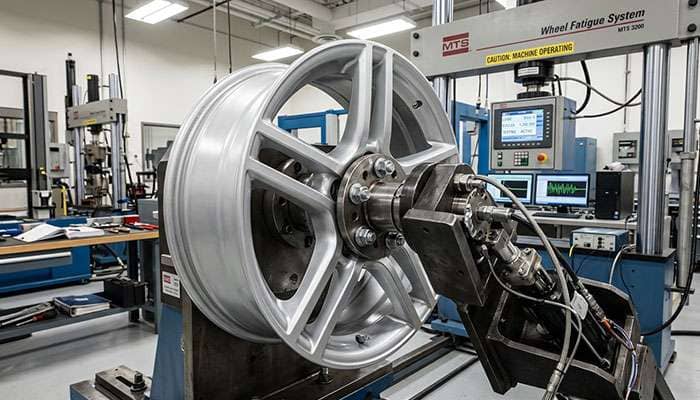
SAE J2530 is the Society of Automotive Engineers standard for aftermarket wheels on passenger cars, light trucks, and multipurpose vehicles. It sets performance requirements and test procedures for the wheels sold in the US aftermarket.
Like JWL, it is built around three tests. The radial fatigue test loads the rim flanges and spokes that carry the vehicle's weight. The cornering fatigue test works the hub and center disc, and is generally considered the most demanding of the three. The curb impact test simulates hitting a curb and checks for rim damage and air loss.
Here is the part most people do not know. SAE J2530 is a voluntary industry standard. It was developed through SAE with input from the aftermarket wheel industry, including SEMA's wheel and tire group, as a way for the industry to hold itself to a safety standard. No federal law requires aftermarket passenger car wheels to pass it.
That is why the mark, or the test documentation behind it, matters so much. Reputable manufacturers test to J2530 because it is the right thing to do and because it protects them. A wheel that cannot show any testing has not demonstrated anything.
Some wheels, especially those made for the European market, carry TUV approval. TUV is an independent testing and certification body in Germany. Its wheel approval process includes testing and a review of the maker's documentation. If a wheel carries TUV approval, you can treat it as independently verified.
This is the variable almost every replica wheel article skips, and it matters as much as the test mark. A wheel can pass every test and still be the wrong wheel for your vehicle if it was rated for a lighter one.
The load rating is the maximum weight the wheel is designed to carry. It is usually stamped on the back of the wheel, on a spoke or the inner barrel, and listed in the wheel's specifications. It is given in pounds or kilograms.
Find your vehicle's gross axle weight rating, or GAWR. It is on the sticker in the driver's door jamb, listed separately for the front and rear axle. Take the higher of the two and divide by two. That is the minimum load rating each wheel needs.
Example: a sedan with a front GAWR of 2,600 pounds and a rear GAWR of 2,400 pounds. Take 2,600, divide by two, and you need wheels rated for at least 1,300 pounds each. A heavier SUV with a 3,400-pound rear GAWR needs at least 1,700 pounds per wheel.
That is the floor, not the target. If you tow, haul, or drive off pavement, pick a wheel rated with some margin above that number. We go deeper into the numbers, including truck and towing loads, in our wheel load rating guide.
Replica wheels are often designed for a whole family of vehicles that share a bolt pattern. The same design might fit a compact sedan and a much heavier SUV from the same automaker. If the replica was rated with the sedan in mind, it may not carry the SUV. Matching the bolt pattern is not enough. Check the load rating against your own GAWR every time.
It changes how the strength is achieved, but it does not change the test. A wheel made any of these ways can pass or fail.
Most replica wheels are cast, meaning molten aluminum is poured into a mold. Cast wheels are the most affordable. To reach a given strength, a cast wheel generally needs more material than a forged one, so it tends to be heavier. That is a normal tradeoff, not a safety problem, as long as the wheel was designed and tested correctly.
Flow-formed wheels start as a casting, then the barrel is spun and pressed under heat. That stretches and compresses the metal, making the barrel stronger and lighter. Forged wheels are pressed from a solid billet of aluminum under very high pressure. They are the strongest for their weight and the most expensive.
The takeaway: a forged label does not replace a test mark, and a cast label does not mean weak. Our comparison of cast vs. forged vs. flow-formed wheels lays out the strength, weight, and price differences in detail.
A good replica should fit like the factory wheel. Three fitment details decide whether it does, and each one is a safety issue, not just a looks issue.
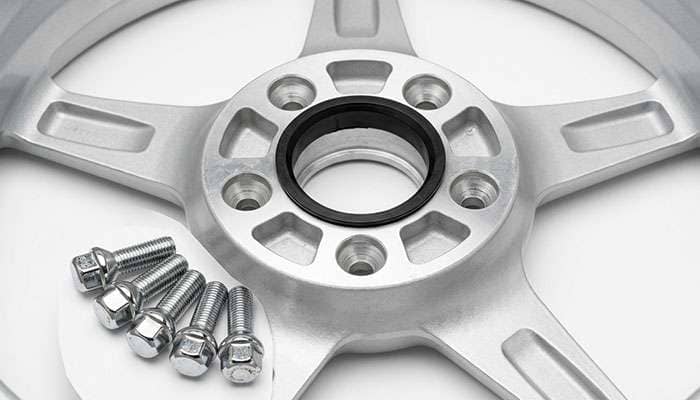
The hub bore is the center hole that fits over your vehicle's hub. On a factory wheel, it is sized exactly to the hub, so the hub carries the weight and keeps the wheel centered. Many replicas are made with the exact factory bore for the vehicle they are designed for. Others use a larger bore so one wheel fits several vehicles, and rely on a hub-centric ring to fill the gap. Without that ring, the lug nuts end up centering and carrying the wheel, which can cause vibration and loose lugs. Our article on hub-centric vs. lug-centric wheels explains why this matters.
The lug seat is the shape where the lug nut or bolt meets the wheel. Common types are conical, ball, and flat. Many European factory wheels use ball-seat lug bolts, while many aftermarket wheels use conical seats. If you reuse your factory bolts on a replica with a different seat, they will not clamp correctly and can work loose. This is one of the most common mistakes I see. Check our guide on lug nut seat type mismatch before you install.
Offset sets where the wheel sits in the wheel well. A replica designed for your vehicle should use a factory-like offset. A wrong offset can cause rubbing, put extra stress on wheel bearings, and change how the car handles.
You can usually tell before you buy. Look for these signs.
The maker is named. A legitimate replica wheel is sold under its maker's brand, and that brand has a real presence: a website, a warranty, and a history. If the listing does not say who made the wheel, that is a problem.
The specs are complete. Size, bolt pattern, offset, hub bore, and load rating should all be listed. A missing load rating is a red flag.
Test marks are stamped or documented. Look for JWL, VIA, TUV, or SAE J2530 on the wheel, or ask for test documentation. A reputable seller can answer that question.
The markings are on the wheel. Beyond the test mark, a quality wheel usually carries the maker's name, size, load rating, part number, and production date cast or stamped on it. That is what makes it traceable.
The price makes sense. Replicas cost less than factory wheels, which is the point. But a set priced far below other replicas of the same size deserves a closer look.
No automaker branding. A replica should not carry the automaker's logo or claim to be genuine. If it does, it is a counterfeit.
An untested wheel does not usually fail on day one. It fails over time, and the damage builds in a predictable order.
1. Vibration and loose lugs. A wheel with the wrong bore or seat, or one that is not quite true, shakes at speed and can loosen its lug nuts.
2. Bent rims. A weak rim bends the first time it meets a serious pothole. A bent rim leaks air, throws the balance off, and often cannot be straightened safely.
3. Tire damage. The same pothole that bends a weak rim can pinch the tire against it. If that happens, read our guide on tire sidewall damage before you drive on it.
4. Fatigue cracks. Repeated loading starts cracks at the spokes or near the lug holes. They grow slowly and are often hidden behind the tire or the brake caliper. If you find one, our article on whether a cracked wheel is safe to drive covers what to do.
5. Wheel separation. The worst case is a wheel that cracks through at the hub or the spokes and comes apart. At highway speed, that is a crash.
6. Buying wheels twice. Most of the time, an untested set ends up replaced by a tested one anyway. Buying a tested, properly rated wheel the first time is the cheapest point on this list.
Here is the process I would follow, start to finish.
Step 1: Get your GAWR. Read the front and rear gross axle weight ratings from the driver door jamb sticker. Divide the higher number by two. Write it down; that is your minimum load rating per wheel.
Step 2: Confirm your fitment specs. Know your bolt pattern, hub bore, factory offset, and lug seat type before you shop.
Step 3: Choose a named maker. Buy replicas sold under an established brand with a warranty, not anonymous listings.
Step 4: Check the load rating. Make sure it meets or exceeds the number from Step 1, with extra margin if you tow or carry heavy loads.
Step 5: Look for a test mark. SAE J2530, JWL, VIA, or TUV, on the wheel or in the documentation.
Step 6: Match the hardware. Use the correct lug seat type and hub-centric rings if the bore is larger than your hub.
Step 7: Torque correctly and re-check. Torque lug nuts to your vehicle's specification with a torque wrench, then re-check after the first 50 to 100 miles.
When you are ready to shop, browse our custom wheels and filter by your vehicle so the bolt pattern and offset are already matched.
Replica wheels are as safe as the testing and rating behind them. The name "replica" only means the wheel copies a factory look. What makes it safe is a recognized test mark, a load rating that covers your vehicle, and fitment that matches your hub, your lug hardware, and your offset.
Skip the counterfeits and the anonymous listings. Choose a named maker, read what is stamped on the back, and do the GAWR math. Do that, and you can get the factory look for a lot less money without giving anything up on safety.
Replica wheels are safe when they carry a recognized test mark such as SAE J2530, JWL, VIA, or TUV, and a load rating of at least half your vehicle's highest gross axle weight rating. The replica label itself only describes the styling.
JWL means the manufacturer states the wheel meets Japan's Light Alloy Wheel standard for cornering fatigue, radial fatigue, and impact. VIA means an independent body in Japan tested and registered the wheel to that standard.
No. SAE J2530 is a voluntary industry standard for aftermarket wheels on passenger cars and light trucks. Reputable manufacturers test to it, but no federal law requires it.
Find the gross axle weight rating on your driver door jamb sticker, take the higher of the front and rear numbers, and divide by two. Each wheel should be rated for at least that much, with extra margin for towing or heavy loads.
No. A replica copies a factory design and is sold under its own maker's brand. A counterfeit, or fake, carries the automaker's logo or claims to be genuine when it is not.
Only if the wheel's center bore is larger than your vehicle's hub. Many replicas use the exact factory bore. If yours does not, a hub-centric ring keeps the wheel centered and lets the hub carry the load.



