
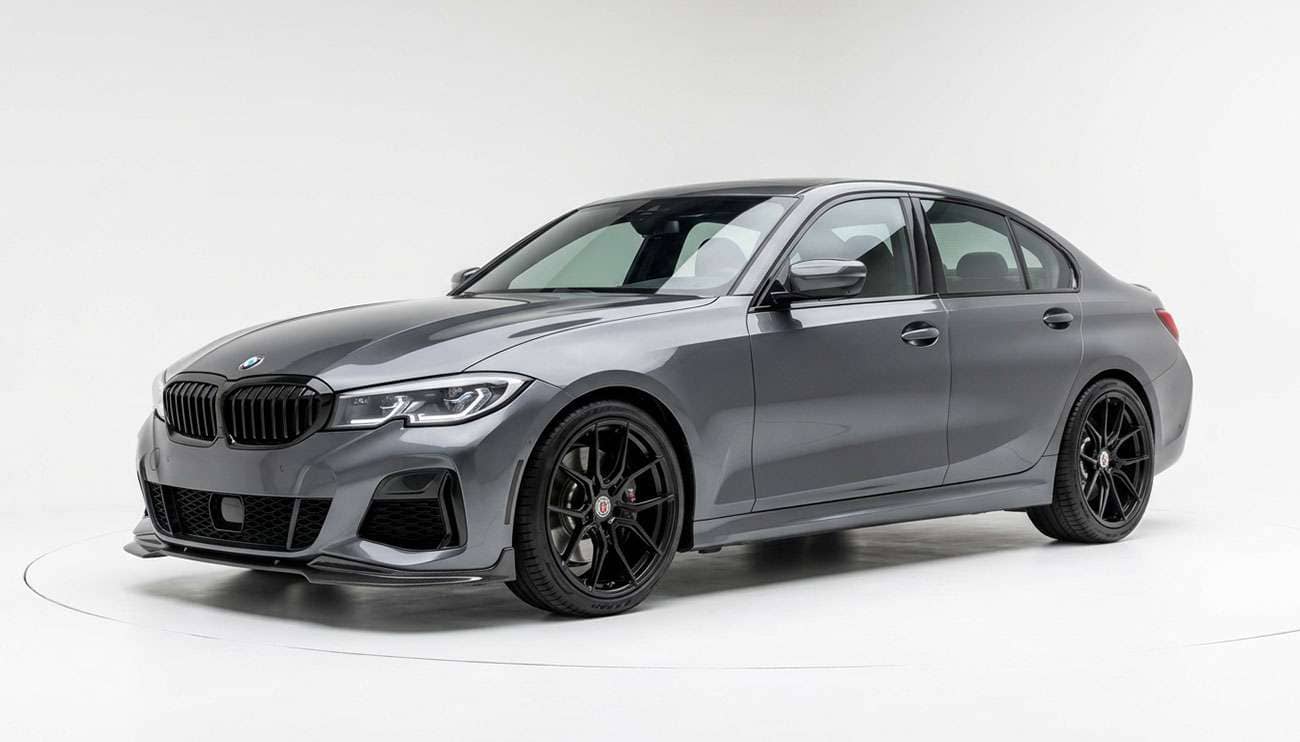
Not by themselves, no. Aftermarket wheels do not carry one value. The identical set is priced three different ways depending on who writes the check. Every other article on this question tells you it depends on "choosing and installing correctly" and then never says what correct means. Here is the variable they leave out: your disposition path. A dealer appraiser, a mainstream private buyer, and an enthusiast buyer look at the same four wheels and arrive at three different numbers. Find your path first, then decide what to do with the wheels.
I have spent a long time on the fitment side of this business, and the pattern is consistent. Owners ask whether wheels add value as though the wheels have an inherent price tag attached to the car. They do not. What has a price tag is the transaction, and the transaction changes shape based on who is buying, what kind of vehicle you are selling, and whether the factory set is still sitting in your garage. The table below is the fastest way to find yourself.
Your Disposition Path |
Effect on the Number |
Best Move Before You List |
|---|---|---|
Dealer trade-in or instant online offer |
No upside. Reconditioning risk on the downside. |
Reinstall the factory set and sell the aftermarket wheels separately |
Private party, mainstream commuter car |
Neutral at best. Reads as "modified" to a cautious buyer. |
Reinstall the factory set, or list the car with both sets included |
Private party, enthusiast platform |
Genuine gain, mostly as speed of sale rather than sticker price |
Leave them on and document brand, size, offset, and receipts |
Lease return |
Zero upside. Near-certain excess wear charge if the factory set is gone. |
Reinstall the factory set before inspection. No exceptions. |
Selling the wheels alone, keeping the car |
Factory wheels have a resale floor. Most aftermarket wheels do not. |
Sell the factory set only if you are keeping the vehicle long term |
No. At a franchise dealer, a used car superstore, or an instant online offer service, aftermarket wheels are worth exactly zero dollars of upside, and the mechanism behind that is worth understanding because it explains almost everything else in this article.
A trade-in appraisal is not an opinion about your car. It is a calculation. The appraiser starts from wholesale book value for that year, make, model, trim, and mileage, then adjusts for condition, reconditioning cost, and how fast that unit is expected to turn on their lot. Every one of those inputs is tied to the vehicle as the manufacturer built it. There is no field on the appraisal sheet for the wheels you chose. Options and packages the factory installed move the number because the guidebooks track them. Parts you installed do not, because the guidebooks do not track them and the wholesale auction market does not pay for them.
That accounts for the zero. The downside is a separate line. Dealers recondition every trade before it hits the front line, and reconditioning means returning the car to the configuration their buyer expects. If your wheels are not the factory set, the appraiser has to consider whether they need to source a replacement set to make the car retail-ready, and that estimate lands in the deduction column. This is not hostility toward modification. It is inventory math. A unit that needs sourcing sits longer, and a unit that sits longer costs the dealer money every day.
There is a second and larger risk at trade-in, and it has nothing to do with taste. If the wheels raise a mechanical or safety question during the walkaround, the appraisal stops being about wheels and starts being about the car. A shimmy at 40 mph, a tire pressure warning on the dash, or visible rub marks in the wheel well all suggest problems that go deeper than four rims, and appraisers price uncertainty conservatively. That is the section further down on fitment flags, and it is where most of the real money is lost.
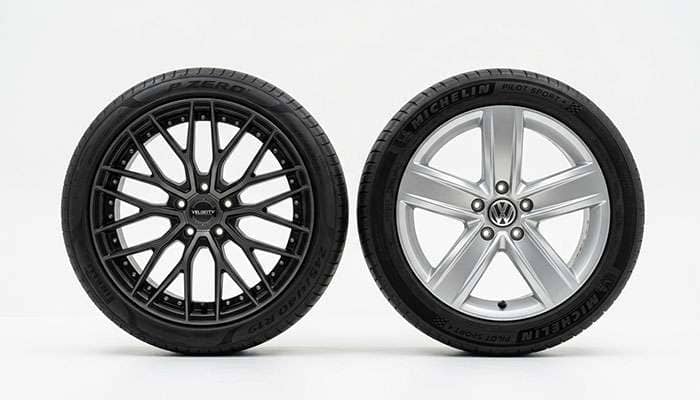
Selling a Camry, an Accord, a CR-V, or a Rogue to a private buyer is a different transaction, but the answer lands close to neutral, with the risk tilted slightly against you.
The buyer for a mainstream commuter car is usually risk-averse. They are buying transportation, often with a limited budget and no cushion for surprises. Their entire evaluation is a search for reasons this car might cost them money. Against that backdrop, any visible deviation from stock is a question mark, not a feature. Fair or not, wheels are read as a proxy for how the car was driven. Some buyers will assume the previous owner cared about the car and spent money on it. Others will assume the previous owner drove it hard. You do not get to choose which buyer shows up.
The practical consequence is not usually a lower price. It is a smaller pool of interested buyers and a longer time to sale, which quietly becomes a lower price when you start dropping the listing to move it. Days on market is the hidden cost here, and it is the cost most owners never attribute to the wheels.
There is a version of this that works in your favor. If you list the car and include the original factory wheels in the sale, the objection evaporates. The buyer who wants stock has stock. The buyer who likes the aftermarket set gets both. You have converted a question mark into a bonus, and it costs you nothing except the garage space you were already using. This is the single easiest way to sell a modified mainstream car without a discount.
There is a real case where the answer is yes, and it is narrower and more specific than most articles admit. Aftermarket wheels increase what you get for the car when three conditions line up at once.
The vehicle is an enthusiast platform. Mustang, Camaro, Challenger, WRX, GTI, Miata, 4Runner, Tacoma, Bronco, Wrangler, F-150 in the trims people actually build. On these vehicles the buyer pool is already made up of people who intended to change the wheels. You did the work and spent the money first. That has value to them because it is money and time they no longer have to spend.
The brand and the specification are legible. A buyer who knows wheels can recognize a known manufacturer at a glance and can look up what a set costs new. A wheel with no brand identity is not something a buyer can price, and anything a buyer cannot price, they discount. This is why construction method matters to resale in a way it never matters at a trade-in desk. Forged and flow-formed wheels from established makers hold recognizable value. Generic cast wheels do not, no matter what they cost you.
The fitment is correct and provable. This is the condition that separates a set that adds money from a set that raises alarms, and it is covered in detail below.
Even with all three lined up, be honest about the shape of the gain. The main return is not a higher asking price. It is a faster sale at your asking price, with fewer lowball offers and less negotiation. On an enthusiast platform, wheels function as a demand accelerator. You are not usually recovering what you spent. You are converting a set of wheels into a shorter listing and a firmer price, which is a real return but a different one from what most owners are hoping to hear. If you are still deciding whether to buy in the first place, we worked through that math separately in our guide to whether custom wheels are worth the money.
This is the part almost nobody spells out, and it is where the actual dollars are.
In most cases your aftermarket wheels are worth more sold as a separate set than they are worth attached to the car you are selling. Bolted to a Corolla headed to a trade-in desk, they add nothing. Listed on their own, sized and specified for a platform that has buyers, they have a market. Not the market they had when they were new, but a real one.
The factory wheels work the other way, and understanding why is useful. Original equipment wheels have a resale floor that most aftermarket wheels never have, because there is a permanent, repeating pool of buyers who need an exact factory match. Body shops finishing collision repairs, owners who bent one wheel on a pothole, fleet operators replacing a damaged spare. That demand does not depend on taste. It depends on how many of that vehicle are on the road, which is why factory wheels off high-volume vehicles often move faster than wheels off low-volume luxury models. Rarity does not create demand. Volume does.
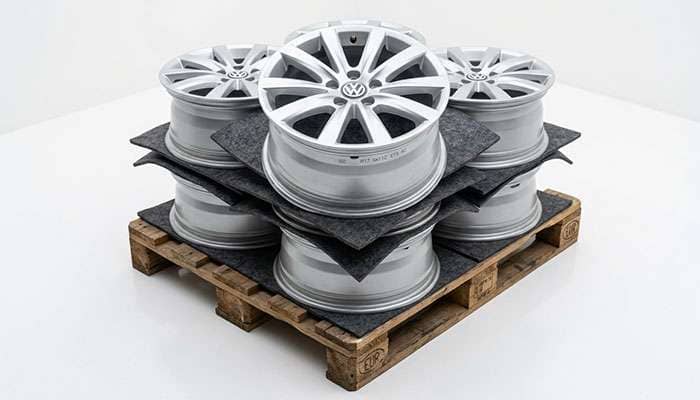
Put those two facts together and the play becomes obvious. Keep the factory set. Store it. When you sell the car, put the factory wheels back on and list the aftermarket set separately. You collect wholesale book value on a stock-configuration car with no reconditioning deduction and no fitment questions, plus whatever the aftermarket set brings on its own. In nearly every scenario except the enthusiast private sale, that path returns more than leaving the wheels on the car.
This also reframes the purchase decision going the other direction. If you keep the factory wheels when you buy aftermarket, the wheel purchase is close to risk-free from a resale standpoint. You have not altered what the car is worth. You have added an asset alongside it. The owners who get hurt on resale are almost always the ones who sold or discarded the factory set, because they removed the option to reset. Our breakdown of the true cost and value of OEM versus aftermarket wheels covers the purchase-side math in more depth.
One warning on storage. Wheels stored badly lose value. Stack them flat with something soft between the faces, keep them out of standing water and off bare concrete in a damp garage, and keep the center caps and the correct lug nuts with the set. A factory set that shows up with three caps and mismatched hardware is worth measurably less than a complete one.
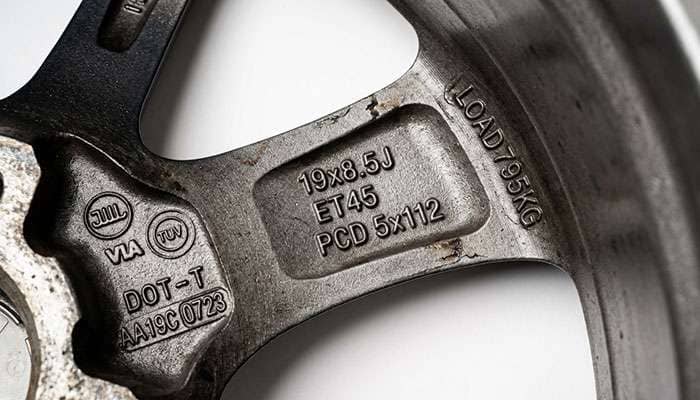
Everything above assumes the wheels are correctly specified for the vehicle. When they are not, the conversation stops being about resale value and starts being about a defect, and defects are priced very differently from preferences.
There is a point worth making here about standards, because it is the part of this question the general-interest articles never touch. In the United States there is no federal performance test that aftermarket wheels must pass before sale. Federal requirements cover markings and certain dimensional items, not strength. The industry standard that fills that gap is SAE J2530, developed with the Specialty Equipment Market Association and its Wheel and Tire Council, which defines cornering fatigue, radial fatigue, and impact testing for aftermarket passenger car and light truck wheels. Reputable manufacturers test to it. Nobody is required to. That distinction is exactly why a buyer or an inspector treats an unidentifiable wheel differently from a known one, and why brand legibility translates into money at sale time.
Here is what actually gets flagged and what it costs you.
Fitment Flag |
What the Buyer or Appraiser Sees |
Effect on Your Number |
What You End Up Buying |
|---|---|---|---|
Load rating too low for the axle |
A safety finding on the inspection sheet |
Deal-breaker on trucks and SUVs |
A correctly rated wheel set |
Wrong offset for the vehicle |
Rub marks in the wheel well, uneven tire wear |
Body reconditioning estimate plus a tire deduction |
Correct-offset wheels and usually tires |
Not hub-centric, no hub rings fitted |
Steering shimmy on the test drive |
Buyer walks away assuming a suspension problem |
Hub rings, or a hub-centric wheel set |
Missing or dead TPMS sensors |
A warning light illuminated on the dash |
Immediate diagnostic deduction and lost trust |
Four sensors and a relearn procedure |
Wrong lug seat type or hardware |
Scored seats, loose or over-torqued lug nuts |
Safety finding, possible stud replacement |
Correct lug hardware, sometimes new studs |
The load rating item deserves the most attention because it is the one owners most often get wrong and the one with the most serious consequences. A wheel has a stamped load capacity, and each wheel needs to carry its share of the heaviest axle the vehicle is rated for. The working guideline is that each wheel should be rated for at least half of the gross axle weight rating it sits under, with margin on top for towing, hauling, or heavy off-road use. Passenger-car-rated wheels fitted to a half-ton truck fail this test routinely, and they fail it invisibly until something loads the wheel hard. Our wheel load rating guide walks through how to read the stamping and match it to your vehicle.
Offset is the second most common error and the most visually obvious to anyone inspecting the car. Pushing the wheel outward changes scrub radius, loads the wheel bearing differently than the engineers intended, and brings the tire closer to the fender liner. The evidence is easy to spot even for a non-expert, which is precisely the problem at sale time. See the problems incorrect wheel offset causes for the full mechanical picture.
TPMS is worth one specific note, because it produces a strange asymmetry. If you sell the wheels alone, sensors add nothing to the price. If you sell the car with a TPMS light on the dash, it costs you real money, because a warning light during a test drive is an unresolved problem in the buyer's mind and they will price it as one. Sensors do not add value to a wheel. They subtract value from a car when they are not working. Our guide to TPMS sensors for aftermarket wheels covers what transfers, what does not, and what a relearn involves.
The deductions above show up on one day, at the sale. The damage accumulates every day before that, and it compounds in a predictable order.
It starts as contact. A wheel and tire package pushed too far outward makes light contact with the fender liner at full lock or over compression. At first this is a noise on a driveway ramp. Then it is a scuff on the liner. Then the liner tears, and now there is a piece of plastic touching the tire at speed.
Next it moves to the tire. Changed scrub radius alters how the tire loads through a corner and how it tracks in a straight line. You see it as feathering across the tread blocks and shoulder wear that does not match side to side. That is a tire set retired early, and tires are the second most expensive consumable on the car after fuel.
Then it reaches the hub. Offset determines the lever arm between the tire contact patch and the wheel bearing. Move the wheel outward and you increase that lever arm, which increases the bending load the bearing carries on every mile. Bearings do not fail suddenly from this. They fail early, and the noise arrives long after the wear started.
Meanwhile the wheels themselves are collecting damage. A wheel sitting further out is more exposed to curbs, and curb rash on all four corners moves a set from clean to discounted. It also moves the wheels out of the resale bracket where they would have brought real money as a separate sale, which cancels the strategy that was going to save you at trade-in time. If you are already there, repairing curb rash is usually worth doing before either sale.
The ladder ends in the same place every time. Liner, then tires, then a bearing, then a wheel set that no longer has resale value, and finally an appraiser who prices all of it into one conservative number. The wheels did not cost you money because they were aftermarket. They cost you money because they were specified wrong, and every mile you drove on them made the bill larger.
Work through these in order. Most of it takes an afternoon.
If step three or four turned up a problem, you are not looking at a resale question anymore. You are looking at a fitment correction, and it is worth doing correctly. Our aftermarket rims catalog lets you filter by the specifications that matter here, so you can match load rating, offset, and bore to what your vehicle actually calls for rather than guessing from a photograph.
The honest answer to whether aftermarket wheels add value is that they add value in one specific situation and remove it in several others, and the deciding factor is not the wheels. It is who you are selling to and whether you still have the factory set.
Sell to a dealer and the wheels are worth nothing on the upside and something on the downside. Sell a commuter car privately and they are close to neutral, costing you time rather than price. Sell an enthusiast vehicle privately and correctly specified, recognizable wheels genuinely help, mostly by shortening the listing. And in almost every case, the highest-return move is the one nobody mentions: keep the factory wheels, put them back on before you sell the car, and sell the aftermarket set on its own.
The part that is fully in your control is specification. Wheels that carry the load, sit at the right offset, center on the hub, and keep the sensors working never become a deduction. Wheels that miss those marks become a defect, and a defect is priced far more harshly than a preference ever will be.
They can, but usually not for the reason owners expect. Correctly specified wheels rarely lower the price directly. What lowers value is reconditioning cost at a dealer, a narrower buyer pool on a mainstream car, or a fitment problem that reads as a mechanical defect during inspection. A wheel with the wrong load rating or offset costs real money. A tasteful, correctly fitted set usually does not.
At a dealer or instant-offer service, yes, almost always. The appraisal is calculated from book value and reconditioning cost, and aftermarket wheels add nothing to the first while creating risk in the second. Reinstall the factory set, then sell the aftermarket wheels separately. That path typically returns more than leaving them on the vehicle.
No. Trade-in appraisals price factory options and packages because the valuation guides and wholesale auction market track them. Owner-installed parts are not tracked and do not appear on the appraisal sheet as a credit. The only direction aftermarket wheels move a dealer offer is down, through reconditioning estimates or inspection findings.
In most cases, sold separately. Attached to a car headed for a trade-in desk they add nothing. Listed on their own, with the size, offset, and bolt pattern stated clearly, they reach buyers actively looking for that specification. The exception is an enthusiast vehicle sold privately, where the wheels help sell the car faster than they would sell on their own.
Installing aftermarket wheels does not void an entire warranty on its own. What a manufacturer can do is deny a specific claim if the modified part caused the failure. A wheel with an incorrect load rating or offset that damages a bearing, a stud, or a suspension component gives them a clear basis to decline that repair. Correct specification is the protection here, which is another reason the stamped load rating matters.
Two categories. Original factory wheels hold value because there is a permanent replacement market for exact fitment, driven by body shops and owners replacing a single damaged wheel. Above that, forged and flow-formed wheels from established manufacturers hold value because the buyer pool can recognize and price them. Unbranded cast wheels lose value fastest, because a buyer who cannot identify a wheel cannot price it and will discount accordingly.



