
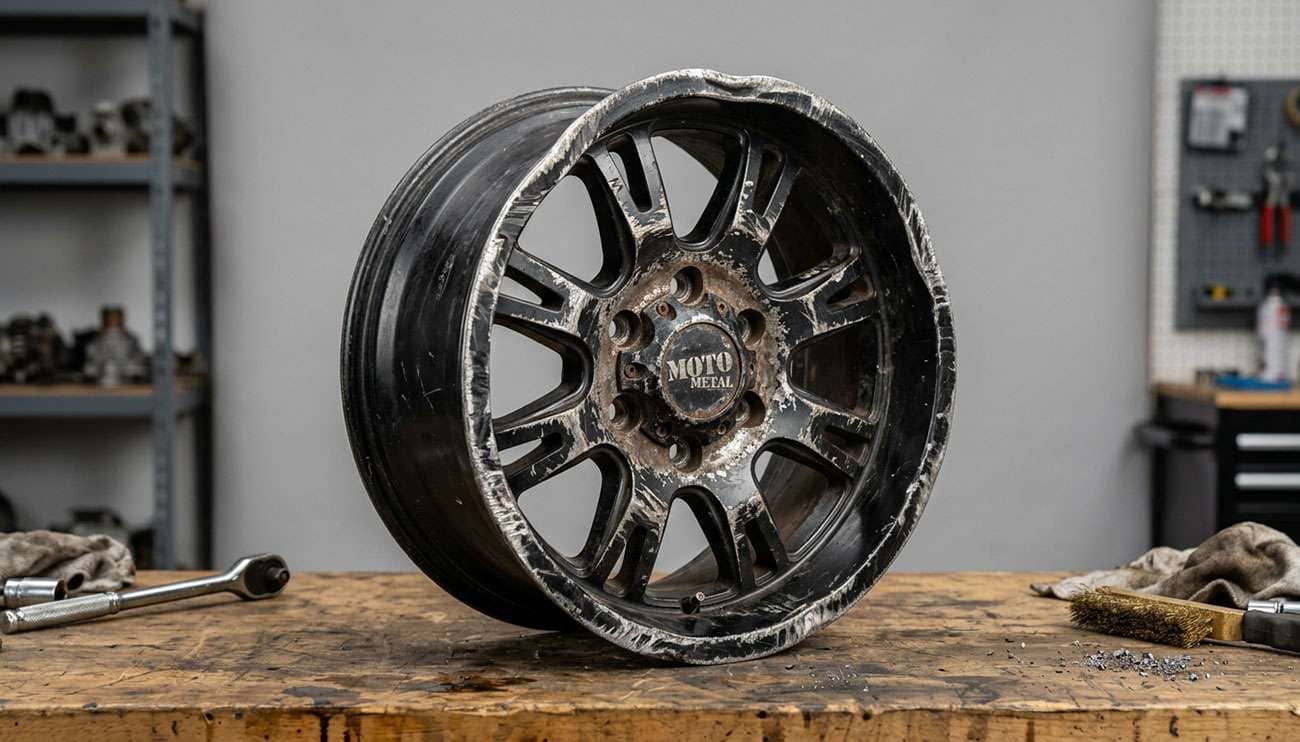
Truck rims fail in different ways than passenger car wheels — and for specific engineering reasons. A half-ton pickup carries 1,500 to 2,000 pounds more curb weight than a typical sedan. A three-quarter-ton or one-ton truck can weigh nearly twice as much. Add towing loads, higher lug torque specs (typically 120 to 165 lb-ft on trucks versus 80 to 100 on passenger cars), larger factory wheel diameters, and off-road use, and the engineering margins that let a passenger car wheel run indefinitely can disappear fast.
This guide covers the eight most common truck rim failure modes, what causes each one, how to spot them early, and when a rim is worth repairing versus replacing. Whether you're running a work truck, a heavy-duty dually, or a lifted off-road rig, the failure patterns below come up repeatedly in the shop.
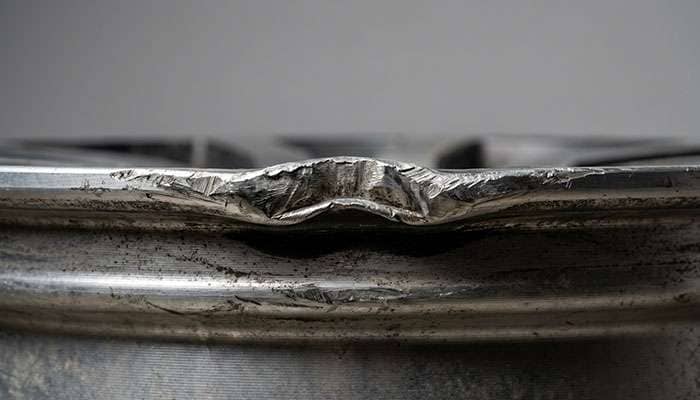
The most common truck rim problem diagnosed in most shops is a bent rim — either at the outer lip, inside the bead seat, or along the inboard rim flange. Trucks are especially prone for two engineering reasons.
First, higher vehicle weight means more kinetic energy transferred into the wheel on impact. A half-ton pickup hitting a pothole at 45 mph delivers roughly 50% more force to the rim than a similar-speed sedan strike. A loaded three-quarter-ton truck doubles that figure again.
Second, modern trucks run larger diameter wheels (18, 20, and 22 inches are common factory options) with shorter sidewall tires. A 35-inch off-road tire on a 20-inch wheel has significantly less sidewall flex than a 65-series passenger tire to absorb impacts. The energy that a tall sidewall would dissipate as deformation goes directly into the rim edge.
How to spot a bent rim: steering wheel vibration that gets worse at highway speeds, a thumping sensation at low speeds, and visible deformation if you sight along the wheel edge while rotating the tire slowly. If vibration is the first symptom, our guide on steering wheel vibration walks through the diagnostic sequence.
Minor bends under 1/8 inch in depth can often be corrected with hydraulic rim straightening at a qualified shop. Anything deeper, anything on the inboard (back) side of the wheel, or anything that affects the bead seat area is replace-only.
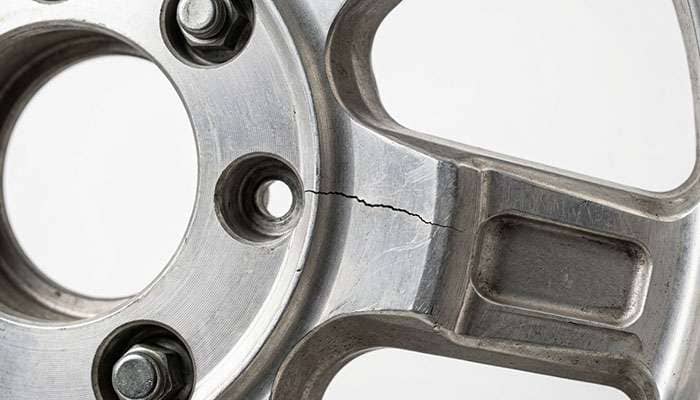
Cracks are the second most common truck rim problem — and by far the most dangerous. Unlike bends, cracks grow. A hairline fracture that doesn't fail today can propagate into complete separation next month. A truck wheel that cracks through at highway speed fails catastrophically.
Common truck rim crack locations:
Off-road trucks and heavy-load haulers develop cracks far more often than highway-only trucks. Every rock hit, every hard cornering load, every loaded-to-unloaded transition accumulates metal fatigue in the wheel structure. Aluminum alloy wheels are particularly susceptible to fatigue cracking because aluminum lacks the fatigue endurance limit that steel has — given enough cycles, any stress level will eventually crack aluminum.
A cracked wheel is replace-only. Welding structural aluminum wheels is not a reliable repair, regardless of what any refinisher claims. The weld heat changes the temper of the surrounding metal, creating a weaker zone immediately adjacent to the repair. Drive on a welded structural wheel at highway speeds at your own risk.
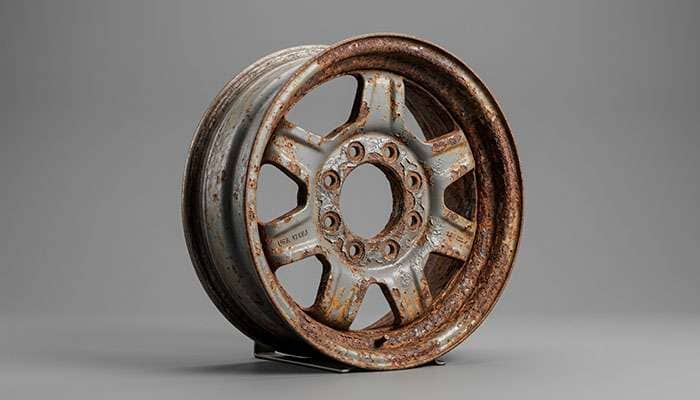
Both wheel materials corrode, but in different ways, at different rates, and with different failure outcomes. Understanding the difference matters because truck wheels get far more exposure to salt, brine, and road chemicals than most passenger car wheels.
Steel truck wheels corrode through the paint or powder coat at any point where the coating is breached — curb strikes, rock damage, factory coating defects, or trailer loading scrapes. Once surface metal is exposed, rust spreads under the coating through a process called filiform corrosion. Rust pockets expand outward, lifting the coating in characteristic worm-like patterns. Serious rust at the bead seat area can cause slow air loss even with a good tire seal.
Aluminum truck wheels don't rust in the conventional sense, but they develop two specific problems. The first is galvanic corrosion at the hub-to-wheel contact point, where the aluminum wheel meets the steel hub. Road salt plus moisture plus dissimilar metals equals pitting at the mating surface — and in severe cases, the aluminum freezes to the steel hub so badly that the wheel has to be beaten off with a hammer or pried free with leverage. The second issue is clear coat failure. Once the clear coat lifts on a polished or machined-face aluminum wheel, the underlying aluminum oxidizes and forms a cloudy white surface that can't be restored without complete refinishing.
For proactive prevention, our guide on how to maintain truck rims covers cleaning schedules, protective coatings, and inspection practices. If you're choosing between materials on a new wheel purchase, car rims explained: which wheel material is best compares the tradeoffs in detail.
Lug seat damage is one of the most commonly overlooked truck rim problems — and one of the most dangerous when it progresses. The lug seat, the tapered conical or ball-shaped area where the lug nut contacts the wheel, takes enormous clamping stress on every installation. Damaged seats don't clamp properly, and lug nuts on damaged seats can loosen while driving.
Common lug seat failure causes on truck rims:
A damaged lug seat can allow lug nuts to back off under driving load — which is exactly how wheels separate from trucks. If you feel a "click" or abnormal movement when tightening a lug, stop and inspect both the seat and the lug nut. Never rely on a damaged seat with a new lug nut to restore proper clamping. Our guide on the 9 most common wheel damage issues covers the full range of mounting and installation failures.
Slow air loss without a visible puncture is one of the most common truck rim complaints — and it's almost always a bead seat issue. The causes fall into four categories:
Repair requires cleaning the bead seat area down to bare metal, resurfacing minor pitting, and often applying a bead sealer during tire installation. Major bead seat corrosion, especially deep pitting that extends beyond surface-level, typically requires wheel replacement. Minor curb rash can be repaired — our guide on how to fix curb rash on wheels walks through what's realistic to repair at home versus what needs professional refinishing.
Dually truck rims face a set of problems that single-wheel setups never encounter:
For dually owners in salt-state conditions, factory-style steel wheels generally hold up better long-term than aftermarket aluminum, despite weighing more. The paint systems used on modern factory steel dually wheels are engineered for the specific corrosion environment these trucks operate in.
Modern trucks commonly run factory diameters of 18, 20, 22, and even 24 inches. Bigger wheels introduce problems that smaller-diameter wheels simply don't have:
If you're running 22-inch or larger wheels on a truck and experience vibration that a standard balance won't fix, ask the shop to perform a Road Force balance (sometimes called Load Force balance). This specific method simulates loaded runout under actual driving conditions and identifies wheels that are technically within spec but still vibrate under real-world load.
Not every damaged truck rim needs replacement. But many of them do. Here's the framework for each common failure mode:
Problem |
Repair Option |
Replace If... |
|---|---|---|
Curb rash (cosmetic) |
Sanding and repainting, USD 75 to 150 per wheel |
Damage extends into structural metal or bead seat |
Bent rim edge under 1/8 inch |
Hydraulic rim straightening, USD 100 to 250 per wheel |
Deformation over 1/8 inch, inboard side damage, or bead seat involvement |
Bead seat leak |
Clean and reseal during tire install, USD 50 to 100 |
Pitting depth exceeds 1/16 inch or covers significant bead area |
Corroded steel wheel |
Wire brush, prime, and repaint — DIY or shop |
Rust-through of structural metal or bead seat perforation |
Hairline or complete crack |
No safe repair available |
Always. Cracked wheels are replace-only. |
Lug seat damage |
Limited repair options exist |
Damage affects lug nut clamping or seat integrity |
Dually outer wheel rust |
Refinish if surface-only corrosion |
Perforation, deep pitting, or structural involvement |
Clear coat failure on aluminum |
Professional strip and refinish, USD 150 to 400 |
Underlying aluminum is pitted or structurally compromised |
For a deeper cost comparison between repair and replacement paths, our guide on whether it's cheaper to repair or replace a rim breaks down the math for common scenarios. The general rule: if the repair cost exceeds 50% of a replacement wheel's price, replacement is almost always the smarter move because repaired wheels often have reduced structural integrity compared to new.
Minor bends under 1/8 inch on the outer rim edge can often be corrected with hydraulic rim straightening at a qualified shop, typically for USD 100 to 250 per wheel. Bends over 1/8 inch, bends on the inboard (back) side, or any deformation that affects the bead seat area are generally replace-only. Never drive on a bent rim long-term even if it holds air — the stress concentration at the bend can progress into a crack.
Impact damage from potholes and curb strikes causes the majority of truck rim problems. Trucks are especially vulnerable because higher vehicle weight means more kinetic energy transferred into the wheel on impact, and the shorter sidewall tires on modern truck wheels (18 to 22 inches) don't absorb impacts as well as taller passenger-car sidewalls. Corrosion from road salt is the second most common cause in northern and coastal regions.
A well-maintained truck rim — without impact damage, corrosion exposure, or mounting errors — can easily last the life of the truck, often 15 to 20 years or more. In practice, most truck rims get retired due to impact damage, curb rash, or cumulative corrosion long before structural fatigue becomes the limiting factor. Aggressive off-road use shortens this lifespan significantly due to repeated impact and flex cycles.
Different failure modes, different rates. Steel truck wheels are far more resistant to impact damage and cracking but are more vulnerable to through-metal corrosion in salt-state conditions. Aluminum truck wheels resist surface rust but are more prone to cracking from fatigue and off-road stress, plus galvanic corrosion at the hub interface. For work trucks in harsh environments, steel tends to outlast aluminum. For street trucks that stay mostly on pavement, aluminum typically offers the better long-term balance.
The most common cause is a bead seat leak — either from corrosion pitting on the rim, minor curb damage at the bead area, or contamination from old tire residue. LT tires common on trucks are stiffer than P-metric tires and can leak at rim locations that would seal fine with a passenger car tire. A shop can clean the bead seat and apply bead sealer during a dismount-inspection. If the bead seat has deep pitting or structural damage, wheel replacement is necessary.
No. Cracks in a wheel grow under load, and a truck wheel that cracks through at highway speed fails catastrophically — typically with immediate tire deflation and loss of control. There is no safe repair for a cracked structural wheel, regardless of what any shop or refinisher offers. Replace the wheel before driving the truck again.



