
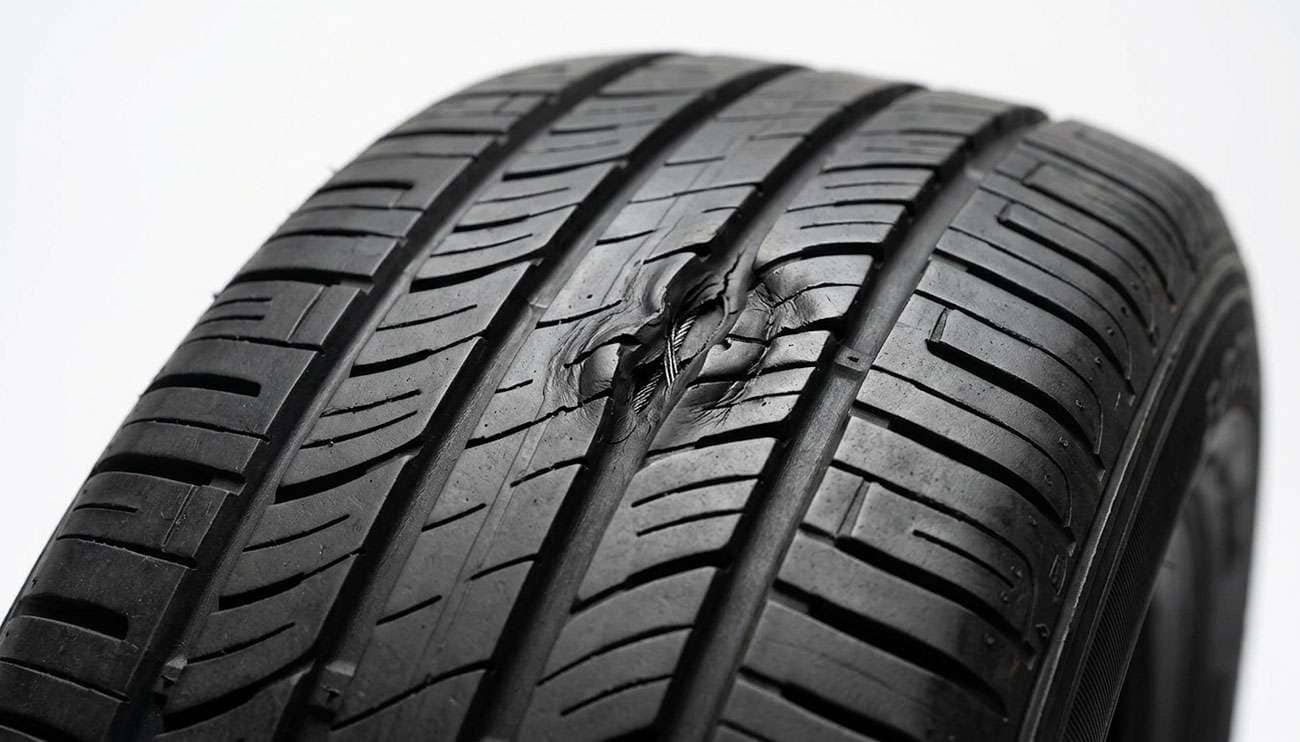
Search this question and you get the same four words back from almost every result: no, it is not safe. Which is true, and also close to useless, because it does not tell you whether you are looking at a tire that will get you eight miles to a shop at 35 mph or a tire that needs a flatbed in your driveway right now. Those are both "broken belt" tires. They are not the same tire.
The variable nobody names is which layer separated. A radial tire is a stack of bonded materials, and a "broken belt" can mean the tread has let go of the belt package, the two steel belts have let go of each other, or the belt package has let go of the body ply underneath. Different symptom, different rate of progression, different answer on whether you can move the car. This guide sorts it by what you can actually observe from the driveway, and then explains the mechanism underneath so the answer holds up when your situation does not match the table exactly.
Find the row that matches what you see and feel. Every one of these is a replacement tire. The column that matters is the last one, which tells you how the tire gets to the shop.
What You Observe |
Likely Separation Mode |
Progression Rate |
How It Gets to the Shop |
|---|---|---|---|
Visible bulge or lifted section in the tread face, tire spins out of round, rim tracks true |
Tread-to-belt separation |
Fast once visible |
Spare on, or tow. Do not drive it. |
Chunks of tread missing or peeling, cords or fabric showing anywhere |
Advanced tread-to-belt, near detachment |
Imminent |
Tow. Do not move the vehicle. |
Speed-linked thump or wobble, no visible bulge, symptom worsens after 10 to 15 minutes of driving |
Belt-edge (belt-to-belt) separation, early |
Weeks to days, accelerating |
Short surface-street trip under 40 mph is defensible. No highway. |
Vibration that came back within days of a fresh balance, weights still on the wheel |
Belt-edge separation or ply separation |
Weeks, accelerating |
Short surface-street trip. Ask for road force, not another balance. |
Side-to-side waddle at parking-lot speed, tread visibly walking left and right when spun |
Ply or casing separation |
Unpredictable |
Spare on, or tow. |
Any of the above plus the tire is losing pressure |
Separation has reached the inner liner |
Imminent |
Tow. |
Two things to notice in that table. First, none of these tires are repairable, so the question is never "fix or replace," it is only "how do I move the car." Second, the mildest row is still a tire you should not take on a freeway, because freeway speed is the specific condition that turns a slow separation into a fast one. More on why in a moment.
Worth clearing up first: the tire belt has nothing to do with any belt under your hood. Several of the top search results for this question have confused a tire belt with a timing belt or a serpentine belt, and one of them will tell you that your engine will be destroyed and the car will need to be towed for costly repairs. That is a different part on a different system. A broken tire belt does not touch your engine.
Inside a modern radial passenger tire, working from the inside out, you have the inner liner (a halobutyl rubber layer that holds air), the body ply (polyester cords running radially, from bead to bead), the steel belt package under the tread (usually two layers of brass-coated steel cord, laid at opposing angles of roughly 20 to 25 degrees), often a nylon cap ply over the belts, and then the tread rubber on top.
Those layers are not glued together in any conventional sense. They are chemically bonded during vulcanization. The steel cords are plated with brass, a copper and zinc alloy, and during curing the copper in that plating reacts with sulfur in the rubber compound to form a copper sulfide interface. That interface is the entire mechanical connection between the steel skeleton of your tire and the rubber around it. It is strong, it is thin, and it is chemically vulnerable to two things: heat and moisture.
Belt separation is the failure of that bond. Not a crack, not a tear, not a puncture. A delamination. The tire can be fully inflated, hold pressure perfectly, look normal in the parking lot, and be structurally coming apart from the inside.
That is what makes it different from the damage most drivers know how to spot. A nail you can see. A gash you can see. Sidewall damage announces itself with a bubble or a cut. A separating belt often announces itself only through the steering wheel, and by then it has been progressing for a while.
Here is the part the rest of the internet skips. "Belt separation" is a category, not a diagnosis. Three distinct interfaces can fail, and they behave differently.
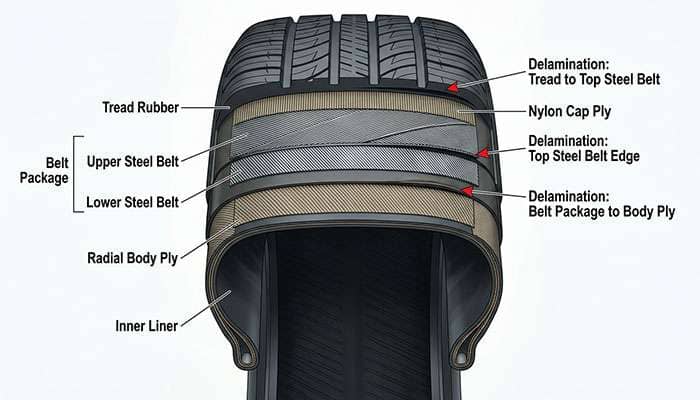
The tread rubber loses its bond to the top steel belt. This is the failure mode most people picture when they think of a tire coming apart on the highway, and it is the one that produces the classic image of a shredded tread carcass lying in the breakdown lane.
Symptom profile: a visible raised area or ripple in the tread face that you can often see with the tire sitting still, and can definitely feel by running a palm across the tread. The rim spins true; the rubber does not. It typically produces a distinct thump once per wheel revolution rather than a smooth vibration.
Once this one is visible, it moves fast, because the separated pocket flexes independently of the rest of the tire and generates its own heat, which degrades the bond further at its edges. This is a self-accelerating failure. Do not drive it.
The two steel belts separate from each other, and it almost always starts at the belt edges rather than in the middle. There is a good engineering reason for that. The two belts are laid at opposing angles, so when the tire deflects into the contact patch, the belts want to shear against each other. That interlaminar shear strain is highest exactly where the belts terminate, at the shoulder. The belt edge is the highest-stress location in the entire tread package, and it is where fatigue cracks initiate.
Symptom profile: usually no visible bulge in the early stages. What you get is a vibration or a thump that is linked to vehicle speed, gets meaningfully worse as the tire warms up over the first ten or fifteen minutes of a drive, and comes back within days of a wheel balance. This is the mode that gets misdiagnosed as a balance problem, an alignment problem, or a suspension problem, and it is the reason people spend money on all three before anyone pulls the tire.
This is the slowest of the three modes and the only one where a careful, short, low-speed trip to a shop is a defensible call. It is also the one that will kill you on a road trip, because sustained highway speed is precisely the loading condition that turns a slow belt-edge crack into a fast one.
The belt package separates from the body ply beneath it, or the body ply cords separate from each other. This is less common in passenger radials than the other two and shows up more often in tires that have been run flat or badly underinflated, or in retreaded and heavily repaired tires.
Symptom profile: lateral movement rather than vertical. The tread visibly walks side to side when the wheel is spun, and the vehicle can feel like it is waddling at low speed. Because the separation is beneath the belt package, this one can reach the inner liner and start producing pressure loss, which is why any separation symptom combined with a slow leak is a tow situation.
Ranked roughly by how early they show up.
This deserves its own section because it is where most of the wasted money goes, and because a shop can honestly balance the wheel, hand it back to you, and send you off on a tire that is still failing.
Balancing corrects mass distribution. If one part of the wheel and tire assembly is heavier than the rest, the machine finds it and you stick lead on the opposite side. That is a real problem with a real fix, and an unbalanced tire genuinely does cause vibration.
Belt separation is not a mass problem. It is a stiffness and geometry problem. The tire has a soft spot and a high spot, so as it rolls it deflects unevenly and the force it transmits into the suspension varies through each revolution. You can balance that assembly to zero on a conventional spin balancer and it will still shake, because the machine never applied any load to the tire. It spun it in the air.
The tool that catches this is a road force balancer, which presses a loaded roller against the tire while it spins, simulating the weight of the vehicle on the pavement, and measures how much the force varies through the rotation. A healthy assembly reads low. A separating tire reads high and will not come down no matter where you put the weights. If you have chased a vibration through two balances, stop paying for balances and ask for a road force measurement. It is the difference between measuring the tire at rest and measuring it under load, and separation only shows up under load.
Worth saying plainly: if a shop balances a tire twice, the vibration returns twice, and the third recommendation is an alignment, you are being walked away from the actual problem. Alignment does not cause a warm-up-dependent thump.
Four things produce similar complaints and get confused constantly. Here is how they separate.
Test |
Belt Separation |
Bent Wheel |
Wheel Bearing |
Brake Rotor |
|---|---|---|---|---|
Changes when you brake |
No |
No |
Sometimes, slightly |
Yes, this is the main clue |
Changes when you steer left or right at speed |
No |
No |
Yes, loads and unloads the bearing |
No |
Gets worse as the tire warms up |
Yes |
No |
No |
No |
Survives a fresh balance |
Yes |
Usually |
Yes |
Yes |
Spun on a jack: what moves |
Tread moves, rim stays true |
Rim and tread move together |
Nothing visible, roughness felt |
Nothing visible |
Character of the noise |
Rhythmic thump, once per revolution |
Rhythmic, often quieter |
Continuous drone or growl |
Pedal pulsation, little noise |
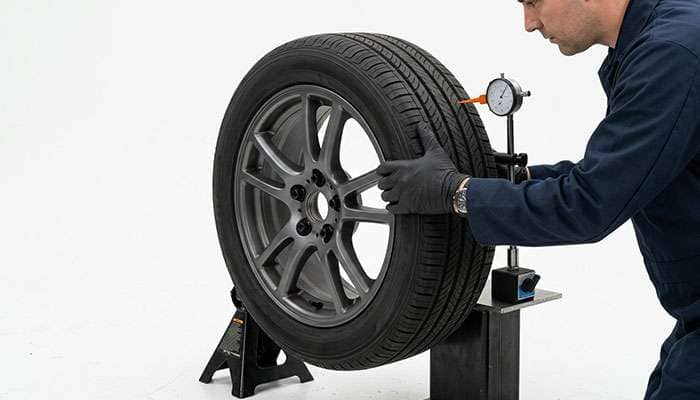
The two rows that do the most work are the warm-up row and the spin-test row. Nothing else on that list cares whether the tire is hot. And if you get the wheel off the ground and watch the tread edge against a fixed reference while a helper turns it slowly, a separated tire will show you a high spot that comes around at the same place every revolution while the rim itself tracks straight. If the rim wobbles too, you are looking at a bent rim instead, or in addition. For a broader walk through the overlapping causes, our guide on steering wheel vibration covers the full decision tree.
The honest engineering answer is that nobody can give you a mileage number, because the remaining life of a separating tire is not a function of distance. It is a function of accumulated heat and flex cycles, and those depend on speed, load, ambient temperature, and how far the separation has already progressed.
What can be said with confidence is which variables move the number, and in which direction:
So the practical framing, which is what you actually need: if the separation is early-stage belt-edge with no visible deformation, a short low-speed trip on surface streets to a shop is a reasonable risk. If there is a visible bulge, missing tread, exposed cords, lateral waddle, or any pressure loss, the tire does not roll again under load. Put the spare on or call a flatbed. And if it is a compact spare, respect its own limits, which are typically 50 mph and a short service range.
Everything above keeps pointing back at heat, so here is the mechanism.
Rubber is viscoelastic. Every time a section of tire rolls into the contact patch it deflects, and every time it deflects it dissipates some of that energy as heat rather than returning it. That is hysteresis, and it is unavoidable in a pneumatic tire. Under normal conditions the tire sheds that heat to the air and the road fast enough to reach a stable operating temperature.
Two things break that equilibrium. Underinflation increases the amount of deflection per revolution, so more energy goes in as heat. And an existing separation creates a pocket that flexes independently, generating heat locally, at exactly the place where the bond is already compromised.
Then the chemistry takes over. That copper sulfide interface between the brass-plated steel cord and the rubber is thermally and hydrolytically unstable. Elevated temperature accelerates its degradation, and where the separation has opened a path, moisture reaches the steel and drives corrosion at the cord surface. Corroded steel cord does not re-bond. So the process runs one direction only: heat degrades the bond, the degraded bond allows more independent flex, more flex makes more heat. There is no plateau and no self-repair. A separating tire never gets better with use, and unlike a flat spot from sitting, it will not smooth out once things warm up. It does the opposite.
This failure mode is the reason a whole federal standard exists. After the tread separation recalls of the early 2000s, Congress passed the TREAD Act, and NHTSA rewrote the tire safety standard as FMVSS 139, which governs new radial tires for light vehicles. The tests in it are aimed squarely at this: a high-speed test, an endurance test at load, and a low-inflation performance test that runs the tire significantly underinflated to prove it survives the exact heat-driven separation mechanism described above. Those tests define what a healthy tire is required to survive. A tire that has already begun separating no longer has that margin.
Set the safety argument aside for a second, because there is a purely financial case for not stretching this out.
Week one: diagnostic spend on the wrong thing. Most people take a separating tire to a shop and describe a vibration. They pay for a balance. It comes back. They pay for another balance, or an alignment. That is real money spent on services that cannot address a delamination. Naming the problem correctly is the cheapest step in this entire sequence.
Week two to four: the other three tires start paying for it. An out-of-round tire transmits a cyclic vertical force into the suspension at that corner. That corner's contact patch loading is now varying through every revolution, which produces irregular wear. The wear does not stay on the bad tire.
Month two: suspension and driveline components. Shocks, struts, bushings, and tie rod ends are all absorbing a load cycle they were not designed to see continuously. On an all-wheel-drive vehicle there is an additional problem: a separated tire changes rolling circumference at that corner, which means the differentials and any transfer clutch are managing a permanent speed difference. That is a meaningfully expensive component to replace and the failure is not usually attributed back to the tire.
Whenever it ends: the replacement you were going to make anyway, plus whatever it took with it. The tire was never salvageable. Every dollar spent between noticing the symptom and replacing the tire bought nothing. The escalating cost is not the tire, it is everything the tire damages while you decide.
No, and this is one of the few questions in tire service with genuine industry unanimity behind it.
The Tire Industry Association and the U.S. Tire Manufacturers Association both define permissible repair narrowly: punctures only, confined to the crown area within the boundaries of the tread shoulders, no larger than 1/4 inch in diameter, with the tire demounted so the interior can be inspected, and repaired with a combination plug and patch unit that fills the injury channel and seals the inner liner. Everything outside that envelope is a replacement.
Separation is not a puncture. There is no injury channel to fill and no hole to seal. The failure is the loss of a chemical bond across a broad interface, and there is no procedure that restores a copper sulfide bond inside a cured tire. A patch would sit on the inner liner, several structural layers away from the delamination, contributing nothing.
You will occasionally hear that the tire can be "shaved" or "trued" to restore roundness. Do not. Machining the tread face removes rubber from a tire whose problem is structural, leaves the separation exactly where it was, and reduces the remaining tread over the compromised area. It hides the symptom and keeps the failure.
Any shop that offers to repair, true, or shave a separated tire and put it back on your car is one to walk away from.
Depends primarily on drivetrain and on how worn the survivors are.
Front- or rear-wheel drive, other tires reasonably fresh: replacing the single failed tire is generally acceptable, provided the replacement matches in size, load index, speed rating, and ideally construction. Try to keep tread depth across an axle within about 2/32 inch.
Front- or rear-wheel drive, other tires well worn: replace in pairs across an axle. A new tire paired with a half-worn one on the same axle gives you different grip levels side to side, which shows up under hard braking and in the wet. And when you do fit two, the new pair goes on the rear regardless of which end drives the car. New tires on the rear is the standard safety recommendation, because a rear axle that loses grip first produces oversteer, which is far harder for a typical driver to catch than understeer.
All-wheel drive: be careful here. AWD systems tolerate only a small difference in rolling circumference between corners before the center differential or coupling is working continuously to absorb the mismatch. Manufacturer tolerances vary and some are tight, often expressed as a maximum tread depth difference in the range of 2/32 to 4/32 inch across the vehicle, or as a maximum circumference difference. Check your owner's manual for the actual number before deciding. If the other three tires are meaningfully worn, replacing all four is the correct answer, and some manufacturers require it. Shaving a new tire to match the worn set is a legitimate option offered by some shops if you want to avoid a full set.
In every case, check the age of the survivors. If one tire separated because the set is old, the other three are on the same clock and made from the same compound with the same depleted stabilizers. Read the DOT date code on each; the last four digits are the week and year of manufacture. Run them through the tire age DOT date checker to see where you stand. Most manufacturers recommend replacement at six years regardless of tread remaining, and treat anything past ten years as out of service. A separation on an eight-year-old tire is not bad luck, it is the first one to go.
You can confirm most separations yourself without special tools.
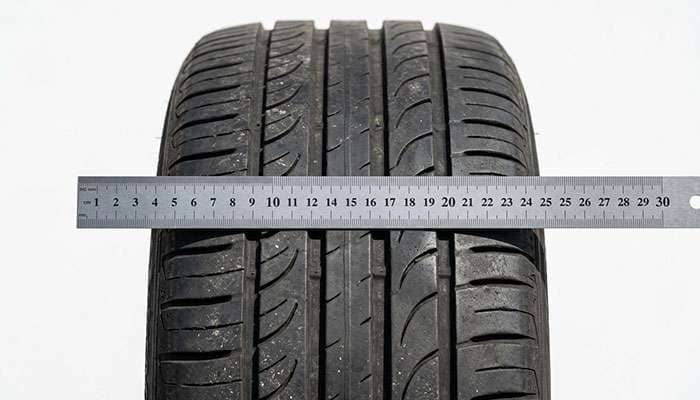
If you get a repeating high spot, you are done diagnosing. The tire is finished, and the only remaining decision is how it gets to the shop.
Because separation is heat-driven and often traces back to a tire that spent time underinflated, overloaded, or simply old, the replacement worth buying is one with real endurance margin rather than the cheapest thing in your size. A few current options across the common categories:
Tire |
Size Shown |
Best For |
Price |
|---|---|---|---|
225/55R17 XL 101H |
Sedans and crossovers, long-wear all-season touring |
$218.99 |
|
245/70R17 XL 114T |
Trucks and SUVs that tow or carry load |
$278.99 |
|
P235/65R18 106V |
High-mileage commuters, tread life priority |
$210.99 |
|
P205/55R16 SL 91H |
Value replacement without dropping to an unknown brand |
$149.99 |
Whatever you choose, match or exceed the load index and speed rating on your door placard. Dropping load index to save money on a vehicle that carries weight recreates the exact condition that produced the separation in the first place.
Two habits prevent most of these failures. Check pressures monthly with a gauge rather than relying on TPMS, which by design will not warn you until you are 25 percent low, well past the point where heat damage begins. And inspect the tread face after any hard pothole hit, not just the sidewall, because impact damage to the belt package can start a separation that takes weeks to show itself.
A broken tire belt is not one failure. It is three, and they do not behave the same way. The tread letting go of the belts is a fast, visible failure that ends with rubber in the breakdown lane. Belt-edge separation is a slow, invisible one that hides behind a vibration and gets misdiagnosed as a balance problem for weeks. Ply separation is the odd one that moves sideways and can start losing air. Knowing which one you have is the difference between a careful five-mile trip to the shop and a call to a flatbed.
What all three share: they cannot be repaired, they cannot be balanced out, they will not stabilize, and they get worse with heat and speed. If you have a vibration that came back after a balance and worsens as the drive goes on, stop paying for balances and get the wheel in the air. Ten minutes with your hand and a straightedge will usually settle it.
And when the tire does need replacing, do not put a bargain casing back into the same conditions that killed the last one. Performance Plus Tire stocks every size across touring, highway, performance, and truck applications. Find your size, match your placard load and speed rating, and get the car back on four sound tires.
Everything above, condensed.
No tire with a separated belt is safe for normal use, but the urgency depends on which layer separated. If there is a visible bulge in the tread face, missing tread, exposed cords, side-to-side waddle, or any pressure loss, do not drive the vehicle at all. Install the spare or call for a tow. If the only symptom is a speed-linked vibration that worsens as the tire warms and there is no visible deformation, a short trip on surface streets below 40 mph to a tire shop is a defensible risk. Freeway speed is not, under any version of this.
The earliest reliable symptom is a thump or vibration that tracks vehicle speed rather than engine speed and gets noticeably worse after ten to fifteen minutes of driving as the tire heats up. Other signs include a vibration that returns within days of a wheel balance, a raised or lifted section in the tread face, irregular wear concentrated in one arc of the tire, and vague wandering or an inconsistent pull. A front tire is usually felt in the steering wheel and a rear tire in the seat or floor. Tire pressure typically stays normal throughout.
There is no reliable mileage figure, because remaining life depends on accumulated heat and flex cycles rather than distance. Speed is the dominant variable, followed by ambient temperature, vehicle load, and whether the driving is sustained or stop-and-go. A tire that tolerates forty minutes of surface streets may fail within a few miles of freeway driving on a hot day. Treat any distance as borrowed, keep the speed down, and get it replaced rather than trying to schedule around it.
No. Balancing corrects uneven mass distribution by adding weights, but belt separation is a stiffness and geometry defect, not a weight defect. A conventional spin balancer measures the assembly in the air with no load on it, so a separating tire can balance perfectly and still shake on the road. A road force balancer presses a loaded roller against the tire while it spins and will reveal the problem. If a vibration has survived two balances, request a road force measurement rather than a third balance or an alignment.
No, they are different failures in different parts of the tire. A sidewall bubble is caused by impact that snaps the radial body ply cords in the sidewall, letting pressurized air migrate into a pocket between the inner liner and the outer rubber. Belt separation is a loss of the chemical bond between layers in the tread area, usually driven by heat and fatigue rather than a single impact. A bubble appears on the side of the tire and a separation appears as a high spot in the tread face. Both mean the tire is finished and neither can be repaired.
Lift the corner safely onto a jack stand and turn the wheel slowly by hand while watching the rim edge and the tread separately against a fixed reference point. If the rim edge tracks straight while the tread rises and falls or walks side to side, the tire is the problem. If the rim itself wobbles, the wheel is bent, and it is possible to have both at once after a hard pothole strike. A second clue: a separation typically worsens as the tire warms up over a drive, while a bent rim behaves identically hot or cold.



