
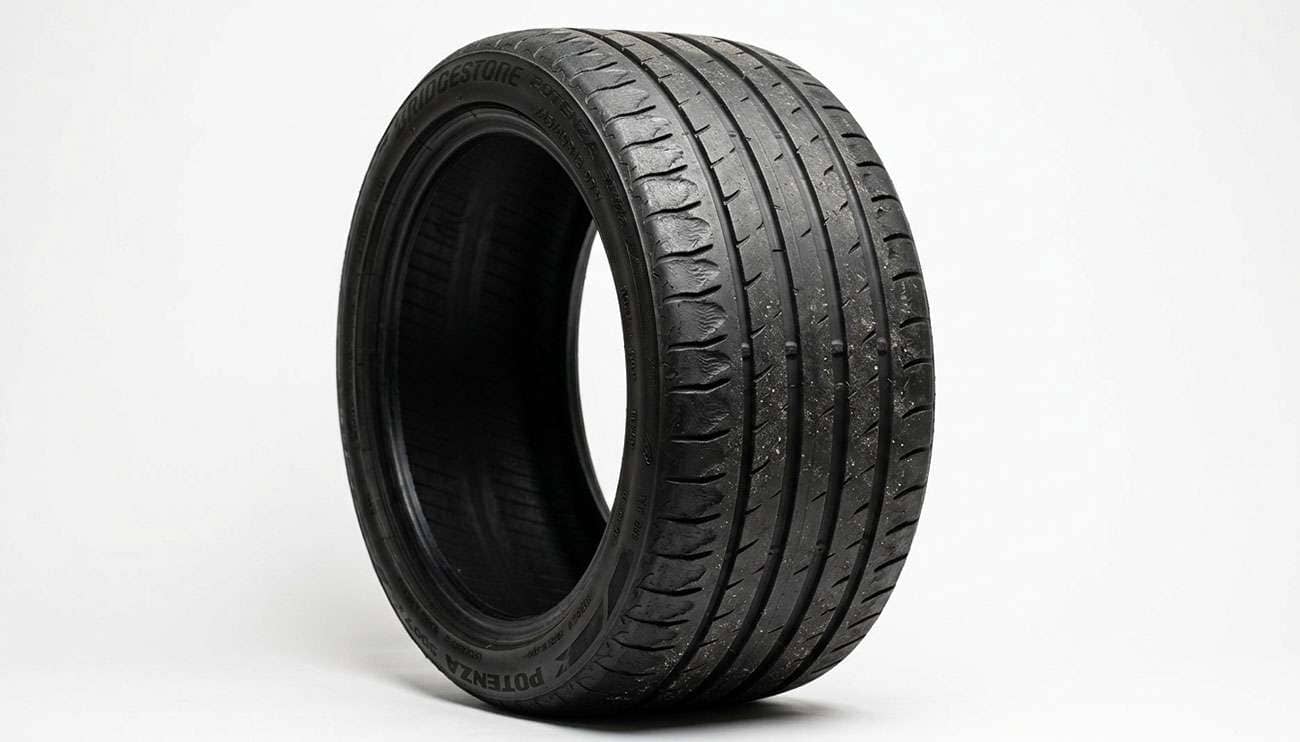
Yes, you can usually drive on unbalanced tires for a short time. But the honest answer to how long depends on one thing almost nobody tells you: what is actually causing the imbalance. A true weight imbalance from a thrown or missing wheel weight buys you two to three months, or a few hundred miles before the tire starts to cup. If the shake is coming from a bent rim, a separated belt, a tire that is already cupped, or a failing wheel bearing, it is not really a balance problem at all, and the safe distance drops to days or to zero.
Search this question and every result repeats the same three lines: two to three months, it depends, and get them balanced. Not one of them tells you what it depends on. Some will even admit in passing that a dented rim or an out-of-round tire throws the exact same vibration, and then never show you how to tell which one you have. That distinction is the whole game. It is the difference between an annoyance you can schedule around next week and a failure that leaves you on the shoulder. Here is the table that draws the line, followed by the reasoning behind every row.
What you feel |
A true balance problem? |
Safe to drive? |
Realistic window |
What it usually is |
|---|---|---|---|---|
Steering shake that appears around 40 to 55 mph and smooths out above and below that band, and it started right after a tire mount or rotation |
Yes |
Short term |
2 to 3 months, or a few hundred miles before cupping starts |
Thrown or missing wheel weight |
Vibration at every speed that never smooths out |
No |
Not really |
Days, inspect now |
Bent rim, out-of-round tire, or separated belt |
A rhythmic roar or drone that rises with speed, and you can feel scalloped ridges when you run a hand across the tread |
No, it is past balancing |
Short term but permanent |
Balancing will not fix it, plan replacement |
Tire already cupped |
A wobble or shimmy that keeps getting worse, often with a clunk or a wandering feel |
No |
Stop and inspect |
Zero at highway speed |
Worn wheel bearing, tie rod, or ball joint |
A new shake right after a pothole or curb strike |
Partly |
Cautious short term |
Inspect within days |
Bent wheel plus a thrown weight |
If the cause is a simple weight imbalance, the widely repeated figure of two to three months is a reasonable ceiling, and it is the only situation where that number actually applies. A wheel comes off balance when the mass of the tire and rim assembly is not distributed evenly around the axis of rotation. The most common reasons are mundane: a clip-on weight that flew off when you clipped a curb, a stick-on weight that let go in the heat, a new tire that has not been balanced yet, or normal tread wear that slowly shifts the assembly's heavy spot. In all of these cases the tire itself is still round and sound. Nothing is failing. You are simply spinning a slightly lopsided wheel, and the penalty is vibration, a small hit to fuel economy, and a clock ticking toward uneven wear.
The reason the clock matters is that the vibration is not passive. Every rotation, the heavy spot slams the tread against the road and then lets it skip. Left alone, that hammering carves a wear pattern into the rubber, and once it does, you have crossed from a problem that balancing solves into one that only new tires solve. That transition typically begins within a month or two of noticeable vibration, which is why the honest guidance is not think of it as three months to relax but three months at the absolute outside, and sooner is cheaper.
That window collapses the moment the cause is anything structural. A tire with a separated internal belt, a wheel bent by a pothole, or a bearing with play in it will also feel like an imbalance, but none of those are safe to ride out, and none of them get better with a set of weights. The rest of this guide is about telling those apart, because the correct answer to how long can I drive depends entirely on which one you are dealing with.
A genuine weight imbalance has a fingerprint, and learning it is what lets you separate a nuisance from a hazard. The classic signature is a steering-wheel or seat vibration that appears in a fairly narrow speed band, usually somewhere between 40 and 55 mph, builds to a peak, and then eases off as you go faster. It is smooth and buzzy rather than harsh and random. It is steady, not intermittent. And it very often shows up right after a tire was mounted, rotated, or repaired, because that is when weights get added, moved, or knocked loose.
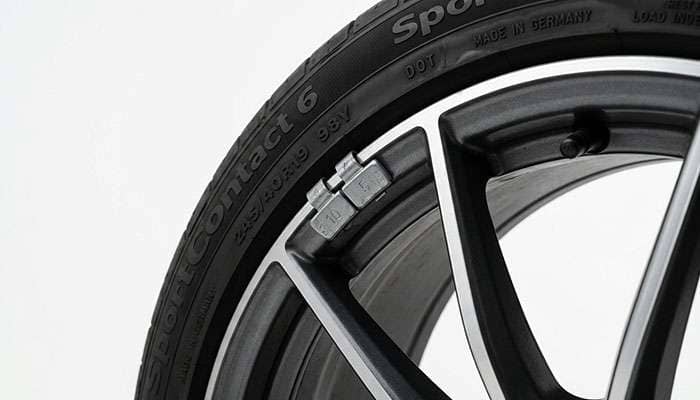
Where you feel the shake is diagnostic on its own. A front-wheel imbalance transmits up the steering column, so you feel it in your hands. A rear-wheel imbalance has no direct path to the wheel, so you feel it in the seat and floor instead. That single clue tells a technician which end of the car to look at before the wheel ever comes off. Alongside the vibration you may notice a faint drop in fuel economy, because a hopping tire wastes energy, and the early stages of irregular wear if you look closely at the tread. What you should not have with a plain imbalance is any clunk, any pull to one side, any grinding, or any sense that the car is wandering. Those belong to other problems.
The Tire Industry Association's standing guidance is that a wheel should be balanced any time a tire is dismounted, mounted, or rotated, precisely because these are the events that upset the weight distribution. If your vibration lines up with the fingerprint above and it started after shop work, a rebalance is very likely the whole fix. If it does not line up, keep reading, because the symptoms are about to diverge in an important way. For a fuller walk-through of pinning the source, our guide on whether a steering wheel vibration is coming from your tires or your wheels covers the isolation steps in detail.
This is the section every competing article skips, and it is the one that actually keeps you safe. Four different failures wear the disguise of an imbalance. Each one has a tell, and each one carries a shorter safe distance than a true balance problem.
A bent rim. When a wheel is bent by a pothole or a hard curb strike, the tire is forced out of round at that spot, and the assembly can no longer spin true no matter how it is weighted. The tell is that the vibration does not disappear when you leave the 40-to-55 window. It is present at low speed and it is present at high speed, because the geometry, not the weight, is wrong. A bent rim also tends to leak air slowly at the bead. This is not a balance issue, and continuing to drive risks a sudden loss of the bead seal. Our companion piece on whether it is safe to drive with a bent rim lays out the wheel-side thresholds.
A separated belt. Inside a radial tire, steel belts hold the tread flat and round. Age, a hard impact, or a bad repair can let a belt separate from the carcass, leaving a soft, bulging section that throws the tire out of round from the inside. It feels like a rhythmic thump or wobble that, again, does not clean up at speed. A separated belt is a structural failure and a genuine blowout risk. The National Highway Traffic Safety Administration ties a large share of tire-related crashes to exactly this kind of internal failure at highway speed. This one is closer to the same family as a sidewall bulge, and if you are unsure what you are looking at, our guide on whether sidewall damage is safe to drive on explains why any structural deformation means stop, not schedule.
A worn bearing or suspension joint. A shimmy that keeps getting worse, that comes with a clunk over bumps, a growl that changes as you steer left and right, or a car that feels like it is hunting for the center of the lane, is not a tire out of balance. It is play in a wheel bearing, a tie rod end, or a ball joint. On solid-axle trucks and older SUVs this can escalate into the violent, self-feeding oscillation known as death wobble. Balancing a wheel does nothing for a worn joint, and a failing bearing can seize. This category is a stop-and-inspect, not a drive-and-monitor.
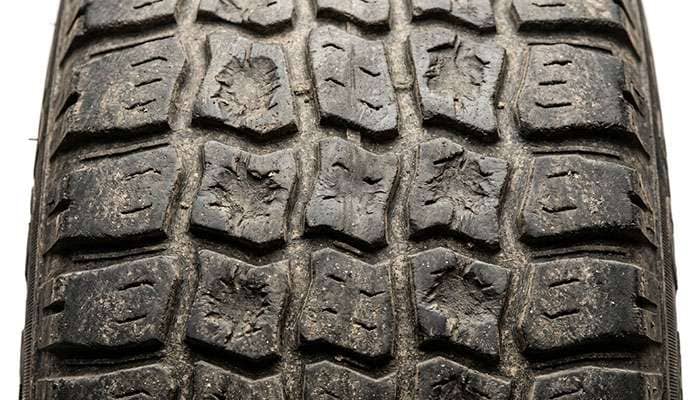
An already-cupped tire. If you ignored a real imbalance long enough, the tire itself became the problem. Cupped or scalloped tread produces a droning roar that rises with speed and a vibration that a fresh set of weights cannot remove, because the low spots are ground permanently into the rubber. This is covered in its own section below, but the short version is that once you can feel the ridges, you are shopping, not balancing.
The unifying rule is simple. A true weight imbalance lives in a speed band and cleans up outside it. Anything that vibrates at all speeds, gets steadily worse, or comes with a clunk, a pull, a growl, or a bulge is a different and more urgent failure. When you are not certain which service the car actually needs, our breakdown of alignment versus rotation versus balancing maps each symptom to the right fix.
Understanding the physics is what turns a vague it depends into a real answer, and it explains why a weight the size of a quarter can rattle your whole steering column. The force produced by an out-of-balance mass follows the relationship force equals mass times radius times angular velocity squared. The two terms that matter to a driver are the mass of the offending weight and, far more importantly, the speed, because speed enters as a square. Double your speed and you do not double the shaking force, you roughly quadruple it.
Run the numbers and the two-to-three-month advice starts to make sense. A half-ounce imbalance at 20 mph produces a force so small you will never feel it. That same half ounce at 60 mph produces on the order of nine times the force, which is exactly why the vibration seems to switch on as you accelerate onto the freeway and why it lives in a band rather than growing forever. Above the resonant band, the suspension and tire begin to absorb and average the input, so a pure imbalance often smooths back out at very high speed. A structural fault does not, which is the diagnostic difference the whole previous section rests on.
There are also two distinct kinds of imbalance, and the difference is why a proper shop puts your wheel on a spinning machine rather than eyeballing it. Static imbalance is a single heavy spot that makes the wheel hop straight up and down, felt through the seat. Dynamic imbalance, also called couple imbalance, is weight offset from one side of the wheel's width to the other, which makes the wheel wobble side to side and shows up as a steering shimmy. Correcting dynamic imbalance requires weights on both the inner and outer rim flanges, and it cannot be detected by the old bubble-style static balancers at all. A modern spin balancer measures both planes at once and tells the technician precisely where and how much weight each flange needs. This is also why balancing is not a driveway job; the tolerances involved, on the order of a fraction of an ounce and a few thousandths of an inch of runout, are below what any at-home method can reliably reach.
The reason to fix a real imbalance promptly is not that it is dangerous on day one. It usually is not. The reason is that the cost of ignoring it climbs on a curve, and the cheapest point on that curve is the day you first feel the shake. Here is how the bill escalates the longer the hop continues.
How long you ignore it |
What is happening |
What it costs you |
|---|---|---|
First few days to weeks |
Vibration, a few percent drop in fuel economy, and driver fatigue on longer trips |
Nothing permanent yet, this is the cheapest fix window |
One to two months |
Cupping and feathering begin on the affected tire, and the wear is irreversible |
Early tire replacement, from one tire to a full set depending on rotation |
Two to three months and beyond |
Constant hop hammers the wheel bearing, tie rod ends, ball joints, and shock absorbers |
Suspension and steering repairs stacked on top of new tires |
Long term neglect |
The tire goes measurably out of round, bearing play grows, and blowout risk climbs |
A tow, a roadside failure, or a crash you could have scheduled away |
The mechanism behind the tire damage is worth spelling out, because it is a trap. When the heavy spot forces the tread to hop, the tire briefly unloads at the top of each bounce and then slams back down, scrubbing rubber off in a repeating pattern spaced to the bounce frequency. Those scrubbed low spots are cupping. And cupping is self-feeding: every scallop makes the tire a little less round, which increases the imbalance, which increases the hop, which cuts the next scallop deeper. What started as a lost half-ounce weight becomes a tire that is now its own vibration source. Our deep dive on what causes tire cupping traces this loop in full, but the takeaway here is the important one: there is a point past which balancing cannot help you, and it arrives faster than most drivers expect.
Balancing fixes an imbalance. It does not fix a damaged tire. Those are two different problems that produce a similar feeling, and knowing which you have decides whether you are spending twenty dollars or several hundred.
If the tread is still smooth and even and the tire spins true on the machine, a standard balance will very likely cure the vibration outright, and you are done. If a standard balance does not fully settle it, that is not a dead end, it is a clue. It usually means the tire and wheel have small high spots that happen to stack up, and the solution is road-force balancing, which loads the assembly against a roller to simulate the weight of the car and then match-mounts the tire's high spot to the wheel's low spot. It is the technique that solves the maddening case of a wheel that is perfectly weight-balanced and still shakes.
But if you can run your hand across the tread and feel scallops, or the tire visibly dips and rises as it turns, no amount of balancing will save it. The rubber is gone in a pattern, the tire is permanently out of round, and the only real fix is replacement. When you reach that point, replace in axle pairs at minimum so the car tracks straight, and if the tire is significantly worn, a full set keeps handling predictable. You can shop a fresh set of tires and have the new set spin-balanced on installation, which resets the clock cleanly. The one thing not to do is pay to balance a tire that is already cupped; it is money spent on a problem balancing cannot touch.
Work through these steps in order the next time you feel a shake, and you will know in a few minutes whether you are looking at a quick balance or a stop-driving situation.
1. Find the speed band. On a safe, open road, note where the vibration starts and whether it fades again as you speed up. A shake that lives between roughly 40 and 55 mph and smooths out on either side points to a true imbalance. A shake at every speed points to something structural.
2. Locate where you feel it. Hands means front, seat means rear. This tells you and your technician where to start.
3. Rule out the deal-breakers. Listen and feel for a clunk over bumps, a pull to one side, a growl that changes when you steer, or a car that wanders. Any of those means bearing, suspension, or a bent wheel, not balance, and it means inspect before you drive far.
4. Run a hand across the tread. With the car safely parked, feel for scalloped high and low spots and look for a bulge in the sidewall or tread. Ridges mean the tire is cupped and past balancing. A bulge means stop driving.
5. Match the result to the table. A clean imbalance signature is a schedule-it-this-week job. Anything structural is a today job. When in doubt, treat it as the more urgent case; a tow is always cheaper than a highway failure.
Is it safe to drive with unbalanced tires? For a genuine weight imbalance, yes, for a couple of months at the outside, with the real cost being uneven wear rather than an immediate hazard. But unbalanced tires is a label drivers hang on any steering vibration, and half the time the true cause is a bent rim, a separated belt, a worn bearing, or a tire that is already cupped, and for those the safe answer is days or none. The competitors that stop at two to three months, it depends are not wrong so much as incomplete; they never tell you what it depends on. It depends on the cause, the cause has a fingerprint you can read in a five-minute drive, and once you can read it, the how long question answers itself. Catch a real imbalance early and it is the cheapest fix in the shop. Wait, and the same problem turns into tires, then suspension, then a tow.
If the cause is a simple weight imbalance and the tire is still round and sound, two to three months is a reasonable outside limit, though cupping can begin within a month or two of noticeable vibration. If the shake comes from a bent rim, a separated belt, or a worn bearing, it is not a balance problem and the safe window is days or zero.
A plain weight imbalance does not cause a blowout by itself, but it drives the tire out of round over time, and a badly out-of-round or cupped tire can develop weak spots that fail at speed. More often, the vibration people call an imbalance is actually a separated belt or structural damage, which is a genuine blowout risk and should not be driven on.
A wheel can be perfectly weight-balanced and still shake if the tire and wheel have small high spots that stack up, or if the tire is slightly out of round. The fix is road-force balancing, which loads the assembly against a roller and match-mounts the tire and wheel. If the tread is already cupped, no balancing will remove the vibration and the tire needs to be replaced.
A weight imbalance shows up in a speed band, usually 40 to 55 mph, and smooths out above and below it. A bent rim vibrates at all speeds because the geometry is wrong, not the weight, and it often leaks air slowly at the bead. If the shake never cleans up as you speed up, suspect the wheel, not the balance.
You can balance a single wheel, but the standard practice is to balance in axle pairs at minimum, and most shops balance all four whenever tires are rotated so the set stays consistent. The Tire Industry Association recommends rebalancing any time a tire is dismounted, mounted, or rotated, since those are the events that upset the weight distribution.
Not necessarily. Balancing corrects uneven weight in the spinning wheel, while alignment corrects the angles at which the tires meet the road. They fix different problems, though a car pulling to one side along with a vibration can mean you need both. If you feel a pull as well as a shake, have the alignment checked at the same time.



