
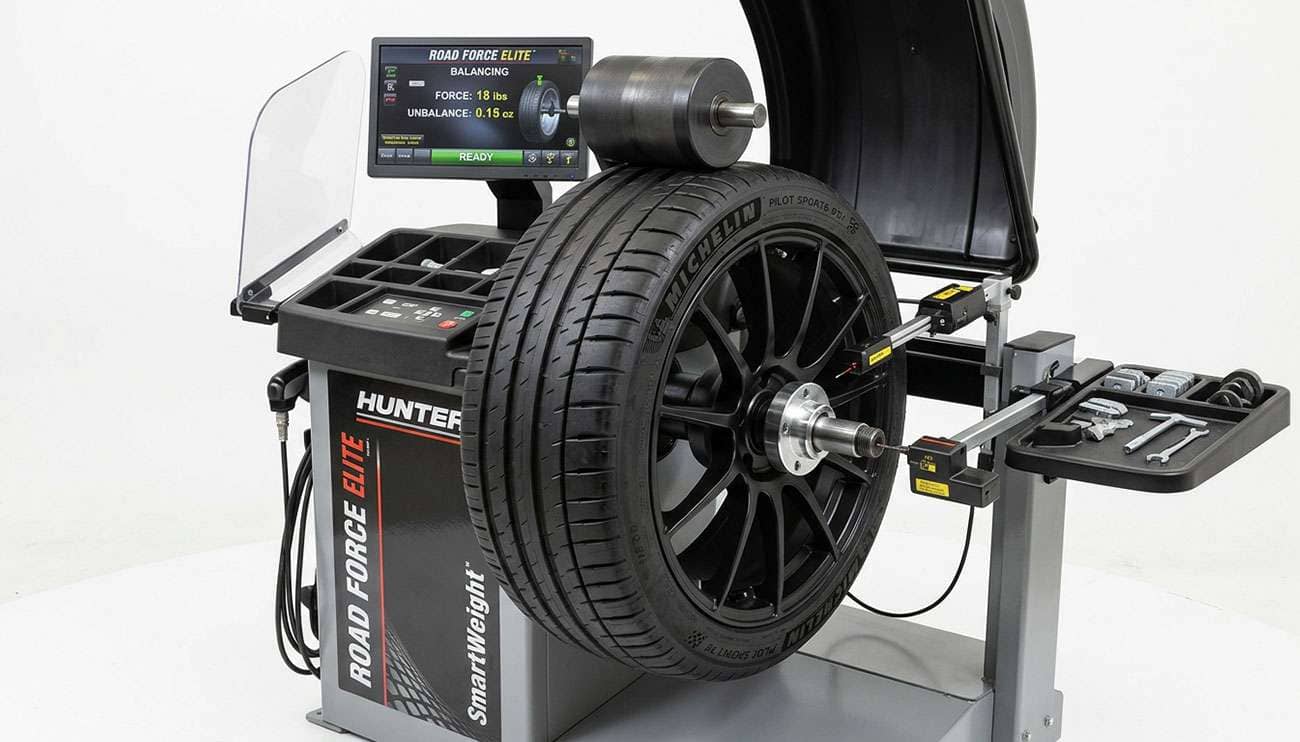
Road force balancing is an advanced form of wheel balancing that adds one critical measurement standard balancing does not have: road force variation, or RFV. On top of correcting the weight distribution of the wheel and tire, a road force machine presses a large load roller against the spinning tire to simulate the weight of the vehicle on the road, then measures how uniformly the tire pushes back. That extra step catches structural problems, like stiff spots and out-of-round conditions, that a standard weight balance simply cannot see.
Here is the situation I see in the shop constantly. A customer gets four tires balanced, drives off, and the steering wheel still buzzes at highway speed. The weights are correct, the balance reads perfect on the machine, and yet the car shakes. That is because standard balancing only measures the assembly while it spins freely in the air, with no load on it. Road force balancing loads the tire like the road does, and that is where the truth comes out. Before you assume the worst, it helps to first pin down whether the problem is your tires or your wheels, which we cover in our guide on steering wheel vibration and whether it is your tires or your wheels.
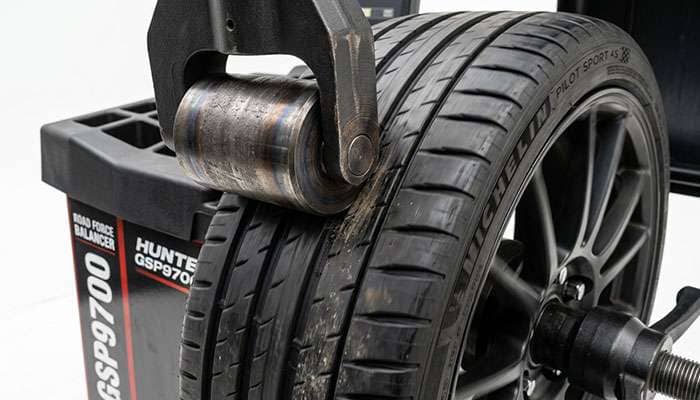
The heart of the system is that load roller. When the machine spins the wheel and tire assembly up to speed, a large diagnostic roller lowers onto the tread and applies a controlled force, typically in the range of 1,200 to 1,400 pounds. That number is not random. It roughly mimics the load a real vehicle puts on a single tire, so the assembly deforms and rolls the same way it would on the pavement.
As the loaded tire rotates, sensors read the force it transmits back through the roller. A perfectly uniform tire pushes back with the same force all the way around. A real tire never does. There are always slight variations in sidewall stiffness, tread thickness, and roundness, and under load those variations show up as a rising and falling force. That fluctuation is the road force variation, and it is the exact thing you feel as a vibration in the seat or the wheel. Compare that to what a basic balancer does, which we break down in our guide on what tire balancing actually does, and you can see why the two are not the same job.
Both processes matter, and road force does not replace standard balancing, it adds to it. A road force machine still corrects the weight imbalance with wheel weights, exactly like a conventional balancer. The difference is the second layer of data. Here is how the two stack up side by side:
Feature |
Standard Balancing |
Road Force Balancing |
|---|---|---|
What It Measures |
Weight distribution only |
Weight plus force variation and runout |
Load Applied |
None (spins free in air) |
1,200 to 1,400 lb roller |
Catches Stiff Spots |
No |
Yes |
Catches Out-of-Round |
No |
Yes (radial and lateral runout) |
Fixes Persistent Vibration |
Only weight-related |
Weight and structural |
Best For |
Routine balancing |
New tires, large wheels, unexplained shake |
The takeaway is simple. Standard balancing solves a weight problem. Road force balancing solves a weight problem and a uniformity problem. If the vibration is coming from the structure of the tire rather than a heavy spot, only the road force process will find it.
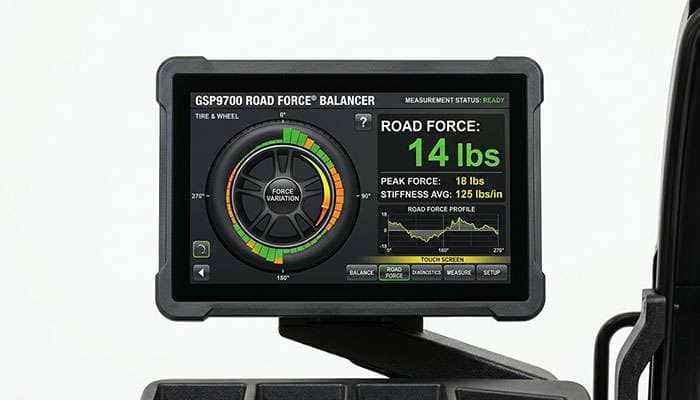
Road force variation is reported as a number in pounds. In plain terms, it puts a figure on how egg-shaped the loaded assembly behaves, or how much the force rises and falls as it rolls. The lower the number, the smoother the ride. A reading in the low single digits is excellent. Once you climb past the high teens and into the twenties, a sensitive driver starts to feel it. The chart below shows the general ranges we work with, though the exact tolerance varies by vehicle since some cars mask vibration better than others:
Road Force Reading |
Ride Quality |
What It Means |
|---|---|---|
Under 10 lbs |
Excellent |
No perceptible vibration; ship it |
10 to 18 lbs |
Good |
Acceptable for most vehicles |
18 to 26 lbs |
Marginal |
May be felt; remount and match-mount |
Over 26 lbs |
Poor |
Re-index the tire or replace it |
The machine also separates the problem into two kinds of runout. Radial runout is when the assembly is out of round vertically, so the effective radius changes as it spins. Lateral runout is a side-to-side wobble. Layered on top of those is force variation, which is the stiffness inconsistency in the tire itself. A high reading points the technician toward whether the trouble lives in the tire, the wheel, or the way the two were mounted together. If you want to understand why the tire structure matters so much here, our breakdown of wheel versus tire structure and the contact patch lays out the engineering.
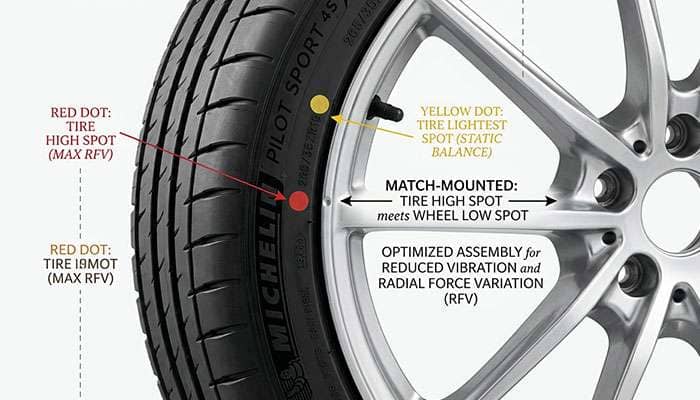
Here is the part most people do not know: a high road force reading often does not mean you need a new tire. The machine identifies the high spot of the tire, the place where it is stiffest or largest, and the low spot of the wheel, the place where the rim runs smallest. The fix is to rotate the tire on the rim so the tire's high spot sits over the wheel's low spot. The two imperfections cancel each other out. This is called match mounting, or ride matching, and it is one of the most useful tricks in the trade.
In practice, the technician breaks the tire bead loose, spins the tire to the position the machine calls for, and reseats it. Sometimes that alone drops the road force number in half. Other tools in the process include bead massaging, which works the tire down into the rim for a cleaner seat, and in stubborn cases running the same tire across a couple of different wheels to find the best pairing. The point is that a good road force process exhausts these corrections before anyone tells you to buy a replacement tire, which can save you real money.
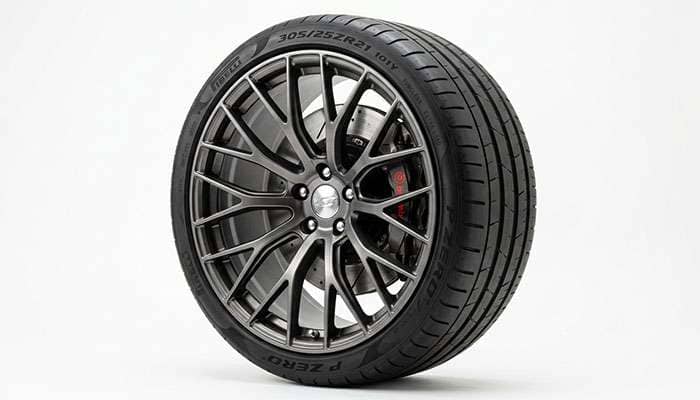
You do not need road force balancing on every service. For a set of tall-sidewall tires on a modest wheel, a good standard balance is usually plenty. Where road force earns its keep is on the setups that amplify every flaw: new tires, larger diameter wheels, and low-profile tires with short, stiff sidewalls. A short sidewall has very little give, so any force variation transmits straight into the cabin instead of being absorbed. It is also the go-to move any time a car has a persistent, unexplained vibration that a normal balance did not cure. If cost is your concern, our guide to tire mounting and balancing cost puts the pricing in context.
Now the honest part. Road force balancing is not magic, and it only addresses the tire and wheel assembly. If the machine gets your numbers down to single digits and the car still shakes, the problem is somewhere else. Common culprits are a bent wheel, worn suspension components, a warped brake rotor if the shake shows up under braking, or a driveline issue. Vibration under specific conditions can also point to alignment or wear problems rather than balance, so it is worth knowing whether your car needs alignment, rotation, or balancing, and understanding how camber, caster, and toe differ. A good shop uses road force to rule the tires in or out, then keeps diagnosing from there.
Road force balancing is the difference between guessing and measuring. Standard balancing corrects weight, and that is essential, but it is blind to the structural inconsistencies that cause so many persistent vibrations. By loading the tire the way the road does and reading the force it throws off, a road force machine tells the technician exactly where the trouble is and, more often than not, how to fix it by match mounting rather than replacing parts. If you are buying new tires, especially low-profile tires on larger wheels, this is the balancing you want. Every set in our wheel and tire packages comes to you mounted and balanced, and if you have ever wondered whether wheel and tire packages arrive balanced, the answer is always yes. If you are chasing a vibration you cannot explain, bring the car in and let us put a real number on it.
Road force balancing is an advanced balancing process that adds a road force variation measurement to standard weight balancing. A load roller presses against the spinning tire to simulate the vehicle's weight, revealing stiffness variations and out-of-round conditions that a normal weight balance cannot detect.
Standard balancing corrects weight distribution by adding wheel weights while the tire spins freely in the air. Road force balancing does the same weight correction but also applies a heavy load roller to measure force variation and runout, catching structural problems in the tire and wheel that weight balancing alone misses.
A car can vibrate even with perfect weight balance because of stiff spots or out-of-round conditions in the tire that only show up under load. Standard balancing cannot see these. Road force balancing loads the tire and identifies them. If road force numbers are already low, the cause is likely a bent wheel, worn suspension, a warped rotor, or alignment.
A reading under 10 pounds is excellent and produces no perceptible vibration. Ten to 18 pounds is good and acceptable for most vehicles. Eighteen to 26 pounds is marginal and may be felt by sensitive drivers, and over 26 pounds usually needs correction through match mounting or a tire replacement. Exact tolerances vary by vehicle.
It is worth it whenever you have a persistent, unexplained vibration, when you install new tires, or when you run large-diameter wheels or low-profile tires that amplify every flaw. In those cases it both diagnoses the problem and often fixes it by match mounting, which can avoid an unnecessary tire replacement.
Match mounting, also called ride matching, is rotating the tire on the wheel so the tire's high spot lines up with the wheel's low spot. The two imperfections cancel each other out, which lowers the road force variation and smooths the ride, often without needing a new tire.



