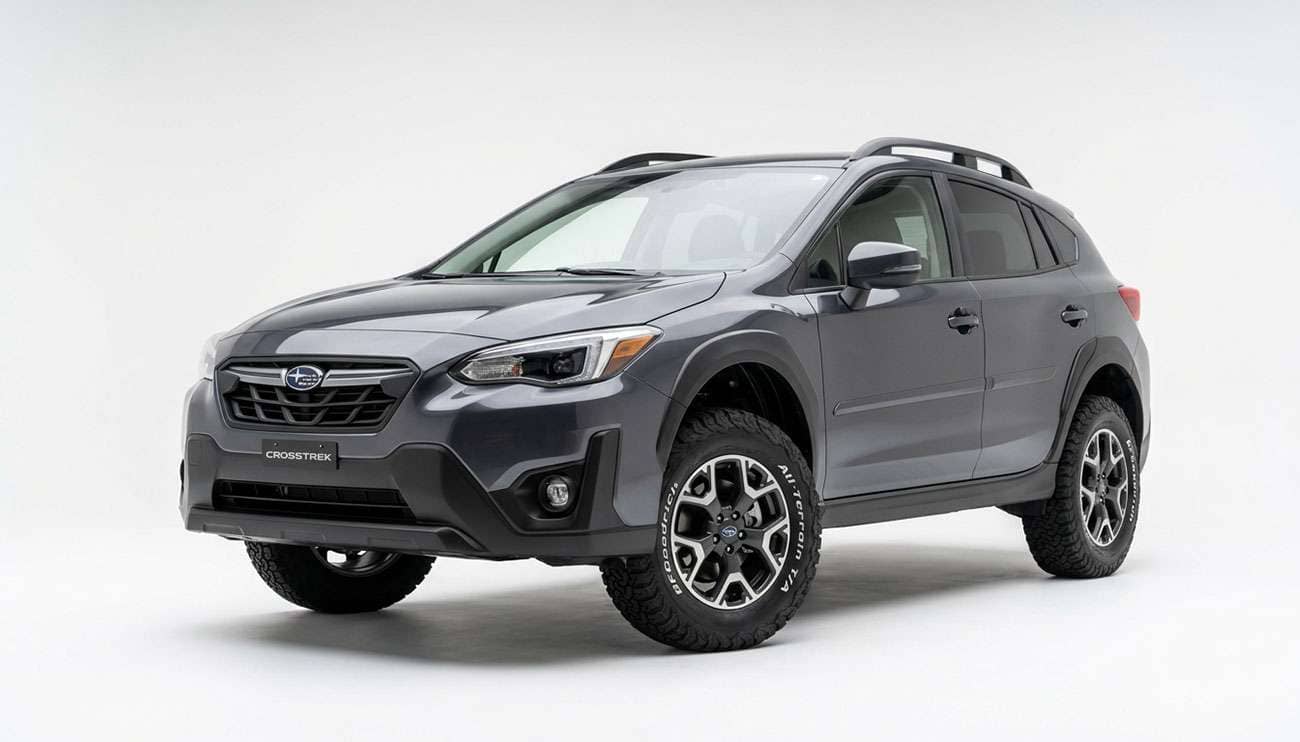
On a stock 2018-or-newer Crosstrek with factory wheels and suspension, the biggest tire that clears cleanly is 225/65R17, about 28.5 inches tall. On 18-inch wheels, the match is 225/60R18. 235/65R17, at 29 inches, is the edge size and can touch the front liner at full lock. A 2013-2017 Crosstrek stops about an inch shorter, at 225/60R17. The Wilderness adds ride height, not tire room.
Most guides stop at one number. That number moves with your model year, your wheel diameter, and how the tire is built, so here is the answer by car.
Crosstrek and Wheel |
Factory Size |
Biggest Clean Fit |
Edge Size (May Rub) |
What Touches First |
|---|---|---|---|---|
2013-2017, 17-inch |
225/55R17 (26.7 in.) |
225/60R17 (27.6 in.) |
225/65R17 (28.5 in.) |
Front mud flap, then liner |
2018-2023, 17-inch |
225/60R17 (27.6 in.) |
225/65R17 (28.5 in.) |
235/65R17 (29.0 in.) |
Front liner at full lock |
2018-2023, 18-inch |
225/55R18 (27.7 in.) |
225/60R18 (28.6 in.) |
235/60R18 (29.1 in.) |
Front liner at full lock |
2024-2027, 17-inch |
225/60R17 (27.6 in.) |
225/65R17 (28.5 in.) |
235/65R17 (29.0 in.) |
Front liner at full lock |
2024-2027, 18-inch |
225/55R18 (27.7 in.) |
225/60R18 (28.6 in.) |
235/60R18 (29.1 in.) |
Front liner at full lock |
2024-2027 Wilderness, 17-inch |
225/60R17 all-terrain (27.6 in.) |
225/65R17 (28.5 in.) |
235/65R17 (29.0 in.) |
Front liner at full lock |
Those are calculated diameters paired with what owners report at stock height. Subaru publishes no upsizing limit. The sizes it approves are the ones on your door placard, the label FMVSS 110 requires on every car. Anything else is your call, and the rest of this article covers what that call involves.
Three generations, and they don't all start from the same place.
The first generation rolled on 225/55R17 tires on 17x7 wheels, about 26.7 inches tall. That is nearly an inch shorter than any later Crosstrek, and the wheel wells are smaller too, which is why this car runs out of room first.
Base, Premium, and Sport models use 225/60R17 98H on 17x7 wheels. Limited and Hybrid models use 225/55R18 98H on 18x7 wheels. Those two sizes are almost the same height, 27.6 and 27.7 inches, so an 18-inch car is not a bigger-tire car. It has the same outside diameter with about 0.4 inch less sidewall.
Subaru's current spec sheet lists 225/60R17 99H on Base and Premium, 225/55R18 98V on Limited, and 225/60R17 99T all-terrains on the Wilderness, all on 7-inch-wide wheels. The gas Sport carried the 18-inch setup through 2026. For 2027 that trim is gone, and the Sport Hybrid and Limited Hybrid run their own exclusive 18-inch wheels.
Two different contact points set the limit, and they respond to different fixes.
There is a third limit on the inboard side. Factory wheels sit at about +55 mm offset, which tucks the tire close to the strut.
The math is unforgiving because a tire grows in every direction. 225/65R17 is 0.9 inch taller than 225/60R17, so it sits about 0.45 inch closer to everything around it. 235/65R17 is 1.4 inches taller and 10 mm wider, so it gives up 0.7 inch of radial room plus 5 mm on each side. That last step is where a quiet car becomes one that touches. If you are already chasing a noise, start with why tires rub.
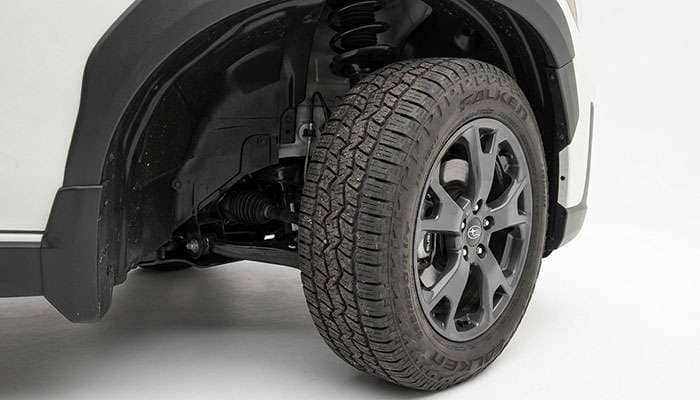
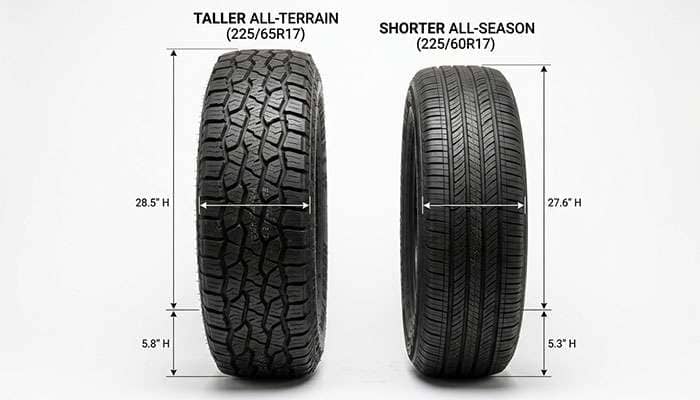
Yes, on 2018-and-newer cars. This is the size I recommend first. It keeps the factory 225 mm width, so the full-lock picture barely changes, and all the added height goes into sidewall. Diameter goes from 27.6 to 28.5 inches, a 3.2 percent gain. The factory 7-inch wheel sits comfortably inside the 6- to 8-inch rim range tire makers approve for this size.
You pick up about 0.44 inch of ground clearance, and your speedometer reads low by the same 3.2 percent. At an indicated 60 mph, you are really doing about 61.9. Our guide to bigger tires and your speedometer covers that correction.
The first thing to touch is often not the liner. Owners on this size report front mud flaps catching, especially in reverse, when the tread grabs the flap and pulls it up. If your car has flaps and you hear that, remove them. On many cars that means a few trim clips and no cutting.
Most 225/65R17 tires are Standard Load 102, with H or T speed ratings, so you gain capacity over the factory tire. If you want an all-terrain, the Yokohama Geolandar A/T G015 comes in 225/65R17 102H, the same tire family Subaru fits to the Wilderness.
Usually yes, but expect to check it. At 29.0 inches it is 5.1 percent taller than 225/60R17 and 10 mm wider, which puts it past the 3 percent window most shops treat as a no-questions swap. The factory wheel is not the problem. This size is approved on 6.5- to 8.5-inch rims, and 7 inches is its measuring rim.
The problem is the liner. Owners at stock height report occasional contact at full lock, mostly toward the front of the well. A lot of them live with it. One Subaru owner running this size on stock wheels reported a slight rub that faded after about 5,000 miles, once the liner had "trimmed itself." I would rather you trim the high spot with a utility knife than let the tire do the job, because the tire is the part that costs money.
Tread design matters here too. Aggressive shoulder lugs on an all-terrain reach closer to the liner than the rounded shoulder of a touring tire in the same size. For the width, load, and rim math between the two sizes, see 235/65R17 instead of 225/65R17.
My rule: if the car carries passengers and gear every week, take 225/65R17. If it is mostly you, and an occasional touch at full lock won't bother you, 235/65R17 works.
Not on a stock car. Past about 235 mm of width, the problem stops being height and becomes the space inside the front well. At +55 mm offset, a 245/65R17 (29.5 inches) crowds the strut on the inside, and 7 inches is the very bottom of its approved rim range. Making it work takes lower-offset wheels, trimming, or both. 255/65R17 (30 inches) is only 8.8 percent taller than stock and still doesn't fit the well. Percentage rules don't know how big your wheel well is.
A real 30-inch build looks like this:
On factory wheels, not by a size. The tire sizes, the 7-inch wheel width, and the +55 mm offset carry over, so the same 225/65R17 and 235/65R17 answers apply. Lift specialists do list 235/65R17 as a standard fit on lifted 2024-and-newer cars and an aggressive fit on older ones, which suggests a little more room on the newer body. At stock height, I treat them the same.
The real difference shows up when you shop for wheels:
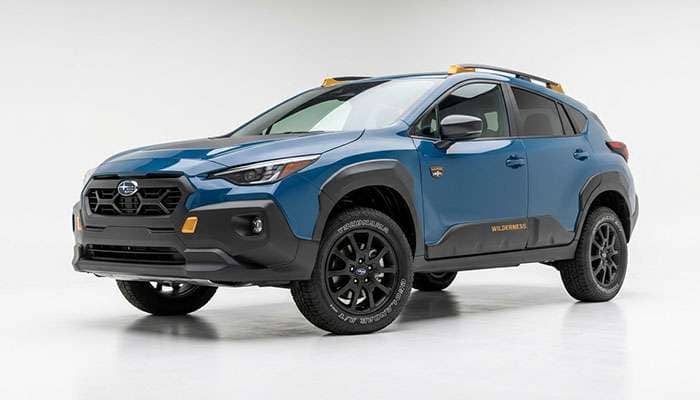
Not by a full size. The Wilderness sits at 9.3 inches of ground clearance against 8.7 on other trims, and Subaru gets there with taller front and rear suspension components. The tire is the same height as a Base car's, on the same 17x7 wheel size, so the full-lock limit at the liner barely moves. What you gain is margin at full compression. 225/65R17 is still the clean fit, and 235/65R17 is still the edge, just a more comfortable one.
The number worth knowing is final drive. Subaru lists 3.700 for standard Crosstreks and 4.111 for the Wilderness. A taller tire lengthens gearing, so it pays to run the math:
A Wilderness on 29-inch tires is still geared shorter than a Base car on factory tires. It doesn't physically take a bigger tire, but it is the Crosstrek that notices one least.
225/60R18 is the 18-inch twin of 225/65R17, with the same width and a 28.6-inch height. 235/60R18, at 29.1 inches, is the twin of 235/65R17 and behaves the same way. Fewer owners run these on Crosstreks, so there is less field data, but the geometry matches within a tenth of an inch.
Both sizes come in real all-terrains. Watch the speed rating, though. Late-model Limited tires are V-rated from the factory (149 mph), and most 225/60R18 tires are H-rated (130 mph). That is a step down on paper, so make it knowingly.
If you want more sidewall for gravel, factory 17s from the same generation bolt straight on and open up every 17-inch size above.
Yes, and this is the variable most Crosstrek answers leave out. Factory wheels run about +55 mm, or about +48 mm on the first generation. Almost no aftermarket 17-inch wheel in 5x100 or 5x114.3 matches that. The street-oriented 7- to 8-inch wheels in those patterns mostly run +30 to +45 mm, so nearly any aftermarket wheel moves the tire outboard.
A +40 mm wheel of the same 7-inch width puts the tire 15 mm farther out. That frees the strut side and makes room for a wider tire. The cost is more scrub radius, more load on the steering and wheel bearings, and less room at the outer liner. I keep Crosstrek wheels in the mid-30s to low 40s. Our guide on how much you can change offset explains why.
Hub bore is the other detail. The Crosstrek's hub is 56.1 mm, and aftermarket wheels are commonly bored around 72.6 to 73.1 mm or larger. Without hub-centric rings, the wheel centers on the lug nuts alone, and that is a common source of highway vibration.
Not if all four match. Bigger is fine. Mismatched is what hurts. Subaru's guidance is blunt: all four tires should match in size, construction, tread pattern, and degree of wear, because mixing them can damage the power train.
Here is the mechanism. CVT Crosstreks send torque rearward through an electronically controlled multi-plate clutch. When front and rear tires roll at different speeds, that clutch has to slip to make up the difference, and slip makes heat. The working limit in Subaru shops is about 2/32 inch of tread depth between tires, which is only about 0.4 inch of circumference. The step from 225/60R17 to 225/65R17 adds 2.8 inches of circumference, so you can never change just two.
So buy four, rotate them on Subaru's schedule, and read our AWD tire requirements before you mix anything. Your temporary spare also drifts further from the other three. The T145/80D17 spare on current gas cars is about 26.1 inches, which is 1.5 inches short of a factory tire and 2.4 inches short of 225/65R17. Treat it as a short trip to the shop and nothing more.
They can, and it rarely comes up in tire advice. Subaru's EyeSight owner's manual lists "Tires that are the wrong size are installed" among the conditions where the system may not operate correctly, alongside unevenly worn tires, incorrect pressure, and a temporary spare. A footnote adds: "The wheels and tires have functions that are critically important. Be sure to use the correct ones."
Subaru doesn't publish a percentage, so there is no official pass mark. The logic is simple. The car calculates road speed from wheel rotation, so a tire 3 percent taller means real speed is 3 percent above what the car thinks it is. For adaptive cruise and pre-collision braking, that is an input error.
Keep the change as small as your goal allows, which is another reason 225/65R17 beats 235/65R17 on a daily driver. If warnings appear after a tire change, go back toward factory diameter and have a dealer look at it. After any lift, have the system checked before you rely on it.
Here is what each step does to a 17-inch car, measured against the factory 225/60R17.
Tire Size |
Diameter |
Change |
Real Speed at Indicated 60 |
Common Load Index |
On a Stock Crosstrek |
|---|---|---|---|---|---|
225/60R17 |
27.6 in. |
Factory |
60.0 mph |
99 (1,709 lb) |
Factory fit |
235/60R17 |
28.1 in. |
+1.7% |
61.0 mph |
102 (1,874 lb) |
Clears, small gain |
225/65R17 |
28.5 in. |
+3.2% |
61.9 mph |
102 (1,874 lb) |
Biggest clean fit |
235/65R17 |
29.0 in. |
+5.1% |
63.0 mph |
104 (1,984 lb) |
Edge size, may rub at full lock |
245/65R17 |
29.5 in. |
+6.9% |
64.1 mph |
107 (2,149 lb) |
Needs new wheels, trimming, or both |
235/70R17 |
30.0 in. |
+8.4% |
65.0 mph |
109 XL (2,271 lb) |
Needs a 2- to 3-inch lift |
On current cars, at least 99 on 17-inch tires and 98 on 18-inch tires. Those are Subaru's factory numbers, 1,709 lb and 1,653 lb per tire at maximum pressure. Four 99-rated tires carry 6,836 lb against a 4,817-lb GVWR, so capacity is not the tight spot here that it is on a half-ton truck.
Every size in the table above gains capacity over the factory tire, because a bigger tire holds more air. The way to get in trouble is going backward, with a narrower winter size or a bargain tire that carries a lower index than your placard. Treat the factory number as a floor, especially on Hybrid trims, which weigh more.
No. This is the trap in 225/65R17, because several of the best-known all-terrains in that size are LT tires. The BFGoodrich All-Terrain T/A KO3, for example, is an LT225/65R17 107/103S, Load Range D, 8-ply rated.
That 107 looks like a win over the factory 99. But its 2,149-lb rating applies at 65 psi, and recent Crosstrek placards call for about 33 psi front and 32 rear. Tire and Rim Association load tables show an LT tire carrying less than a passenger tire of the same size at the same pressure. So you either run the placard number and lose the capacity you paid for, or you raise pressure and make a 3,300-lb crossover ride like a truck. The extra weight is also rotating mass that a modest four-cylinder and CVT have to spin up.
Subaru's own answer is the Wilderness: a 99T all-terrain, not an LT. Stick with passenger or Euro-metric all-terrains. Our P-metric vs. LT tires guide has the full breakdown.
A little liner contact sounds harmless, and at first it is. Left alone, it climbs.
The biggest tire on a stock Crosstrek is about 28.5 inches: 225/65R17 on 17s and 225/60R18 on 18s. 235/65R17 works on 2018-and-newer cars if you accept an occasional touch at full lock and maybe a trimmed liner. First-generation cars stop at 225/60R17.
The Wilderness doesn't change the physical limit, but its shorter final drive handles a taller tire best. Whatever size you choose, keep all four matched, stay away from LT construction, and pay attention to how EyeSight behaves afterward. Model year, wheel, and tire build decide the edge cases. Diameter alone never does.
On a 2018-or-newer Crosstrek with factory wheels and suspension, 225/65R17 is the biggest clean fit at about 28.5 inches. On 18-inch wheels, use 225/60R18. 235/65R17 is the edge size and may touch the liner at full lock.
Yes on 2018-and-newer cars, with no lift or trimming in most cases. Front mud flaps are the most common contact point. On a 2013-2017 Crosstrek, this size is an edge fit because that car has smaller wheel wells.
Usually, on factory 17-inch wheels, but owners report occasional liner contact at full lock. Some trim the liner at the contact point. It is a 5.1 percent diameter increase over 225/60R17, so your speedometer will read low by that amount.
Yes. All four must match, because the AWD system has to work constantly if front and rear tires roll at different speeds. Moving from 225/60R17 to 225/65R17 adds 2.8 inches of circumference, far beyond what the system tolerates.
Yes. All-terrains are made in the factory 225/60R17 and in 225/65R17. Choose passenger or Euro-metric all-terrains rather than LT tires, and keep the load index at or above your door placard. The Wilderness comes with a 99T all-terrain from the factory.
2013-2023 Crosstreks use 5x100. 2024-and-newer Crosstreks use 5x114.3. Both have a 56.1 mm hub bore, so most aftermarket wheels need hub-centric rings. Wheels from an older Crosstrek will not bolt onto a 2024 or newer car.