
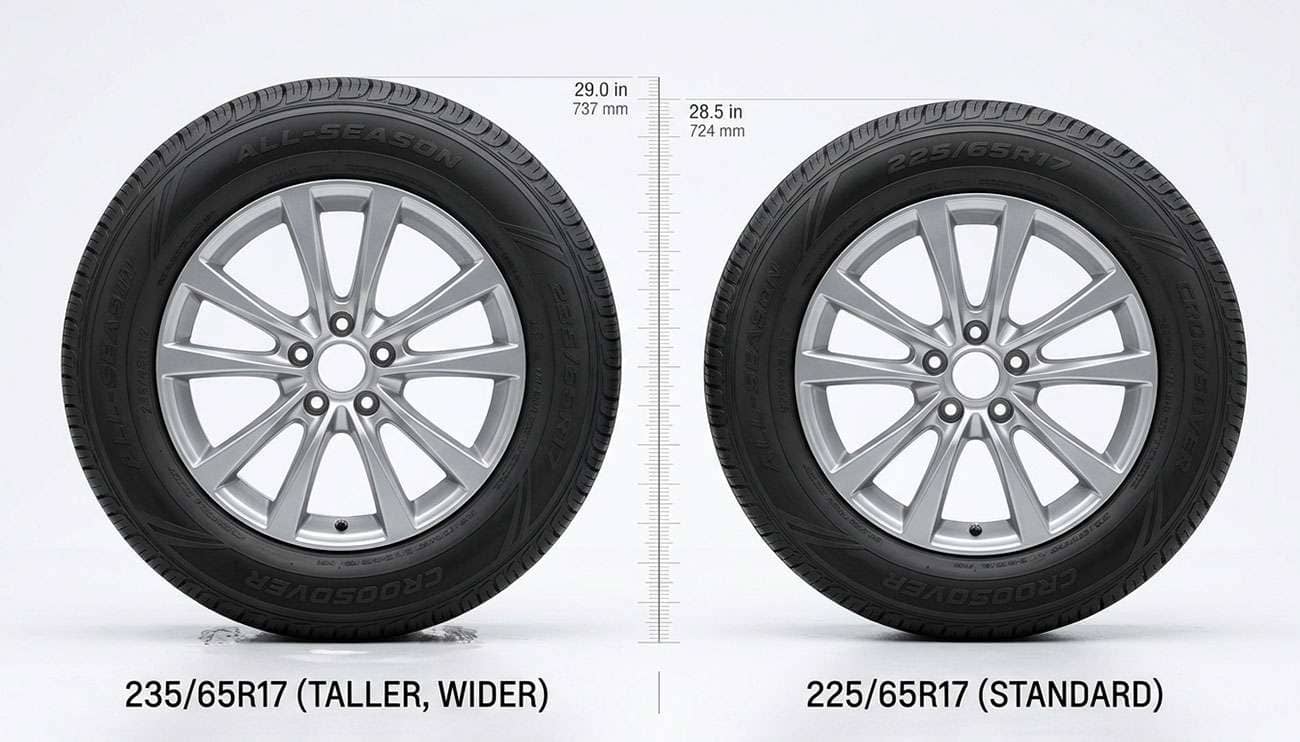
Yes. A 235/65R17 is one of the safest plus-size moves you can make on a vehicle that came with 225/65R17. It's only half an inch taller, it fits the same wheels, and Honda itself made this exact jump when it moved the CR-V LX to 235/65R17 for 2017. What decides whether your swap is an upgrade or a quiet downgrade isn't the size. It's three numbers on the sidewall: the load index, the speed rating, and, if you drive an AWD crossover, whether all four tires change together.
I'm Hank Feldman. I've been mounting tires at Performance Plus Tire since 1971, and this is one of those questions I hear across the counter every single week. Usually the customer has already decided to go a size up. What they haven't done is look at the little numbers after the size. Find your current tire in the table below and you'll know exactly what to buy.
Your Current Tire |
Drivetrain |
Can You Run 235/65R17? |
What to Buy |
|---|---|---|---|
225/65R17 102T (Standard Load) |
FWD |
Yes |
Any 235/65R17 rated 103 or higher, T or higher |
225/65R17 102H (Standard Load) |
FWD or AWD |
Yes, if you keep the H rating |
235/65R17 104H or 104V; skip the T-rated options |
225/65R17 106 (Extra Load) |
Any |
Only in Extra Load |
235/65R17 108 XL; a 104 Standard Load carries less |
Any 225/65R17 |
AWD |
Yes, as a full set of four |
Four matching 235s; never mix sizes across axles |
LT225/65R17 (Load Range D) |
Any |
Rarely |
Stay LT; very few 235/65R17s are built that way |
Ten millimeters of width. That's the whole difference on paper, and it's why this swap is so popular. Both tires share the same 65 aspect ratio and the same 17-inch wheel. But because the sidewall height is a percentage of the width, those 10 extra millimeters make the sidewall a little taller too, and that shows up twice in the overall diameter.
Measurement |
225/65R17 |
235/65R17 |
Difference |
|---|---|---|---|
Overall diameter |
28.5 in |
29.0 in |
+0.5 in (+1.8%) |
Section width |
8.9 in |
9.3 in |
+0.4 in |
Sidewall height |
5.8 in |
6.0 in |
+0.25 in |
Circumference |
89.6 in |
91.2 in |
+1.6 in |
Revolutions per mile |
707 |
695 |
12 fewer |
Ground clearance gain |
Baseline |
+0.25 in |
Half the diameter gain |
Typical approved rim range |
6.0 to 8.0 in |
6.5 to 8.5 in |
Overlaps on 6.5 to 8.0 in |
A 1.8 percent diameter change is small. The tire industry's rule of thumb is to stay within about 3 percent of the original diameter for a swap that needs no other changes, and this one sits comfortably inside that line. If you want the full measurement breakdown of the bigger size on its own, we covered it in what tire size 235/65R17 is.
Here's the part that tells you this swap is legitimate and not just a forum trick. The 225/65R17 is the factory size on a huge number of compact crossovers, which is why it's one of the most common tire sizes on the road. When Honda redesigned the CR-V for 2017, the base 17-inch size moved up to 235/65R17. An automaker doesn't change a tire size on its best-selling vehicle on a whim. They ran the clearance, the brakes, the stability control, and the speedometer calibration on the bigger size. That doesn't make it automatically right for your vehicle, but it tells you the jump is well within what these platforms were built for.
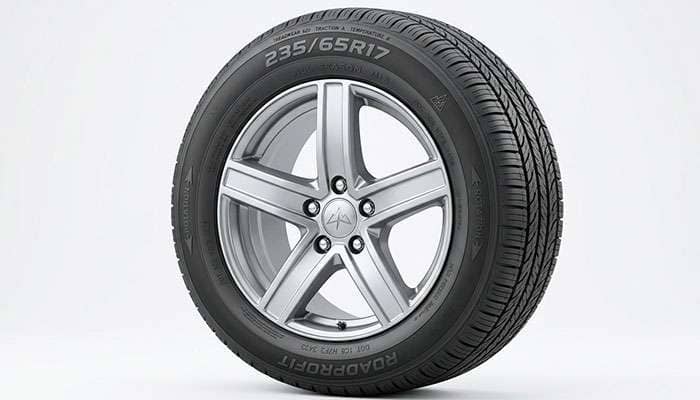
Almost always, yes. This is where the 225-to-235 swap is easier than most plus-size moves. Every tire size has an approved rim width range set by the tire maker, built on Tire and Rim Association guidelines. Most 225/65R17 tires list 6.0 to 8.0 inches. Most 235/65R17 tires list 6.5 to 8.5 inches. The factory wheels that wear 225/65R17 are typically 6.5 or 7 inches wide, which lands right in the middle of the overlap.
The 235 is designed around a 7.0-inch "measuring rim," so on a 7-inch factory wheel it sits exactly the way the engineers drew it. On a 6.5-inch wheel, it's at the narrow end of its approved range. That's still in spec. The sidewall stands just a hair more rounded and the steering may feel a touch softer, but you won't see the uneven wear you get from a truly undersized wheel.
Look on the back of a spoke or inside the wheel barrel for a stamp like "17x6.5J" or "17X7JJ." The number after the x is the width, measured bead seat to bead seat. If you can't find it, the tire shop can read it while the wheel is off for mounting. Then glance at the approved rim range on the spec sheet for the exact 235/65R17 you want. In this size, I almost never see a conflict, but it takes thirty seconds to be sure.
On most compact crossovers, no. The tire grows about a quarter inch in radius and about 0.4 inches in width. On the same wheel, that width splits roughly in half: 0.2 inches closer to the fender on the outside, and 0.2 inches closer to the suspension on the inside.
That inside number is the one I'd watch. Nearly every compact crossover uses MacPherson struts up front. The strut body and the coil spring seat sit right next to the inner sidewall, and on some vehicles the gap is only a little more than a finger's width. Two-tenths of an inch usually doesn't close that gap, but it's the first place to look.
Wheel spacers and aftermarket wheels with different offset change the picture completely. If you're keeping the factory wheels, the 0.2-inch split holds. If you're changing wheels at the same time, match the factory offset as closely as you can, and the 235 will behave just like it does on the stock wheel.
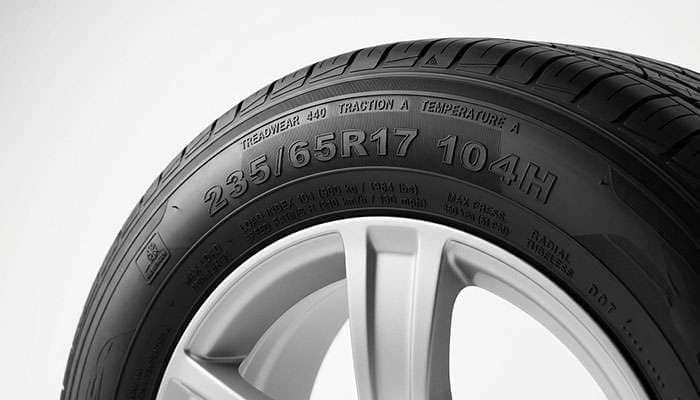
Usually, but not always, and the exception catches people. A bigger tire holds more air, and air carries the load, so in the same construction the 235 carries more. The trouble starts when your current tire is Extra Load and the replacement isn't.
Construction |
225/65R17 |
235/65R17 |
Change per Tire |
|---|---|---|---|
Standard Load (most common) |
102 / 1,874 lb |
104 / 1,984 lb |
+110 lb |
Standard Load (lower index) |
102 / 1,874 lb |
103 / 1,929 lb |
+55 lb |
Extra Load to Extra Load |
106 / 2,094 lb |
108 / 2,205 lb |
+111 lb |
Extra Load to Standard Load |
106 / 2,094 lb |
104 / 1,984 lb |
-110 lb |
Look at that last row. Somebody running 225/65R17 106 XL tires, usually because they tow a small trailer or keep the cargo area full, buys a 235 because it's "bigger," grabs a Standard Load 104, and ends up with 110 pounds less capacity on every corner. That's 440 pounds across the vehicle. The size went up and the capacity went down.
The rule is simple. Under FMVSS 110, every vehicle carries a placard that lists the original tire size and the pressure that supports its maximum loaded weight. NHTSA's guidance is that replacement tires must carry at least the load of the originals. Read the load index on the sidewall you have today, then make sure the number on the new tire is the same or higher. If your current tire says XL or Extra Load, the new one needs to say it too. Our guide to what XL load range means shows where to find it.
Keep using the pressure on the door placard as your starting point. A Standard Load 235 at the placard pressure carries more than the 225 it replaced, so you're covered. Extra Load tires reach their full rating at a higher pressure than Standard Load, typically around 41 to 42 psi, so if you're running XL, check the tire maker's load and inflation table rather than guessing.
It can, and this is the variable I see skipped most often. Speed rating isn't just about top speed. It's a measure of how well the tire handles heat at sustained highway speeds, and the construction that earns a higher rating usually brings sharper steering response too.
In the 225/65R17 size, H-rated tires (good to 130 mph) dominate the market. In 235/65R17, there's a much bigger share of T-rated tires (good to 118 mph), because the size is popular with highway-terrain and light all-terrain designs aimed at SUVs. So it's easy to walk out of a shop with a T-rated 235 replacing an H-rated 225 and never notice.
Does that matter? On a crossover that came from the factory on T-rated tires, no. Plenty did. But if your placard or current sidewall says H, the vehicle maker tuned the handling around that tire. Dropping to T gives up a little steering precision and a little heat margin. It also matters for insurance in some cases, and many tire shops won't install a lower speed rating than the placard calls for without a signed waiver. Match it or go higher. For the full rundown on the difference, see our comparison of H vs. T speed ratings.
Yes, as long as all four tires change together. This is where a lot of the folks asking this question live, because most vehicles wearing 225/65R17 are compact crossovers, and a big share of them have AWD.
Here's the mechanism. An AWD system connects the front and rear axles through a coupling, a clutch pack, or a center differential. When all four tires roll the same distance per revolution, that coupling has nothing to do on a straight road. When the front and rear roll different distances, the coupling has to make up the difference every single mile. A 235 rolls 1.8 percent farther per turn than a 225. Put 235s on one axle and 225s on the other and the coupling is slipping constantly, building heat and wearing parts that are expensive to replace.
It's not just size. A worn tire has a smaller circumference than a new one in the same size. That's why several AWD manufacturers publish limits on how much tread depth can differ between tires, some as tight as 2/32 inch. If you're switching sizes, you're buying four new tires anyway, which solves the problem neatly. If you get a flat later and the tire can't be repaired, replace it with the same size and ask about shaving the new tire down to match the other three. We go deeper on this in our article on AWD tire requirements.
Most of these crossovers carry a compact temporary spare. It was never the same size as the road tires, and it's only meant for short, slow trips to the shop. That doesn't change when you move to 235s. Just don't let a temporary spare stay on an AWD crossover any longer than the owner's manual allows.
On a front-wheel-drive crossover, mixing sizes front to rear won't hurt a drivetrain component, but it still upsets the handling balance the vehicle was tuned around. I'd do all four regardless.
Not much on either count. The 235 rolls 1.8 percent farther per revolution, so your speedometer reads 1.8 percent low.
Speedometer Shows |
Actual Speed on 235/65R17 |
Error |
|---|---|---|
30 mph |
30.5 mph |
+0.5 mph |
45 mph |
45.8 mph |
+0.8 mph |
55 mph |
56.0 mph |
+1.0 mph |
65 mph |
66.2 mph |
+1.2 mph |
75 mph |
76.4 mph |
+1.4 mph |
A mile and change at highway speed. Most factory speedometers already read slightly high from the factory, so on a lot of vehicles the 235 actually brings the needle closer to true. Your odometer will under-count by the same 1.8 percent, which adds up to about 180 uncounted miles every 10,000. Worth knowing for oil changes, not worth losing sleep over. If you're curious how bigger jumps play out, our article on bigger tires and your speedometer covers recalibration.
When I compared the same tire models in both sizes across the market, the 235 typically weighed about 1 to 3 pounds more per tire. The Yokohama Geolandar A/T4, for example, adds a little under 2 pounds per tire going from 225 to 235. That's rotating weight, so it costs a little more than the same weight in the cargo area, but it's small. Add a slightly wider footprint and you're looking at a change most drivers can't measure, often a few tenths of a mile per gallon. Tread design matters far more. Moving from a low-rolling-resistance touring tire to an all-terrain will cost you more than the size change ever will.
One more thing to remember: since your odometer under-reads, hand-calculated mileage will look about 1.8 percent worse than it really is. Multiply your displayed miles by 1.018 before you blame the tires.
Done right, this is about as low-risk as a size change gets. Done wrong, it fails quietly, and in a predictable order.
A T-rated tire replacing an H-rated one, or a 235 pair on one axle with 225s on the other, changes how the vehicle turns in and how it settles in a fast corner. Most drivers chalk it up to "new tires" and stop noticing. The stability control system notices, because it was tuned for a matched set.
A tire running at the wrong pressure for its load wears the shoulders. A tire that brushes the strut or liner leaves a polished band on the inner sidewall, and repeated contact can scuff down to the cords. If you've found a scuff or a bulge on a sidewall, read whether sidewall damage is safe to drive on before your next highway trip.
The Extra Load to Standard Load mistake lives here. A crossover loaded for a road trip, or pulling a small trailer, puts each tire close to its limit. Take away 110 pounds of capacity per tire and you push it past. An overloaded tire flexes more with every turn, and flex builds heat. Heat breaks down the bond between the rubber and the steel belts. NHTSA lists overloading among the leading contributors to tire failure, and it rarely gives a warning before the tread lets go.
Mixed sizes across the axles on an AWD crossover keep the coupling working every mile. On some systems that shows up as a shudder on tight turns or a warning light. On others, it shows up as a rear differential or transfer unit repair that costs more than four new tires. Every stage above ends with the same lesson: the right 235 costs about the same as the wrong one.
Here's how I'd walk a customer through it at the counter. Ten minutes, start to finish.
Most of the folks making this move are driving crossovers on pavement nearly all the time, and for them a quality all-season touring or highway tire is the right call. You can compare load indexes, speed ratings, and tread designs across our selection of all-season tires.
Going from 225/65R17 to 235/65R17 is about as close to a free upgrade as tires get. It fits the same wheels, it clears on nearly every crossover, the speedometer change is small enough that some vehicles end up more accurate, and an automaker made the same move on one of the best-selling crossovers in America. The size was never the risky part. The risk lives in the numbers that come after it: a load index that slips from Extra Load to Standard, a speed rating that drops from H to T, and a pair of 235s sharing a vehicle with a pair of 225s on an AWD system. Match those three things and you'll get a slightly taller, slightly wider, better-looking tire with nothing to regret.
Yes, on most vehicles. The 235 fits the same wheels and is only about half an inch taller. Make sure the new tire's load index and speed rating match or exceed your current tire, and replace all four on an AWD vehicle.
About 0.5 inches taller in overall diameter (29.0 inches vs. 28.5 inches) and about 0.4 inches wider. That's a 1.8 percent diameter increase and roughly a quarter inch of added ground clearance.
Rarely on factory wheels. The tire sits about 0.2 inches closer to the strut on the inside and 0.2 inches closer to the fender on the outside. Check the gap at the strut and turn lock to lock after mounting.
Yes. Honda made 235/65R17 the factory size on the CR-V LX starting with the 2017 redesign, and the size is a common upgrade for earlier CR-Vs that came with 225/65R17. Replace all four on AWD models.
Not on an AWD vehicle. The 1.8 percent difference in rolling distance forces the AWD coupling to slip constantly. On front-wheel drive it won't damage the drivetrain, but it upsets handling balance, so replacing all four is still the right call.
Slightly. The speedometer reads about 1.8 percent low, so an indicated 65 mph is about 66.2 mph actual. Most drivers don't need to recalibrate for a change this small.



