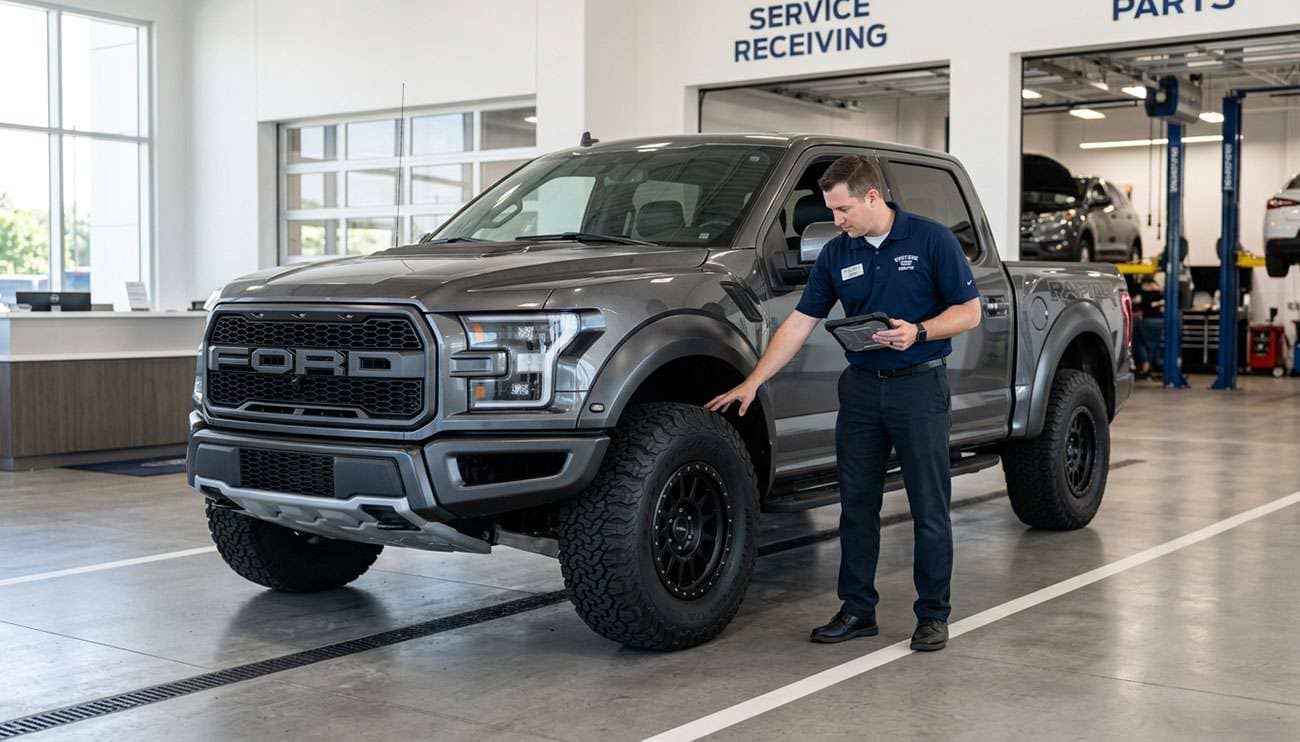
Short answer: not by themselves, and never all at once. Under the federal Magnuson-Moss Warranty Act, a manufacturer can't void your truck's warranty just because you put on bigger tires. What it can do is deny a specific repair when it can show the bigger tires, or the leveling kit you added to fit them, caused that part to fail. The variable nobody names is how far your setup sits from what the factory itself offers on your truck. A size Ford, GM, Ram, or Toyota already puts on another trim of the same truck is hard to blame for anything. A 35 on a leveling kit puts your ball joints, CV axles, wheel bearings, and steering parts on the table, and on a big jump with no regear, your driveline claims get a closer look. Most answers stop at "they can't void your whole warranty." True. That's the part that won't cost you money.
I'm Dennis Feldman, and I handle fitment at Performance Plus Tire. This question comes in right before almost every truck upgrade we do, and it deserves a straight answer instead of a shrug. One thing up front: I'm a fitment guy, not a lawyer, and nothing here is legal advice. What I can give you is what the federal rules say, what the manufacturers print in their own warranty booklets, and how the parts actually wear when you change the tires.
Find the row that matches what you've changed. The further down the table you go, the more claims a dealer can reasonably tie to your modification.
What You Changed |
Warranty Risk |
Claims Most Likely to Be Questioned |
Why |
|---|---|---|---|
A tire size the factory offers on another trim of your truck, on stock suspension |
Lowest |
Hard to tie to anything |
The manufacturer engineered and validated that size on your platform |
Slightly bigger tires, about 3 percent or less in diameter, stock suspension, no rubbing |
Low |
Rarely anything; possibly speedometer-related complaints |
Small changes in load, gearing, and geometry |
Bigger tires plus an aftermarket leveling kit |
Moderate |
Ball joints, CV axles, tie rods, struts, alignment-related wear |
Front suspension angles changed outside factory settings |
Lift kit and 35s, wider wheels, no regear |
High for the affected systems |
Front end, wheel bearings, steering, and a closer look at transmission and axle claims |
More weight, more leverage, and taller effective gearing |
A factory-backed lift or leveling kit, installed by the dealer |
Lowest for the kit itself |
Tires larger than the kit's approved size |
The kit carries its own manufacturer warranty |
Warranty claims are judged one part at a time. This is how the same set of tires can leave one repair fully covered and get another one denied.
Part That Fails |
Can Bigger Tires Plausibly Cause It? |
What a Dealer Will Look At |
|---|---|---|
Infotainment, power windows, HVAC, interior electronics |
No |
Nothing about your tires; should be covered as normal |
Engine internals |
Very unlikely |
Maintenance records, not tire size |
Wheel bearings and hubs |
Yes, with heavier tires and lower-offset wheels |
Tire weight, wheel offset, spacers |
Ball joints, CV axles, tie rods, struts |
Yes, especially with a level or lift |
Ride height, suspension angles, kit brand |
Transmission, transfer case, axles |
Sometimes, after a big size jump with no regear |
Diameter change, gearing, towing history |
TPMS sensors |
Only if the sensors were moved or replaced |
Whether the sensors are factory parts |
Camera and radar driver-assist systems |
Possibly, after a ride-height change |
Lift height and whether the sensors were recalibrated |
Not the whole thing. The Magnuson-Moss Warranty Act is the federal law that governs consumer product warranties, including new-vehicle warranties. Section 102(c) of the Act prohibits what's called a tie-in: a warrantor can't make your coverage depend on using a branded part or service unless it provides that part or service free. The Federal Trade Commission's rule implementing it, 16 CFR 700.10, says flatly that no warrantor may condition the continued validity of a warranty on using only authorized parts for non-warranty service.
The same rule spells out the other side, and this is the part that matters for your tires. It doesn't stop the warrantor from denying liability for damage caused by the unauthorized part, "where the warrantor can demonstrate that the defect or damage was so caused." The FTC's consumer guidance puts it plainly: simply using an aftermarket part doesn't void your warranty, but if that part causes damage to a covered component, the manufacturer or dealer can deny coverage for that repair. The company has to show the aftermarket part caused the need for the repair.
This isn't theory. In April 2018, FTC staff sent warning letters to six major companies that sell cars, phones, and game consoles, flagging warranty language that told customers to use specific parts to keep coverage. In June 2022, the FTC announced orders against Harley-Davidson and generator maker Westinghouse over warranty terms that conditioned coverage on genuine parts, and required both to fix their warranties and notify customers. The message has been consistent for years: a warranty can't be voided for using parts that didn't come from the manufacturer.
In practice, the first person who decides is the service advisor and the dealer's warranty administrator, and they're looking at your truck, not a law book. If your truck comes in with a leaking front CV boot and it's sitting three inches higher with 35s on it, they're going to connect those dots. If it comes in with a dead touchscreen, your tires are irrelevant. The closer the failed part sits to the tires and suspension, the easier it is for a dealer to make the case, and the more your paperwork matters. Our guide to whether aftermarket wheels void your warranty covers the same rule from the wheel side.
They all say some version of the same thing, and it lines up with the federal rule: changing the truck doesn't wipe out the warranty, but damage the change causes isn't covered. Here's how each one puts it in its own words.
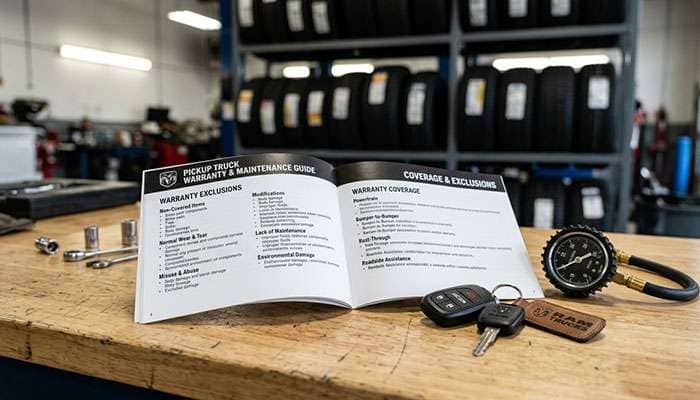
Ford. Ford's warranty guide excludes damage caused by alterations or modifications of the vehicle, including the body, chassis, or components, and damage from a non-Ford part when that part fails or causes a Ford part to fail. It has gone further and named examples outright: "lift kits, oversized tires, roll bars."
GM. Chevrolet's warranty booklet lists alteration or modification of the body, chassis, powertrain, and driveline among the things it doesn't cover, along with damage from installing non-GM parts. It's also specific about the scope: unapproved parts or alterations "will void the warranty coverage for those components that are damaged or otherwise affected." Those components, not the truck.
Ram. Ram's warranty booklet says it directly: "Certain changes that you might make to your truck do not, by themselves, void the warranties." It then lists changing the vehicle's configuration or dimensions among the things it doesn't cover, and says repairs or adjustments caused by those changes aren't covered.
Toyota. Toyota's own parts site, on the listing for its TRD suspension lift kit, warns that "tires and wheel combinations larger than OEM sizes may void the vehicle's warranty." Read that through the federal rule above and the practical meaning is the same as everyone else's: what's at risk is coverage for what those bigger tires and wheels affect.
Booklets change by model year, so pull the one for your truck. It's in the glovebox packet and on the manufacturer's owner site, and the section you want is usually titled something like "What Is Not Covered."
An aftermarket leveling kit doesn't void the warranty either, but it's the single biggest reason front-end claims get questioned, because it changes suspension angles outside factory settings. Here's where it gets interesting: the manufacturers sell their own.
Ford Performance has sold Fox-based leveling kits for the F-150 and Ranger, and Ford's parts warranty says installation of those select kits by an authorized installer "will NOT void your New Vehicle Limited Warranty." Toyota sells dealer-installed TRD lift kits for the Tacoma and Tundra, and genuine parts installed by a dealer are covered for 12 months or the remainder of the new-vehicle warranty, whichever is longer. Mopar sells lift kits for Jeep models through its dealers too; ask the dealer for the kit's warranty terms in writing before you buy.
The fine print matters. A factory-backed kit covers the kit and keeps the vehicle warranty in place for the kit. It doesn't automatically bless whatever tire you put on it. Toyota's warning about tire and wheel combinations larger than OEM sizes sits right on its own lift kit listing. If you want the cleanest warranty path, stay with the kit's listed tire size, or a size the factory already offers on your truck. If you want to know which sizes clear without a lift at all, see the biggest tire without a lift.
If your truck rides on air, the suspension computer is watching ride height. GM told its technicians in 2021 that aftermarket height-sensor links and lowering kits on some Tahoes, Suburbans, Yukons, and Escalades set off a Service Leveling System message, and that damage or performance concerns from those modifications may not be covered. Raising an air-ride truck with modified height-sensor links puts you in the same conversation from the other direction.
The ones physically connected to the tire. Here's the mechanism for each, because a dealer has to be able to explain it too.
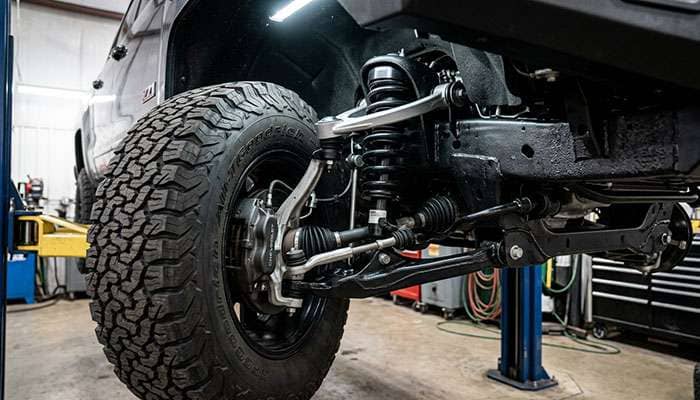
A bigger tire is heavier, and a wider wheel with lower offset pushes the tire's centerline further outboard of the bearing. Both add leverage on the bearing every time you hit a pothole or turn hard. This is the most common place a big wheel and tire package and a warranty claim collide, and spacers make it worse; see do wheel spacers hurt your car before you add them. Our guide to wheel offset and tire width package fitment shows how far offset moves the load.
On an independent front suspension, a leveling kit or lift changes the angle the CV axles and ball joints run at, all the time. Taller, heavier tires also put more force through the steering system at low speed. Wear on these parts after a ride-height change is the easiest claim for a dealer to tie to a modification.
Pads and rotors are wear items that most new-vehicle warranties don't cover anyway. But a heavier, taller tire takes more braking effort to stop, so expect them to wear faster.
The tires themselves don't hurt your sensors. But if your sensors got moved to new wheels, damaged during mounting, or replaced with aftermarket units, a sensor failure may not be a factory warranty claim. Our guide to TPMS sensors for aftermarket wheels covers how to keep them working.
Raising the front of a truck tips the forward radar and camera up. Calibration specialists say ride-height and tire-size changes can throw those sensors out of calibration, and that manufacturers typically don't provide calibration procedures for ride heights outside factory specs, except for their own approved kits. SEMA's own testing of a 2022 Silverado 1500 with a 2-inch level, and 3.5-inch and 6-inch lifts, found the factory driver-assist features still worked, and SEMA was careful to say that result applies to that one truck. If a lane-keep or emergency braking fault shows up after a lift, expect the conversation to start with your ride height.
Usually not, but a big jump without a regear invites scrutiny. A taller tire acts like a taller final drive ratio. Going from a 31.6-inch tire to a 35 is about an 11 percent jump, which means the transmission and axles see more torque load for the same acceleration, and the transmission may hunt between gears or run hotter when towing. If a transmission or differential fails on a truck towing heavy with 35s and stock gears, expect the dealer to ask about it. A small step inside about 3 percent is a different story; it changes very little. Our guide to regearing after bigger tires covers when a regear is worth it.
Bigger tires make your speedometer read slow and your odometer log fewer miles than you actually drove. On many trucks, the transmission also uses vehicle speed to decide when to shift. A recalibration fixes all three, and a receipt shows the shop did it right. Our guide to bigger tires and your speedometer explains how far off you'll be at each size.
A warranty denial doesn't show up the day you mount the tires. It shows up later, one part at a time, and each rung costs more than the one before it.
Every rung is cheaper to avoid than to argue. The easiest way to stay at the top of that list is to pick a size close to what your truck already runs. Our Advanced Tire Size Calculator shows the diameter change, speedometer error, and revolutions per mile for any size you're considering.
Bigger tires don't void your truck warranty. Federal law has been clear on that for decades, and the FTC has enforced it. What they can do is cost you coverage on the specific parts they can reasonably be blamed for, and every manufacturer's booklet says so in its own words.
The question that decides your risk is how far past the factory envelope you go. A size your truck already comes with on another trim is nearly bulletproof. A modest step on stock suspension is low risk. Add an aftermarket level or lift, wider wheels, and 35s on stock gears, and the front end, bearings, and possibly the driveline become the dealer's call. Keep the change small, keep your paperwork, and you'll keep your warranty doing its job. Run your options through our Advanced Tire Size Calculator before you buy.
Only for repairs the bigger tires, or related modifications, caused. Under federal law, the manufacturer has to be able to show the aftermarket part caused the damage. Unrelated repairs should still be covered.
Not the whole warranty. An aftermarket leveling kit can lead to denied claims on front suspension and driveline parts. Some manufacturer-backed kits installed by a dealer, such as select Ford Performance leveling kits, come with a statement that they won't void the new vehicle warranty.
No, but a large size jump without a regear can draw scrutiny on transmission and axle claims, especially on a truck that tows. Small changes of about 3 percent or less rarely matter.
The safest is a size the manufacturer already offers on another trim of your truck. After that, a size within about 3 percent of your factory diameter on stock suspension is a low-risk step.
No. The same federal rule applies. Wheels with very different offset, or spacers, can lead to denied wheel bearing and hub claims, but they can't void the warranty as a whole.
Ask the dealer to explain in writing which part failed and how your tires caused it. Ask for a supervisor, then contact the manufacturer. The FTC also suggests contacting your state attorney general or local consumer protection office.