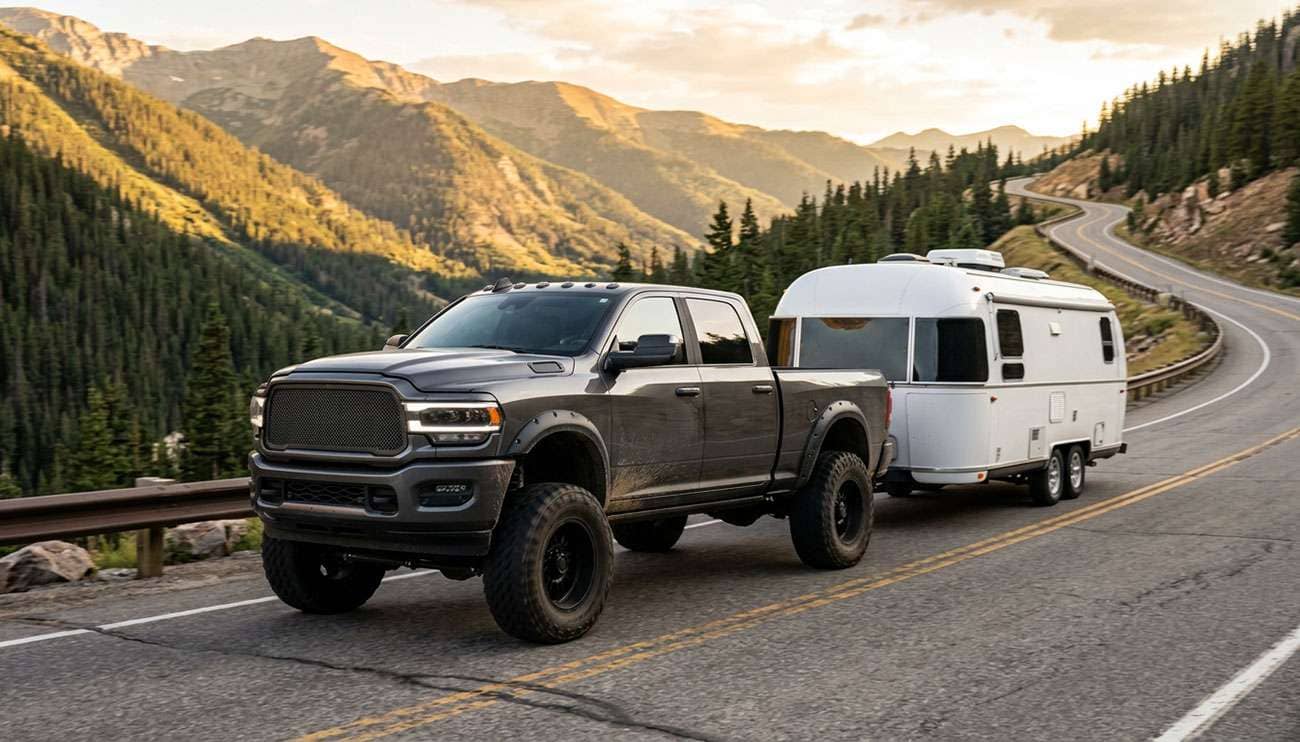
Yes, bigger tires decrease what your truck can safely tow, even though the number printed in your owner's manual never changes. Here's the part nobody puts in front of you: tow ratings are published by axle ratio, and a taller tire quietly moves your truck down that chart. Put 35s on a truck that left the factory on 32s with 3.73 gears, and it pulls like a 3.42 truck. On the GM chart below, that exact step was worth 1,000 pounds of trailer. Then check the new tire's load index, because some bigger tires carry less than the ones you took off.
I've been putting tires on trucks since 1971, and this question crosses our counter every week. The usual answer is "it depends." It depends on three things you can check in your driveway: how much taller the tire is, what that does to your gearing and brakes, and what the new tire can carry.
How Much Taller |
Common Swap |
3.55 Gears Now Act Like |
3.73 Gears Now Act Like |
What It Means When You Tow |
|---|---|---|---|---|
About 3% |
31 to 32 in. |
3.44 |
3.61 |
Less than one factory axle-ratio step. Check the new tire's load index and move on. |
About 6% |
31 to 33 in., or 33 to 35 in. |
3.33 to 3.35 |
3.50 to 3.52 |
Roughly one full step down the towing chart. Use the next-lower ratio's rating. |
About 9% |
32 to 35 in. |
3.26 |
3.42 |
One to two steps down. Starting from a standard tow axle, often taller than any ratio the factory sells. |
About 12% |
33 to 37 in. |
3.17 |
3.33 |
Taller than the gearing most tow packages use. Regear before you hook up anything heavy. |
15% or more |
32 to 37 in. |
3.07 |
3.23 |
At or past the tallest gearing most trucks are sold with. Regear and upgrade brakes, or keep a stock-size set for towing. |
No, and that's exactly why people get caught. Your door sticker, owner's manual and towing guide don't change when the new tires go on. What changes is whether your truck still matches the configuration that earned the rating.
Since the mid-2010s, the major full-size pickup makers have rated their trucks under SAE J2807, the Society of Automotive Engineers' tow-rating standard. The famous test is the Davis Dam grade on Arizona State Route 68: about 11 miles and 3,500 feet of climb, started at 100 degrees with the A/C on full, and a single-rear-wheel truck has to hold at least 40 mph. The truck also has to launch five times in five minutes on a 12 percent grade, hold the rig there on the parking brake alone, and pass acceleration, braking, understeer and trailer-sway tests.
Every one of those tests runs on the truck as built, factory tires and axle ratio included. Change the tire diameter and you've changed the gearing that climbed the grade and the leverage the brakes stopped with. Nobody re-ran the tests on your combination.
Open any manufacturer's towing guide. Ratings aren't listed by truck. They're listed by engine, cab, drive and axle ratio, each row with its own gross combined weight rating (GCWR) and trailer rating.
GM's 2009 Silverado 1500 owner's manual shows how much that axle column matters. A 2WD regular cab with the 5.3L V8 and four-speed automatic was rated at 7,200 pounds on 3.42 gears and 8,200 pounds on 3.73 gears, with GCWR stepping from 12,000 to 13,000 pounds. Same truck, same engine, same transmission, a thousand pounds apart.
That 3.42 to 3.73 step is the same 9 percent you add going from a 32-inch tire to a 35. Dodge's own tow-rating data has shown the tire option alone moving max towing by as much as 1,100 pounds, for two reasons: the change in effective axle ratio, and a tire whose load capacity caps the rear gross axle weight rating (GAWR).
Under FMVSS 110, the NHTSA standard for tire selection on vehicles up to 10,000 pounds GVWR, the combined load rating of the tires on each axle can't be less than that axle's GAWR. P-metric tires on a truck get their rating divided by 1.10 first. Once you swap tires, nobody checks that math but you.
The math is one line: effective ratio equals your axle ratio times the old tire diameter divided by the new one. A taller tire covers more ground per turn, so less torque reaches the pavement at every speed, in every gear.
Go from 31s to 33s and the tire is 6.5 percent taller. A 3.55 axle now acts like a 3.33. Go from a factory 32.1-inch 275/65R18 to a true 35 and the tire is 9 percent taller, so 3.55s act like 3.26s and 3.73s act like 3.42s. Skip the napkin and plug your sizes and axle ratio into our gear ratio and RPM calculator. It gives you your effective ratio, acceleration change and speedometer error in one pass.
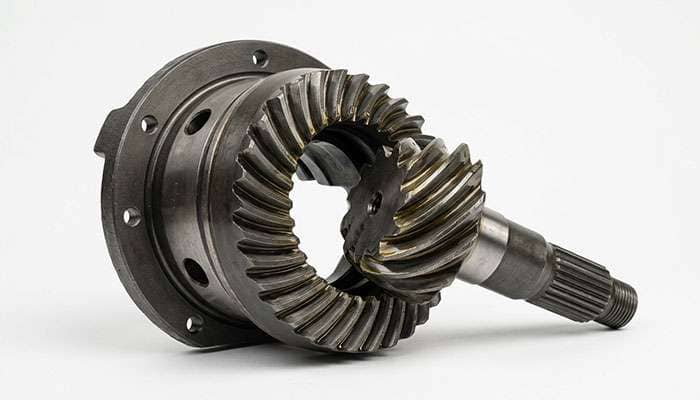
The axle ratios offered on one truck are usually only 5 to 10 percent apart. A 3.31 to a 3.55 is about 7 percent. A 3.42 to a 3.73 is about 9. So a 6 to 9 percent taller tire doesn't nudge you. It moves you about one full row down the towing chart.
A common rule says to cut your tow rating by the same percentage your tire grew. That's a fair start for gearing, but it cuts the wrong number. Gearing limits GCWR, the total weight of truck plus trailer. Your trailer limit is what's left after you subtract the truck, and the truck didn't get any lighter.
Say your towing guide row shows a 16,800-pound GCWR and an 11,000-pound max trailer on 3.55 gears and 32-inch tires. Move to 35s and scale the GCWR the same 9 percent: about 15,400 pounds, or 1,400 less. Now add weight. A 35x12.50R20 all-terrain typically weighs 75 to 80 pounds against roughly 45 for a factory 275/65R18 highway tire, and the wheels usually gain too. Call it 200 pounds for the set. Your working trailer number lands around 9,400 pounds. A 9 percent taller tire took about 15 percent off your trailer.
That's an estimate, not a factory re-rating. It keeps you on the safe side of a number nobody tested.
Sometimes two axle ratios share the same GCWR. That means something other than gearing set the limit for that row, like cooling or the rear axle. The same 2009 GM chart shows it: the six-speed 5.3L on 3.42 gears jumped from 6,600 to 9,100 pounds with the heavy-duty cooling package and no gear change. In that case your real gearing loss is smaller than the estimate, and the row method at the end of this guide will show it.
Yes, through leverage and rotating weight. Leverage is the bigger one, and it's the one that gets skipped.
Stopping force at the pavement equals brake torque divided by the tire's rolling radius. Make the tire 9 percent taller and your brakes need about 9 percent more torque to stop the same rig at the same rate. In one hard stop on dry pavement, ABS and grip often still set the limit, so you mostly feel a harder pedal. Where it costs you is heat on a long downgrade, and heat is what makes brakes fade.
Tire weight sits out at the tread, the worst place for it. Spinning a tire up takes roughly as much energy as moving it down the road, so every extra pound out there costs your brakes about two pounds' worth of work. Four tires that each weigh 35 pounds more act like about 280 extra pounds. Against a 16,000-pound rig that's a couple of percent, smaller than the leverage effect but stacked on top of it.
Taller effective gearing drops engine rpm at any road speed, so you get less engine braking on the way down a grade. And the torque needed to hold a rig on that J2807 12 percent grade scales with tire radius, so a 9 percent taller tire asks your parking brake for 9 percent more than the factory tested. Re-set your trailer brake controller gain with the trailer loaded so the trailer does its share of the stopping.
A tire doesn't tow. It carries. How much it carries comes from the load index on the sidewall, not the height, and a 32-inch tire can be good for anywhere from about 2,500 to more than 3,400 pounds.
Take a 275/65R18, about 32.1 inches tall. As a P-metric standard-load tire at 116, it's rated 2,756 pounds on a car, but FMVSS 110 divides that by 1.10 on a truck, so about 2,505 pounds. As an LT Load Range C at 113, it carries 2,535. As an LT Load Range E at 123, it carries 3,415, but only at its maximum rated pressure, usually 80 psi. Same height, nearly 900 pounds apart per tire.
When you tow, the real question is whether the two rear tires can hold up the rear axle. Your hitch sits behind that axle, so tongue weight adds roughly 1.33 to 1.40 times its value to it. A 900-pound tongue can add about 1,200 pounds. We walk through that lever in our guide to towing tire load range on a half-ton.
My shop rule is to keep each rear tire at or below about 85 percent of its rated capacity when you're hooked up, using the derated number for P-metric tires. If you're shopping all-terrains for the job, construction matters as much as size, which is why we wrote up whether you can tow with all-terrain tires.
Yes, and this trap gets the most people, because bigger looks stronger. Flotation sizes, the ones written in inches like 33x12.50R20, come off their own load tables under the Tire and Rim Association system. In 20-inch sizes they typically carry far less than a metric LT tire of the same height on the same wheel.
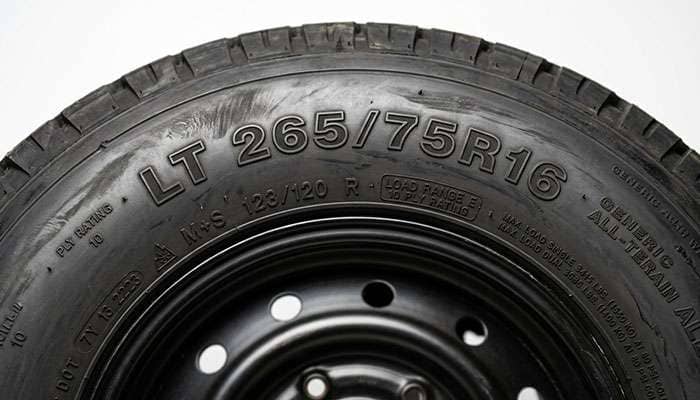
Here's what typical load ratings look like across sizes people move between. Always read the exact sidewall of the tire you're buying.
Tire Size |
Height |
Load Range |
Typical Load Index |
Max Load per Tire |
|---|---|---|---|---|
P275/65R18 (common factory half-ton size) |
32.1 in. |
Standard Load |
116 |
2,756 lb (2,505 lb on a truck) |
LT275/65R18 |
32.1 in. |
E |
123 |
3,415 lb |
LT33x12.50R15 |
33 in. |
C |
108 |
2,205 lb |
LT33x12.50R20 |
33 in. |
E |
114 |
2,601 lb |
LT275/60R20 |
33.0 in. |
E |
123 |
3,415 lb |
LT275/70R18 (common factory 3/4-ton size) |
33.2 in. |
E |
125 |
3,640 lb |
LT35x12.50R20 |
35 in. |
E |
121 |
3,195 lb |
LT35x12.50R20 |
35 in. |
F |
125 |
3,640 lb |
LT295/65R20 |
35.1 in. |
E |
129 |
4,080 lb |
Look at the two 33-inch tires on 20-inch wheels. Both say Load Range E and 10-ply. The 33x12.50R20 typically carries 2,601 pounds. The LT275/60R20 typically carries 3,415. That's 814 pounds per tire, 1,628 across your rear axle, between two tires that look nearly identical side by side. Ply rating tells you how much air the tire needs. Load index tells you how many pounds it holds up. On older trucks and Jeeps, the classic 33x12.50R15 is usually a Load Range C at 108, or 2,205 pounds, less than a lot of factory P-metric tires carry even after the truck derate.
This one hurts more because it's the truck you bought to tow. A common factory 3/4-ton tire, the LT275/70R18 E, carries 3,640 pounds. Swap to a 35x12.50R20 E at 121 and each tire drops to 3,195, which is 890 pounds less across the rear axle. The factory picks tires to clear the rear GAWR on your door sticker, and on many heavy-duty trucks it doesn't leave much to spare. Do that math before you tow.
The fix comes in the same height. A 35x12.50R20 in Load Range F typically runs 125, matching the factory tire. A metric LT295/65R20 E, 35.1 inches tall, typically runs 129 and carries 4,080 pounds. The Tire Industry Association's guidance for technicians is simple: a replacement tire's load capacity should equal or exceed the original equipment tire's. Shop by load index first and diameter second, and check the wheel's load rating too.
Both, and both get missed because they have nothing to do with the engine.
A taller tire lifts the truck by half the diameter increase. Going from 32.1 to 35 inches raises your receiver about 1.5 inches before any lift or leveling kit, and most 35s go on with one. A trailer that was level is now nose-high, which shifts weight toward its rear axle and off the tongue. Too little tongue weight is a classic setup for sway. J2807 rates trucks at 10 percent tongue weight, and most trailer makers ask for 10 to 15 percent on a conventional hitch.
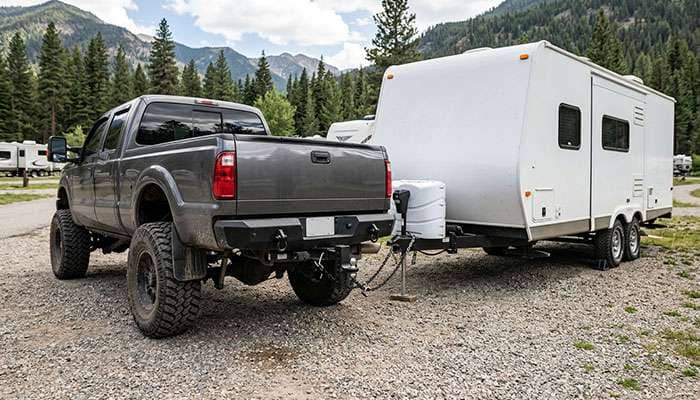
The fix is an adjustable drop shank sized to the gap between your level coupler and your receiver. Planning a lift too? Our lift kit tire size chart shows what each lift height typically clears, so you can figure your drop before the parts arrive.
Payload is GVWR minus what the truck weighs. Heavier tires, wheels and a lift kit all come out of it, and so does tongue weight. Pull a 9,000-pound trailer at 12 percent tongue weight and you've put 1,080 pounds in the bed before anybody gets in the cab. Most half-tons run out of payload before they run out of tow rating, and a heavy wheel and tire package moves that wall closer.
For towing, the bar is lower than for daily driving. A truck that commutes empty can live with a 6 percent taller tire. Hook up a trailer near your old limit and that same 6 percent is a full row on the chart.
A towing regear should put your effective ratio back where the factory rated it: multiply your axle ratio by the new diameter divided by the old. A 3.55 truck that went from 32.1-inch tires to 35s needs about 3.87, so you'd look at 3.92 or 4.10. A 3.73 truck needs about 4.07, which means 4.10. Our breakdown of whether you need to regear after bigger tires has the full chart and what the job typically costs.
New gears restore torque at the wheels and take heat off the transmission. They don't fix brake leverage, rotating weight, the new tire's load index or your payload. On 35s or bigger with a heavy trailer, budget for brakes too, and recalibrate the speedometer so your shift tables and road speed line up again.
Bigger tires don't automatically void a factory warranty. What they do is hand the dealer an easy story when a towing part fails, like cooked transmission fluid or a rear wheel bearing that gave up under load. Keep your receipts and fluid records, and stay inside the limits you calculated. Our write-up on whether bigger tires void your truck warranty covers what a dealer can and can't deny.
The damage doesn't show up all at once. It climbs a ladder, and every rung costs more than the last.
Go from 32.1-inch tires to 35s without recalibrating and your speedometer reads 65 while you're doing about 71. Many trailer tires carry speed ratings well below your truck's, and some are limited to 65 mph. Our guide to bigger tires and your speedometer shows how to check and correct it.
Taller effective gearing keeps the transmission in lower gears longer and the torque converter unlocked more often on grades. That makes heat, heat breaks down fluid, and you start noticing downshifts on overpasses the truck used to pull in top gear.
Less engine braking plus more brake torque per stop means hotter rotors and pads on every long grade. Pads glaze, the pedal gets long, and the trailer starts pushing.
If the new tires carry less than the old ones, the rear pair runs at or past its limit every time you hook up. Overloaded tires run hot at highway speed, which shows up first as shoulder wear and then as belt-edge separation or a bulge. If you spot anything on a sidewall, our guide to whether tire sidewall damage is safe to drive on tells you what's repairable and what's done.
A rear tire that lets go at 70 mph with 9,000 pounds pushing on your hitch is the top of the ladder: sway and loss of control. The cheapest place to get off this ladder is the tire counter. Pick the size by load index first, and match the gearing to it.
Here's the process I'd walk you through at the counter. Grab your door sticker and the towing guide for your truck's model year.
If step 5 or 6 gives you a number you don't like, you have three real options: tow lighter, regear and move to a higher load index in the same height, or keep a factory-size set of LT tires for towing season.
Bigger tires don't change the tow rating printed in your manual. They change the truck it was printed for. The gearing that climbed Davis Dam, the brake leverage that stopped the test trailer and the tire capacity behind your rear axle rating were all measured on the factory tire. A 6 to 9 percent taller tire moves you about one row down the towing chart, and because the truck doesn't get lighter, the trailer number drops faster than the tire grew.
None of that means you can't run 35s and tow. It means you do it with the right numbers, and you buy the bigger tire by load index before you buy it by height.
Here's what to remember before you tow on bigger tires.
Yes. About 3 percent taller is hard to measure. About 6 percent is roughly one axle-ratio step on your towing chart. At 9 percent or more, most trucks run taller gearing than their tow package was rated on, and the new tire may carry less than stock.
Not by themselves. A taller tire lowers your effective gear ratio, adds rotating weight and reduces brake leverage. What makes a tire better for towing is a higher load index and stiffer LT construction near your factory height.
Yes, two ways. Diameter changes your effective axle ratio, which is how manufacturers set GCWR in their towing guides. And each size comes with its own load index, which limits what your rear axle can carry once the tongue weight goes on.
Yes, especially when you tow. Taller effective gearing keeps the transmission in lower gears longer and the torque converter unlocked more often on grades. Both make heat, and heat is what breaks down fluid and wears converter clutches.
If you tow anywhere near your original rating, yes. A truck that left the factory on 32-inch tires with 3.55 gears needs about 3.87 to get back to stock on 35s, so 3.92 or 4.10. Towing light, you can keep stock gears, but use the lower effective ratio when you figure your limit.
No. A higher load range can restore capacity a weaker tire was costing you, but it can't raise your published tow rating, GCWR or GAWR. Those come from the axles, frame, brakes, cooling and gearing, not the tires alone.