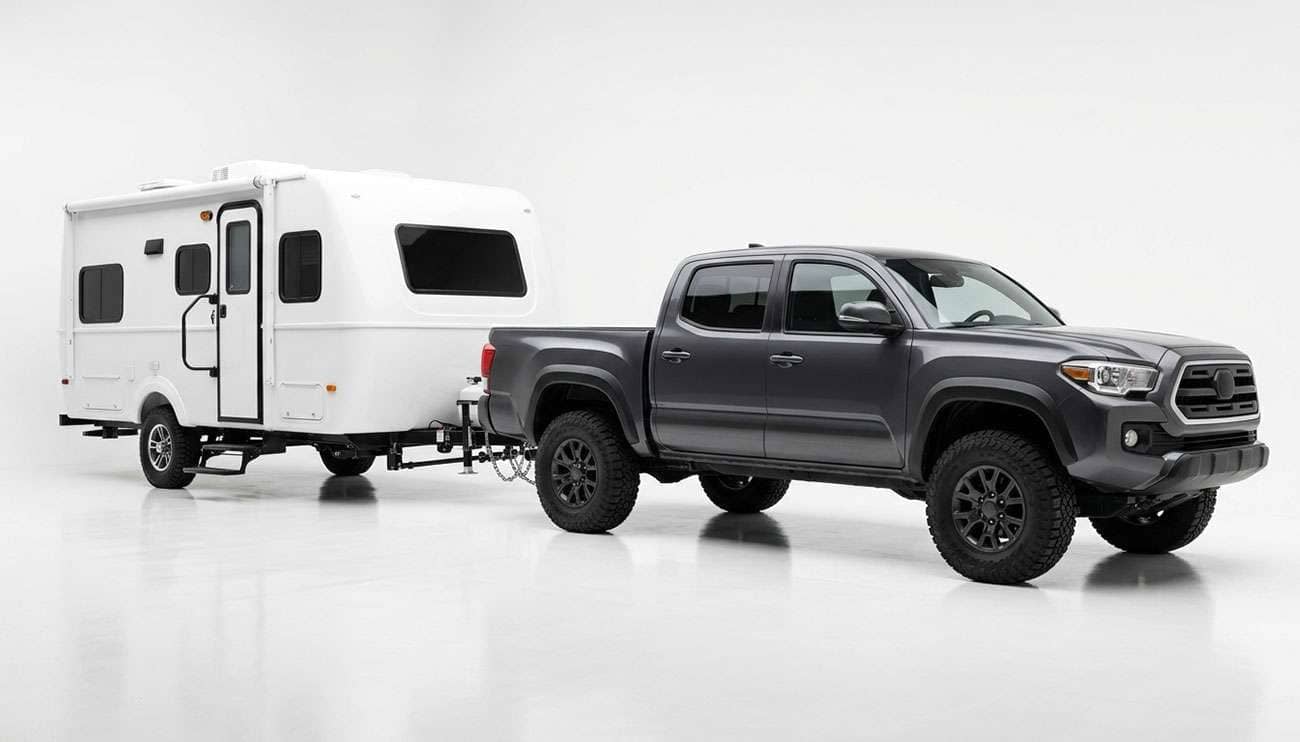
Yes, if the all-terrain tire on your truck is built for the load. "All-terrain" describes the tread, not the casing underneath it, and the same A/T in the same size is often sold as a passenger tire and as an LT Load Range E. In 275/65R18, that works out to 2,505 pounds of counted capacity per tire on a pickup for the passenger version, versus 3,415 pounds for the E. And the E only delivers its number at 80 psi. Read the sidewall prefix, the load letter, and your pressure before you hitch up.
If you've been told "it depends," that's what it depends on. I've been mounting truck tires since we opened the doors in Long Beach in 1971, and the most common towing mistake I see isn't a bad tire. It's a good tire in the wrong construction, or the right construction aired down like a passenger car. The tread pattern on the shelf looks identical either way. The casing under it is not.
Walk out to your truck and read the sidewall. The letters in front of the size and the load marking after it tell you more about towing than the tread ever will. Match what you find to this table.
What the Sidewall Says |
What It Is |
Full Capacity Reached At |
Towing Reality |
|---|---|---|---|
"P" prefix or no prefix, standard load (SL) |
Passenger construction |
About 35 to 36 psi |
Light duty only; counted at about 91 percent of its rating on a pickup or SUV |
"XL" or "Extra Load" |
Reinforced passenger construction |
About 41 to 42 psi |
A step up from SL, still derated on a truck, and not the same thing as Load Range E |
"LT" prefix, Load Range C (6-ply rating) |
Light truck construction |
Typically 50 psi |
Tougher casing, but capacity close to a derated passenger tire in the same size |
"LT" prefix, Load Range D (8-ply rating) |
Light truck construction |
Typically 65 psi |
Middle ground; less common in all-terrain sizes |
"LT" prefix, Load Range E (10-ply rating) |
Light truck construction |
Typically 80 psi |
The towing all-terrain, as long as you run the pressure your load needs |
Load Range E aired down to 35 to 45 psi |
Light truck casing at low pressure |
Not reached |
Carries only what that pressure allows; E strength without E capacity |
"LT" prefix, Load Range F (12-ply rating) |
Heavy-duty light truck construction |
Typically 80 to 95 psi |
Heavy-duty pickups where the placard calls for it; more casing than most half-tons need |
Always go by the maximum load and pressure printed on your own tire. The pressures above are the common values, and a few sizes run different numbers.
Here's the part nobody puts in front of you. Across the all-terrain market, a little over half of the tires are built on light truck casings, and roughly three out of four of those are Load Range E. The rest are passenger construction wearing the same aggressive tread. In 275/65R18, the split runs about half Load Range E and about a third passenger standard load. Step up to 20-inch sizes like 275/60R20 and passenger construction becomes the majority. So when a buddy says "I tow with A/Ts," the only honest follow-up is: which ones?
Open the driver's door. The tire and loading information placard, required under Federal Motor Vehicle Safety Standard No. 110, lists the original tire size, load specification, and cold inflation pressure. The certification label nearby lists your gross vehicle weight rating (GVWR) and gross axle weight ratings (GAWR). Any replacement all-terrain has to meet or beat what those labels call for. For towing, you want margin on top of that.
The right ones are, and for certain kinds of towing they're the best choice you've got. The tread design brings real advantages to a tow rig, along with a couple of trade-offs worth knowing before you hook up.
Boat ramps covered in algae. Wet grass at the county fairgrounds. A gravel campground loop after a rainstorm. Those are the places a highway tire spins and an all-terrain pulls. Open shoulder blocks and deeper voids bite loose surfaces, and many LT all-terrains carry tougher sidewall compounds that shrug off the sharp rock that lines a lot of back roads. If your towing ends somewhere unpaved, an A/T is a smart pick.
Tall, independent tread blocks flex before they grip. Owners towing around 5,000 pounds describe feeling those blocks move under a side load, a little lag before the tire takes a set in a lane change or a crosswind. It isn't dangerous on a properly loaded, properly inflated tire, but it's real, and it's more noticeable on a fresh, full-depth tread than a half-worn one. All-terrains also tend to weigh more than highway tires in the same size, and weight at the corners asks more of your brakes.
Most LT all-terrains carry S, R, or Q speed ratings, good for 112, 106, and 99 mph respectively. Those are well above any sane towing speed, so the speed symbol rarely limits an A/T tow rig. Capacity and pressure do.
You can tow light with them, but you're starting with less than the sidewall suggests. Plenty of half-ton pickups and SUVs leave the factory on passenger-construction tires, and a passenger all-terrain in the original size and load index keeps you legal to the placard. Towing is where the margin runs thin.
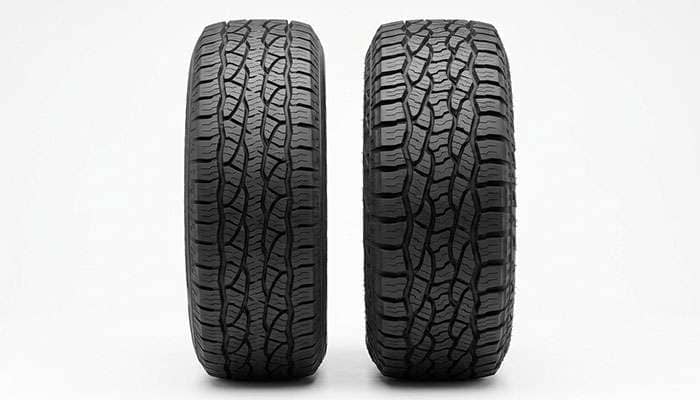
When a passenger tire goes on a light truck or SUV, its load capacity is divided by 1.10. Toyo and Nitto spell this out in their technical bulletins, tracing it to Federal Motor Vehicle Safety Standard No. 120 and the load tables in the Tire and Rim Association Yearbook. The reasoning is simple: trucks see harder service than cars. A 116 load index is rated for 2,756 pounds, but on your pickup it counts as 2,505. We break down the full math in our P-metric vs. LT tire comparison.
An XL passenger tire reaches a higher maximum load at around 41 to 42 psi instead of 35 or 36. That's a genuine step up. It still gets the 1.10 treatment on a truck, and it still isn't built on a light truck casing. Don't let anyone sell you "XL" as a stand-in for "E."
A passenger tire near its limit doesn't announce itself. It flexes more, runs hotter, and wears the shoulders faster. Toyo's bulletin includes thermal images showing an under-inflated LT tire running noticeably hotter than the same tire at proper pressure under equal load, and heat is what breaks tires down. You won't feel that at the wheel. You'll find it later.
Not for every trailer, but Load Range E is where an all-terrain gains real reserve. Load Range C is the one that fools people, because "LT" on the sidewall sounds like a big upgrade. Look at the same 275/65R18 all-terrain built three different ways.
Construction |
Sidewall Reads |
Rated Load |
Reached At |
Load Counted on a Pickup |
|---|---|---|---|---|
Passenger, standard load |
275/65R18 116T |
2,756 lb |
About 36 psi |
2,505 lb |
LT, Load Range C |
LT275/65R18 113/110T |
2,535 lb |
50 psi |
2,535 lb |
LT, Load Range E |
LT275/65R18 123/120S |
3,415 lb |
80 psi |
3,415 lb |
Loads are single-tire ratings. The second number in an LT service description (110 or 120 here) applies to dual rear wheel fitments.
Look at the first two rows again. Once the passenger tire takes its 1.10 derate, the Load Range C version carries just 30 pounds more per tire. The C does give you a stouter light truck casing that handles rocks and punctures better, and that's worth something. For towing capacity alone, it barely moves the needle. The E carries 910 pounds more per tire than the derated passenger version, about 36 percent more. Toyo's Open Country A/T III is one all-terrain sold in all three of these versions in this exact size, so the same tread really can land on your truck with three very different capacities.
Load range tells you the casing's pressure class. Load index tells you pounds. You need both, and the difference trips people up constantly. Our explainer on load range vs. load index walks through how the two work together on the sidewall.
Here's some good news if you're shopping taller tires. In sizes like 275/70R18 and 275/65R20, nearly every all-terrain on the market is Load Range E. The passenger-versus-LT question mostly comes up in the original-equipment sizes that half-tons and SUVs wear from the factory.
No. This is the trap I see most often at the counter. A fella buys Load Range E all-terrains for towing, doesn't like the ride at the pressure the shop set, and lets them down to 40 psi. Now he's got a 10-ply rated casing carrying about what the pressure allows, not what the sidewall says.
The maximum load on an LT sidewall is only valid at the maximum pressure stamped next to it. Below that, the tire carries whatever the manufacturer's load and inflation table lists for that pressure in that size. Run a Load Range E at a Load Range C pressure and it carries roughly what a C carries. You bought the strength. You didn't buy the capacity unless you inflate for it.
Start with the placard and your owner's manual, since many truck makers list a separate towing or loaded pressure. If you've switched from the original tire type, use the tire maker's load and inflation table to find the pressure that supports your actual axle weight, then check it cold, before you drive. If you're unsure where your truck's baseline number lives, here's how to find your recommended tire pressure.
An E-rated tire at 80 psi asks a lot of the wheel under it. Aftermarket wheels carry a load rating, and some are marked with a maximum inflation pressure. Make sure the wheel's rating covers the tire's capacity and the pressure you plan to run. A tire rated for 3,415 pounds on a wheel rated for less is a wheel rated for less.
Tongue weight lands on your rear tires, and it lands heavier than the scale at the coupler suggests. Truck makers' own towing guides, Ram's among them, put conventional tongue weight at roughly 10 to 15 percent of the loaded trailer and fifth-wheel pin weight at 15 to 25 percent.
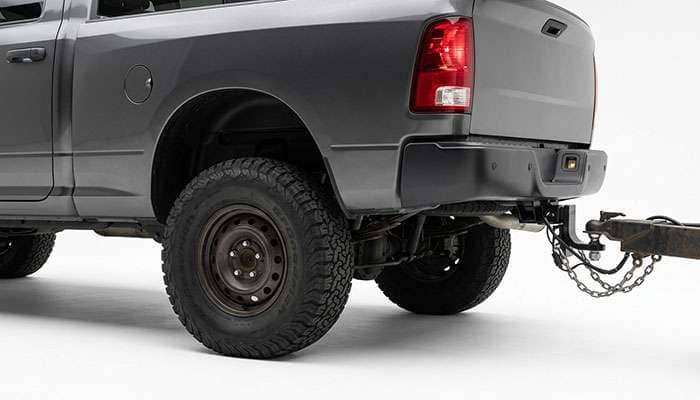
The hitch ball sits behind the rear axle, so tongue weight works like a lever. It loads the rear axle by more than its own weight and lifts some load off the front. On a pickup with a 145-inch wheelbase and the ball 50 inches behind the axle, the rear axle picks up about 1.34 times the tongue weight. An 840-pound tongue on a 7,000-pound travel trailer adds roughly 1,130 pounds to the rear axle, or about 565 pounds per rear tire, on top of you, your passengers, and everything in the bed. A properly set weight distribution hitch pushes some of that back toward the front axle and the trailer.
Plenty of trucks pass the GVWR check and still overload the rear axle, and the rear tires are what pay for it. Our guide to overloaded rear axle tires walks through finding your real limit, case by case. For all-terrain shoppers, the takeaway is simple: size your rear tire capacity to the loaded rear axle, not to a quarter of the truck's weight.
It depends on where you tow. For a mostly paved tow, a highway-terrain tire in the same construction usually feels more planted. For a tow that ends on dirt, gravel, or a wet ramp, the all-terrain is the better tool. Mud-terrains are the wrong tool for most highway towing.
Tighter, rib-style tread blocks move less under side load, so a highway tire gives the steadiest on-center feel on long interstate pulls. Many owners who tow a big travel trailer or fifth-wheel on pavement stick with them for exactly that reason. If you're weighing that trade against everyday traction, our all-terrain vs. all-season comparison covers how the tread types behave on the road.
Rugged-terrain tires sit between A/T and M/T with bigger shoulder lugs. Mud-terrains take it further, with tall, widely spaced blocks that squirm more on pavement, wear faster under a heavy tongue, and stop longer on wet roads. Plenty of mud-terrains come in Load Range E, so capacity isn't the issue. Stability is.
Whatever tread you pick, the sidewall rules from the first table still decide whether it can carry the load. A highway tire on a passenger casing has the same 1.10 problem as a passenger all-terrain.
Usually not. Your truck's tires steer, drive, and brake. Your trailer's tires just follow and carry, and they're scrubbed sideways in every tight turn on a tandem axle. Special trailer (ST) tires are built for that job, and the trailer's own placard lists what it needs. For the full breakdown, see our guide to trailer tires vs. car tires. Keep the all-terrains on the truck, where the traction does something.
An overloaded or under-inflated tire doesn't fail on the first trip. It pays you back slowly, then all at once, usually with a trailer attached.
This takes about an hour, a tape measure, and a trip to a truck-stop scale. I'd rather you spend the hour than find out on the shoulder of the freeway.
You can absolutely tow with all-terrain tires. Plenty of our customers do it every weekend, from boat ramps to back-country campgrounds. The tread isn't the question. The casing is. A passenger all-terrain, a Load Range C, and a Load Range E can wear the same name and the same tread in the same size and still differ by 900 pounds of capacity per tire on a pickup.
Read the sidewall, apply the 1.10 factor if it's a passenger tire, weigh your rig, and run the pressure your load calls for. If your numbers come up short, shop all-terrain tires in Load Range E in your truck's size and tow with margin to spare.
Here's what decides whether your all-terrains are ready to tow.
Yes, if the tire's construction and pressure match the load. An LT Load Range E all-terrain inflated for your axle weight tows well. A passenger all-terrain works for light trailers but loses about 9 percent of its rated capacity on a truck.
LT all-terrains have tougher casings and aren't derated on trucks. Load Range E adds the most capacity. Load Range C carries only slightly more than a derated passenger tire of the same size.
Not always. Weigh your loaded rear axle, divide by two, and compare that to your tire's capacity at the pressure you run. If you're near the limit, Load Range E gives you the reserve.
Start with your door placard and owner's manual. If you've changed tire types, use the tire maker's load and inflation table for your axle weight. Set it cold, and never exceed the tire's or wheel's maximum.
Not on their own. Low tongue weight and hitch setup are the usual causes. Flexing tread blocks and low pressure can make the truck feel less planted, which makes any sway harder to control.
It's usually not the right call. Trailer tires follow and carry rather than steer and drive, so special trailer tires matched to the trailer's placard are the better fit.