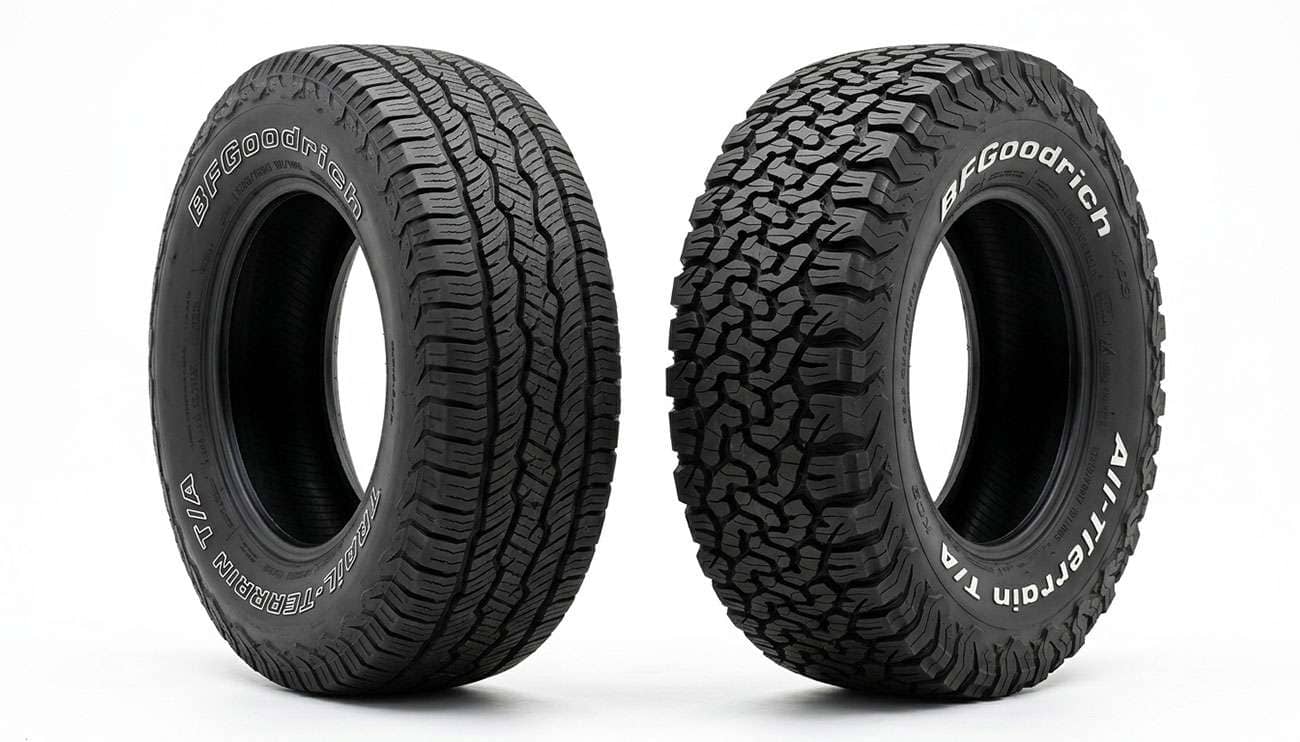
Most Trail-Terrain vs. KO3 comparisons tell you it depends on how much you off-road. Off-roading is the second question. The first one is printed on your driver's door jamb. Every BFGoodrich Trail-Terrain T/A is a passenger-construction tire, built in Standard Load or Extra Load. Every All-Terrain T/A KO3 is a light-truck tire, built in Load Range C through F. If your placard lists a passenger or metric size, the Trail-Terrain is the drop-in match. If it lists an LT size, the KO3 is the only one of the two that keeps your load rating.
I'm Dennis, and fitment is what I do all day at Performance Plus Tire. Below is the decision in one table, then the numbers most comparisons leave out: load at real pressures, published weights, speed ratings, warranty by construction and side-by-side prices. I'll also cover the new Trail-Terrain T/A+, which is replacing the original T/A size by size.
Start here: match the tire to your placard and your load
Your Situation |
Better Pick |
Why |
|---|---|---|
Placard lists a passenger size (P265/70R17 or 235/65R17), mostly pavement, gravel on weekends |
Trail-Terrain |
Same construction your vehicle was engineered around. Lighter, quieter, longer warranty. |
Placard lists an LT size (LT245/75R17 E, LT275/65R18 E) |
KO3 |
The Trail-Terrain isn't made in LT construction. A passenger tire would put you under spec. |
Half-ton that tows near its rating or hauls heavy payload every week |
KO3 in Load Range D or E |
A passenger tire on a truck is derated by 1.10, which leaves thin margin at the rear axle. |
Placard calls for a T or H speed rating and you drive long highway miles |
Trail-Terrain |
Most Trail-Terrain sizes are T (118 mph) or H (130 mph). Every KO3 is S (112 mph) or lower. |
Crossover on a 55- or 60-series 17- to 19-inch size |
Trail-Terrain |
BFGoodrich doesn't make the KO3 in most of these sizes. |
Lifted rig on 33-inch or larger tires, rock trails, airing down |
KO3 |
LT casing, CoreGard sidewall technology and flotation sizes the Trail-Terrain doesn't offer. |
Which sizes each tire actually covers
Size Group |
Trail-Terrain T/A |
All-Terrain T/A KO3 |
|---|---|---|
15- and 16-inch, 70 to 75 series (older trucks, Jeeps, mid-size pickups) |
Yes, SL and XL |
Yes, LT Load Range C to E |
17- and 18-inch, 65 to 75 series (half-tons, full-size SUVs) |
Yes, SL and XL |
Yes, LT Load Range C to E |
17- to 19-inch, 55 to 60 series (crossovers) |
Yes, SL and XL |
Only a handful of sizes |
20- and 22-inch, 45 to 65 series (late-model trucks and SUVs) |
Yes, SL and XL |
Yes, LT Load Range D to F |
Flotation sizes (35x12.50, 37x12.50, 40x13.50) |
No |
Yes, mostly Load Range F |
No. BFGoodrich builds the Trail-Terrain T/A, and the new T/A+, as a passenger-construction tire in Standard Load (SL) and Extra Load (XL) only. It isn't a 10-ply tire, and there is no Load Range C, D or E version. The KO3 goes the other direction. BFGoodrich makes it only in LT and flotation sizes, from a 6-ply-rated Load Range C up to a 12-ply-rated Load Range F. The two tires share a family look and a 3PMSF snow rating. Under the tread, they're built for different jobs.
Under FMVSS No. 110, every passenger vehicle and light truck up to 10,000 lbs GVWR carries a placard that lists the original tire size and cold inflation pressure. That size string is your construction requirement. "P265/70R17" or "265/70R17 115T" means the engineers sized the axles, suspension tuning and pressures around a passenger tire. "LT265/70R17 121/118S" means they needed light-truck capacity, and a passenger tire would leave you under spec on every corner. You can usually step up from passenger to LT construction. You shouldn't step down from LT to passenger.
Here's the part nobody puts in front of you. The Tire and Rim Association says that when a P-metric tire goes on a light truck, SUV or trailer, you divide its rated load by 1.10. A 265/70R17 115 Trail-Terrain is rated for 2,679 lbs at full passenger rating. On a pickup, plan on 2,435 lbs. That's plenty for a half-ton running empty to the trailhead. It's the number that matters once the bed is full or the hitch is loaded.
Switching to LT construction doesn't automatically buy you more capacity. In 265/70R17, the KO3 in Load Range C is rated for 2,469 lbs at 50 psi, which lands almost exactly on the derated Trail-Terrain number. You only gain real capacity in Load Range D (2,910 lbs at 65 psi) and Load Range E (3,415 lbs at 80 psi). An LT tire reaches those numbers only at those pressures. Run a KO3 at the 35 psi printed on a half-ton placard and it carries less than its sidewall number. Our P-metric vs. LT tire guide walks through the inflation math when you switch constructions.
265/70R17, spec by spec
Spec |
Trail-Terrain T/A |
KO3 Load Range C |
KO3 Load Range E |
|---|---|---|---|
Construction |
Passenger, Standard Load |
Light truck, 6-ply rated |
Light truck, 10-ply rated |
Service description |
115T |
112/109S |
123/120S |
Max load, single |
2,679 lbs (2,435 lbs derated on a truck) |
2,469 lbs at 50 psi |
3,415 lbs at 80 psi |
Max inflation |
44 psi |
50 psi |
80 psi |
Speed rating |
T (118 mph) |
S (112 mph) |
S (112 mph) |
New tread depth |
12.5/32 inch |
15/32 inch |
16/32 inch |
Published weight |
42 lbs |
46 lbs |
55 lbs |
Treadwear warranty |
60,000 miles (65,000 on the T/A+) |
50,000 miles |
50,000 miles |
UTQG |
660 A A |
Not graded (LT tire) |
Not graded (LT tire) |
3PMSF severe snow rating |
Yes |
Yes |
Yes |
Our price, each |
$236.95 |
$277.99 |
$304.99 |
If your crossover or SUV calls for Extra Load, the Trail-Terrain comes in XL in most of those sizes, and XL reaches its rated load at about 41 psi instead of 35. Our breakdown of SL vs. XL tires explains when the extra capacity is worth having.
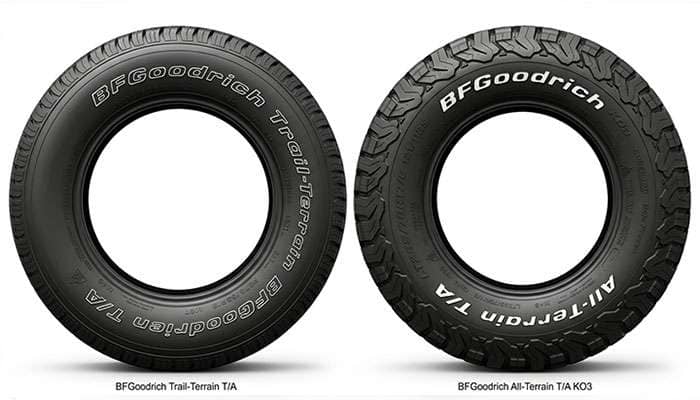
In matching sizes, a Load Range D or E KO3 weighs 10 to 16 lbs more per tire than the Trail-Terrain. That's 40 to 62 lbs per set, and every pound of it is unsprung and rotating. Here are BFGoodrich's published weights in the sizes most trucks and SUVs run.
Size |
Trail-Terrain T/A |
KO3 (Load Range) |
Difference Per Tire |
Difference Per Set |
|---|---|---|---|---|
245/75R16 |
38 lbs |
49.5 lbs (E) |
+11.5 lbs |
+46 lbs |
265/70R16 |
40 lbs |
51 lbs (D) |
+11 lbs |
+44 lbs |
255/70R17 |
40 lbs |
50 lbs (D) |
+10 lbs |
+40 lbs |
265/65R17 |
42 lbs |
52 lbs (D) |
+10 lbs |
+40 lbs |
245/75R17 |
40 lbs |
52.9 lbs (E) |
+12.9 lbs |
+51.6 lbs |
265/70R17 |
42 lbs |
55 lbs (E) |
+13 lbs |
+52 lbs |
275/65R18 |
45 lbs |
59 lbs (E) |
+14 lbs |
+56 lbs |
285/70R17 |
46 lbs |
61.6 lbs (E) |
+15.6 lbs |
+62.4 lbs |
The exception worth knowing: the Load Range C KO3 in 265/70R17 weighs 46 lbs, only 4 lbs over the Trail-Terrain. If you want KO3 tread and an LT casing on a light-duty truck, C is the lightest way to get it.
Fifty pounds in the cabin barely registers. Fifty pounds at the four corners changes how the truck drives. Unsprung weight moves up and down with every bump, so your shocks have to control more mass each time the tire hits an expansion joint. Rotating weight also takes more energy to spin up and more brake to slow down. You feel it most on crossovers and mid-size trucks, where the brakes and dampers were sized around a lighter tire.
A heavier tire with deeper tread and a stiffer casing rolls harder, so expect a few percent of fuel economy to go away on an LT all-terrain swap. Put a number on it before you buy. A truck that covers 15,000 miles a year at 18 mpg burns about 833 gallons. Every 1 percent of fuel economy you lose is roughly 8.3 gallons, or about $29 a year at $3.50 a gallon. The Trail-Terrain sits on the efficient side of this comparison, and BFGoodrich says the new T/A+ cuts rolling resistance by about 5 percent on average compared with the original T/A.
The Trail-Terrain, and on a highway commute you'll hear the gap. The KO3 is the tougher tire, and you pay for that toughness in noise and ride. Three mechanisms drive the difference.
An LT casing uses heavier plies and a stiffer sidewall, and a Load Range E tire is built to carry its load at up to 80 psi. A stiffer sidewall at a higher pressure behaves like a stiffer spring, so more of every pothole and seam reaches the cabin. The Trail-Terrain's passenger casing flexes more and soaks up more of the hit before it gets to your suspension.
The KO3 starts with 15/32 to 16/32 inch of tread and wider grooves between the blocks. Taller blocks squirm more under load, and wide voids pump air as they hit the road, which produces the steady hum all-terrain owners know. The Trail-Terrain runs a tighter pattern at 12.5/32 inch with full-depth 3D sipes, and BFGoodrich tuned it specifically to keep road noise down.
Independent comparative testing published in Canada scored the Trail-Terrain ahead of the KO3 on comfort and cabin noise, and drivers who've spent time on the newer T/A+ describe it as riding closer to a touring tire than a truck tire. You can narrow the gap on a KO3 by running pressure from the load-inflation table instead of the sidewall max, and by choosing Load Range C or D over E when your load allows.
Both carry the Three-Peak Mountain Snowflake, so both earned a severe snow rating. On new tires, they're close. Where they separate is later in the tire's life, and that's the part a snowflake symbol can't tell you.
To earn the symbol, a tire has to beat a standard reference tire by at least 10 percent in a snow acceleration test under ASTM F1805. That test runs on new tires. It says nothing about how much snow traction is left at 30,000 miles. Comparative testing put the two BFGoodrich tires within a few percent of each other in snow braking when new, with the lighter, more heavily siped Trail-Terrain slightly ahead.
Snow traction comes from grooves that pack with snow and release it, plus sipes that give the blocks biting edges. Most tire pros treat 5/32 to 6/32 inch as the practical floor for winter driving. Measured to 6/32, the KO3's 15/32- or 16/32-inch start gives you 9/32 to 10/32 inch of winter-useful depth. The Trail-Terrain's 12.5/32-inch start gives you 6.5/32 inch. If you live where it snows four months a year and you keep tires a long time, that difference shows up in the third winter.
BFGoodrich says plainly that the Trail-Terrain isn't designed for extreme winter conditions like ice, and the same physics applies to the KO3. All-terrain rubber firms up in deep cold, and neither tread carries the dense siping of a dedicated winter tire. Our guide to whether all-terrain tires are good in snow covers where that line sits.
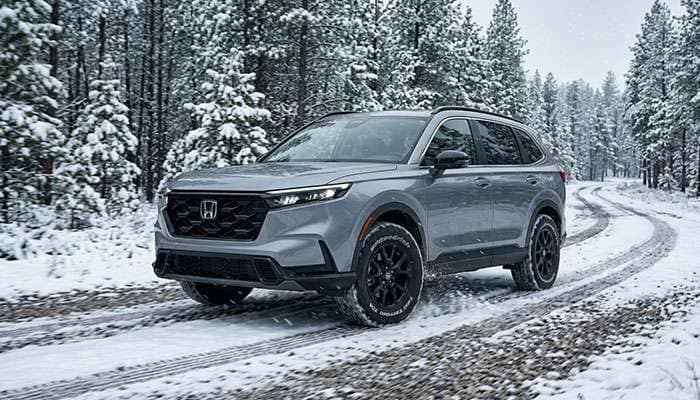
If off-road means rock, shale or aired-down trail work, yes. If it means graded gravel, washboard and forest service roads, the Trail-Terrain covers it with less weight and less noise on the drive there.
The KO3 pairs its LT ply construction with CoreGard sidewall technology, serrated shoulder blocks and mud-phobic bars in the grooves. The deeper tread gives sharp rock more rubber to chew through before it reaches the belts. BFGoodrich also says it builds its off-road tires with tighter beads so they stay seated when you air down. That matters, because airing down is where an LT tire pulls away from a passenger tire. A stiffer casing holds its shape at trail pressures without folding the sidewall over on itself. Here's our take on whether you should air down your tires and how far to go.
Gravel, packed dirt, light mud, washboard and a snowy road to the trailhead are all inside the Trail-Terrain's range. Comparative testing showed the KO3 clearly ahead on gravel, while the Trail-Terrain held its own in mud. For a crossover or half-ton that sees dirt a few weekends a year, you get most of the useful capability without carrying an LT casing to work every day.
A passenger sidewall is thinner, and that's the Trail-Terrain's real limit off-road. Sharp rock that pinches a loaded sidewall can cut it, and industry repair standards don't allow sidewall repairs, so a cut sidewall means a new tire. If your trails have ledges and broken shale, the KO3's casing is cheap insurance. For the full KO3 story, including what changed from the KO2, read our KO3 tire review.
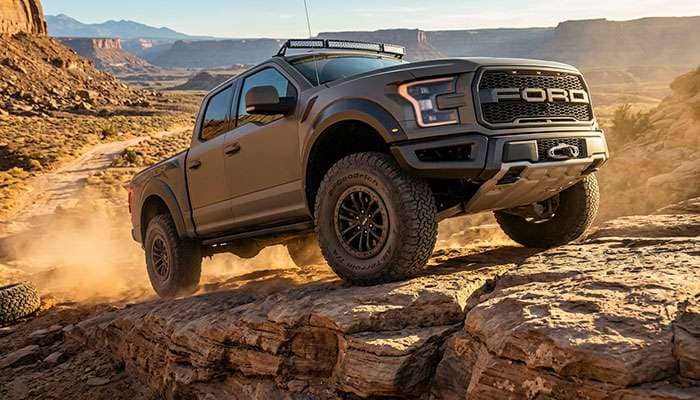
Yes, within your vehicle's ratings, as long as your placard calls for a passenger tire. The question is margin. Towing loads the rear axle, and that's exactly where a derated passenger tire runs out of room first.
A conventional trailer puts roughly 10 to 15 percent of its weight on the hitch. Hook up a 7,000-lb camper and you add 700 to 1,050 lbs over the rear axle, on top of whatever is in the bed. Now look at the rear GAWR on your placard and compare it with two times your tire's derated capacity. Two 265/70R17 115 Trail-Terrains give you 4,870 lbs on a truck. If your loaded rear axle runs close to that number, you're out of margin.
Choose the KO3 in Load Range D or E if you tow most weekends, tow near your rating, or carry a slide-in camper or a bed full of gear. You gain capacity, and the stiffer LT sidewall deflects less under side load, so the truck feels more settled when a semi passes. If you tow a light utility trailer a few times a year, an XL Trail-Terrain at the right pressure is usually enough. Our guide to towing tire load range on a half-ton runs the numbers by trailer weight.
On paper, the Trail-Terrain. It carries a 60,000-mile treadwear warranty, and the T/A+ raises that to 65,000. The KO3 carries 50,000 miles in every size. In rubber, the KO3 starts with more to wear: 15/32 to 16/32 inch against 12.5/32 inch. Both facts are true, and they don't contradict each other.
Warranty mileage reflects the duty a tire is expected to see. A KO3 usually lives on a heavier truck, carries more load, tows, and spends time on gravel that scrubs tread faster than pavement. Its compound is tuned for cut and chip resistance first. A Trail-Terrain usually lives on a crossover or a commuting half-ton. Put a KO3 on a light truck that stays on pavement, rotate it on schedule, and it can run well past its warranty.
The Trail-Terrain carries a 660 treadwear grade under NHTSA's Uniform Tire Quality Grading system. The KO3 carries no grade at all, because UTQG applies to passenger tires and LT tires are exempt. A missing grade isn't a weakness. It just means you compare the KO3 on warranty and tread depth instead.
Both warranties are prorated and both require regular rotation. BFGoodrich's Trail-Terrain mileage coverage also excludes original-equipment versions, so a set that came on your vehicle from the factory may not carry it. Here's how tire mileage warranty proration actually pays out when you file a claim.
In June 2026, BFGoodrich announced the Trail-Terrain T/A+ as the replacement for the original Trail-Terrain T/A. The job stays the same: an on-road all-terrain for crossovers, SUVs and light trucks. BFGoodrich kept the tread design and changed the compound to one with a higher silica content.
BFGoodrich claims up to 25 percent better wear, 10 percent better wet traction and about 5 percent lower rolling resistance compared with the original T/A. The warranty climbs from 60,000 to 65,000 miles, and the tire keeps its 3PMSF rating. The T/A+ launched in 33 sizes, and BFGoodrich is adding more 17- to 22-inch fitments through 2027.
Nothing about construction. The T/A+ is still a passenger tire in SL and XL, with the same 12.5/32-inch starting tread depth, so every point above about load, derating, speed ratings and placards applies to both versions. It simply widens the warranty gap over the KO3 to 15,000 miles. Don't wait for it if your size isn't out yet. The original T/A has the same tread design, the same 3PMSF rating and a 60,000-mile warranty. If the T/A+ is already in your size at a similar price, take the newer compound.
A mismatch costs money in both directions. Only one direction also costs safety margin.
The fix costs less than one tow bill: a KO3 in the load range your placard and your trailer call for.
None of that is dangerous. It's money and comfort you didn't need to spend.
Here's where both tires are made in the same size, so you can see the price and capacity gap side by side. Load figures are single-tire maximums. Trail-Terrain figures are before the 1.10 truck derating, and KO3 figures are at the LT tire's rated pressure. Prices were current when this was published, and each product page shows today's price.
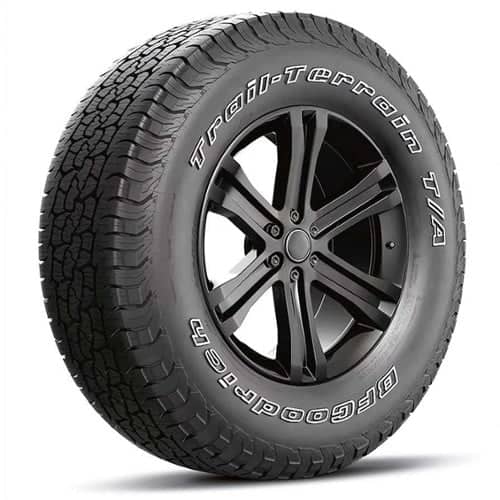
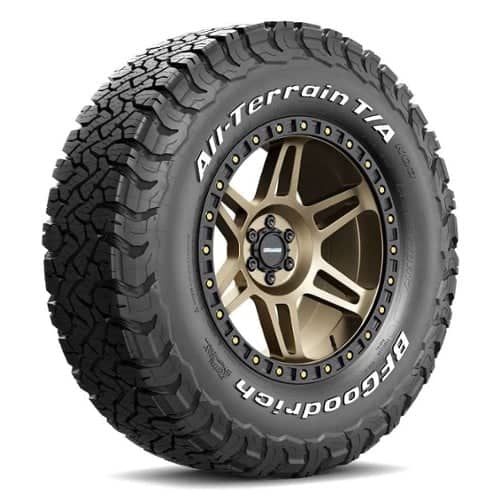
Size |
Trail-Terrain T/A |
Trail-Terrain Price |
All-Terrain T/A KO3 |
KO3 Price |
|---|---|---|---|---|
235/70R16 |
235/70R16 106T, 2,094 lbs |
$182.54 |
LT235/70R16 110/107S D, 2,337 lbs |
$231.99 |
265/70R16 |
265/70R16 112T SL, 2,469 lbs |
$225.59 |
LT265/70R16 117/114S D, 2,833 lbs |
$280.99 |
225/65R17 |
225/65R17 102T SL, 1,874 lbs |
$214.75 |
LT225/65R17 107/103S D, 2,149 lbs |
$231.99 |
245/75R17 |
245/75R17 112T SL, 2,469 lbs |
$219.58 |
LT245/75R17 121/118S E, 3,197 lbs |
$279.99 |
265/65R17 |
265/65R17 112T SL, 2,469 lbs |
$248.48 |
LT265/65R17 116/113S D, 2,756 lbs |
$264.99 |
255/55R18 |
255/55R18 109H XL, 2,271 lbs |
$240.57 |
LT255/55R18 109/105S D, 2,271 lbs |
$319.99 |
285/60R18 |
285/60R18 116H SL, 2,756 lbs |
$239.33 |
LT285/60R18 118/115S D, 2,910 lbs |
$329.99 |
265/70R18 |
265/70R18 116T SL, 2,756 lbs |
$262.33 |
LT265/70R18 124/121S E, 3,527 lbs |
$318.99 |
Look at 255/55R18. The XL Trail-Terrain and the Load Range D KO3 carry the same 2,271 lbs, and the KO3 costs $79.42 more per tire. In a size like that, the LT casing buys you puncture resistance and airing-down ability, not capacity.
BFGoodrich doesn't make the KO3 in most crossover sizes. If your placard reads like one of these, the Trail-Terrain is your BFGoodrich all-terrain.
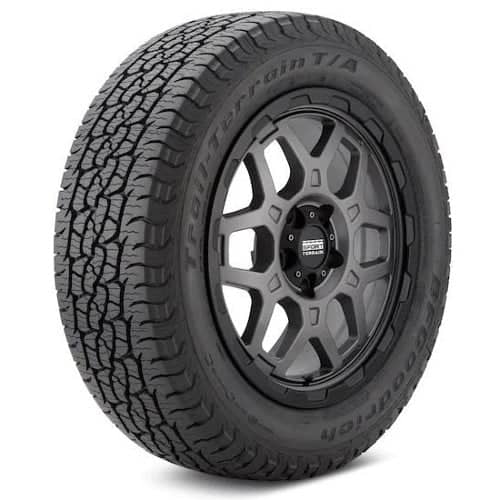
Size |
Service Description |
Price |
|---|---|---|
99H, 1,709 lbs |
$216.30 |
|
100H, 1,764 lbs |
$246.84 |
|
102H XL, 1,874 lbs |
$253.07 |
|
105H XL, 2,039 lbs |
$257.89 |
|
112H XL, 2,469 lbs |
$354.01 |
The Trail-Terrain tops out at 285 mm wide and doesn't come in flotation sizes. Wider tires for lifted trucks and heavy-duty pickups are KO3 territory.
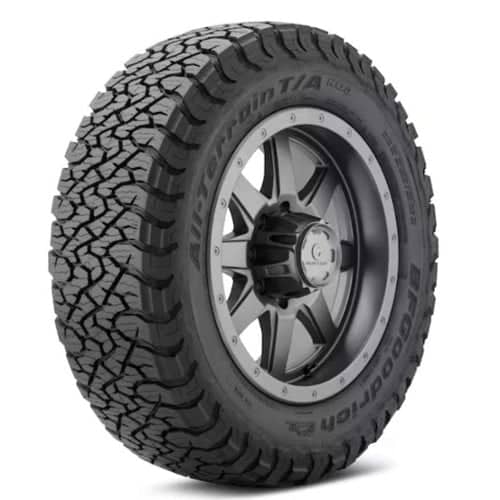
Size |
Service Description |
Price |
|---|---|---|
129/126S E, 4,079 lbs |
$399.99 |
|
128S F, 3,968 lbs |
$379.99 |
|
128R F, 3,968 lbs |
$469.99 |
|
125R F, 3,638 lbs |
$519.99 |
Don't see your size? The full lineup of both models is on our BFGoodrich tires page.
Still weighing other brands against these two? Compare them with the rest of the category on our best all-terrain tires page.
All you need is your door jamb and an honest look at how you use the vehicle.
The Trail-Terrain vs. KO3 decision isn't about which tire is better. It's about which construction your vehicle and your load require. The Trail-Terrain is lighter, quieter, rated for higher speeds and backed by a longer warranty. The KO3 is built for load, abuse and aired-down trail work, and it carries more tread into its third winter.
Start with your door placard, run the rear-axle math if you tow, and be honest about the terrain you drive. If you want a second set of eyes on your size or load range, call our team at Performance Plus Tire and we'll match the right BFGoodrich to your vehicle.
Here's the short version of the Trail-Terrain vs. KO3 decision.
No. The Trail-Terrain T/A and T/A+ are passenger-construction tires in Standard Load and Extra Load only. If you need a 10-ply-rated Load Range E tire from BFGoodrich's all-terrain line, that's the All-Terrain T/A KO3.
BFGoodrich is replacing it with the Trail-Terrain T/A+, which launched in 2026 with a new compound and a 65,000-mile warranty. The T/A+ is rolling out size by size through 2027, so the original T/A is still sold in many sizes with its 60,000-mile warranty.
Yes. The KO3's deeper tread, wider voids and stiffer LT casing make more road noise and a firmer ride than the Trail-Terrain, which BFGoodrich tuned for quiet pavement driving.
Yes, if the size fits. Set pressure from the LT load-inflation table rather than the placard, because an LT tire at passenger pressure carries less than its rated load. Also check the speed rating, since every KO3 is S-rated (112 mph) or lower.
Yes. It carries the Three-Peak Mountain Snowflake severe snow rating. BFGoodrich notes it isn't designed for extreme conditions like ice, so a dedicated winter tire still wins on glare ice.
The Trail-Terrain carries the longer warranty at 60,000 miles, or 65,000 on the T/A+, against 50,000 for the KO3. The KO3 starts with deeper tread, so on a light-duty truck that stays on pavement it can outlast its warranty.