
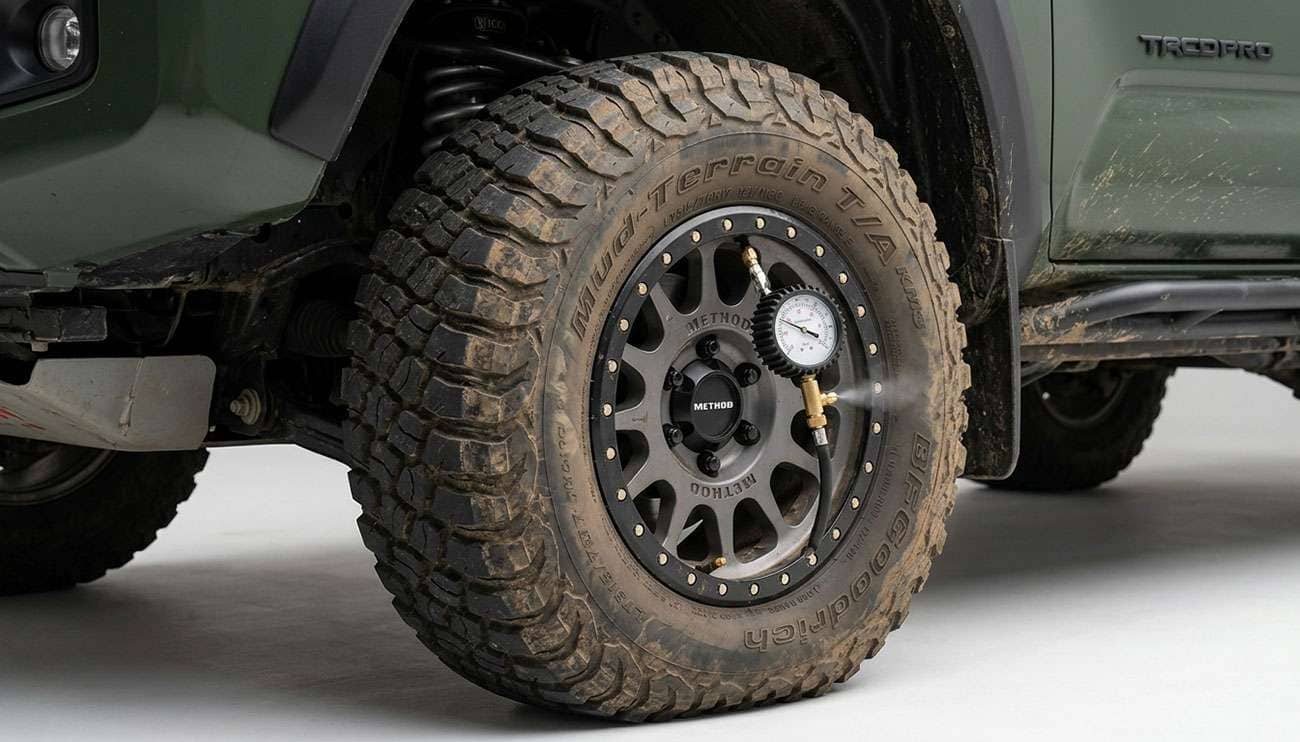
Airing down — deflating your tires below highway pressure before you head off-pavement — is one of the most-talked-about techniques in the off-road world. Plenty of articles will tell you how to do it. Fewer will tell you whether you actually should.
That's the question this article answers. Not how to drop pressure, not the precise PSI for every terrain (we have a dedicated article on the science and tested PSI ranges for that). The question here is simpler: given your vehicle, your tires, and where you actually drive — is airing down worth doing?
The honest answer for a lot of drivers is no. For a smaller group, it's an essential part of getting their truck where they want it to go. Here's how to tell which group you're in.
Three things change when you drop tire pressure for off-road use:
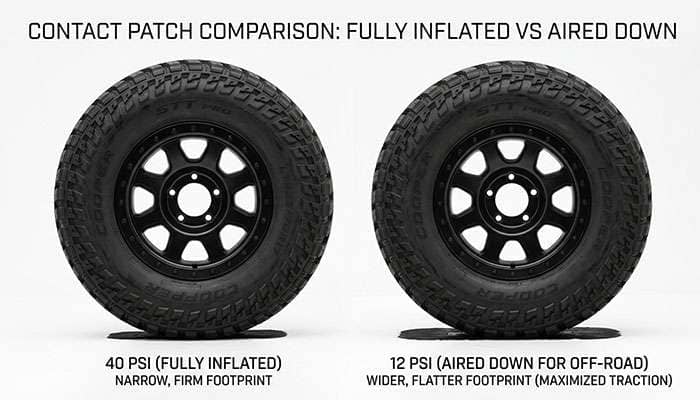
1. The contact patch grows. A 33-inch tire at 35 PSI typically has a footprint of around 30-40 square inches. Drop that to 15 PSI and the footprint can grow 50-80% larger. More rubber on the ground means more grip on loose, soft, or uneven surfaces.
2. The sidewall flexes. A softer sidewall conforms to rocks and obstacles instead of bouncing off them. This improves traction on rocks, reduces shock load to the suspension, and lowers the risk of pinch flats at low speeds.
3. The ride softens. On washboard, ruts, and corduroy roads, lower pressure absorbs vibration that would otherwise transfer through the suspension into the frame and into your spine.
That's the upside. The cost is reduced sidewall stiffness, increased rolling resistance, more heat buildup at speed, and a higher risk of de-beading the tire from the wheel. Whether the upside is worth the cost is what the next four questions answer.
Run through these four before deflating anything. If you can't answer "yes" to all four, airing down is probably the wrong call for that day.
1. Is the terrain actually demanding enough to need it? Light gravel roads, packed dirt fire roads, and grass do not require airing down. Modern all-terrain and rugged-terrain tires handle those surfaces fine at street pressure. Airing down only delivers measurable benefit when the terrain is loose, soft, sharp, or significantly uneven — sand, mud, rocks, washboard, or deep snow.
2. Will you stay below off-road speeds for the duration? Aired-down tires generate substantially more heat at speed because the sidewall flexes more on every rotation. Sustained driving above 30-40 MPH on deflated tires risks heat-induced tread separation and catastrophic blowout. If you're going to spend half the day at highway speeds and only thirty minutes on the trail, airing down isn't worth the round-trip risk.
3. Do you have a reliable way to reinflate? A portable air compressor or CO2 tank is non-negotiable. Driving on aired-down tires back to the highway is one of the fastest ways to ruin them. If you don't own a way to air back up, don't air down.
4. Is your tire and wheel setup safe at low pressure? Stock highway tires on factory wheels can handle moderate airing down (down to about 18-20 PSI) but are not designed for the 8-12 PSI range. Beadlock wheels, LT-rated tires, and dedicated off-road setups are. Match the pressure to the equipment.

Five terrain types where the math clearly favors airing down:
If your driving falls into one of these categories on a regular basis, airing down is part of doing it right. Look at your tire category — H/T, A/T, or M/T — and your typical PSI to set realistic baseline numbers.
Just as important — when airing down is the wrong move:
The general guides on airing down tend to emphasize the benefits and gloss over the failure modes. The failure modes are worth knowing in detail.
De-beading. When tire pressure drops below a critical threshold and lateral force is applied — hard cornering, hitting a rock at angle, a sudden directional change — the tire bead can separate from the wheel rim. The result is an instantly flat tire and a long walk back to camp. This is the single biggest reason serious off-roaders run beadlock wheels, which mechanically clamp the bead to the wheel and allow much lower pressures safely.
Sidewall pinch and impact damage. At very low PSI, hitting a sharp rock at speed can pinch the sidewall between the rock and the wheel, cutting or puncturing the tire from inside. Aired-down tires are also more vulnerable to sidewall punctures from sharp debris because there's less internal pressure to keep the rubber taut.
TPMS faults. Most modern vehicles trigger a tire pressure warning light below 25-28 PSI. The light isn't dangerous, but it can mask actual low-pressure problems by becoming the new normal. Reset the system after airing back up to avoid that.
Heat buildup at speed. Already covered above, but worth restating: aired-down tires are not safe for highway speeds, even briefly. The internal heat generated by repeated sidewall flexing is the most common cause of catastrophic off-road tire failure.
Reseating beads in the field. If you do de-bead a tire on the trail, getting it reseated requires either a high-volume air compressor (most portable units don't move enough air fast enough), an explosive starter fluid trick that's risky and damages the tire, or a tow back to a shop. Plan for this before it happens.
For more on protecting tires through their full life cycle, our off-road tire maintenance guide covers the broader picture.
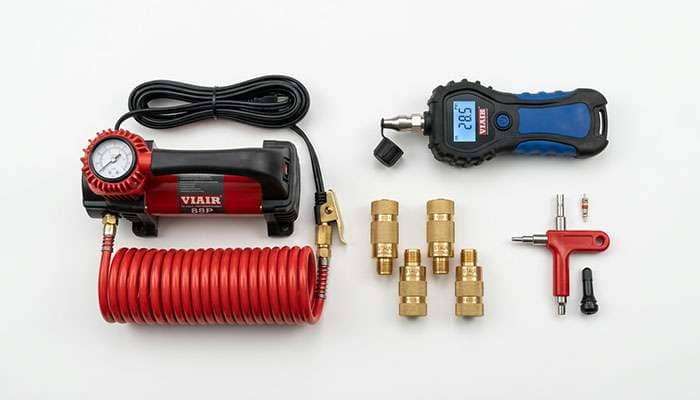
The minimum gear list for airing down safely:
Tread life and tire condition also matter — heavily worn tires are more prone to sidewall failure at low PSI. Our guide on off-road tire tread life covers when to replace before they become a liability.
Use these as starting points, not gospel. Vehicle weight, tire size, sidewall ply rating, and load all influence the right number for your specific setup. When in doubt, run higher and air down further if traction isn't sufficient.
Terrain |
Standard Wheels (PSI) |
Beadlock Wheels (PSI) |
|---|---|---|
Highway / paved road |
Manufacturer spec (35-45) |
Manufacturer spec (35-45) |
Light gravel or forest service road |
25-30 |
25-30 |
Hard-packed dirt |
20-25 |
18-22 |
Washboard or rough trail |
18-22 |
15-18 |
Soft sand or dunes |
12-18 |
8-12 |
Deep mud |
15-20 |
10-15 |
Rock crawling |
10-15 |
5-10 |
Deep snow |
18-25 |
15-20 |
For the testing methodology and detailed PSI behavior across different tire constructions, see our science of airing down tires companion piece.
Airing down is the right call for a specific kind of driver in specific conditions: someone running soft sand, deep mud, real rocks, washboard, or deep snow, with a way to reinflate, on equipment that can handle low PSI safely. Outside that group, airing down is either overkill or actively harmful — to the tires, to the wheels, or to the day.
If you're in the right group, the technique pays off in traction, ride quality, and trail capability. If you're not, save the gear money and stick to street pressure. The same A/T tires that don't need airing down on a graded forest road still cover ninety percent of recreational off-roading just fine at factory PSI.
Need help selecting the right tire and wheel setup for the kind of off-roading you actually do? Our guide on choosing off-road tires walks through fitment, sizing, and category selection. Or browse our off-road tire selection directly, or call us at 888-926-2689 — we'll match you to the right combination for your vehicle and use case.
For standard (non-beadlock) wheels, going below 10 PSI significantly raises the risk of de-beading, especially under cornering or hard impact. Beadlock wheels can safely run as low as 5-8 PSI for rock crawling. The "too low" threshold also depends on tire ply rating, vehicle weight, and load. When in doubt, stay 2-3 PSI above the lowest recommended pressure for your terrain and equipment.
Yes — but generally only if you misuse the technique. Damage typically results from driving at highway speeds on aired-down tires (heat buildup), running below safe pressure for the wheel and load (de-beading or sidewall pinch), or hitting sharp obstacles at speed when the sidewall is too soft to resist puncture. Used correctly at low off-road speeds, airing down does not damage tires.
No, not for moderate airing down. Standard wheels handle pressures down to 12-15 PSI without major risk under controlled off-road driving. Beadlocks are necessary only when running extreme low pressures (below 10 PSI), typically for rock crawling, mud bogging, or competitive off-roading where the additional grip outweighs the cost and DOT-compliance issues of beadlock wheels.
Use a portable air compressor or CO2 tank to bring all four tires back to manufacturer-recommended PSI before returning to paved roads. A quality 12V compressor like the VIAIR 400P typically takes 3-5 minutes per tire to go from 15 PSI to 35 PSI. CO2 systems are faster — around 30 seconds per tire — but require refills. Reinflate before highway driving, not at the gas station after.
Yes. Most modern vehicles trigger a TPMS warning when pressure drops below 25-28 PSI, which is well above typical off-road airing-down ranges. The light doesn't indicate damage — just that pressure is below the on-road threshold. After airing back up, the light should reset automatically within a few miles of driving, or it can be manually reset through the vehicle's settings menu.
For moderate off-road use at speeds below 30 MPH, stock all-terrain or highway tires can be aired down to about 18-22 PSI without significant risk. Stock tires generally lack the reinforced sidewalls of LT-rated off-road tires, so going below 18 PSI on stock fitments is not advisable. If you're regularly heading off-road, a dedicated LT-rated A/T or R/T tire upgrade is worth the investment.



