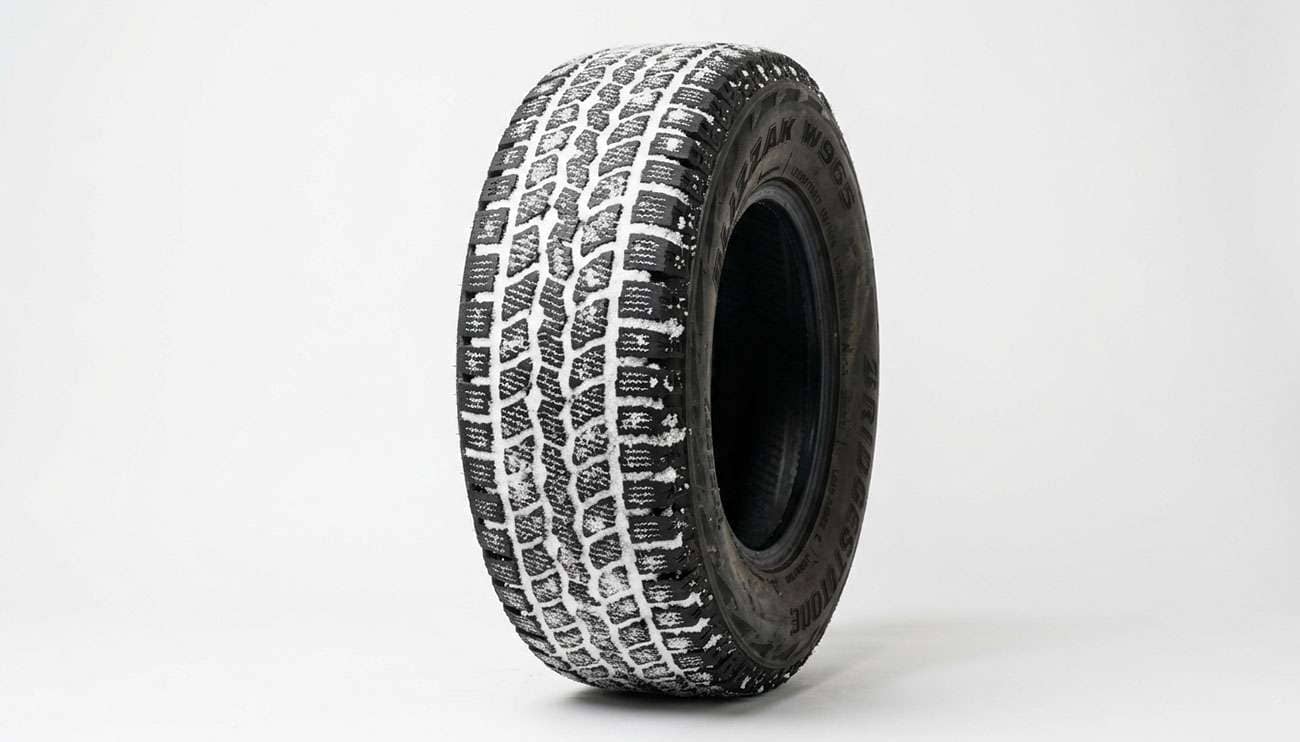
Short answer: Some all-terrain tires are genuinely good in snow, and some are barely better than a highway tire once the road packs down. Two things decide which kind you're driving on: whether the sidewall carries the three-peak mountain snowflake symbol, and how much tread is left. A snowflake-rated all-terrain with 6/32 inch or more of tread handles plowed and packed snow well. Without the symbol, or below 6/32 inch, it falls off fast. And no all-terrain grips ice like a dedicated winter tire.
Most answers to this question stop at "all-terrains are fine in light snow." Nobody defines light snow, and nobody tells you which mark on the sidewall or which tread depth moves your tire from one side of that line to the other. That's what the table below does.
I'm Dennis Feldman, and I handle fitment questions at Performance Plus Tire every day. Every October the same call comes in from truck and SUV owners with a ski trip or a mountain cabin on the calendar: do I need winter tires, or will my all-terrains get me there? The answer is printed on your sidewall and sitting in your tread grooves, and you can check both in about two minutes.
How your all-terrain tires will do in snow, by sidewall mark and tread depth:
Your All-Terrain Tire |
Plowed or Packed Snow |
Deep, Unplowed Snow |
Ice and Freezing Rain |
Counts as a Snow Tire for California Chain Control? |
|---|---|---|---|---|
Mountain snowflake symbol, 6/32 inch or more of tread |
Good. Close to an all-weather tire |
Good, if the vehicle has the ground clearance |
Weak. Well short of a winter tire |
Yes. The snowflake mark comes with M+S |
Mountain snowflake symbol, under 6/32 inch |
Fair, and dropping with every 32nd |
Fair. Shallow grooves pack up and stop clearing |
Poor |
No. Below the 6/32 inch minimum |
M+S only, 6/32 inch or more |
Fair. M+S is not a snow traction test |
Good. Big voids dig and self-clean |
Poor |
Yes |
M+S only, under 6/32 inch |
Poor |
Fair to poor |
Poor |
No |
No M+S or snowflake mark |
Poor |
Depends on the tread design |
Poor |
No |
For comparison: dedicated winter tire, 6/32 inch or more |
Excellent |
Good, limited by ground clearance |
Best you can get without studs |
Yes |
Look hard at row three. An M+S all-terrain with 6/32 inch of tread is legal as a snow tire under California chain control and under the Colorado Traction Law. Legal and good are two different tests, though. The M+S mark is assigned by tread design, not by a snow traction test, so a tire can meet the law and still be the weakest thing on your truck when the road packs down.
The ones that carry the three-peak mountain snowflake symbol on the sidewall of the size you're buying. That symbol is the dividing line in the all-terrain category, and it splits the aisle almost in half.
The all-terrain category was built around gravel, dirt, and highway miles. A traditional all-terrain compound is mixed for cut and chip resistance and long tread life, with big tread blocks, stone ejectors in the grooves, and relatively few sipes. That's exactly what you want on a rocky forest road in August. It's not what you want on packed snow at 25 degrees F, because snow grip comes from two things a traditional all-terrain is short on: lots of small biting edges, and rubber that stays flexible in the cold.
The newer generation of all-terrains closed that gap on purpose. Engineers added full-depth sipes, which keep their biting edges as the tread wears, and shifted to compounds that stay pliable well below freezing. Several of the best-selling all-terrains now carry the snowflake rating, including the BFGoodrich All-Terrain T/A KO3 and the Falken Wildpeak A/T4W. Others in the same aisle, built for long highway life or maximum cut resistance, don't.
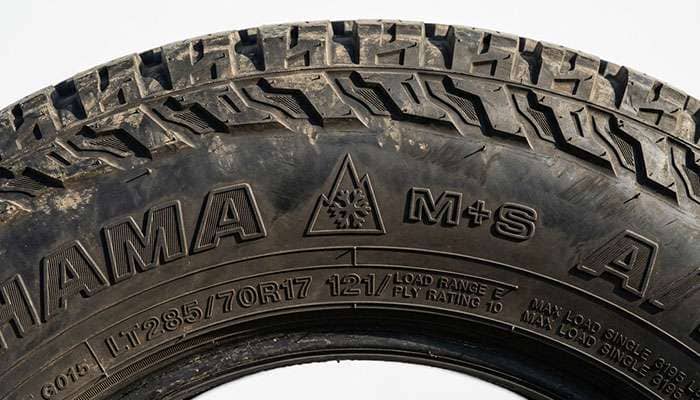
The rating lives on the sidewall of each individual size, not on the tire line as a whole. Before you buy, confirm the symbol on the exact size, load range, and construction you're ordering, and confirm it again on the tires when they're mounted. If you're shopping by photo, look for a mountain with three peaks and a snowflake inside it, molded near the size and load markings. Our guide to the snowflake tire symbol covers the marking in more detail.
An aggressive-looking tread fools a lot of people. Big blocks and wide voids look like snow tires, and in deep, loose snow they do dig. On packed snow the rubber matters more than the pattern. Tread compounds built for summer heat and sharp rocks start to stiffen somewhere around 40 to 45 degrees F, and stiff rubber can't conform to the micro-texture of packed snow. For more on how cold changes grip, see our breakdown of what temperature is too cold for all-season tires.
This is the part almost nobody explains, and it's the reason a snowflake-rated all-terrain still isn't a winter tire.
Under the U.S. Tire Manufacturers Association definition, a tire earns the three-peak mountain snowflake by passing the ASTM F1805 snow traction test. The tire runs on medium-packed snow, and the test measures how much traction it develops while accelerating, compared with a standardized reference tire. To qualify against the current 16-inch reference tire, it needs a snow grip index of at least 1.12, meaning about 12 percent more accelerating traction than the reference. The test is run with the air at 38 degrees F or colder and the snow surface between roughly 5 and 25 degrees F.
Now look at what that test leaves out:
Every one of those gaps matters on a truck or SUV. A heavy vehicle needs more stopping grip than a light one, and stopping is the one thing the symbol doesn't measure. The rating is still the best single signal you have for snow traction, and it's far more meaningful than M+S. Just read it for what it is: proof the tire can pull you up a packed-snow grade when it's new.
Plan on 6/32 inch as your snow floor. Below that, an all-terrain's snow traction falls off much faster than its wet or dry traction does.
Snow traction depends on groove volume. As the tire rolls, the grooves pack with snow, and that packed snow grips the snow on the road, because snow sticks to snow better than rubber does. The sipes add biting edges on top of that. As the tread wears, the grooves get shallower, they hold less snow, and the sipes get shorter. Tires with sipes that stop short of the full tread depth lose those edges entirely partway through their life.
Two of the strictest mountain states draw their legal line in the same place. California defines a snow tire for chain control as one marked M+S with at least 6/32 inch of tread. Colorado's Traction Law requires at least 3/16 inch, which is the same 6/32 inch. NHTSA's minimum for any tire on any road is 2/32 inch. That gap between 2/32 and 6/32 is where a lot of all-terrains spend their last winter: legal on a dry highway and nearly useless on a snowy grade.
What your remaining tread means in snow:
Remaining Tread Depth |
Snow Traction |
California Snow Tire / Colorado Traction Law |
What to Do |
|---|---|---|---|
10/32 inch or more |
Full, for what the tire was designed to do |
Meets both, if marked M+S or snowflake |
Drive it this winter |
7/32 to 9/32 inch |
Noticeably reduced on packed snow |
Meets both, if marked |
Fine for plowed roads; budget for replacement by next fall |
6/32 inch |
At the edge |
Just meets both |
Replace before the first mountain trip |
3/32 to 5/32 inch |
Poor |
Fails both |
Replace now if you drive in snow |
2/32 inch or less |
None worth counting on |
Fails both, and below the NHTSA minimum |
Replace before driving anywhere |
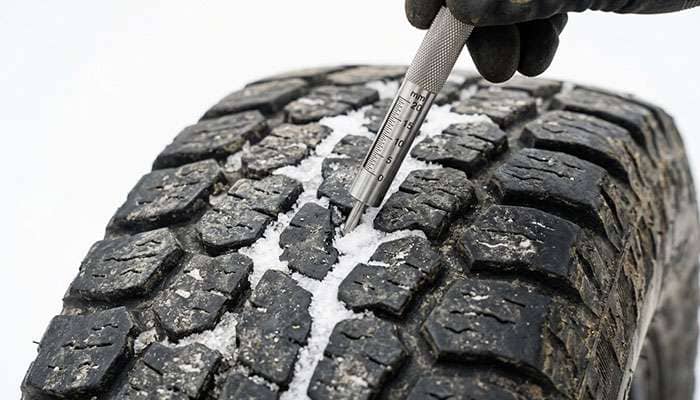
Here's a number most buyers never see. Most P-metric all-terrains start out with roughly 11/32 to 14/32 inch of tread. Most LT all-terrains start around 15/32 to 18/32 inch. Subtract the 6/32 inch snow floor, and a typical LT all-terrain has about 10/32 inch of usable snow life, while a typical P-metric all-terrain has about 7/32 inch. Same category, same snowflake symbol, and potentially a full extra winter of usable snow tread. Measure in the inner, center, and outer grooves on all four tires and go by the lowest reading. For more on reading wear, see our article on what tread depth to replace tires at.
No, not compared with a winter tire, and the snowflake symbol doesn't change that.
Ice traction comes from a very soft compound, dense siping, and, in the best studless winter tires, a rubber texture that wicks away the thin film of water that sits on top of ice. All-terrain tires are built in the opposite direction. Even the snowflake-rated ones use firmer compounds so they can survive gravel, rock, and 50,000-plus highway miles. On glare ice and freezing rain, that firmness costs you stopping distance.
There's a separate rating for this. The Ice Grip symbol, defined under ISO 19447, comes from a braking test on ice, and a tire has to stop measurably better than a reference tire to earn it. As the U.S. Tire Manufacturers Association describes it, the symbol is meant for passenger tires designed for ice conditions. That leaves LT all-terrains out entirely, and it tells you how far apart the two categories sit on ice.
If your winter means black ice on the morning commute, freezing rain, or icy shaded switchbacks, the honest answer is a dedicated winter tire. A few all-terrain lines are molded to accept studs, and studs change the ice picture completely where they're legal. Without studs, slow down, open up your following distance, and don't let four-wheel drive talk you into speeds the tires can't stop from.
It depends on the marks on both tires, and that's the comparison most people get backward.
The all-terrain's quiet advantage is depth. Starting with more tread means it stays above the 6/32 inch snow floor for more of its life, and that matters more in year three than it does on the day you buy it.
On packed snow, an LT all-terrain can give up some grip compared with the same tread in a P-metric size. In deep snow and over the life of the tire, it often comes out ahead. The variable is construction and air pressure, not the tread pattern.
LT tires use heavier casings and stiffer sidewalls so they can carry more load, and they run at higher pressures to do it. A Load Range E tire can be rated for up to 80 psi. A stiffer tire at higher pressure puts down a smaller, firmer footprint, and on packed snow a smaller footprint means fewer sipe edges touching the road at once. The P-metric or XL version of the same tread, in the same size, usually runs in the mid-30s psi and flexes more.
The fix is to run the right pressure, not the maximum. If your truck came from the factory on LT tires, use the pressure on the door placard. If you upgraded from P-metric to LT, use the load-inflation table for the load you actually carry, and don't simply pump the tires to the number molded on the sidewall. NHTSA also points out that tire pressure drops as the outside temperature drops, so check your pressures cold, after the truck has sat for at least three hours. Our comparison of P-metric vs. LT tires covers the construction differences in more detail.
Off pavement, in deep unplowed snow, dropping pressure lengthens the footprint and helps an all-terrain float and claw. It's a legitimate trail technique, but it comes with rules: low speed only, no pavement, and air back up before you hit the highway. A soft tire rolling over rocks you can't see under the snow is how sidewalls get cut, and a cut sidewall is a different problem entirely. If you've been aired down on a rocky trail, check your sidewalls against our guide to whether sidewall damage is safe to drive on before your next highway run.
Same rule, more extreme results.
Mud-terrain tires have huge voids, very few sipes, and hard compounds built to resist chunking. In deep, loose snow they paddle through better than almost anything. On packed snow and ice they're among the worst tires you can run, because there's so little rubber touching the road and so few edges in that rubber. Most mud-terrains carry M+S, and very few carry the snowflake symbol.
Rugged-terrain tires, the hybrids between all-terrain and mud-terrain, land in between. Some carry the snowflake symbol and some don't, and that mark matters more than the category name. If the sidewall has the mountain and snowflake, treat it like a rated all-terrain. If it doesn't, treat it like a mud-terrain on packed snow.
They help you go. They don't help you stop or turn, and that's where snow accidents happen.
Four-wheel drive and all-wheel drive split engine power across all four tires, so each tire has less work to do pulling away from a stop. That's a real advantage on a snowy grade. Braking, though, has always used all four tires, on every vehicle. Two-wheel drive and four-wheel drive stop on exactly the same four contact patches, and cornering grip works the same way.
Here's the twist. The snowflake test measures accelerating traction, which is the part your drivetrain already helps with. Stopping and cornering are the parts the rating doesn't measure and four-wheel drive doesn't improve. So the weakest link on a 4WD truck in snow is always the same: how well the tires stop it. That's also why a heavy pickup on marginal tires feels confident right up until the first stop sign at the bottom of a hill.
Often, yes, as long as they're marked and have enough tread. Here's how the two most common rule sets work.
California defines a snow tire as one marked M+S, or something similar, on the sidewall, with at least 6/32 inch of tread. A snowflake-rated all-terrain qualifies because the snowflake symbol always comes with M+S.
Even when R1 or R2 lets you skip them, you still have to carry chains. Two things trip up truck owners. A worn all-terrain under 6/32 inch doesn't count no matter what's on the sidewall. And a lot of heavy-duty pickups weigh too much for the R2 exemption, so they chain up regardless of tires. Our article on whether you need chains with 4WD or AWD in California covers chain control in more detail.
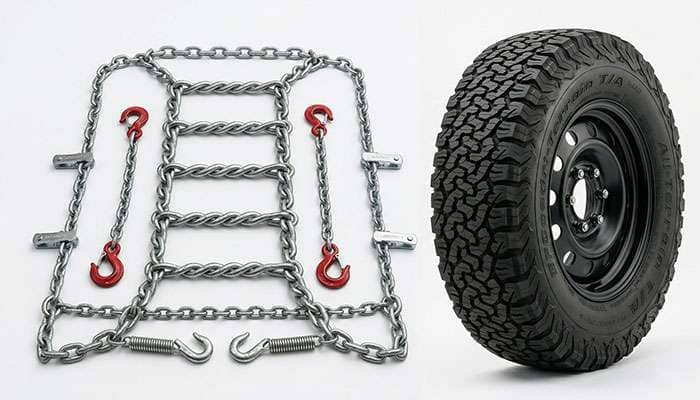
Colorado's Traction Law is in effect every year from September 1 through May 31 on the I-70 mountain corridor between Dotsero and Morrison, and the state can activate it on other highways when conditions call for it. To comply, your tires need at least 3/16 inch of tread and one of these: the M+S mark, the mountain snowflake symbol, or an all-weather rating. If your tires don't meet that standard, you need chains or an approved alternative traction device. Getting caught without either carries a $50 fine plus a $17 surcharge.
Notice what both states accept: M+S alone, at 6/32 inch, is legal. That's the gap the decision table at the top points to. The law sets a minimum for being on the road, not a standard for being good at it.
Answer that by the winter you actually drive in, not the one in the commercials. Find your row.
What to run, based on your winter:
Your Winter |
What to Run |
Why |
What You End Up Buying |
|---|---|---|---|
A few mountain weekends a year on plowed highways |
Snowflake-rated all-terrains with 8/32 inch or more, plus chains in the truck |
Handles packed snow and satisfies most chain control levels short of R3 |
Snowflake-rated all-terrains when your current set nears 6/32 inch |
Daily driving in a snow-belt town, packed snow for weeks at a time |
Dedicated winter tires from late fall to spring |
Stopping and cornering on packed snow, where the rating doesn't test |
A winter tire set, ideally on its own wheels |
Rural or unplowed roads, deep snow, ranch or trail use |
Snowflake-rated all-terrains or rugged-terrains with deep tread |
Void volume and ground clearance matter most in deep snow |
Snowflake-rated all-terrains, LT if you haul or tow |
Black ice, freezing rain, icy shaded roads |
Studless winter tires, or studded tires where they're legal |
No all-terrain is built for ice braking |
Winter tires |
Towing or plowing with a 3/4-ton in snow |
Snowflake-rated LT all-terrains at the correct load pressure |
You need the load range and the snow rating at the same time |
Snowflake-rated LT all-terrains in Load Range E |
Current all-terrains at 6/32 inch or less going into winter |
New tires before the first storm |
They fail the snow tire definition in California and Colorado |
A new set, all four at once |
If two rows fit you, go with the one that involves more ice or more weeks of packed snow. The tire that handles your worst day is the right tire.
Running a worn or unrated all-terrain into winter doesn't fail all at once. It costs you in steps, and each step costs more than the last.
Step five costs less than step three, and it can be in your driveway before the first storm.
Do this in the driveway before your first mountain trip. It takes about ten minutes.
All-terrain tires can be good in snow, but the category name doesn't tell you whether yours are. The sidewall does. A three-peak mountain snowflake symbol means the tire passed a packed-snow traction test when it was new. Your tread depth tells you how much of that is left, and 6/32 inch is where both the snow performance and the legal definition run out. Even the best rated all-terrain won't stop on ice like a winter tire, and four-wheel drive won't cover for it.
Check your marks, measure your tread, and find your row. If your all-terrains are rated and deep, drive them with confidence and carry chains. If they aren't, now is the time to fix it, before the first storm closes the pass. When you're ready, browse our winter and snow tires or call us with your size, and we'll tell you which tires in that size carry the snowflake.
Here's the whole answer in five lines.
• The snowflake symbol splits the category: A three-peak mountain snowflake all-terrain is good on packed snow. An M+S-only all-terrain is good in deep snow and fair at best on packed snow.
• 6/32 inch is the snow floor: California and Colorado both stop counting a tire as a snow tire below 6/32 inch, and snow traction falls off fast past that point.
• The rating tests going, not stopping: The ASTM F1805 test measures accelerating traction on packed snow. It doesn't test braking, cornering, or ice.
• LT tires trade some packed-snow grip for longer snow life: LT all-terrains typically start with 15/32 to 18/32 inch of tread, versus 11/32 to 14/32 inch for P-metric, but need the right pressure to grip.
• Ice needs a winter tire: No all-terrain, rated or not, brakes on ice like a dedicated winter tire, and 4WD doesn't help you stop.
Yes, if they carry the three-peak mountain snowflake symbol and have at least 6/32 inch of tread. Those tires handle plowed and packed snow well. All-terrains marked only M+S work in deep, loose snow but are noticeably weaker on packed snow, and no all-terrain is good on ice.
No. Even a snowflake-rated all-terrain uses a firmer compound and less siping than a dedicated winter tire, so it stops and corners worse on packed snow and much worse on ice. A rated all-terrain is a strong choice for occasional snow and mountain trips, while winter tires are the better choice for weeks of packed snow or regular ice.
Generally yes. Their large tread voids dig and self-clean in deep, loose snow, and trucks running them usually have the ground clearance to stay on top. The limits are tread depth, since shallow grooves pack up, and ground clearance.
In California you must carry chains under R1 and R2 chain control even with qualifying snow tires, and everyone must put them on under R3. An all-terrain counts as a snow tire there only if it is marked M+S and has at least 6/32 inch of tread.
No. Virtually every dedicated winter tire carries the symbol, but so do many all-weather and all-terrain tires. The symbol only means the tire passed a packed-snow acceleration test when new. It doesn't measure braking, cornering, or ice grip.
Plan on replacing tires for snow use at 6/32 inch. California and Colorado both require at least 6/32 inch for a tire to count as a snow tire, and snow traction drops sharply below that even though the tire stays legal for dry roads down to 2/32 inch.