
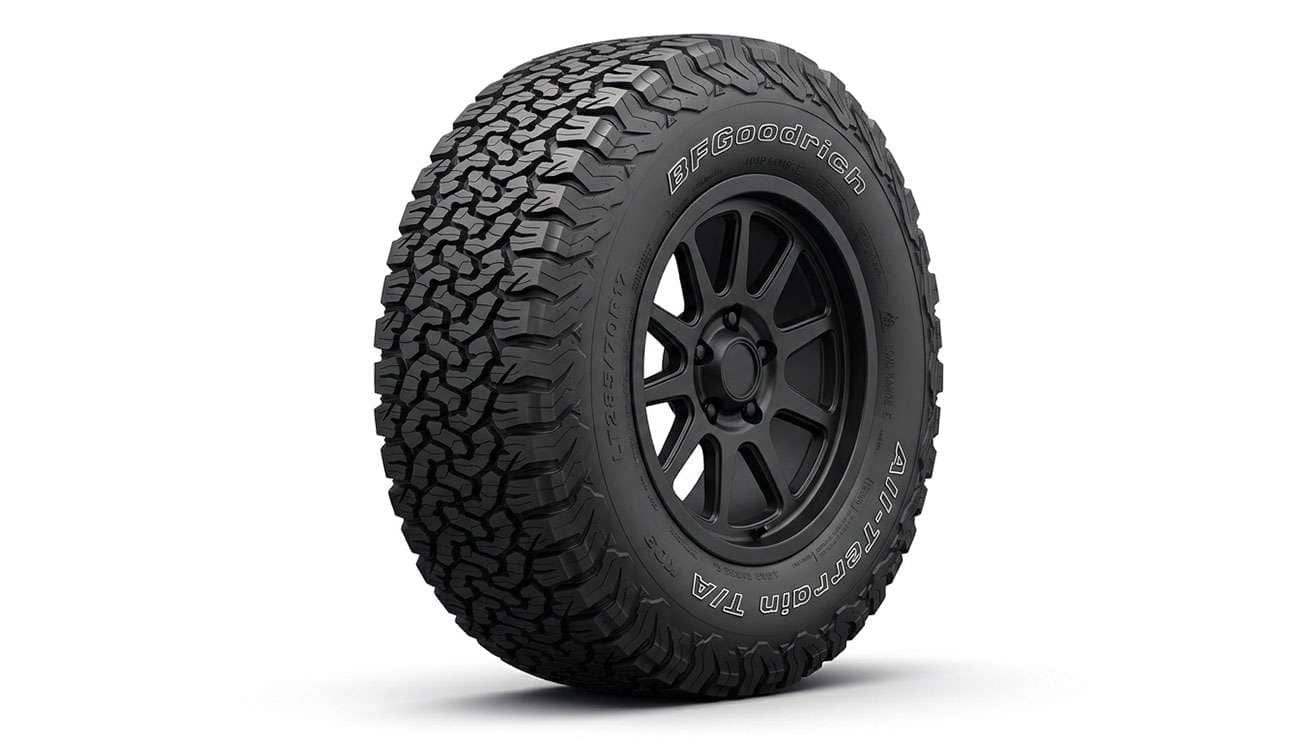
Short answer: yes, the BFGoodrich All-Terrain T/A KO3 is a very good tire. That is the easy part, and it is also the least useful thing anyone can tell you. Almost every all-terrain tire from a major manufacturer is good now. The question that actually matters when you are standing in front of a set of KO2s with 40,000 miles on them is whether the KO3 is enough better to justify moving up a generation, and that answer is not universal.
Here is the variable nearly every KO3 review skips: what percentage of your miles are on gravel. BFGoodrich did not build the KO3 to beat the KO2 everywhere. The engineering effort went into three specific places, and two of them only show up if your tires spend real time on loose, sharp, unpaved surfaces. If you are a pavement-heavy driver who sees a dirt road twice a year, you are paying for durability you will never collect on. If you run forest service roads, ranch two-tracks, or washboard gravel every week, the KO3 is the most meaningful all-terrain upgrade BFGoodrich has released in a decade.
This article breaks the decision down by use case, with real load ranges, real pricing from our catalog, and the third-party test results that do not always flatter the new tire. We stock 89 KO3 SKUs across 83 sizes, and we still stock the KO2, so we have no reason to push you one direction.
Find the row that describes your truck and how you actually use it. This is the whole article in one screen.
Your Driving Mix |
Recommendation |
The Reason |
|---|---|---|
90 percent pavement, dirt road a few times a year |
Either tire, KO3 if ride quality matters |
You will never cash in the gravel durability gain. The quieter tread pitch is the only upgrade you will actually feel. |
25 to 50 percent gravel, forest road, or ranch two-track |
KO3, clearly |
Chip-and-tear resistance is where the new compound and footprint were aimed. This is the buyer BFGoodrich designed for. |
Rock crawling, aired down, low-speed technical trails |
KO3 |
Advanced Deflection Design and the extended shoulder rubber protect the sidewall failure zone that ends most trail days. |
Deep mud is your primary terrain |
Look at a mud-terrain instead |
The KO3 is still an all-terrain. Better mud-phobic bars help, but tread void is what clears deep muck. |
Snow-belt daily driver, minimal off-road |
KO3 |
Full-depth 3D sipes plus the new compound carry the severe snow rating, and the sipes stay effective deeper into the tread life. |
Replacing one or two tires on an existing KO2 set |
Buy KO2 |
Never split generations across an axle. Different compounds and footprints produce different rolling circumference under load. |
Towing or hauling near your payload ceiling |
Check the load range in your size first |
Several KO3 sizes gained load range over the equivalent KO2. A few did not. The sidewall stamping is the only authority. |
If your row said KO2, that is a legitimate answer and not a consolation prize. We wrote a full breakdown of whether the BFG KO2 is still worth buying now that the KO3 is in the market, and the short version is that a tire with a decade of proven field data behind it is worth serious consideration.
BFGoodrich has been building all-terrain tires since 1976, when it created the category with the original Radial All-Terrain T/A. The KO3 is the fourth generation in that line, following the KO in 1999 and the KO2 in 2014. Ten years between generations is a long development window, and the KO3 arrived in 2024 with a genuinely new tread pattern rather than a facelift.
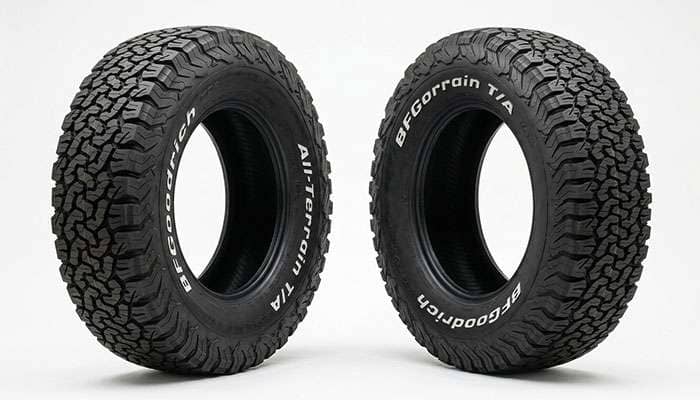
The engineering brief was organized around what BFGoodrich calls the three Ts: treadwear, toughness, and traction. Here is what each one produced in hardware.
Treadwear. A new all-terrain tread compound formulated for longevity both on pavement and in abrasive off-road conditions, paired with an optimized footprint shape designed to distribute stress evenly across the contact patch. Uneven stress distribution is what produces the cupping and shoulder scallop that ends most all-terrain tires well before the tread wear indicators say they are finished.
Toughness. CoreGard Technology carries over from the KO2, but the sidewall package is more aggressive. The KO3 uses split and bruise-resistant sidewall rubber derived from the Baja T/A KR3 race tire, an Advanced Deflection Design intended to push protruding rocks and sticks away rather than let them snag, and extended shoulder rubber that runs further down the sidewall to cover more of the critical failure zone. If you have ever had a trail day end because of sidewall damage and the question of whether it is safe to drive on, this is the part of the tire you should care about most.
Traction. Full-depth locking 3D sipes, updated serrated shoulder design, refreshed mud-phobic bars, and interlocking tread elements that stabilize the tread center while providing biting edges off pavement. The full-depth part matters more than it sounds. Sipes that only exist in the top few 32nds disappear halfway through the tire's life, taking your winter traction with them.
What did not change is the thing most buyers actually wanted preserved: the KO3 still looks like a BFG all-terrain, and it still runs the aggressive sidewall tread that makes the tire recognizable from fifty feet away.
This is the most-searched question about the tire, and it deserves an honest answer rather than a marketing summary. The KO3 is better in most measurable ways, but not all of them, and the gains are concentrated rather than spread evenly.
Category |
KO2 |
KO3 |
|---|---|---|
Gravel durability |
Known to chip and chunk on sustained gravel miles |
New compound and footprint aimed specifically at this weakness |
Road noise |
Audible from new, gets louder as the tread wears |
Noticeably quieter on pavement in back-to-back owner testing |
Snow traction |
3PMSF rated, strong reputation |
3PMSF rated, small measured improvement in comparison testing |
Wet pavement |
Slightly ahead in at least one independent comparison test |
Competitive but not a clear win on wet asphalt |
Dry off-road and rock |
Benchmark performance |
Effectively equal, with a stronger sidewall package |
Weight |
Heavy for its size |
Still heavy, no meaningful reduction |
That wet pavement row is the one worth pausing on. Independent comparison testing has found the KO2 marginally ahead of the KO3 on wet asphalt, on the order of a few percent. In practical terms that is a difference you would need instrumentation to detect, and it is more than offset for most drivers by the KO3's gains elsewhere. But if you drive a lightweight all-wheel-drive crossover in a rain-heavy climate and you never leave pavement, the KO3 is not the tire that solves your problem, and neither is the KO2. A dedicated highway or touring all-season is.
The other honest note: an all-terrain tire is always a compromise. If you want to see how the KO3 stacks up against a hybrid terrain competitor rather than its own predecessor, we ran that matchup in our BFGoodrich KO3 versus Nitto Ridge Grappler comparison.
The light truck KO3 sizes we stock carry a 50,000-mile treadwear limited warranty, the same headline figure the KO2 carried. That number is the manufacturer's contractual floor, not a life expectancy, and treating the two as the same thing is how people end up disappointed.
Real-world KO2 owners have reported anywhere from 40,000 to 65,000 miles depending on use. The spread is enormous because all-terrain tires do not usually die of tread depth. They die of tread damage. That distinction is the entire argument for the KO3.
Three things end an all-terrain tire early, in order of how often we see them:
Chip and tear on gravel. Sharp aggregate at highway speed picks pieces out of the tread block edges. It looks cosmetic at first and then compounds, because every chipped edge becomes a stress riser for the next one. One well-documented KO2 test covered roughly 7,100 miles with about 44 percent of it on gravel and dirt, and the tires came out visibly chewed up. That is the exact failure the KO3 compound and optimized footprint were designed to slow down.
Irregular wear from neglected rotation. Heavy LT-metric tires on a truck that never gets rotated will cup, feather, and scallop on the shoulders. At that point the tire is loud and vibrating with 8/32 of tread left. Rotate every 5,000 to 7,500 miles, and cross-rotate if your vehicle and tires permit it.
Underinflation under load. An E-rated or F-rated tire run at pressures set for an empty bed will flex excessively in the sidewall, build heat, and wear the shoulders. Set pressure to the vehicle placard for daily driving and adjust upward for loaded work, never above the maximum stamped on the sidewall.
Do those three things and a KO3 that sees a mixed-use life should comfortably beat its warranty number. The 16/32 of tread depth on the light truck sizes gives you plenty of material to work with.
Every KO3 carries the three-peak mountain snowflake symbol, and BFGoodrich credits the new all-terrain compound and the full-depth 3D sipes for earning it. That is a real credential, but it is worth understanding exactly what it certifies and what it does not.
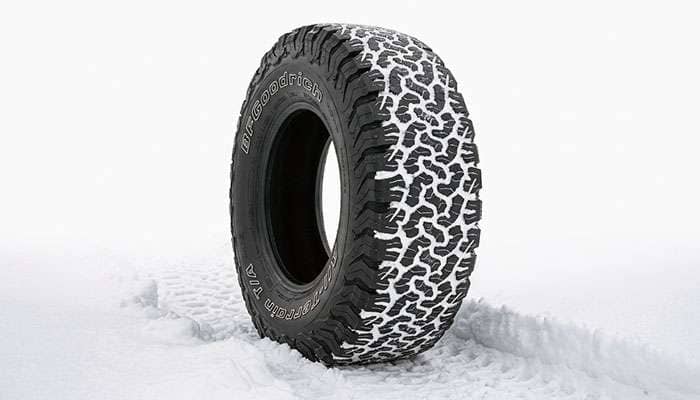
The 3PMSF brand is awarded based on a standardized medium-packed-snow traction test. A tire has to deliver a traction index meaningfully above a standard reference tire to qualify. It is a snow acceleration test. It is not an ice test, and it is not a braking test. That is why a 3PMSF-branded all-terrain and a dedicated studless winter tire can both wear the same symbol and still behave very differently at a stop sign on a cold morning.
What that means in practice for a KO3 owner: on packed snow and unplowed roads, the tire is genuinely capable, and comparison testing puts it slightly ahead of the KO2. On sheet ice it is an all-terrain tire, which is to say it is adequate and not exceptional. If you live somewhere with a real ice season, the KO3 is a strong year-round tire that still does not replace a winter tire on the worst days.
The full-depth siping is the underrated part of the winter story. Because the 3D sipes run the depth of the tread rather than just the surface layer, a half-worn KO3 retains far more of its biting edges than a half-worn tire with shallow siping. Winter performance that survives to 50 percent tread is worth more than a slightly better number when the tire is brand new. If you want the full standard explained, we covered what the snowflake tire symbol actually means in a separate guide.
Yes, the KO3 makes more noise than a highway tire. No, it is not loud by all-terrain standards, and it is measurably quieter than the KO2 it replaces.
Noise in an aggressive tread comes from air being compressed and released between tread blocks as they enter and leave the contact patch. Manufacturers manage it with pitch sequencing, which means varying the block spacing around the circumference so the frequencies spread out instead of stacking into one dominant tone. The KO3 uses an optimized pitch arrangement along with the interlocking tread elements that stabilize the center rib, and owners running back-to-back sets on the same vehicle have consistently reported the new tire is quieter on pavement.
The more important improvement may be what happens later. A common KO2 complaint was not the noise when new but the noise at 30,000 miles, once irregular wear started producing a growl. The KO3's even-wear engineering, if it delivers, should slow that progression. That claim is still accumulating field data, so treat it as a well-founded expectation rather than a proven result.
Practical expectation setting: coming from a highway all-season, you will hear the difference immediately and stop noticing it within a week. Coming from a mud-terrain, the KO3 will feel like a library. Coming from a worn set of KO2s, the truck will get noticeably quieter.
The KO3 is not unusually difficult to balance, but it belongs to a category of tire that punishes a lazy balance job, and that is why the question keeps coming up.
Light truck all-terrains are heavy, with stiff sidewalls and thick tread. A standard spin balancer only measures mass distribution. It tells you where the heavy spot is and nothing else. On a tire this stiff, the problem is often not mass at all but stiffness variation, meaning the tire is not perfectly uniform in how it deflects as it rolls. A tire can balance perfectly on the machine and still shake the steering wheel at 65 mph.
Road force balancing solves this by pressing a loaded roller against the tire while it spins, simulating the vehicle's weight and measuring the variation directly. The machine then tells the technician how to match-mount the tire on the wheel, rotating the tire's high point to line up with the wheel's low point so the two cancel each other out. On a large-diameter aggressive all-terrain, this is the difference between a smooth truck and a persistent vibration nobody can chase down. Our full explanation of what road force balancing does and when you need it covers the process in detail.
Two practical notes. First, ask for road force balancing when you buy any LT-metric all-terrain in a 17-inch diameter or larger. It usually costs a few dollars more per tire and it saves return visits. Second, if a shop tells you a new set of KO3s cannot be balanced, get a second opinion before you accept a defect claim. In the overwhelming majority of cases the tire is fine and the equipment or the technique is the limiting factor.
These two questions come up together constantly, so let us handle both.
Is BFGoodrich made by Michelin? Effectively, yes. Michelin acquired the Uniroyal Goodrich Tire Company in 1990, and BFGoodrich has operated as a Michelin brand ever since. They share manufacturing capability, materials science, and testing infrastructure. That is why you will see Michelin technology language appear in BFGoodrich product literature.
Which is better? They are positioned for different buyers, and the honest answer is that the brand matters less than the segment. Michelin's light truck all-terrain lineup, the LTX A/T family in particular, is engineered around on-road refinement, tread life, and ride comfort, with competent but conservative off-road capability. BFGoodrich's Terrain family is engineered around off-road durability first, with on-road manners as the constraint rather than the goal.
Translated into a buying rule: if 85 percent of your miles are pavement and you want the quietest, longest-wearing tire that can still handle a gravel driveway and a snowy commute, Michelin is usually the better fit. If you actually leave pavement, if you carry loads on rough surfaces, or if sidewall damage is a real risk in your world, BFGoodrich is the better fit and the KO3 is its sharpest tool. We looked at the brand's overall track record across its whole catalog in our full assessment of whether BFGoodrich tires are any good.
We currently stock 89 KO3 part numbers covering 83 distinct sizes, from LT215/75R15 up through LT39x13.50R17, in 15, 16, 17, 18, 20, and 22-inch diameters. Load ranges run from C through F depending on size, and BFGoodrich has flagged increased load range on a number of the sizes rolling out through this year. That is a meaningful detail for anyone towing.
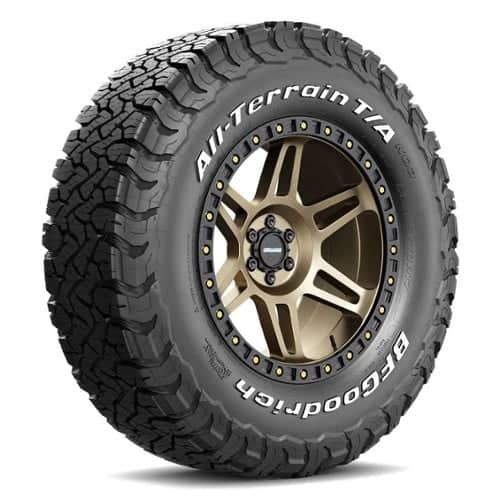
Load range is not a marketing tier. It defines the maximum inflation pressure and therefore the maximum load the tire can legally carry. Moving from a D-rated tire to an E-rated tire in the same size changes the load capacity, the ride quality, and the correct inflation pressure for your vehicle. If any of that is unfamiliar, our guide on how to read tire load range and ply ratings is worth ten minutes before you order.
Now the part everybody wants: what the generational upgrade actually costs. Here is a sample of common sizes where we stock both tires, with current pricing at the time of writing.
Size |
KO3 |
KO2 |
Difference |
|---|---|---|---|
LT245/75R16 |
USD 249.99 |
USD 243.33 |
Plus 6.66 |
LT265/70R17 |
USD 285.99 |
USD 285.44 |
Plus 0.55 |
LT255/65R17 |
USD 269.99 |
USD 308.43 |
Minus 38.44 |
LT275/65R18 |
USD 329.99 |
USD 309.16 |
Plus 20.83 |
LT285/70R17 |
USD 320.99 |
USD 261.11 |
Plus 59.88 |
LT315/70R17 |
USD 379.99 |
USD 331.11 |
Plus 48.88 |
LT305/65R18 |
USD 444.99 |
USD 535.31 |
Minus 90.32 |
LT35x12.50R20 |
USD 512.99 |
USD 525.11 |
Minus 12.12 |
LT37x13.50R22 |
USD 671.99 |
USD 738.47 |
Minus 66.48 |
Notice what that table does not show: a consistent generational price premium. In several sizes the KO3 is the cheaper tire, sometimes by a wide margin, because KO2 inventory in those sizes is thinning as the line phases out and pricing no longer reflects volume. In others the KO3 runs 50 to 60 dollars more per tire.
The practical instruction is simple. Do not assume the new tire costs more. Price your specific size before you decide, because in roughly a third of the overlapping sizes we stock, the upgrade decision makes itself on price alone. You can check current pricing and availability for every size on the BFGoodrich All-Terrain T/A KO3 product page.
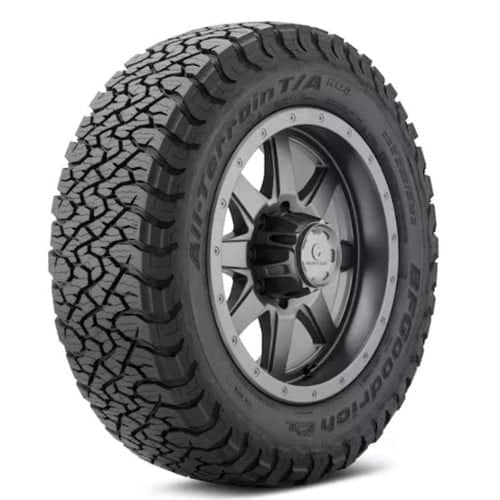
The KO3 is a good tire, and for the right driver it is a genuinely better tire than the KO2 rather than a marketing refresh. BFGoodrich took the KO2's one legitimate weakness, its tendency to chip and chunk on sustained gravel miles, and aimed a new compound, a new footprint, and full-depth siping directly at it. Along the way the tire got quieter, gained a small measured edge in snow, and picked up a more serious sidewall protection package.
What it did not do is get better at everything. Wet pavement is a wash or a slight step back. The tire is still heavy. Deep mud still calls for a mud-terrain. And if you are a pavement-heavy driver, most of what you are paying for is durability against damage you will never encounter.
So run the gravel test on yourself. If a meaningful share of your miles happen on loose, sharp, unpaved surfaces, buy the KO3 and do not think about it again. If they do not, price your size in both generations and let the number decide, because there is no shame in buying a decade-proven tire that is still in production and still very good.
Yes. The BFGoodrich All-Terrain T/A KO3 is a strong all-terrain tire with a new tread compound, an optimized footprint, full-depth 3D sipes, and a more protective sidewall package than the KO2. It is best suited to drivers who spend real time on gravel, dirt, or rough surfaces. Pavement-heavy drivers will feel the quieter ride but will not collect on the durability gains.
In most categories, yes. The KO3 is better on gravel durability, quieter on pavement, and slightly better in snow. Dry off-road performance is effectively equal, and at least one independent comparison test found the KO2 marginally ahead on wet asphalt. Neither tire is meaningfully lighter than the other.
Light truck KO3 sizes carry a 50,000-mile treadwear limited warranty. Real-world life depends far more on damage than on wear. Rotate every 5,000 to 7,500 miles, set inflation pressure correctly for your load, and a mixed-use set should comfortably exceed the warranty figure. Sustained high-speed gravel driving is the fastest way to shorten it.
Yes. Every KO3 carries the three-peak mountain snowflake symbol for severe snow service, earned through the new all-terrain compound and full-depth 3D sipes. It performs well on packed snow and unplowed roads. On sheet ice it behaves like an all-terrain rather than a dedicated winter tire, so drivers in heavy ice climates may still want a winter set.
They produce more noise than a highway tire but less than the KO2 they replace. The KO3 uses an optimized tread pitch arrangement and interlocking tread elements that stabilize the center of the contact patch. Owners running both generations on the same vehicle have consistently reported the KO3 is quieter on pavement.
Not inherently, but like all heavy light truck all-terrains they benefit from road force balancing rather than a standard spin balance. A stiff, thick tire can be perfectly balanced for mass and still vibrate because of stiffness variation. Road force equipment measures that directly and lets the technician match-mount the tire to the wheel to cancel it out.
Yes. Michelin acquired the Uniroyal Goodrich Tire Company in 1990, and BFGoodrich has operated as a Michelin brand since then. The two share manufacturing capability, materials research, and testing infrastructure, though they are positioned for different buyers. Michelin leans toward on-road refinement while BFGoodrich leans toward off-road durability.



