
You paid for a set of 80,000-mile tires. They wore out at 58,000. So you walk back into the shop expecting a free set, or close to it, and instead you get a number that looks nothing like what you imagined. That gap between the mileage stamped on the box and the credit you actually collect is where almost every driver gets blindsided.
Here's the part nobody explains at the point of sale: a mileage warranty was never a promise that your tires will last that long. It's a promise about what the manufacturer does if they don't, and that "if" comes loaded with conditions, a formula, and a tread-depth threshold that quietly disqualifies most people before they ever file. Let's break down exactly how it works, why your number comes up short, and how to make sure you actually collect what you're owed.
A treadwear or mileage warranty states that a tire should reach its legal wear-out point no sooner than a set number of miles, commonly 50,000, 60,000, or 80,000, or a maximum number of years, whichever comes first. That last clause matters more than people think. The mileage figure is a ceiling on coverage, not a floor on performance.
What the warranty does not do is guarantee you'll see those miles. Tire makers are explicit that the number assumes ideal conditions, and your real-world result depends on driving style, road surface, climate, load, inflation discipline, and alignment. A heavy right foot, a few thousand miles of aggressive cornering, or a steady 3 PSI underinflation will erode tread faster than the lab model that generated the warranty number ever accounted for. The mileage rating is closer to a benchmark than a contract.
This is the same distinction we draw in our breakdown of how a tire and rim warranty works: the manufacturer is covering its own product against falling short, not insuring your habits. Once you read the mileage number as "the most you're protected for, under perfect upkeep" instead of "the least you'll get," everything else about proration starts to make sense.
Proration is the mechanism that turns a worn-out tire into a partial credit. The key word is credit, not refund. You don't get cash back, and you rarely get a free tire after the early period. What you get is a discount applied to a comparable new tire from the same manufacturer, scaled to how much of the warranted life you didn't receive.
Most manufacturers run a short free-replacement window first, typically the first year of ownership or the first 25 percent of treadwear, whichever comes first. Inside that window, a qualifying tire is replaced at no charge. After that, you're in proration territory, and the math is straightforward.
The mileage version works like this: divide the miles you didn't receive by the total warranted miles, and that percentage becomes your credit against the price you paid. If a tire carried a 40,000-mile warranty and wore out at 30,000, you used three-quarters of the coverage. The remaining 10,000 of 40,000 miles, or 25 percent, becomes a 25 percent discount toward an equivalent new tire. On an 80,000-mile tire that quits at 60,000, you're looking at roughly 25 percent again, not a free replacement.
Some manufacturers prorate by tread depth instead of odometer reading, using a formula along the lines of current tread depth minus 2/32", divided by original usable tread minus 2/32", multiplied by the original price. Either way, the structure is identical: the more life you actually got, the smaller your credit. And remember, that credit applies to the tire only. You still pay for mounting, balancing, and installation on the replacement set. Exact policies and percentages differ by brand, so your specific manufacturer's warranty terms are the final word on the calculation.
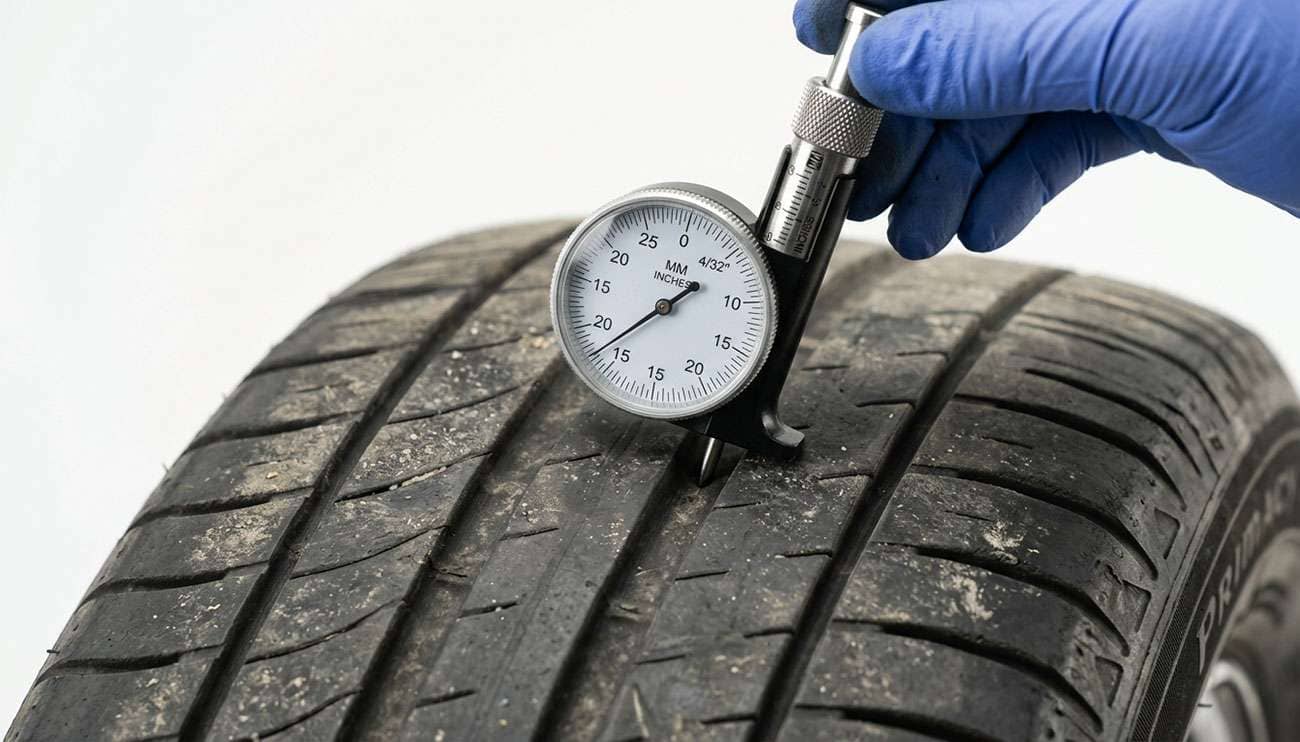
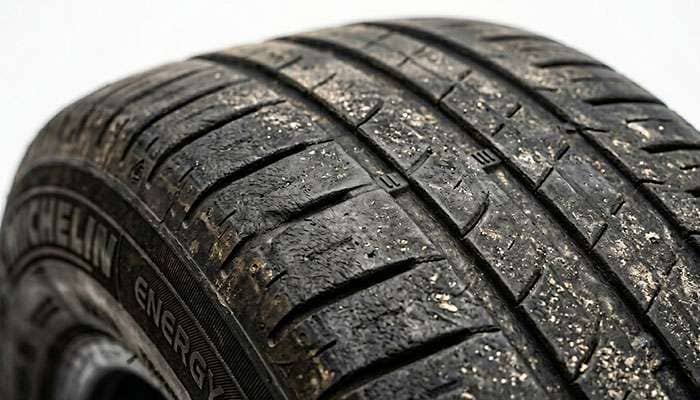
Here's the structural problem that quietly defeats more claims than any clause in the fine print. A treadwear warranty only pays out once the tire is worn down to 2/32" of remaining depth, the point at which the tread blocks meet the molded wear bars. Manufacturers also specify that proration is only considered when all four tires reach that point together.
The catch is that 2/32" is the legal minimum, the depth at which a tire is considered worn out and unsafe in most states. Wet traction, hydroplaning resistance, and braking distance have all degraded badly long before you get there. In other words, to collect on a mileage warranty, you have to keep driving on tires that are already at the end of their safe life, and run all four down to the bars at the same time.
That's why most drivers never file. Sensible tire replacement happens at 4/32" to 5/32" for wet-weather safety, well above the warranty threshold, which means the typical owner swaps out before the claim window ever opens. If you want to see exactly where your tires sit against that line, our guide to checking tire tread depth walks through the gauge-and-wear-bar method. The honest takeaway: the warranty is real, but its trigger point and your safety interests pull in opposite directions.
Assume you do reach the threshold cleanly. The manufacturer still won't pay unless you can prove the tires earned their wear honestly. These are the conditions that most often turn an eligible claim into a denied one:
Missing maintenance records. Mileage coverage is conditioned on documented, regular rotations. No rotation history, no claim. Keep your receipts, because the manufacturer wants proof, not your word. Our overview of tire rotation covers the intervals that keep coverage intact.
Alignment neglect. If a tire shows the diagonal feathering, inside-edge scrubbing, or cupping that signals a misaligned or worn suspension, the manufacturer reads that as a vehicle problem, not a tire defect, and walks away. A current wheel alignment protects both the tread and the warranty.
Inflation abuse. Chronic under- or over-inflation leaves a wear signature the inspector can read instantly. Uneven shoulder wear or a worn center rib tells the story, and it disqualifies the claim.
Original owner, original vehicle. Treadwear warranties almost universally apply only to the first purchaser and the vehicle the tires were first mounted on. Sell the car or the tires and the mileage coverage typically doesn't transfer.
The time limit. Even unused, the warranty expires. Most mileage coverage ends four, five, or six years from the purchase date regardless of miles driven, and proof of purchase is required. Slow-driving owners can age out of an 80,000-mile warranty without ever approaching 80,000 miles.
Road hazards aren't treadwear. Punctures, impact breaks, sidewall cuts, and pothole damage are explicitly outside the treadwear warranty. Those are the domain of a separate road hazard plan. If that's a coverage gap you care about, weigh the math in our look at purchasing a road hazard warranty.
Every warranty outcome falls into one of three buckets. Knowing which one applies before you walk in saves you the disappointment of expecting a free set and leaving with a discount, or expecting anything at all on damage that was never covered.
Coverage Tier |
What You Receive |
When It Applies |
|---|---|---|
Free replacement |
No-charge replacement tire (you may still pay mount and balance) |
Qualifying wear-out or defect within the early window, often the first year or first 25% of treadwear |
Prorated credit |
Partial credit toward a comparable new tire from the same brand, scaled to unused mileage |
Tire reaches 2/32" before its warranted mileage, with rotation and maintenance records in hand |
Not covered |
Nothing under the mileage warranty |
Road hazard or impact damage, uneven wear from neglect, non-original owner, or coverage aged out past the time limit |
The dividing line between the top two rows is that early free-replacement window. The line between prorated and not covered is almost always documentation and cause of wear. Treadwear ratings themselves feed directly into how generous a mileage number a maker is willing to print, which is why two tires in the same size can carry very different warranties. Our explainer on reading tire treadwear ratings shows how that UTQG grade connects to the mileage promise.
If you want the mileage warranty to be more than a marketing number on the box, treat it like a contract with homework. A few disciplined habits keep your claim alive and, just as importantly, push your tires closer to their rated life so a claim becomes a backstop rather than a hope.
Rotate on schedule and keep every receipt. Documented rotations are the single most common thing inspectors ask for, and the same practice spreads wear evenly so all four tires age together, which is what the warranty requires anyway. Hold inflation at the door-placard spec, not the number on the sidewall, and check it monthly. Get an alignment when you install the set and any time you notice pull or edge wear. Save your original purchase invoice with the date, because proof of purchase and the time-limit clock both run off it.
Then read your specific warranty document when you buy. The early free-replacement window, the proration method, the maintenance requirements, and the expiration date vary by manufacturer, and the differences are large enough to influence which tire you choose. For the layer of coverage that mileage warranties deliberately leave out, our guide to reading your tire warranty coverage goes line by line through what the fine print really says.
The best defense against a disappointing proration check is a tire engineered to actually hit its number, built with a harder, longer-wearing compound and a tread design that resists irregular wear. A few touring options in our lineup are known for matching real-world mileage to their printed warranties.
The Goodyear Assurance MaxLife is purpose-built around tread longevity and carries one of the stronger mileage warranties in the touring class. The Continental TrueContact Tour pairs a long warranty with balanced all-season grip, a sensible pick when you don't want to trade wet traction for mileage. The Cooper Endeavor and the Hankook Kinergy GT round out the value end, both delivering long warranties without a premium price. You can compare the full touring range on our tire catalog, or jump straight to Goodyear tires and Continental tires to match a model to your vehicle and driving profile.
Whatever you choose, the math from the rest of this article still applies. A long warranty is only as good as the upkeep behind it, so buy the right compound for your miles, then maintain it like the coverage depends on it, because it does.
A mileage warranty isn't the safety net most drivers assume it is. It's a prorated credit, triggered only at a tread depth you shouldn't still be driving on, conditioned on records you have to keep, and capped by a clock that runs whether you drive or not. None of that makes it worthless, it just makes it specific. Read the number on the box as a maintenance target rather than a guarantee, keep your rotation and alignment history, and you'll either reach the mileage you paid for or have a clean claim if you don't. Either outcome beats finding out at the counter that "80,000 miles" never meant what you thought.
No. A mileage warranty pays a prorated credit toward a comparable new tire from the same manufacturer, not a cash refund. The credit is based on the percentage of warranted miles you didn't receive, and it applies to the tire price only, so you still cover mounting, balancing, and installation on the replacement.
The warranted mileage assumes ideal conditions and disciplined upkeep. Aggressive driving, underinflation, missed rotations, alignment issues, heavy loads, and harsh climates all shorten tread life below the rated number. The figure is an engineering benchmark, not a promise that every driver will reach it.
Most manufacturers only consider a treadwear claim once all four tires are worn to 2/32" of remaining depth, the legal worn-out point marked by the molded wear bars. Because that depth is already unsafe in wet conditions, many drivers replace earlier and never reach the claim threshold.
Common disqualifiers include missing rotation and maintenance records, uneven wear from poor alignment or misinflation, damage from road hazards or impacts, transferring the tires to a different owner or vehicle, and letting the warranty's time limit expire, which is typically four to six years from the purchase date.
No. Treadwear and mileage warranties cover premature even wear and manufacturing defects, not punctures, impact breaks, or sidewall cuts. That kind of damage falls under a separate road hazard warranty, which you buy in addition to the standard coverage.



