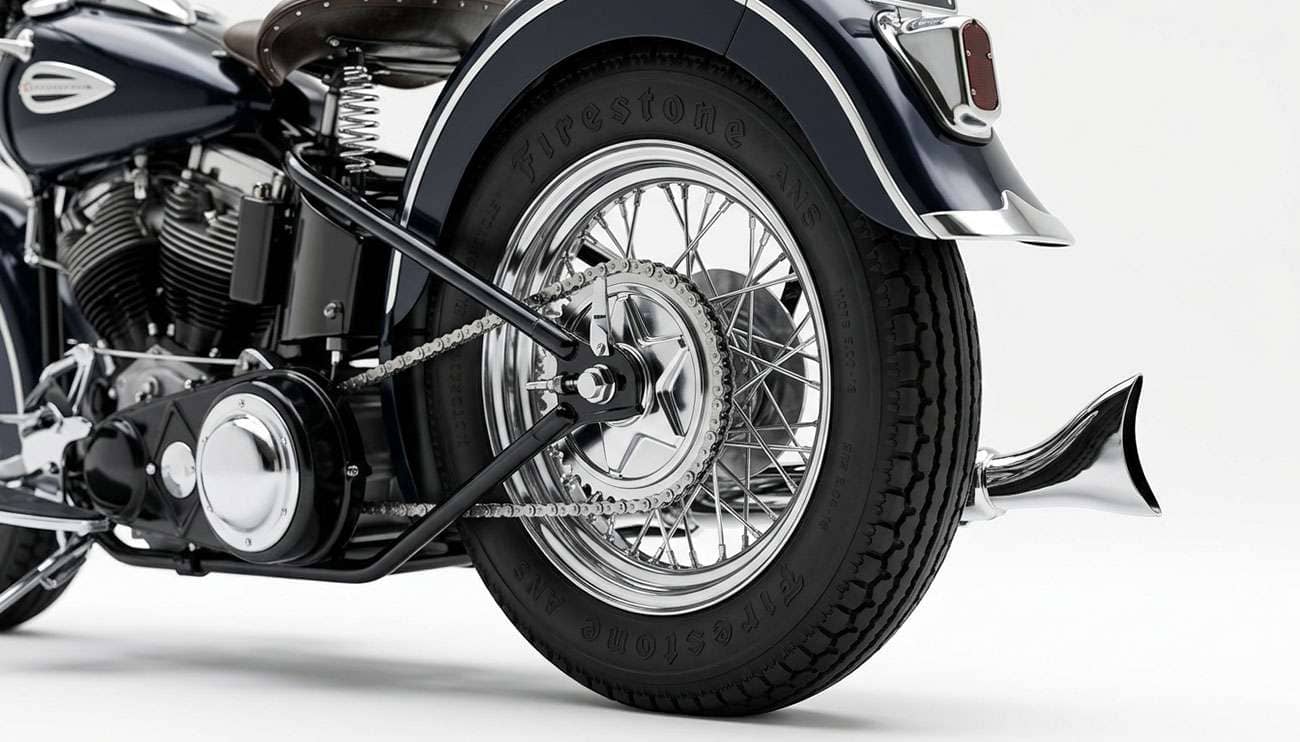
The best tire for a classic motorcycle is the one its rim was built to hold, and the rim narrows the field before riding style comes up. Pre-1930 beaded-edge clincher rims take only reproduction clinchers. 1930s-to-1950s American iron runs inch sizes like 4.00-18 and 5.00-16, where reproduction bias-ply is the market. Narrow 18- and 19-inch rims on 1960s and 1970s bikes open up classic patterns with published speed and load ratings. Only later classics are real radial candidates.
You'll hear "it depends on how you ride" a lot. It does, but only after three things: the rim type, the rim width, and whether the tire publishes a rating for the speed and load you'll put on it. Find your bike below, then match the tire to your riding.
Your Bike |
Rim You Likely Have |
Common Sizes |
What Fits |
Where to Start |
|---|---|---|---|---|
Pre-1930 veteran and early vintage |
Beaded-edge clincher with a hooked rim lip |
28x3, 28x2-1/2, 26x3, 30x3, 30x3-1/2 |
Reproduction beaded-edge clinchers only |
Firestone Smooth Clincher M/C, G&J Black Button |
1930s to 1950s Harley-Davidson and Indian |
Drop-center spoked, tube type |
4.00-18, 4.50-18, 4.00-19, 5.00-16 |
Reproduction bias-ply in the original inch sizes |
Firestone ANS, Coker Classic Diamond Tread, Indian Script |
1960s and 1970s British, European, and Japanese |
Narrow drop-center spoked, about 1.60 to 2.15 inches wide |
3.00-21, 3.25-19, 3.50-19, 4.00-18, 4.10-18 |
Classic-pattern bias-ply, some with published ratings |
Ensign Universal, Phoenix Motorcycle |
Late 1970s to 1990s classics |
Wider spoked or cast rims, some tubeless |
100/90-19, 110/90-18, 130/90-16 |
Modern bias-ply or a classic-pattern radial, matched front and rear |
Match the factory construction first |
Once you know your row, the riding decides which spec to insist on. A show bike and an interstate bike can share a rim size and still need different tires.
How You Ride |
Spec That Matters Most |
What to Check on the Sidewall |
Picks to Shop |
|---|---|---|---|
Shows, judging, and parades |
Period-correct tread, sidewall, and lettering |
Correct size for the model year and correct whitewall style |
Coker Double Pinstripe WW M/C 5.00-16 ($389), Coker Classic Beck Tread 4.00-18 WW ($406) |
Back roads and club runs under about 55 mph |
Exact size, correct rim width, fresh date code |
DOT symbol, "tube type" marking, four-digit date code |
Firestone ANS Motorcycle 5.00-16 ($236), Coker Classic Diamond Tread 4.00-18 ($172) |
Regular highway riding at 60 to 70 mph |
A published speed letter and load capacity |
Speed letter (S is 112 mph) and maximum load at a stated pressure |
Ensign Universal 3.25-19 ($169), rated S and 467 lb |
Road and dirt on a 1960s or 1970s scrambler |
Road-legal knobby with a published letter |
N rating (87 mph) and on-road approval |
Prices are current at the time of writing. Every tire here is a tube-type fitment unless noted, so budget a new tube and rim strip with each.
Start at the wheel, not the catalog. The rim decides how the tire stays on, which sizes it accepts, and how wide a footprint the tire can make. Three checks take about five minutes.
A beaded-edge rim has a rolled, hooked lip on each side. The tire has a hard rubber bead with no steel wire inside it, and nothing mechanical locks that bead in place. Air pressure in the inner tube pushes the bead outward into the hooks, and that pressure is the only thing holding the tire on the wheel. Wired-on beads began replacing beaded edges in the late 1910s, and by 1930 the change was essentially complete, so check the rim profile on any machine from the teens or 1920s.
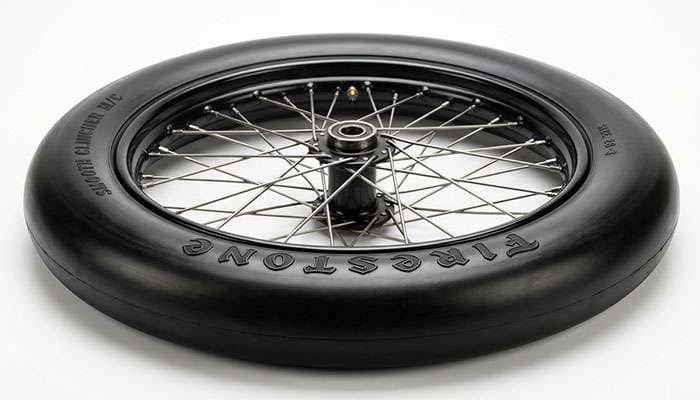
Clincher sizes read differently, too. A 28x3 is about 28 inches tall overall with a 3-inch section, which puts the rim itself closer to 22 inches.
From roughly 1930 on, motorcycle rims got a well, or drop center, in the rim bed. The tire's steel bead wires can't stretch, so you push one bead into the well for enough slack to lever the other over the flange. Once inflated, the bead seats on the rim shoulder without depending on high pressure. Almost every spoked classic from the 1930s through the 1970s uses this design.
Nearly all of those wheels need a tube and a rim strip, because spoke nipples pass through the rim bed and the rim isn't airtight. Our guide to tube-type versus tubeless tires on classics covers when a sealed rim changes the answer.
Measure across the inside of the rim flanges. Classic spoked rims commonly measure 1.60, 1.85, or 2.15 inches, and British rims often carry a WM stamping, where WM2 means 1.85 inches. Tire makers publish a recommended rim width for each size, and they don't always agree: reproduction specs call for a 2.15-inch rim under a 4.00-18, while one major maker's classic-pattern 4.00-18 calls for 2.50 inches.
Here's the mechanism. A rim narrower than spec pulls the sidewalls in and sharpens the crown, so the bike falls into turns and the contact patch shrinks at lean. A rim wider than spec flattens the crown, so the bike resists turning in.
For a clincher rim, you need a reproduction beaded-edge tire in the exact size on your rim or original tire, because no current mainstream street tire is built with a beaded edge. Reproductions in the common veteran sizes come in smooth, button, and zig-zag treads, in black or all-white.

Tire |
Size |
Tread |
Look |
Price |
|---|---|---|---|---|
28x3 |
Button |
All black, early 1900s pattern |
$190 |
|
28x3 |
Smooth |
Plain period street tread |
$230 |
|
30x3-1/2 |
Smooth |
Larger-section early machine |
$300 |
|
30x3 |
Smooth |
Early road machine style |
$462 |
Because air holds a beaded edge in place, low pressure isn't a ride-quality problem. It's a retention failure: a soft clincher's bead can climb out of the hook under cornering or braking load. Check pressure cold before every ride, and fit a new tube and rim band every time the tire comes off.
FMVSS 119, the federal standard that governs motorcycle tires, applies to tires for use on motorcycles manufactured after 1948, so a tire made only for an earlier machine isn't required to meet it. Check the sidewall for the DOT symbol. If it isn't there, treat it as a parade-and-club-run tire.
This is reproduction territory. The best options for a Flathead, Knucklehead, Panhead, or Chief are bias-ply tires built to original tread designs in the exact inch sizes the factory used. Big twins ran mostly on 18- and 19-inch wheels through the 1930s. Sixteen-inch wheels started appearing around 1940, and the 5.00-16 became the signature big-twin size. Smaller American models of the late 1940s and 1950s moved to sizes such as 3.25-19 and 3.50-18.
Most best-tire lists focus on bikes from the 1960s onward, so the names you've seen may not come in your size. Our guide to vintage motorcycle tire sizes decodes every format you'll see molded on these sidewalls.

The Firestone ANS, short for All Non-Skid, traces back to Firestone's 1940s motorcycle line, and its blocky sawtooth tread is the look most people picture on a postwar big twin. The Coker Classic Motorcycle runs a simpler period street pattern for about the same money. Both are tube-type bias-ply with a 3.00-inch recommended rim width in 5.00-16, and one product sheet flags a 2.5-inch rim as too narrow. Published diameters differ by 0.15 inch, 26.40 against 26.25, a 0.57 percent gap that won't move your speedometer.
Tire |
Tread |
Sidewall |
Best For |
Price |
|---|---|---|---|---|
Period street pattern |
Black |
Riders who want a clean stock look |
$233 |
|
Sawtooth block |
Black |
1940s and 1950s big twins, period customs |
$236 |
|
Indian pattern with molded script |
Black |
Indian restorations headed for judging |
$271 |
|
Period street pattern |
Double pinstripe whitewall |
Show bikes and dressers |
$389 |
For 18-inch wheels, the Coker Classic Motorcycle Diamond Tread is the value play at $172 in 4.00-18, with a 2.15-inch rim spec. The Firestone ANS and Zig Zag cover the same size with bolder period treads, and the Coker Classic Beck Tread adds a true whitewall for show bikes.

Tire |
Tread |
Sidewall |
Best For |
Price |
|---|---|---|---|---|
Diamond |
Black |
Riders on a budget, front or rear |
$172 |
|
Zig-zag |
Black |
Period zig-zag look on 18-inch wheels |
$244 |
|
Sawtooth block |
Black |
Postwar flatheads and military-style builds |
$259 |
|
Beck pattern |
Whitewall |
Show bikes on 18-inch wheels |
$406 |
Here's the part nobody puts in front of you. The published specs on these reproductions list size, rim width, diameter, and construction, but no speed letter or load index, and that's the norm across the period patterns. If your big twin sees sustained 70-mph interstate time, a modern 130/90-16 bias tire with a published speed letter is the spec-driven choice, since 5.00-16 and 130/90-16 cross-reference. For the riding most restored pre-1958 bikes see, a reproduction with the DOT symbol is the right tire, and the federal testing section below explains why.
Narrow 18- and 19-inch spoked rims define this era, and it's where the market gets crowded, in sizes like 3.25-19, 3.50-19, 4.00-18, and 4.10-18. The variable that separates these tires isn't the tread. It's the rating molded into the sidewall.
Take 3.25-19, a common classic front size. Classic-pattern tires in it run from no published speed letter, through P (93 mph) on the Dunlop K70 and S (112 mph) on the Ensign Universal, up to V (149 mph) on the ContiClassicAttack radial sold in 100/90 R19 as a 3.25-19 replacement. Same nominal size, same retro look, very different limits.
3.25-19 Class Front |
Construction |
Speed Rating |
Maximum Load |
|---|---|---|---|
Bias-ply, tube type |
Not listed |
Not listed |
|
Dunlop K70 3.25-19 |
Bias-ply, tube type |
P (93 mph) |
465 lb at 32 psi |
Bias-ply, tube type |
S (112 mph) |
467 lb |
|
ContiClassicAttack 100/90 R19 |
Radial, tubeless |
V (149 mph) |
507 lb (load index 57) |
A 650 twin that cruises at 80 mph with a passenger is running within 13 mph of a P-rated tire's limit, and heat and load eat into that margin. Ridden to Sunday breakfast at 50, the same bike never comes close.
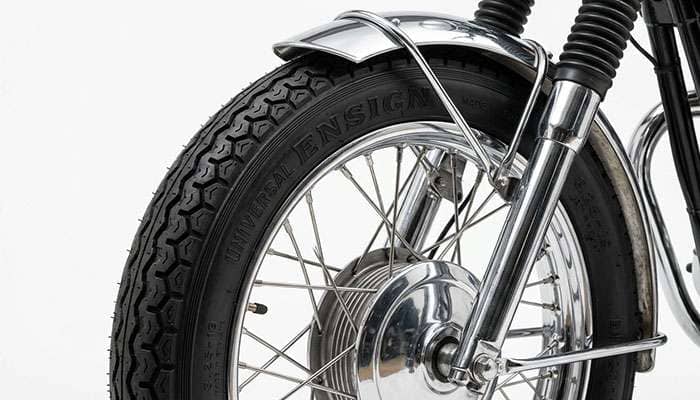
The Phoenix Motorcycle line targets 1960s and 1970s European and Japanese bikes such as BMW, Honda, and Kawasaki, and it's the price leader at $96.58 for a 3.60-19 front. The Ensign Universal is the pick when you want a published S rating for road speed, and the Deka Motorcycle in 3.50-19 covers the period look. For scramblers, the Ensign Trials Universal is road-legal, rated N to 87 mph, and built for on- and off-pavement use.

Tire |
Size |
Typical Position |
Published Rating |
Price |
|---|---|---|---|---|
3.60-19 |
Front |
Not listed |
$96.58 |
|
4.10-18 |
Rear |
Not listed |
$131.51 |
|
3.25-19 |
Front or rear |
S (112 mph), 467 lb |
$169 |
|
3.50-19 |
Front or rear |
Not listed |
$187 |
|
4.00-19 |
Rear |
N (87 mph) |
$208 |
Buy both ends at once if both are due, and keep them in the same construction. A fresh front over a fifteen-year-old rear is a trap: the hardened rear breaks traction first, with very little warning.
Yes, on the right bike, as a matched pair, in a size the radial maker lists as a replacement. The best-known classic-pattern radial uses a 0-degree steel belt to limit the growth bias-ply casings show at speed, and comes in 100/90 R19, 110/90 R18, and 120/90 R18 to replace 3.25-19, 4.00-18, and 4.25-18.
Bias-ply and radial casings flex differently, generate different cornering forces, and damp bumps differently. Mix them and the two ends of the bike stop agreeing on how far to lean and how quickly to settle. Some modern retro bikes run a bias front with a radial rear, but the motorcycle maker engineered and tested that pairing as part of the OE spec. On a classic, keep both ends the same construction.
The bikes that gain the most are the later, heavier, faster classics: big-bore 1970s and 1980s machines with rims wide enough for the radial's approved width and the performance to use a V rating. A 1950s single on WM1 rims gains nothing from a 149-mph tire, and a pre-1930 clincher machine can't mount one at all. Check the radial's approved rim width and dimensions against your rim and fender clearance before you order. On a bike headed for judging, a non-original construction is an easy deduction.
A reproduction tire can carry the DOT symbol without a speed letter. Those are two different promises, and each one tells you something about how hard you can ride.
Under FMVSS 119, a motorcycle tire's sidewall has to show the DOT symbol, tire identification number, size, maximum load and its cold inflation pressure, ply count and cord material, and tube type or tubeless. If the tire is limited to 55 mph or less, it must say so in a "Max speed" marking. The standard, administered by NHTSA, also requires a high-speed test: after a two-hour run at 88 percent of maximum load, the tire runs 30 minutes each at 375, 400, and 425 rpm against a 67.23-inch test drum.
Do the math on that drum and the steps work out to 75, 80, and 85 mph. To pass, the tire has to finish with no separation, chunking, cracking, or broken cords, and with pressure no lower than where it started. That's a meaningful test with a ceiling of 85 mph.
A speed letter is the manufacturer's rated maximum speed for the tire at its rated load: N is 87 mph, P is 93, S is 112, H is 130, and V is 149. A DOT-marked reproduction with no letter isn't untested. It's certified to a federal test that tops out at 85 mph, and the maker promises nothing past that, so ride inside that envelope or buy a letter that covers what you do. Our breakdown of vintage tire speed ratings goes letter by letter.
The last four digits of the tire identification number are the week and year of manufacture, so 2425 means the 24th week of 2025. NHTSA's tire aging advisory sets no hard limit and points owners to tire and vehicle maker recommendations of six to ten years. On a classic that covers 500 miles a season, age retires tires long before tread does.
Classic bikes rarely wear tires out. They age them out, and the damage builds in a predictable order, from cheapest to fix to most expensive.
Compare that to doing it right. At the prices above, a matched pair runs from about $228 for Phoenix front and rear on a 1960s bike to about $812 for a pair of 4.00-18 Beck whitewalls. Add tubes and rim strips and you've replaced every rubber part between road and rim, a small number next to any rung on that ladder.
If you've found a crack and can't tell whether it's cosmetic or structural, our guide to tire sidewall damage and whether it's safe to drive on shows how to judge it.
Six steps, in this order, and you won't buy the wrong tire.
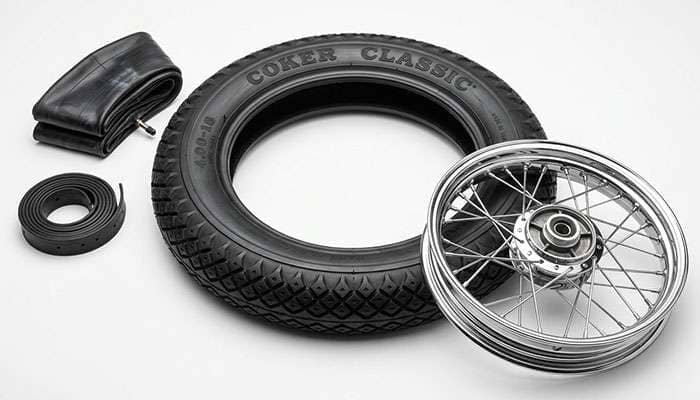
If you'd rather start from the full lineup, our vintage motorcycle tires page lists clincher, 16-, 18-, 19-, 20-, and 21-inch fitments in one place.
There's no single best classic motorcycle tire, but there is a best tire for your bike, and you find it in order: rim type, then original size and rim width, then a published rating that covers how you ride. Clinchers get reproduction clinchers. 1930s-to-1950s American iron gets period bias-ply like the Firestone ANS or Coker Classic Diamond Tread. 1960s and 1970s bikes get the widest choice, and the speed letter on the sidewall should break the tie.
If the price of period rubber surprises you, here's why vintage motorcycle tires cost what they do.
For the brand history behind these treads, see our collector's guide to authentic period rubber.
Five things to remember.
New reproduction tires in the correct size, mounted with new tubes and rim strips on a correctly sized rim, are safe for the riding they're built for. Old tires are a different story, so check the date code and sidewalls. For sustained highway speed, choose a tire with a speed letter that covers it.
Often, if the bike has drop-center rims and a modern tire exists in an equivalent size for your rim width. Beaded-edge clincher rims can't take modern tires at all. Keep the overall diameter close to original and run the same construction front and rear.
Almost all spoked classic rims need a tube and a rim strip, because spoke nipples pass through the rim bed and the rim isn't airtight. Beaded-edge clinchers also depend on tube pressure to stay on the rim.
Big twins of the 1930s ran mostly on 18- and 19-inch wheels in sizes such as 4.00-18, 4.50-18, and 4.00-19. Sixteen-inch wheels started appearing around 1940, and 5.00-16 became the signature big-twin size. Smaller 1950s models used sizes such as 3.25-19 and 3.50-18.
Not unless the motorcycle manufacturer approved that combination. Radial and bias-ply casings flex, corner, and damp differently, so mixing them makes the two ends of the bike behave differently. On a classic, keep both ends the same construction.
There's no federal age limit. NHTSA's tire aging advisory points owners to tire and vehicle maker recommendations, which range from six to ten years from manufacture. Read the last four digits of the DOT code for the week and year, and replace sooner if you see cracking or hardened rubber.