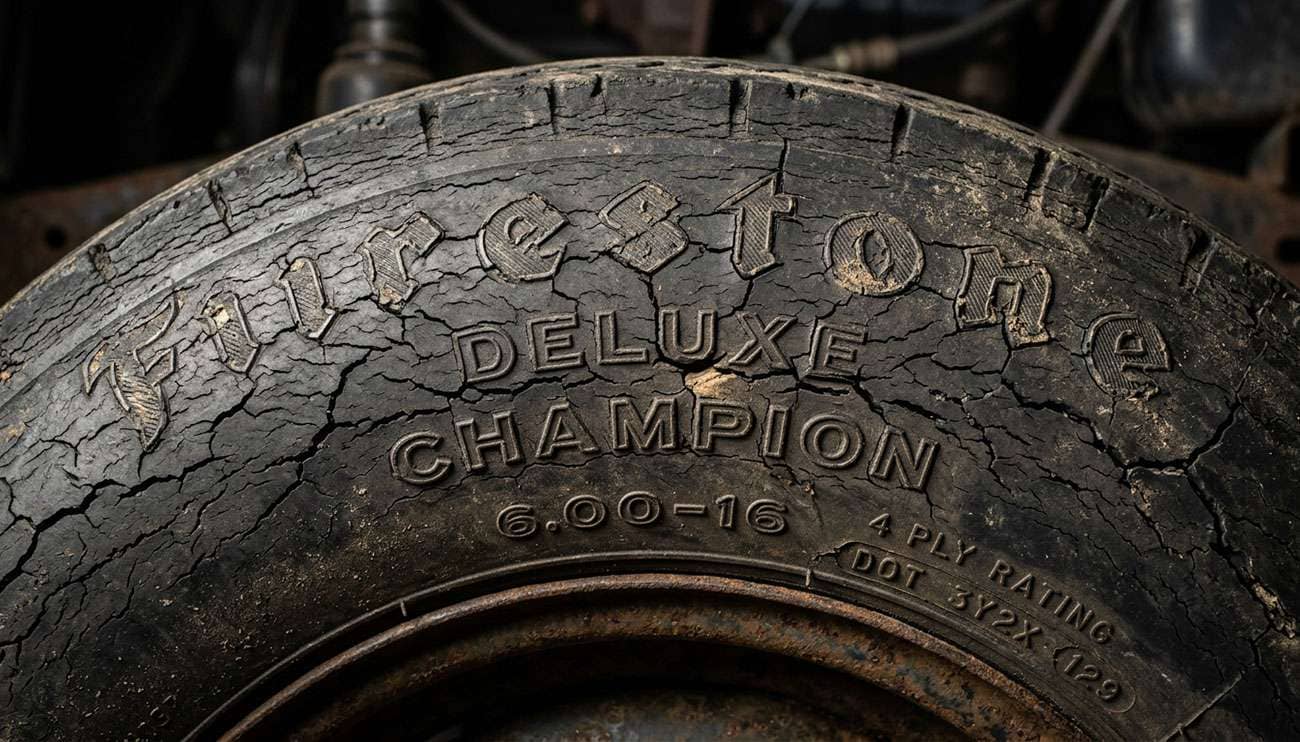
Here's the uncomfortable truth that a lot of classic car owners don't want to hear: a tire can look perfectly fine on the outside and still be dangerously close to failure. Tread depth doesn't tell the whole story. Age does. Rubber compounds deteriorate from the inside out, and a tire that's been sitting in a garage for 15 years — even one that's never been driven on — can be as unsafe as a bald tire on a highway. If you've got a classic car, antique vehicle, or project build that's been sitting for any length of time, the tires deserve serious scrutiny before you take it anywhere near public roads.
Tire rubber is not static. From the moment a tire is manufactured, a slow chemical process called oxidation begins breaking down the rubber compounds and polymers that give the tire its strength and flexibility. Heat, UV exposure, ozone, and oxygen all accelerate this process — and there's no way to stop it. A tire that looks fine to the naked eye may have internal structure that's compromised enough to fail under load, at speed, or in a turn.
Most drivers are conditioned to check tread depth as the primary safety indicator. For vintage tires, tread is almost irrelevant compared to age. A tire with full tread depth but 20 years of age is far more dangerous than a slightly worn tire that's two years old. The rubber loses elasticity, the internal cords weaken, and the bond between the rubber layers deteriorates — all without visible external warning. When these tires fail, they fail suddenly. Blowouts. Sidewall separation. Tread separation at highway speed. These are not gradual failures you'll feel coming — they happen instantly.
Many classic car owners assume that a tire kept in a climate-controlled garage, stored indoors, or rarely driven on is somehow exempt from age-related degradation. It isn't. Oxidation happens regardless of use — in fact, a tire that's been sitting stationary can develop flat spots, ozone cracking, and sidewall brittleness faster than one that's regularly driven at moderate distances. Driving actually helps circulate the oils and polymers within the rubber compound. Storage doesn't preserve tires — it just slows certain types of wear while other degradation processes continue.
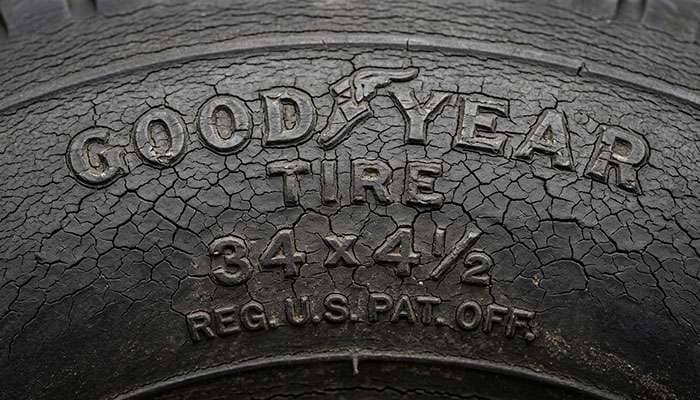
Every tire manufactured after 2000 has a DOT code molded into the sidewall that includes a four-digit week-and-year code. Knowing how to read it is essential for any classic car owner evaluating whether their tires are safe to use.
Look for the letters "DOT" on the sidewall, followed by a series of letters and numbers. The last four digits of the full DOT code are what you're looking for — this is the date code. The first two digits indicate the week of manufacture, and the last two indicate the year. A code reading 2318 means the tire was manufactured in the 23rd week of 2018. If you see only three digits at the end of the DOT code, the tire was manufactured before 2000 — those tires are using a different, older coding system and should be considered well beyond their safe service life regardless of condition.
Most major tire manufacturers and automotive safety organizations use the following guidelines as outer limits for tire service life:
Tire Age | Recommended Action | Risk Level |
|---|---|---|
Under 6 years |
Safe for normal use if tread and condition are good |
Low |
6–10 years |
Inspect carefully; replace if any degradation is visible |
Moderate — inspect before every drive |
Over 10 years |
Replace immediately regardless of tread or appearance |
High — do not drive on public roads |
Unknown age (no DOT) |
Replace immediately |
Very High |
These are maximums, not targets. A tire that's 8 years old with visible sidewall cracking should be replaced today — not at year 10. The age limits assume a tire in good condition with no visible degradation. Any visible deterioration moves the timeline up significantly.
Before putting any vintage or stored vehicle on public roads, every tire needs a thorough physical inspection. You're looking for specific types of deterioration that indicate the tire is no longer safe regardless of age. Get down low, check all four corners, and don't rush this.
Fine surface cracks in the sidewall rubber — sometimes called "checking," "crazing," or dry rot — are one of the most visible signs of age-related degradation. Small, hairline surface cracks are a yellow flag; they indicate oxidation is actively occurring. Deep cracks, cracks that run in multiple directions, or cracks that you can see into are a hard stop — that tire needs to come off the vehicle before it moves. Pay special attention to the area where the sidewall meets the tread and where the sidewall meets the bead. These are high-stress areas where cracks initiate failures.
Run your finger across the tread blocks and between the grooves. If the rubber feels hard and brittle rather than slightly pliable, the compound has lost its elasticity. Visible cracking in the tread grooves — not just at the surface but down into the groove walls — is a serious warning sign. This type of deterioration significantly increases the risk of tread separation, especially at highway speeds or when the tire heats up under load.
Any bulge, bubble, or visible deformation in the sidewall indicates internal damage — typically a broken or separated internal cord. This is an immediate replacement situation, full stop. A sidewall bulge is a blowout waiting to happen and can fail without any additional warning. If you find one on a classic car that's been sitting, don't move the vehicle until the tire is replaced.
Tires that have been stationary for long periods — months or years — often develop flat spots where the tire contacted the floor. Minor flat spots sometimes work themselves out after a few miles of driving as the tire warms up. Severe flat spots, especially on older or harder rubber compounds, may be permanent and cause persistent vibration and uneven wear. If the vibration doesn't resolve after 10–15 miles of careful driving, the tire should be replaced.
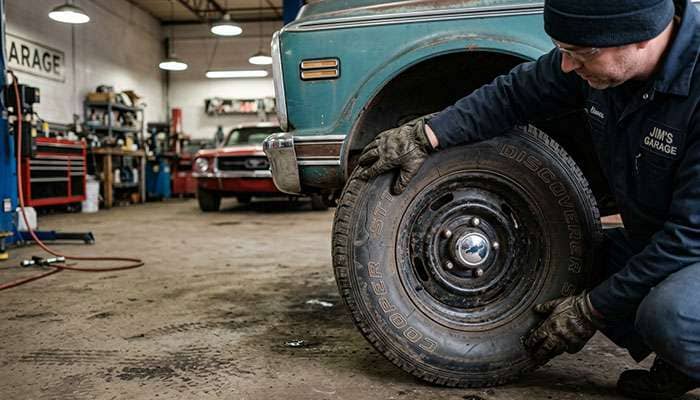
Bias-ply tires — the construction type original to most pre-1970s vehicles — have specific safety characteristics that differ from modern radials. Understanding these differences matters if you're running period-correct tires on a classic car that actually gets driven.
Bias-ply tires run hotter than radials at highway speeds. The diagonal cord structure creates more internal friction, which generates heat — and heat is the enemy of tire longevity. Most original-spec bias-ply tires have speed ratings that top out well below modern highway speeds. Running a bias-ply tire at sustained 70+ mph generates heat loads it was never designed to handle. For show cars trailered to events this is a non-issue; for cars driven on highways, it's a real consideration. Keep speeds moderate, allow cooling breaks on long trips, and never push a bias-ply tire to its physical limits.
Bias-ply tires have a fundamentally different handling character — more sidewall flex, less precise steering response, and a different feel in corners. If you're accustomed to driving modern vehicles, the first time behind the wheel of a classic on bias-ply tires can be surprising. The car will feel less connected, more floaty, and will require more anticipation in corners. These aren't safety defects — they're design characteristics — but they do require adjusted driving style and expectations, especially in wet conditions where bias-ply wet-weather grip is significantly inferior to modern radials.
For classics that see regular road use, many owners opt for modern radial tires in period-correct sizes and sidewall styles. The classic tire category includes radials in authentic vintage sizes with whitewall and raised white letter sidewalls — so you get the look without sacrificing modern safety and performance. If your driving involves highways, regular road trips, or any situation where the car needs to perform in an emergency, radials are the safer choice.
Not every old tire is an immediate crisis. Context matters. A well-preserved, properly stored tire at 7 years old with no visible cracking used exclusively for slow-speed, short-distance show driving is a very different risk profile from the same tire being driven on a highway road trip. Here's how to think through the decision.
You should pull the tires off the vehicle and replace them before driving under any of these conditions: the tire is over 10 years old regardless of appearance; there are any sidewall bulges or deformations; cracking is deep, widespread, or visible in the tread grooves; you cannot locate a DOT date code; the tire was manufactured before 2000; or the rubber feels hard and brittle with no give when you press your thumb into the sidewall.
Tires in the 6–10 year range with only minor surface checking, no bulges, and supple rubber may be acceptable for limited, low-speed, short-distance use — such as driving onto and off of a trailer, moving the car within a private property, or slow-speed show events. They should not be used for highway driving or any situation requiring emergency handling performance. Inspect them before every use and replace them at the first sign of additional deterioration.
If you've determined your tires need replacing, the good news is that quality replacements are available in most common vintage sizes. Performance Plus Tire carries a wide range of antique tires in both bias-ply and radial construction, including whitewalls and raised white letter sidewalls in the sizes most commonly needed for classic and antique vehicles. For help cross-referencing your original vintage size to a currently available replacement, use the Antique/Classic Tire Size Conversion tool.
Vintage tires are one of the most underestimated safety risks on classic cars. The tread looks fine. The car hasn't been driven much. The tires are original to the build. None of that makes them safe. Rubber ages whether you drive on it or not, and a tire that fails at speed on a public road doesn't just put you at risk — it puts everyone around you at risk too. The 10-year rule is a ceiling, not a target. If your tires show any visible deterioration, act now, not later.
Replacing the tires on a classic car is one of the most impactful safety investments you can make, and it doesn't have to compromise authenticity. Quality bias-ply and radial tires in period-correct sizes and sidewall styles are available for nearly every commonly restored American vehicle. Browse the full selection at Performance Plus Tire and give your classic the rubber it deserves — so you can drive it with confidence instead of hoping for the best.
Here's what every classic car owner needs to remember about vintage tire safety.
• Age is the primary safety concern: Tread depth is almost irrelevant for vintage tires. A tire over 10 years old should be replaced immediately regardless of how good it looks.
• Storage doesn't prevent degradation: Rubber oxidizes whether a tire is driven or not. A garage queen with original tires is not automatically safe — it may be worse than a driven car due to flat spotting and surface hardening.
• Read the DOT date code: The last four digits of the DOT code tell you the week and year of manufacture. If you can't find a date code or the tire predates 2000, replace it immediately.
• Specific warning signs demand immediate replacement: Sidewall bulges, deep cracking, tread groove cracking, and brittle rubber are all hard stops — don't drive on tires showing these symptoms.
• Radials are a legitimate safety upgrade: Period-correct radial tires in vintage sizes offer meaningfully better safety, wet weather grip, and highway performance than original bias-ply tires while still looking correct on the car.
Most tire manufacturers and safety organizations recommend replacing any tire over 10 years old regardless of tread depth or appearance. For vintage cars that are driven on public roads, many experts recommend replacing tires at 6 years. Tires showing visible cracking, bulging, or brittleness should be replaced immediately regardless of age. When in doubt, the cost of new tires is far less than the cost of a blowout at speed.
No. Dry rot — the cracking and deterioration of aged rubber — cannot be repaired. Products marketed as "tire dressings" or "tire conditioners" can temporarily improve the appearance of a cracked tire but do not restore structural integrity or stop the underlying deterioration. A tire showing dry rot should be replaced. Using a conditioner to make an unsafe tire look better is a cosmetic fix that creates a false sense of security.
Not if they're old. An unused tire stored for 10+ years is just as compromised as a driven one of the same age — possibly more so, since the lack of driving means the rubber oils haven't been circulated and the tire may have developed flat spots and surface hardening. Zero miles on the odometer does not mean zero age-related degradation. Check the DOT date code and apply the same age-based replacement guidelines as any other tire.
Original bias-ply tires were typically rated for speeds well below modern highway limits — many vintage tires carried speed ratings equivalent to 75–85 mph maximum. More importantly, bias-ply tires build heat significantly faster than radials at sustained highway speeds, and heat is a primary cause of tire failure. For road driving on highways, limit speeds to 60–65 mph maximum with regular cooling breaks, and seriously consider upgrading to period-correct radials if your car sees regular road use above those speeds.
The full DOT code including the date is sometimes only molded on one side of the tire — the inner sidewall facing the vehicle. Safely raise and support the vehicle, then look at the inner sidewall for the complete DOT sequence ending in the four-digit date code. If you still cannot find a date code after checking both sidewalls, or if the code ends in only three digits (indicating manufacture before 2000), treat the tire as beyond its safe service life and replace it.