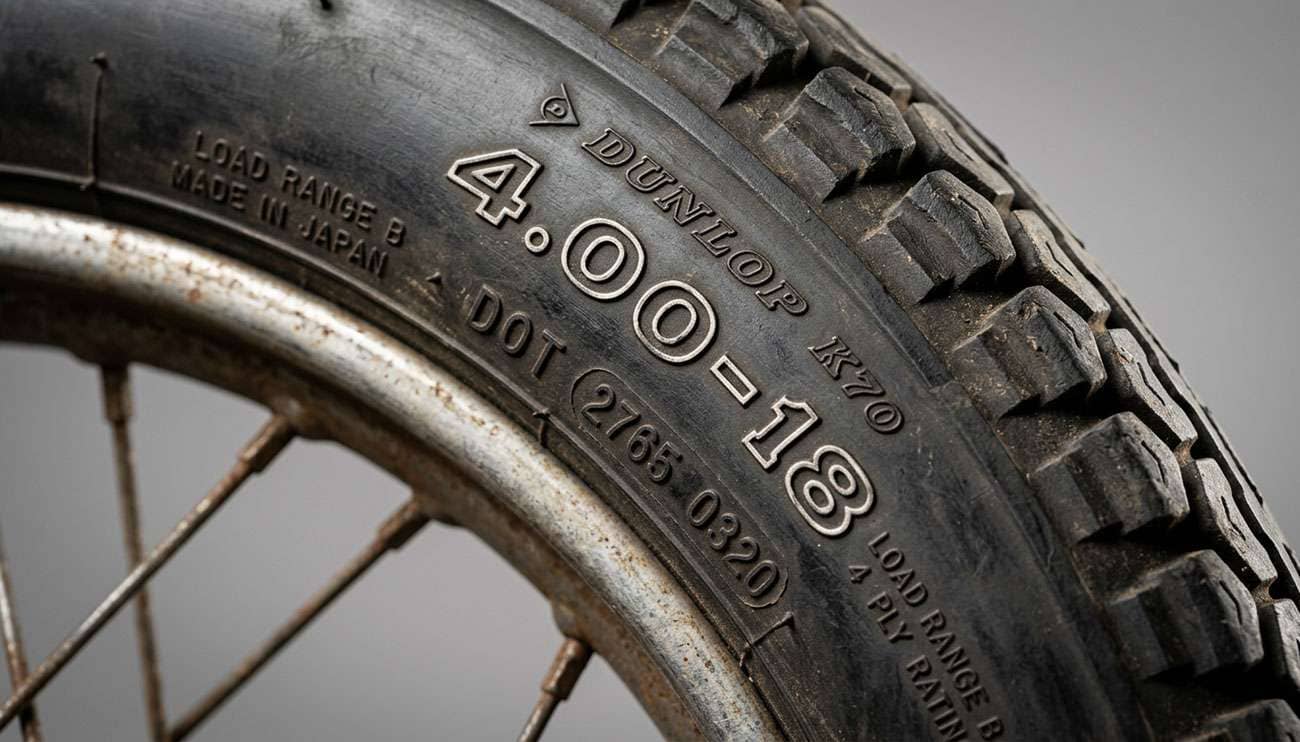
Pull a vintage motorcycle out of long-term storage and one of the first puzzles is the rubber. Your owner's manual calls for 3.50-19 front and 4.00-18 rear. Your dealer catalog from 1972 lists those sizes. But the tire shop's database wants 100/90-19 and 110/90-18. The Avon catalog lists the same tire as MJ90-19 and MN90-18. The Bridgestone equivalent is 90/90-19 and 110/80-18. Same wheel, same bike, four different sets of numbers, and none of them match the math you'd expect.
This isn't sloppy labeling. It's the result of three sizing systems being grafted onto a fourth over six decades of motorcycle history, each one trying to describe the same tire in a different way. If you know what each format encodes, you can shop confidently across catalogs, decades, and brands. If you don't, you end up running a tire that's the wrong overall diameter, the wrong profile for your rim width, or the wrong speed rating for your bike. This guide decodes every format you'll encounter on a vintage bike, with conversion references and the practical fitment notes that the catalogs leave out.
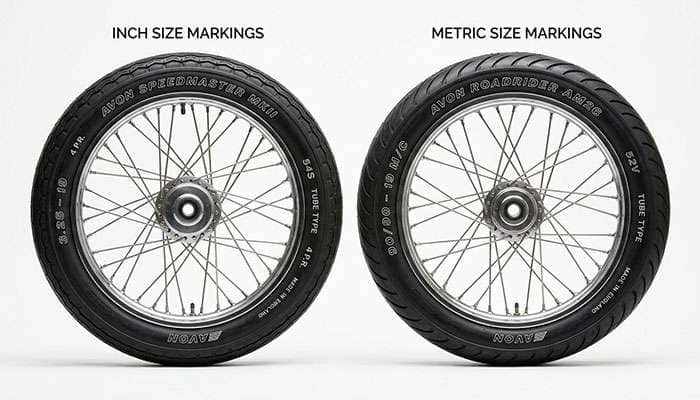
Four formats are in active use on vintage motorcycle tires. The order they appeared in roughly tracks the eras of the bikes you'll find them on.
System |
Example |
What It Encodes |
Era |
|---|---|---|---|
Standard Inch |
4.00-18 |
Width in inches, rim diameter in inches, ~100% aspect ratio assumed |
Pre-1970s |
Low-Profile Inch |
4.25/85-18 |
Width in inches, aspect ratio (82% default or 85% explicit), rim diameter |
1970s |
Alphanumeric (Alpha) |
MT90-16 |
M = motorcycle, letter = width code, aspect ratio, rim diameter |
Late 1960s through today on some Harleys |
Metric |
130/90-16 |
Width in millimeters, aspect ratio percentage, rim diameter in inches |
Mid-1980s onward, modern standard |
A vintage bike that left the factory with inch-marked rubber may now wear alpha or metric replacements, because the original size no longer rolls off any modern production line. Knowing how to translate between systems is what makes that swap work.
The oldest format you'll see on a classic motorcycle is two numbers separated by a dash. The first is the section width in inches. The second is the rim diameter in inches. Aspect ratio isn't called out, because in this system it's assumed to be approximately 100% — meaning the sidewall height is roughly equal to the width. The tire profile is essentially square in cross-section.
A 3.50-19 reads as 3.5 inches wide with about 3.5 inches of sidewall height, mounted on a 19-inch rim. A 4.00-18 is 4 inches wide with 4 inches of sidewall, on an 18-inch rim. A 5.00-16 — the dominant size on Big Twin Harleys from the 1930s through the early 1970s — is 5 inches by 5 inches on a 16-inch wheel.
This format dominated vintage British twins (BSA, Triumph, Norton), early Honda CBs, vintage Harleys, and most pre-1970s European bikes. Some inch-marked tires also include a speed rating letter inside the size string, like 3.50H19, where the H falls between the width and the rim diameter. The H is the speed rating, not part of the dimension.
The standard inch system is being phased out of new tire production. You can still buy genuine inch-sized tires from specialty makers — Coker, Firestone, Avon, Excelsior, Dunlop K70 — but for many sizes, your only path forward is finding the metric equivalent and verifying it fits your rim and your fender.
By the early 1970s, motorcycle handling expectations had moved past square-profile tires. Manufacturers wanted shorter sidewalls for better cornering and steering response. The low-profile inch system kept the inch-based width and rim measurements but added a non-100% aspect ratio.
The catch is that the aspect ratio is often invisible. A tire marked 4.25-18 with no second number is assumed to be 82% aspect ratio by default — meaning the sidewall height is 82% of 4.25 inches, or about 3.49 inches. If the manufacturer wanted to specify an 85% profile, they'd write it explicitly: 4.25/85-18, with sidewall height of about 3.61 inches.
This format had a short production window and is now genuinely rare on new tires. You'll mostly see it in vintage reproduction stock and the occasional off-road tire. If you have a bike from the mid-to-late '70s wearing low-profile inch rubber, expect to convert to metric for any modern replacement.
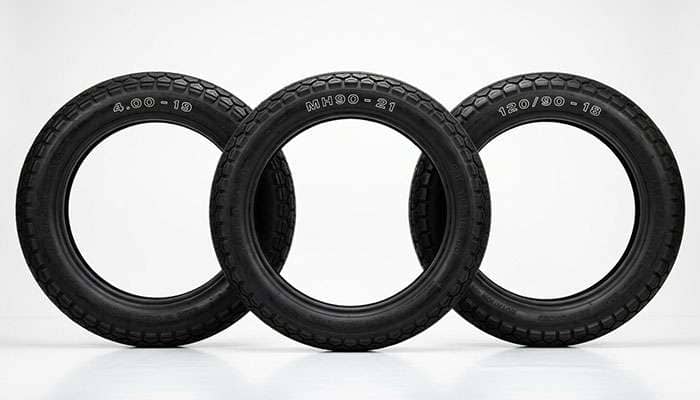
The alpha system was the bridge between inch and metric. It appeared in the late 1960s as a way to standardize tire sizing across an industry that was starting to globalize, and it's still used on some Harley-Davidson touring bikes and replacement tires today.
An alpha size like MT90B16 breaks down as four pieces:
So MT90B16 reads as a motorcycle tire, 130mm wide, with sidewall height 90% of 130mm (about 117mm), bias-belted construction, on a 16-inch rim.
The alpha system tops out around MV (150mm). Anything wider was developed after the system was already being replaced by metric, so wider tires use metric labeling exclusively. If you're shopping for a replacement on a vintage Harley touring bike, alpha-marked options will frequently appear next to metric equivalents in the same size — they're describing the same tire.
The metric system became the global standard by the mid-1980s and remains the default format on virtually every motorcycle tire sold today. Three pieces of data, separated cleanly:
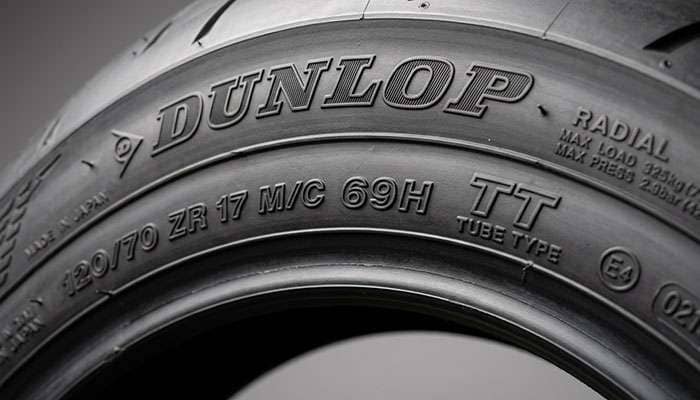
You'll often see additional codes in the metric size string. A construction letter (R for radial, B for bias-belted) typically falls between the aspect ratio and the rim diameter: 120/70R17 is a 120mm radial. A speed rating letter may appear immediately before the construction code (120/70ZR17 means Z-rated radial). After the size, you may see a load index and speed rating combination like (58W) — that's the load capacity number plus the speed rating.
For vintage motorcycle owners, the metric format is what you'll see on most modern replacement tires designed to fit classic bikes. Continental's ContiClassicAttack, Heidenau K34, Avon Roadrider MkII, and the bias-look radials from Autobahn all carry metric sizing even when designed specifically for vintage applications.
The chart below cross-references the most common vintage motorcycle tire sizes across all three modern formats. Use it as a starting point — verify final fitment against your rim width spec and clearance before buying.
Inch Size |
Metric Equivalent |
Alpha Equivalent |
Typical Use |
|---|---|---|---|
3.00-21 |
80/90-21 or 90/90-21 |
MH90-21 |
Vintage front, narrow rim |
3.25-19 |
90/90-19 or 100/90-19 |
MJ90-19 |
British twins, early Honda CB front |
3.50-19 |
90/90-19 or 100/90-19 |
MM90-19 |
Triumph, BSA, vintage Honda front |
3.50-18 |
90/90-18 or 100/90-18 |
MM90-18 |
Vintage Brit and Japanese mid-size |
4.00-18 |
110/90-18 |
MN90-18 |
Vintage rear, '60s-'70s standards |
4.25-18 |
110/90-18 or 120/90-18 |
MR90-18 |
Late '70s low-profile rear |
4.50-18 |
120/90-18 |
MR90-18 |
Vintage rear, larger displacement |
5.00-16 |
130/90-16 |
MT90-16 |
Vintage Harley Big Twin |
5.10-16 |
130/90-16 |
MT90-16 |
Vintage Harley Big Twin variant |
Two things to note about this chart. First, where two metric options are listed for one inch size, the lower aspect ratio (90/90 vs 100/90) gives you a closer match to the original overall diameter, while the wider option offers more rubber on the rim and a slightly modernized look. Second, alpha equivalents are exact translations of the metric width — MN90-18 always means 110/90-18, period.
Here's where the cross-reference chart starts arguing with the calculator. A 4.00-18 should convert to about 101.6mm wide (4 inches × 25.4 mm/inch). But every modern fitment guide tells you to replace a 4.00-18 with a 110/90-18, not a 100/90-18. The 110 is roughly 8mm wider than the math says it should be. What's going on?
Two answers. First, vintage tire dimensions were always nominal. Old 4.00-18 tires were spec'd to a target but actually measured anywhere from 4.25 to 4.6 inches wide depending on the manufacturer, the production batch, and what rim they were mounted on. The "4.00" was a label, not a precise measurement. The Bridgestone Spitfire S11 — the standard mid-size rear tire of the 1980s — measured 4.6 inches wide in a 110/90-18, which is exactly what those old "4.00" tires actually were in the real world.
Second, modern tire profiles are slightly different than vintage profiles, even at the same nominal dimensions. Modern compounds and casing constructions sit a touch differently on the rim, so a 110/90-18 mounted on a vintage 1.85-inch rim will measure pretty close to what an original 4.00-18 measured on the same rim back in 1972.
The practical conclusion is that you trust the cross-reference charts published by tire manufacturers (Bridgestone, Avon, and Continental all maintain them) over your own math. If a chart says 110/90-18 replaces a 4.00-18, that's the tire that will actually fit and feel right, regardless of what the conversion factor says. If you change overall diameter by more than a few percent, you'll throw off your speedometer accuracy and potentially your gearing feel — keep mounted OD within roughly 3% of the original to avoid those problems.
Beyond the size itself, vintage motorcycle tires carry additional codes that matter for both safety and fitment. The most important are speed rating, load index, and construction.
Speed rating is a single letter that indicates the maximum sustained speed the tire is designed to handle. The most common ratings on vintage motorcycle tires are J (62 mph / 100 km/h), S (112 mph / 180 km/h), H (130 mph / 210 km/h), V (149 mph / 240 km/h), and Z (149+ mph / 240+ km/h). On inch-marked tires, the speed rating is often embedded in the size string itself: 3.50H19. On alpha and metric tires, it appears just before the rim diameter or as part of a load/speed index after the size.
Load index is a number that codes the tire's maximum carrying capacity. You'll see it on modern replacement tires for vintage bikes as part of a service description like (58W), where 58 is the load index and W is the speed rating. Vintage tires often used a ply rating (4PR, 6PR) in place of a load index. The two systems aren't directly equivalent, but the spec from your motorcycle's owner's manual tells you what minimum load capacity you need.
Construction codes are a single letter indicating how the tire is built. R is radial. B is bias-belted (cross-ply with stabilizing belts under the tread). A dash or no letter means standard bias-ply. Most vintage motorcycles were designed around bias-ply construction, and many vintage owners prefer the ride feel and sidewall stability that bias-plies provide. Bias-belted hybrids and "bias-look radials" — radials with a tread pattern designed to look period-correct — are increasingly common as a compromise between authentic appearance and modern grip.
TT and TL markings tell you whether the tire is built for tube-type or tubeless service. Vintage spoked rims almost always require tubes, regardless of what the tire is rated for. Mounting a tubeless-rated tire on a tube-type rim still requires a tube. The reverse — mounting a tube-type tire tubeless — is not safe and not recommended.
M/C designation simply means the tire is built for motorcycle use. Some sidewalls include this marking explicitly; others omit it because the size format itself already implies motorcycle service.
If you don't have your owner's manual or factory specs handy, the table below covers the typical OEM sizing for the most common vintage motorcycle categories. These are starting points — always verify against your specific year and model before buying.
Bike Category |
Typical Front |
Typical Rear |
|---|---|---|
Pre-WWII American (Indian, vintage Harley) |
4.00-18 or 4.50-18 |
4.00-18 or 4.50-18 |
Vintage Harley Big Twin (1936-1973) |
5.00-16 |
5.00-16 |
British twins (Triumph, BSA, Norton, 1950s-1960s) |
3.25-19 or 3.50-19 |
3.50-19 or 4.00-18 |
Vintage Honda CB (1960s-early 1970s) |
3.25-19 |
3.50-18 or 4.00-18 |
Vintage Japanese mid-size (mid 1970s) |
3.50-19 or 100/90-19 |
4.00-18 or 110/90-18 |
Late Shovelhead and FX models (1976-1984) |
MT90-19 (130/90-19) |
MT90-16 (130/90-16) |
Plenty of vintage tire sizes are still produced new — 5.00-16, 4.00-18, 3.50-19, and most of the British and American standards remain available from Coker, Firestone, Avon, Indian, and a handful of specialty brands. But some sizes have genuinely fallen out of production, and the conversion process gets more involved.
The first principle is to maintain the original mounted overall diameter as closely as possible. Changes to OD beyond about 3% will throw off your speedometer accuracy, alter your effective gearing, and can mess with your bike's handling balance. The cross-reference chart above gives you a starting point, but you should also calculate the OD of any candidate replacement against the original spec.
The second principle is to verify the replacement size fits your rim width. Vintage spoked rims are narrow by modern standards — typically 1.60, 1.85, or 2.15 inches wide. A modern metric tire designed for a wider rim will sit with a flattened profile on a narrow vintage rim, with the contact patch crowning up more than the tire was designed for. Most tire manufacturers publish rim width charts that specify the acceptable range for each size; stay inside that range and the profile will look right.
Third, check fender, chain, and fork clearance with the replacement size before you commit. A wider tire that technically fits the rim may rub a fender stay at full compression, contact the chain on the drive side, or bind on the swingarm at full lock. Test these clearances with the bike on the ground, fully loaded, with the steering at full lock both ways.
Performance Plus Tire stocks vintage motorcycle tires across all the major formats — bias-ply originals like the Coker Classic Motorcycle 5.00-16, the Avon SpeedMaster MkII 4.00-18, the Firestone Zig Zag M/C, and the Indian INDIAN Script Motorcycle in both 5.00-16 and 4.00-18, plus modern bias-look radials like the Autobahn Bias Look Radial 5.00-16 for owners who want vintage appearance with modern construction. The full Vintage Motorcycle Tires catalog is the place to start when you know your size, and the Antique Tires section covers pre-1940s applications. If you're working through a broader vintage build that includes the rest of the bike's rubber, our vintage motorcycle tires safety guide covers the construction and aging issues that affect all vintage rubber, and the collector's guide to authentic period rubber walks through the period-correct options brand by brand.
For deeper context on related sizing topics, the antique tire sizes decoded piece does for vintage automotive what this article does for motorcycles, and the vintage tire speed ratings article covers the speed rating letter codes in more depth. If you're considering a bias-look radial as your replacement, the bias-look radial tires guide explains the construction trade-offs in detail. And the most popular vintage tire sizes overview is worth a read for context on which sizes have stayed in production and which haven't.
A 3.50-19 is a standard inch-system size. The 3.50 is the section width in inches (3.5 inches across the tread when mounted and inflated). The 19 is the rim diameter in inches. Aspect ratio is not specified because it's assumed to be approximately 100% — meaning the sidewall height is roughly equal to the width. The closest modern metric equivalent is 90/90-19 or 100/90-19, depending on the desired profile.
Yes, the 110/90-18 is the standard modern replacement for a 4.00-18, and it's the substitution recommended by most tire manufacturer cross-reference charts. The pure math suggests 100/90-18 would be closer (100mm equals about 3.94 inches), but vintage 4.00-18 tires actually measured closer to 4.6 inches wide in real-world fitment, which matches what a modern 110/90-18 delivers. Verify the 110/90-18 is approved for your rim width and clears your fender and swingarm before installing.
MT90-16 is an alphanumeric (alpha) size. The M means it's a motorcycle tire. The T is the width code, which translates to 130mm. The 90 is the aspect ratio percentage — sidewall height equals 90% of width. The 16 is the rim diameter in inches. MT90-16 is identical in dimensions to 130/90-16 in metric format. This size is most commonly found on Harley-Davidson touring bikes from the 1980s onward.
Most vintage spoked rims require inner tubes regardless of whether the tire itself is rated TT (tube-type) or TL (tubeless). Spoked rims have spoke nipples that pierce the rim well, which prevents the rim from holding air pressure on its own. Some later vintage rims with sealed beads or specifically rated tubeless construction can run without tubes, but you should verify the rim's tubeless rating before relying on it. Mounting a tube-type tire as tubeless is not recommended under any circumstances.
Match or exceed the speed rating specified by your motorcycle's manufacturer. Most vintage cruisers and touring bikes were spec'd for S (112 mph) or H (130 mph) ratings. Vintage British twins and Japanese standards typically called for H or V (149 mph). Pre-war and early postwar bikes often used J-rated (62 mph) or unrated tires consistent with their lower top speeds. Going to a higher-rated tire than original is always safe; going lower is not. Check your owner's manual or a marque-specific reference for the exact spec.
The alpha system was developed in the late 1960s, when motorcycle tires didn't get much wider than MV (150mm). By the time bikes started running 160mm, 170mm, and 180mm rear tires in the 1990s and beyond, the metric system had already replaced alpha as the industry standard. Wider modern tires were never assigned alpha codes. If you see an alpha-marked tire, it will always be 150mm or narrower. Anything wider on your bike will be metric-marked exclusively.
Bias-ply tires match the construction your vintage motorcycle was designed around, providing the original ride feel, sidewall stability, and handling balance. Radials offer better grip, longer tread life, and more compliance over rough surfaces, but they can change how the bike steers and corners compared to original spec. Bias-look radials are a compromise — radial construction underneath, vintage tread pattern on top — and have become popular as a way to get modern grip without abandoning period appearance. The right choice depends on whether you prioritize originality, daily-driver performance, or aesthetics.