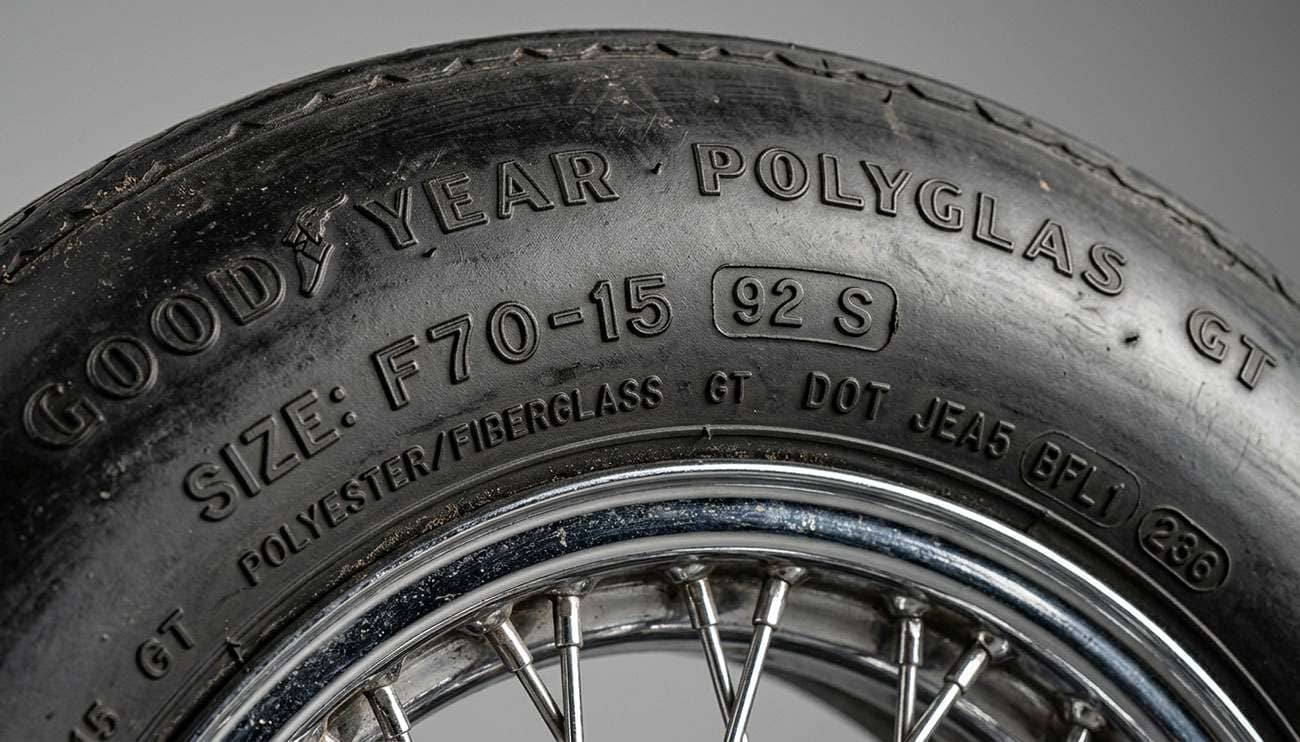
Modern drivers make a reasonable assumption: any tire sold in the United States today will handle whatever speed the car can reach. On a 2026 passenger car with Z-rated rubber, that assumption is correct. On a 1968 muscle car with period-correct bias-ply tires, that same assumption is dangerously wrong. Classic car tires were rated — and engineered — for a narrower speed envelope than modern rubber, and the "don't run them above 85 miles per hour" rule of thumb that gets passed around in classic car circles comes from real tire physics rather than generational caution.
The engineering reasons behind vintage tire speed limits trace back to construction methods, compound chemistry, and thermal limits that no longer apply to modern radial tire technology. When today's classic car owner bolts on reproduction bias-ply tires, or when the owner of an unrestored survivor car runs decades-old original rubber down the interstate, the physics of the 1960s comes along for the ride whether the driver realizes it or not.
Here's the full picture — how vintage speed ratings were established, what they meant in period, what they mean on modern reproduction tires, and how to interpret the codes on a sidewall today.
A tire speed rating is fundamentally a thermal limit. As a tire rotates at highway speed, internal friction generates heat. The rubber compound, the nylon or polyester cap layer, and the steel or fabric belt package all heat up as rotation accelerates. The speed rating represents the maximum continuous speed at which the tire can sustain operation without the internal components reaching temperatures that cause structural failure.
Modern speed ratings are verified through standardized laboratory testing. A tire is mounted on a simulated roadway, loaded to rated capacity, and run at progressively increasing speeds for controlled durations. The rating assigned is the maximum sustained speed at which the tire passes the full test protocol without failure, deformation, or damage. For more detail on the modern system, our article on tire speed rating explained walks through the letter codes.
Three things drive the speed rating:
Heat buildup resistance. Compound formulations that resist thermal breakdown at sustained high temperatures. Modern compounds incorporating silica and synthetic polymers resist heat far better than period-correct 1960s natural rubber formulations.
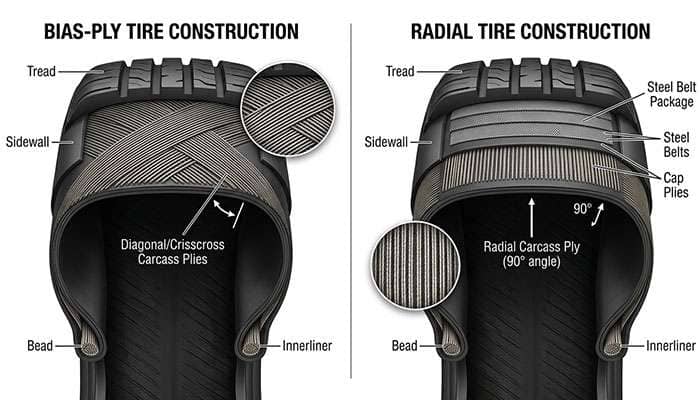
Internal construction integrity. The belt package, cap layer, and bead construction must resist the centrifugal forces that try to throw the tire apart at high RPM. Modern radial construction with steel belts and nylon cap plies handles these forces much better than vintage bias-ply construction with fabric cord layers.
Sidewall stability. At high speed, tire sidewalls flex with every revolution. Excess flex generates heat and eventually causes fatigue failure. Modern low-profile radial sidewalls flex less and therefore run cooler than tall bias-ply sidewalls at the same speed.
All three factors weighed against vintage tire construction by design.
The modern letter-based speed rating system (S, T, U, H, V, W, Y, Z) is a later standardization. Pre-1970 American passenger car tires often carried no letter speed rating at all, or used an earlier rating convention that mapped roughly as follows:
No rating stamped. The majority of passenger car tires produced through the 1960s carried no speed rating code. This did not mean the tires had no speed limit — it meant the industry had not yet standardized a consumer-facing rating system. Manufacturers published separate technical specifications for their products, but the sidewall simply did not show a speed rating letter.
S rating (later adoption). When the letter system standardized in the late 1960s and early 1970s, the S rating was assigned to tires capable of 112 mph sustained speed. Many period performance tires from the 1970s — Firestone Wide Ovals, Goodyear Polyglas GTs, BFGoodrich Radial T/As — carried S ratings once the system was in place.
T rating. Assigned to tires capable of 118 mph. Common on performance-oriented passenger cars of the late 1970s and early 1980s.
H rating. 130 mph capability. Appeared on high-performance tires during the late-1970s and 1980s transition period as radial technology matured.
The practical reality for a classic car owner is that most pre-1975 passenger car tires operated in what we would now call the S rating range or lower, regardless of whether a code was stamped on the sidewall. The engineering capability of the tire was the constraint, not the labeling convention.
Compounding the issue: even S-rated vintage tires were rated for short bursts at the quoted speed, not for continuous highway cruising at that pace. A 112-mph-rated 1970 Firestone Wide Oval could theoretically touch 112 mph for brief intervals under controlled conditions. Running the same tire at 95 mph for an hour on a hot summer day was a different matter entirely, and represents the kind of real-world duty cycle that caused tire failures in the era.
The specific limitation of pre-1975 tire technology is bias-ply construction itself. Bias-ply tires use internal cords that run diagonally across the tire, layered in opposing directions. This construction was strong, stable at moderate speeds, and well-suited to the road conditions and driving speeds of the 1940s through 1960s. It has specific thermal and structural weaknesses at higher speeds that modern radial construction does not share.
At sustained highway speeds, bias-ply tires exhibit several failure-mode precursors:
Sidewall and tread flex as one unit. Unlike radial construction, where the sidewall and tread package flex independently, bias-ply construction couples the two. This means sidewall flex contributes directly to tread heating, and tread flex contributes directly to sidewall heating. The combined thermal load at high speed accumulates faster than a radial tire would show.
Standing waves at high speed. Above roughly 80 to 90 mph on bias-ply tires, a phenomenon called the standing wave becomes visible. The tire physically deforms just behind the contact patch into a wave pattern that travels around the tire circumference. This is structural failure in progress — the wave generates substantial heat, the cords begin working harder, and the tire will rapidly progress to belt separation or catastrophic failure if speed is sustained.
Cord fatigue accumulation. The diagonal cord construction works each cord differently as the tire rotates. At higher speeds, this differential working accelerates, and cord fatigue begins accumulating on a timescale that can produce failure within minutes of exceeding the tire's thermal and structural envelope.
Our article on the construction difference at bias-ply vs. radial tires for classic cars covers the full construction breakdown, and the hidden engineering behind tire evolution from bias-ply to modern radials goes deeper on the technology shift.
Three specific failure modes account for the vast majority of vintage tire failures caused by exceeding the speed rating.
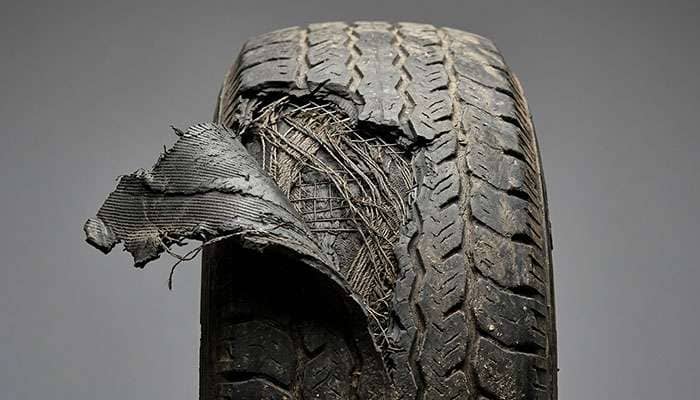
Tread separation. The outer tread layer of the tire partially or completely separates from the underlying belt or cord package. Feels like an immediate severe vibration followed by the sound of tread slapping the wheel well. Drivers typically have enough warning to slow and pull over before complete failure, but the tire is destroyed and the wheel well and fender can suffer damage.
Belt separation. The belt package inside the tire — the cords that hold the tire's shape — pulls apart or delaminates from the rubber. Produces severe vibration, often accompanied by a distinct rhythmic thumping. Can progress to blowout if not addressed immediately.
Sidewall blowout. Complete catastrophic failure of the tire sidewall. Typically accompanied by rapid air loss, loss of vehicle control, and significant damage to the wheel and surrounding bodywork. This is the failure mode that puts drivers at serious risk.
Our article on tire sidewall damage covers the visual indicators of developing sidewall failure. On vintage tires, these indicators often appear with very little warning before catastrophic failure, which is why the speed rating limit is a hard safety boundary rather than a conservative suggestion.
The "keep it under 85" guideline that circulates in classic car communities has three specific origin points.
Bias-ply thermal safety margin. On a typical pre-1975 bias-ply tire, sustained operation at 85 mph produces thermal load comfortably within the tire's design envelope. Operation at 95 mph or higher pushes closer to the thermal ceiling on a hot day, and 100+ mph approaches the failure threshold. The 85 mph figure is a conservative engineering rule-of-thumb that leaves headroom for variables like ambient temperature, pavement heat, tire age, and load conditions.
Pre-1975 chassis design. American passenger cars from the 1950s and 1960s were engineered for comfort at moderate highway speeds. Steering geometry, suspension damping, and aerodynamic characteristics typically performed well below 85 mph but became progressively less stable above that threshold. The 85 mph rule reflects chassis limitations as much as tire limitations — even a modern radial on a 1963 Impala frame will produce disquieting handling at 100 mph.
Vintage tire age reality. A tire stamped with an S rating in 1972 is not an S-rated tire in 2026 even if the tread looks adequate. Aging reduces a tire's practical speed capacity far below its original rating. An S-rated vintage tire with 50 years on it may not safely handle 75 mph on a hot summer day, regardless of what the sidewall says. The 85 mph rule accommodates this reality by treating vintage-era tires conservatively relative to their original ratings. Our breakdown on whether vintage tires are safe to use covers the age-reduction factor.
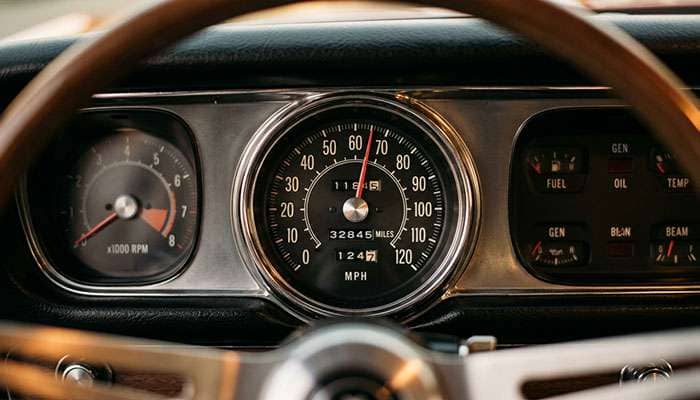
One of the more confusing aspects of vintage tire speed ratings is that classic car speedometers often read much higher than the tires were ever rated to handle. A 1967 Chevrolet SS 396 speedometer shows 120 mph. A 1970 Plymouth Road Runner shows 150. A 1969 Corvette reads 160. The factory tires that came on those cars? S-rated at best, typically lower.
This mismatch is deliberate. Speedometer scales were designed with style and market positioning in mind, not as indications of what the car could safely sustain. A speedometer that topped out at 90 mph would have signaled "economy car" in the showroom. A 140 mph speedometer on a muscle car communicated performance positioning regardless of whether the chassis, tires, or engine actually supported that speed in sustained operation.
For modern classic car owners, the takeaway is simple: ignore the speedometer when thinking about vintage tire speed limits. The tire is the limiting factor. If the speedometer reads 120 mph and the tires are S-rated bias-ply from 1972, the car's safe sustained cruising speed is nowhere near what the dashboard suggests.
Modern reproduction tires with vintage styling are a different matter. These tires use contemporary construction methods — often radial, sometimes bias-look radial, rarely true bias-ply — and carry contemporary speed ratings. The sidewall styling may be period-correct, but the internal engineering is typically 2020s technology.
Typical speed ratings on contemporary vintage-style tires:
The advantage of modern radial construction in vintage styling is substantial for practical highway use. A classic car running a modern T-rated radial-construction whitewall tire can safely cruise at 80 mph where the same car on authentic bias-ply reproductions would be approaching its thermal ceiling. For daily-driven classics, the modern radial option is the responsible safety choice.
Contemporary vintage-style tires will carry a modern speed rating code somewhere on the sidewall, typically as part of the size and service description string. Here's how to find and interpret it.
Size string format. The size typically reads something like "215/75R15 95T" or "P215/75R15 95S." The letter at the end of the service description is the speed rating.
Common ratings on vintage-style tires:
Unrated tires. Authentic bias-ply reproductions and some specialty low-volume tires may not carry a modern letter rating. In these cases, consult the manufacturer's specification sheet for the recommended maximum sustained speed. Assume anything unrated is in the S category or below, and plan driving speeds accordingly.
Our article on how to read tire ratings covers the full sidewall code breakdown including load index, size convention, and date codes alongside speed rating.
Here's the practical speed capacity comparison across vintage and vintage-style tire categories.
Tire Type |
Typical Speed Rating |
Recommended Max Sustained Speed |
|---|---|---|
Period-correct bias-ply reproduction (Coker Classic Bias-Ply, Firestone reproductions) |
Often unrated or S |
85 mph or lower, shorter bursts only above 75 mph |
Bias-look radial (American Classic, Coker Classic Radial) |
S to T |
90 to 100 mph under normal conditions |
Narrow whitewall radial (Diamond Back, Coker Classic Radial) |
S to T |
90 to 100 mph under normal conditions |
Wide whitewall radial |
S to T |
90 to 100 mph under normal conditions |
BFGoodrich Radial T/A and similar RWL performance classics |
S, T, or H depending on size |
100 to 120 mph depending on specific rating |
Modern blackwall radial in classic size |
T, H, V, or higher |
Matches the rated figure under normal conditions |
Note that "recommended max sustained speed" assumes reasonable ambient temperature, properly inflated tires, correct load range for the vehicle, and good tire condition. Hot days, underinflation, overloading, or aged rubber all reduce effective speed capacity below the table values.
Practical guidance based on how you use the car.
Concours restorations with authentic bias-ply. Cruise at 65 mph maximum, never push above 75 mph even briefly. These cars are typically trailered or driven short distances between shows, which fits the tire capability. The authenticity benefit and show value justify the speed limitation.
Weekend driven classics with vintage-style radials. 75 to 80 mph sustained cruising is realistic on modern S or T-rated vintage-style tires. Treat the speed rating as a ceiling, not a target, and leave 15 to 20 percent margin for real-world conditions.
Daily driven classics on modern tires. Whatever the speed rating on the installed tires supports, with the understanding that the vehicle's chassis, brakes, and steering may have their own limitations that argue for driving below the tire ceiling regardless.
Survivor cars with original-era rubber. Do not drive at highway speeds. Tires that spent 40+ years mounted to a vehicle have accumulated enough aging, compound breakdown, and structural fatigue that they should be treated as collector artifacts rather than functional road tires. Replace with modern reproduction tires before any meaningful road use. Our replacement checklist for classic car tires covers this decision point.
Vintage tire speed ratings represent real engineering boundaries rather than cautious industry opinion. Pre-1975 American passenger car tires operated within thermal and structural envelopes that modern radial technology has long since moved past, and the 85 mph rule of thumb that's been passed down through classic car culture accurately represents the sustained-speed capacity of period-correct bias-ply rubber.
Modern vintage-style tires changed the math substantially. Radial construction with vintage appearance allows today's classic car owner to run period-correct styling with meaningfully better speed capacity, handling, and thermal reserve than the authentic original would have delivered. For daily-driven classics, this is the responsible safety choice.
The one fact to remember: the speedometer scale on a 1960s muscle car was never an indication of safe sustained speed on period-correct rubber. The tire is the limit, and knowing what the tire can actually handle is the starting point of safe classic car driving. For vintage-correct tires at every speed-rating tier — from concours-grade authentic bias-ply to modern T-rated radial-construction classics — visit Performance Plus Tire.
Most pre-1970 American passenger car tires carried no speed rating on the sidewall because the letter-based rating system had not yet standardized. When ratings began appearing in the early 1970s, the most common rating on performance-oriented tires was S (112 mph). Many standard passenger tires would have rated below S if tested against modern criteria. Authentic bias-ply reproductions sold today are often unrated for speed in the modern sense.
The 85 mph guideline reflects three stacked factors: bias-ply tire construction produces standing wave deformation and accelerated thermal buildup above this threshold; pre-1975 chassis geometry and suspension damping become progressively unstable at higher speeds; and aged vintage tires have reduced effective speed capacity below their original rating. Modern vintage-style radial tires handle higher sustained speeds comfortably, so this rule applies specifically to period-correct bias-ply rubber.
Three primary failure modes develop: tread separation, where the tread layer partially or completely separates from the belt package; belt separation, where internal structural cords delaminate from surrounding rubber; and sidewall blowout, where complete catastrophic tire failure produces rapid air loss and potential loss of vehicle control. On vintage bias-ply tires these failures typically develop with little visual warning, making speed rating limits hard safety boundaries rather than conservative suggestions.
Yes, typically meaningfully higher. Modern radial-construction tires with vintage styling commonly carry S (112 mph) or T (118 mph) ratings, with some performance-oriented classics like the BFGoodrich Radial T/A available in H-rated (130 mph) variants. Authentic bias-ply reproductions retain the lower speed capacity inherent to bias-ply construction regardless of modern manufacturing improvements.
Look at the tire size string on the sidewall, typically formatted as something like "215/75R15 95T" or "P215/75R15 95S." The letter at the end of the service description is the speed rating. Pre-1970 tires may not have a letter code; in those cases, assume S-category capacity or lower, and treat the tire as suitable for sustained speeds below 85 mph. Authentic bias-ply reproductions often carry manufacturer specifications that recommend specific sustained speed limits even when no letter rating is molded into the sidewall.
Yes, modern H-rated or higher tires allow higher sustained speeds than period-correct rubber, but the chassis limits may still apply. A 1960s muscle car with updated modern tires can safely sustain speeds above 85 mph from a tire-capacity standpoint, but the original chassis geometry, steering system, brakes, and suspension damping were not engineered for sustained high-speed operation. For safe cruise-speed upgrades, pair modern tires with suspension improvements, modern shocks, and verified brake capacity.