
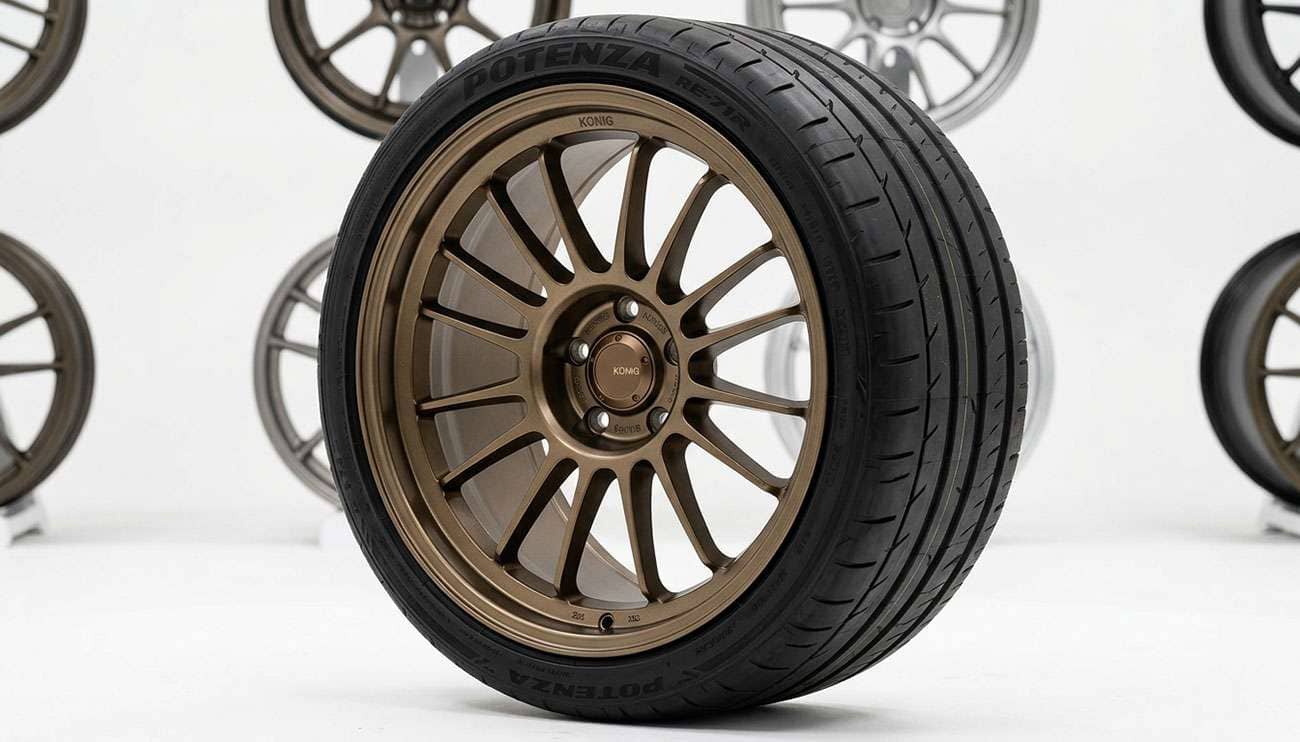
Look for one word on the spec sheet: flow formed. That single manufacturing method is what lets a wheel land under twenty pounds while still costing two hundred dollars instead of nine hundred. Konig's flow-formed line is where I send most people, and their Hypergram in a 15x7.5 comes in at 11.62 pounds for around $206. But here's the part nobody tells you at the counter: going up two inches in diameter costs you more weight than switching brands ever will.
I've been selling wheels on Cherry Avenue long enough to watch people agonize over which brand is lighter while ordering a size that adds six pounds a corner. Let me save you that. What follows is the mechanism that makes a cheap wheel light, real published weights rather than guesses, and an honest accounting of what you actually get for the trouble.
There are three ways to make an aluminum wheel, and the middle one is the reason this article exists.
Cast is molten aluminum poured into a mold. Cheapest to produce, and it makes up the overwhelming majority of wheels on the road. The grain structure is relatively loose, so to hit a given strength target the wheel needs more material, which means more weight.
Forged starts with a solid billet of aluminum squeezed under enormous pressure. The grain structure ends up dense and aligned, so you can hit the same strength with far less material. That's why forged wheels are light. It's also why they cost what they cost: the tooling and the press time are expensive, and every design needs its own dies.
Flow formed splits the difference, and it's clever. The wheel starts as a casting, but then the barrel gets spun on a mandrel while rollers press against it under heat and pressure. That process stretches and compresses the barrel material, aligning the grain structure much the way forging does, but only where it matters most. You end up with a barrel that has near-forged strength characteristics and a face that's still cast.
The result is a wheel that's meaningfully lighter and stronger than a straight casting, at a fraction of what forging costs. On a typical enthusiast size you're looking at several pounds saved per corner over a comparable cast wheel. That is the entire value proposition, and it's a real one. We went through the full manufacturing comparison in cast vs. forged vs. flow-formed wheels if you want to go deeper on the metallurgy.
So the shopping rule is simple. If the listing doesn't say flow formed, rotary forged, or flow forged, assume it's cast. Those first three terms all describe the same process under different marketing names.
Here's the table I wish more people saw before they ordered. These are published net weights straight from Konig's own fitment chart for the Hypergram, which is one line, one construction, one design. The only thing changing is size.
Size |
Bolt Pattern and Offset |
Published Net Weight |
Our Price |
|---|---|---|---|
15x7.5 |
4x100, +35 |
11.62 lbs |
$205.77 |
15x8.5 |
4x100, +25 |
12.67 lbs |
$219.80 |
16x7.5 |
4x100, +38 |
13.90 lbs |
$234.43 |
16x8 |
4x100, +38 |
15.25 lbs |
$246.34 |
17x8 |
4x100, +45 |
16.33 lbs |
$275.93 |
17x9 |
5x114.3, +25 |
18.78 lbs |
$285.28 |
Read down that weight column. Same wheel, same maker, same process, and you've gained better than seven pounds a corner going from a 15x7.5 to a 17x9. That's twenty-eight pounds on the car, all of it unsprung and rotating, which is the worst possible place to carry it. No brand switch in this price bracket is going to give you seven pounds back.
Now look closer at something subtler. In Konig's chart the 17x8 in 5x114.3 with a +45 offset weighs 16.33 pounds, while the same 17x8 in the same bolt pattern at +35 weighs 16.77. Different offset, different barrel geometry, different weight. Which means a model doesn't have a weight. A part number has a weight.
That distinction matters when you're shopping, because most retail listings quote one figure for an entire model line, and that figure is often a shipping weight rather than the wheel itself. If a spec sheet tells you a 17-inch alloy weighs 35 pounds, you're reading the weight of the box.
I'm going to be direct: for a street or autocross car on a budget, Konig's flow-formed range is the best value in the category and it isn't especially close. They've been at this over thirty years, they publish honest per-part-number weights, and the pricing sits where a normal person can actually reach it.
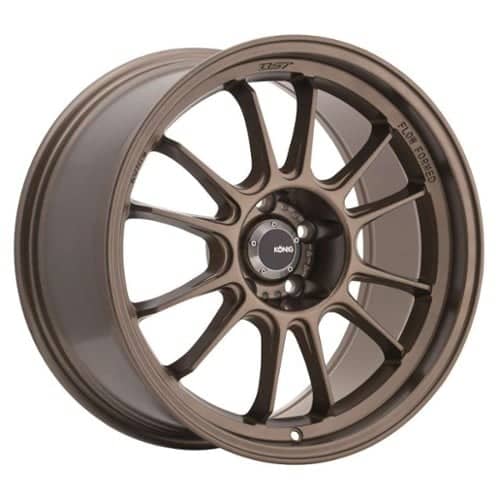
Hypergram is the one to beat. A twelve-spoke design with enough spoke clearance to fit over most big brake upgrades, and the weights above tell the story. The 15x7.5 in 4x100 +35 at $205.77 is 11.62 pounds and is about the best pound-per-dollar figure you will find anywhere. Moving up, the 16x8 in 4x100 +38 runs $246.34 at 15.25 pounds, and the 17x8 in 4x100 +45 is $275.93 at 16.33 pounds. For a wider setup the 17x9 in 5x114.3 +25 at $285.28 covers a lot of rear-drive builds.
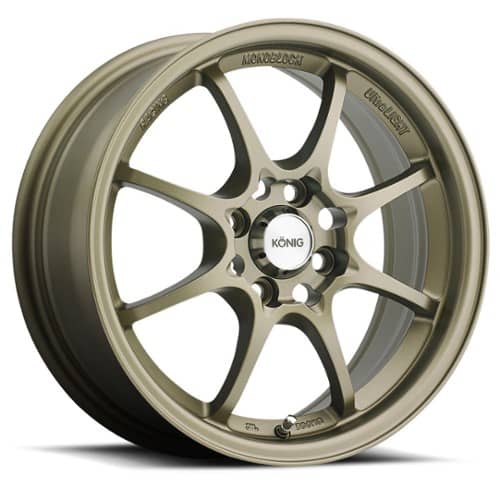
Helium is the cheapest way into flow-formed construction we stock. The 15x6.5 in 4x100 +40 is $127.51. If you're building a cheap track rat or need a dedicated set for a spare pair of tires, start here and stop looking.
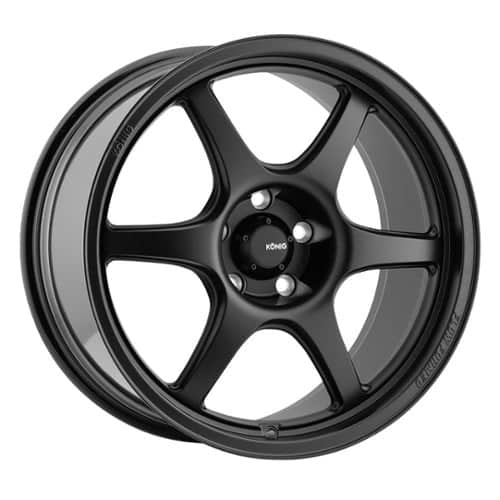
Hexaform is the same flow-formed construction with a cleaner six-spoke face if the Hypergram's busier look isn't for you. The 15x7.5 in gloss white is $210.45, and the 17x9 in 5x100 +40 is $239.40, which is a lot of wheel for the money.
Countergram, Heliogram, Ultragram, and Diverge round out the flow-formed line. The Heliogram 15x7 in matte bronze at $213.89 and the Diverge 16x7.5 in gloss black at $217.43 are both solid. Same process, different faces, pick the one you want to look at.
Konig isn't the only game, and depending on what you drive one of these may suit you better.
Motegi MR145 Traklite 3.0 is a flow-formed wheel aimed squarely at the track-day crowd, available in 15, 17, and 18 inch. Motegi has been building lightweight motorsport-oriented wheels a long time and the Traklite is their honest budget entry.
Forgestar F14 deserves a mention even though it stretches the definition of budget at the upper sizes. It's flow formed, it's a genuine enthusiast favorite, and the smaller and drag-oriented sizes are more reachable than people assume.
Black Rhino Rapid and Stadium are the answer if you're on a truck or SUV rather than a car. The Rapid 17x8.5 in 6x114.3 at $263.50 is flow formed, which is genuinely unusual in the truck wheel space where nearly everything is a heavy casting.
TSW Imatra, Kemora, and Paddock plus the Curva CFF series cover the 18 to 20 inch European and sport sedan fitments with flow-formed construction at sensible money.
What I'd steer you away from is any wheel marketed as lightweight that doesn't name its construction method or publish a weight. In this price bracket, silence on both counts usually means a plain casting with good photography. Our roundup of the best cheap wheels that won't break the bank covers the wider value market including the ones that aren't chasing weight at all.
Let me be straight with you about the payoff, because the internet oversells this badly.
Wheel weight is unsprung and rotating, which means it works against you three separate ways. The suspension has to control that mass over every bump, so more of it means the tire loses contact with the road more easily on broken pavement. The engine has to spin it up, so more of it blunts acceleration. The brakes have to slow it down, so more of it lengthens stops. Saving weight here does more per pound than saving it almost anywhere else on the car.
That's all true. Here's the honest part. On a street car driven at street speeds, going from a heavy cast wheel to a flow-formed one is something you notice in ride quality and steering response more than anything you'd measure with a stopwatch. It feels like the car settles more quickly after a bump and turns in a touch more eagerly. That's a real improvement and worth having. It is not a horsepower upgrade, and anyone telling you four pounds a corner transformed their commute is selling something.
Where it genuinely shows up is at an autocross or a track day, where you're accelerating and braking constantly and the suspension is working hard. There the difference is measurable. We put numbers to it in how much wheel weight actually affects performance, and our piece on why lightweight wheels matter covers the physics in more detail.
One more honest note. A lighter wheel paired with a heavier tire is a wash. The tire is often the bigger number of the two, and it's the part people forget to weigh. If you're doing this properly, look at the wheel and tire together.
Since weight lives at the part number and not the model, here's how to get the real figure before you spend.
Go to the manufacturer's fitment chart, not the retail listing. Konig, Motegi, and the other serious flow-formed makers publish charts listing every part number with its size, bolt pattern, offset, load rating, and net weight. That chart is the truth.
Match on the full specification. Find your exact diameter, width, bolt pattern, and offset. A 17x8 in 5x114.3 is a different part number from a 17x8 in 4x100, and they don't weigh the same.
Treat any round number with suspicion. Real published wheel weights come with decimals, because somebody weighed one. A figure like 35 or 55 pounds on a passenger car wheel is a shipping weight.
Sanity check against the size. A flow-formed 15-inch lands around 11 to 13 pounds, a 16-inch around 14 to 15, a 17-inch around 16 to 19, and an 18-inch around 17 to 21. Anything claiming to be far under those figures at a budget price is either forged and mispriced or the number is wrong.
A light wheel that doesn't fit is worse than a heavy one that does. Three things to settle before you order.
Offset. This is where budget wheel shoppers get burned most often, because aggressive offsets look great in photos and rub in reality. Our guide to wheel offset is the piece to read first.
Center bore. Aftermarket wheels are bored large so one wheel fits many cars, which means you'll almost certainly need hub-centric rings. Skip them and you'll chase a vibration that no amount of rebalancing fixes, for reasons we explain in hub-centric vs. lug-centric wheels.
Load rating. Lightweight and adequately rated are not the same thing. Konig publishes a load rating alongside every weight in those charts, and it needs to clear your vehicle's requirement with margin. This matters most on heavier cars and anything carrying passengers and gear. Our wheel load rating guide walks through checking it.
Good budget lightweight wheels come down to one word on the spec sheet and one decision about size. Look for flow formed, then buy the smallest diameter that clears your brakes and looks right on the car. Do those two things and you'll land somewhere between eleven and seventeen pounds a corner for two to three hundred dollars a wheel, which is a genuinely good outcome.
Konig's flow-formed line is where I'd start almost anyone, with the Hypergram as the default and the Helium as the budget floor. Motegi's Traklite covers the track-day crowd, and Black Rhino's Rapid handles the truck side where light wheels are rare. Whatever you pick, get the weight from the manufacturer's fitment chart for your exact part number rather than from a listing, and weigh the tire while you're at it.
Call the Fitment Team with your year, make, and model and we'll confirm bolt pattern, offset, and load rating before anything ships. You can browse the full Konig wheel lineup to see what's on the shelf in your size today.
Look for flow-formed construction, which delivers near-forged strength and weight at a fraction of forged cost. Konig's flow-formed range is the best value in the category, with the Hypergram at 11.62 lbs in 15x7.5 for around $206 and the Helium starting near $128. Motegi's MR145 Traklite 3.0 suits track use, Black Rhino's Rapid covers trucks, and TSW and Curva handle larger European fitments. Avoid any wheel marketed as lightweight that won't name its construction method or publish a weight.
Flow forming starts with a cast wheel, then spins the barrel on a mandrel while rollers compress it under heat and pressure. That stretches and aligns the grain structure of the barrel material much the way forging does, producing a barrel that is stronger and lighter than a plain casting while the face remains cast. It costs far less than full forging. Rotary forged and flow forged describe the same process.
A flow-formed 17-inch typically lands between about 16 and 19 pounds depending on width and offset. Konig publishes the Hypergram 17x8 at 16.33 lbs in 4x100 +45 and the 17x9 at 18.78 lbs in 5x114.3 +25. For reference, a flow-formed 15-inch runs roughly 11 to 13 lbs and an 18-inch roughly 17 to 21 lbs. Weight varies by exact part number, so check the manufacturer's fitment chart for your specific size and offset.
Not quite, but they close most of the gap for a small fraction of the price. Forging aligns the grain structure throughout the entire wheel, so a forged wheel is lighter and more resilient overall, particularly in the face. Flow forming only treats the barrel, leaving the face cast. For street driving, autocross, and most track-day use, flow formed is the sensible choice. For competition where every pound counts or where impact resilience is critical, forged is worth the money.
Many retail systems store a shipping weight rather than the wheel's net weight, and that figure often includes packaging and is assigned at the model level rather than per part number. That is why the same figure appears for a 17x8 and a 17x9 of the same design. Real published wheel weights come with decimals and vary by size and offset. Always take the number from the manufacturer's fitment chart.
On the street the difference is felt more than measured. Because wheel weight is unsprung and rotating, reducing it improves how quickly the suspension settles after bumps and how eagerly the car turns in, and it slightly helps acceleration and braking. At an autocross or track day, where you accelerate and brake constantly, the gains become measurable. Remember to account for tire weight as well, since a heavy tire can cancel out the savings from a lighter wheel.
Reviewed by Hank Feldman, Founder, Performance Plus Tire



