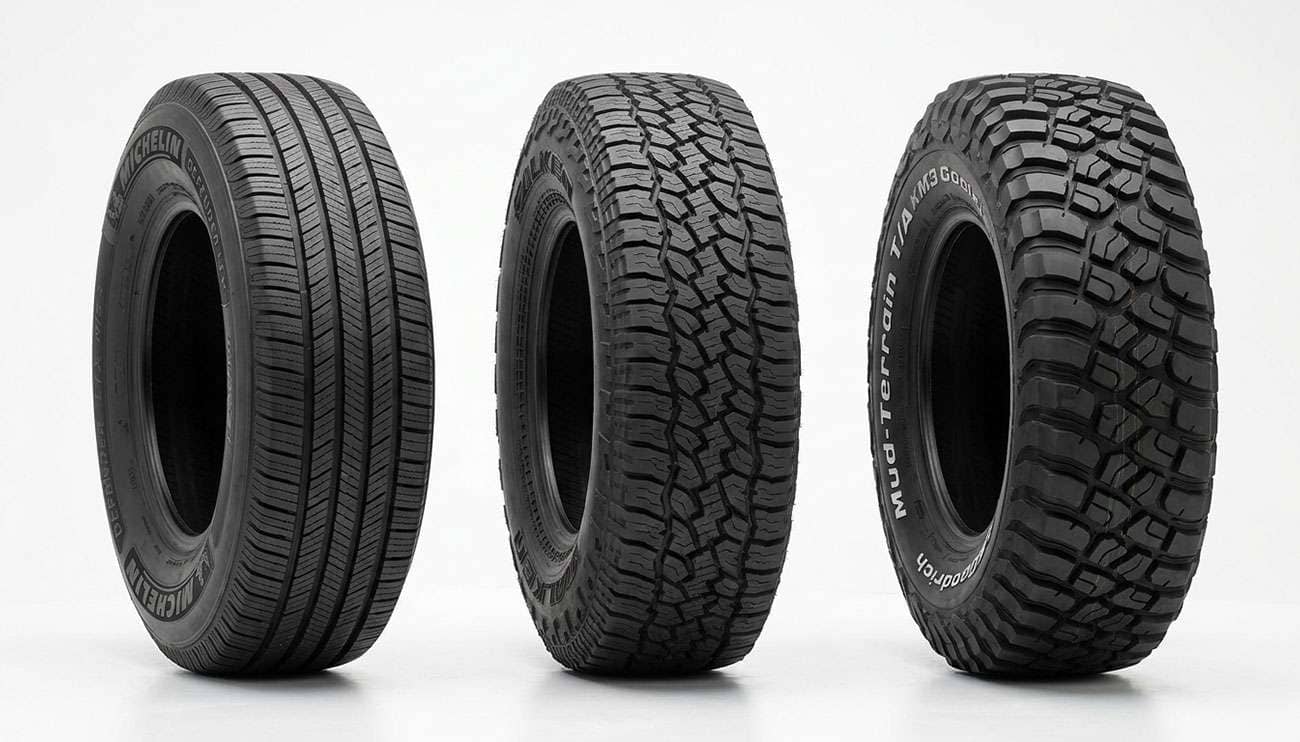
For most trucks and Jeeps, the best 285/70R17 tire is the Falken Wildpeak A/T4W, because it comes in every construction this size is sold in and carries one of the best warranties in each. But the right tire starts with the load range your truck needs, not the tread. A 285/70R17 can be a passenger tire rated for 2,756 lb, an LT Load Range C rated for the same 2,756 lb at a much higher pressure, a Load Range D or E rated for 3,197 lb, or a Load Range E rated for 3,748 lb. Most best-of lists rank tread patterns. Pick the load rating first, and the right tire gets easy.
I have been putting 33-inch tires on Jeeps, Broncos and pickups in Long Beach for a long time, and 285/70R17 is the size people ask about most. It is the 33-inch tire that fits a 17-inch wheel, it comes on several off-road trims from the factory, and it is the go-to upgrade for anyone stepping up from a 265/70R17. That popularity is exactly why the load ratings get confusing.
What Your Placard Calls For |
What You Can Buy |
Rated Load per Tire |
Pressure to Reach That Rating |
|---|---|---|---|
Passenger size, or a 265/70R17 you are upsizing from |
P285/70R17 116 or 117, Standard Load |
2,756 to 2,833 lb |
35 psi |
LT285/70R17 Load Range C, 116 (factory on several Bronco, Colorado and Wrangler trims) |
LT C 116, or any D or E |
2,756 lb |
50 psi |
LT285/70R17 Load Range D, 121 (factory on the Ram 2500 Power Wagon) |
LT D 121, or E 121 or 126 |
3,197 lb |
65 psi (D) or 80 psi (E) |
Heavy towing, camper or built-up overland rig |
LT E 126 |
3,748 lb |
80 psi |
Start at the driver's door jamb. The tire placard tells you the size, load index and pressure the truck was engineered around. In 285/70R17, those placards vary more than most people expect:
Rule one is simple: your replacement has to match or beat the load index on that placard. A C-range Jeep can step up to a D or E. A Ram 2500 on a D 121 cannot step down to a C 116.
Rule two is where people get caught. A passenger 285/70R17 116 and an LT285/70R17 Load Range C 116 carry the same maximum load, 2,756 lb. They just reach it at different pressures. The passenger tire gets there at 35 psi. The LT tire needs 50 psi. At the same 35 psi, the light truck load table puts an LT285/70R17 at roughly 2,105 lb. Swap constructions without changing the pressure and you change how much the tire can carry. Our guide to P-metric vs. LT tires explains the construction side.
If you are upsizing a half-ton from 265/70R17 passenger tires and you do not tow heavy, a passenger 285/70R17 or an LT Load Range C is the right neighborhood. If you tow near your rating, carry a slide-in camper or build a heavy overland rig, look at Load Range E. Our breakdown of load range vs. load index walks through reading both numbers.
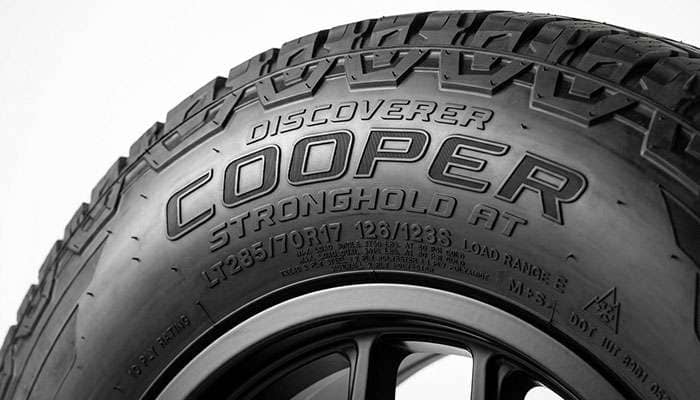
This is the part nobody puts in front of you. In 285/70R17, "Load Range E" comes in two versions:
Same letter, same 80 psi ceiling, 551 lb apart. Load range tells you the maximum pressure. Load index tells you the weight. Tire makers can build this size to either standardized rating, and they split:
Some models even come both ways. The BFGoodrich Mud-Terrain T/A KM3 has been sold in LT285/70R17 as a 121/118Q and as a 126/123Q, both Load Range E. Read the full service description on the sidewall, not just the letter.
Does a 121 E ever make sense? Sure. On a Ram 2500 whose placard calls for a D 121, an E 121 meets the requirement with a higher pressure ceiling. On a C-range Bronco or Jeep, a 121 is already far more tire than the truck needs. The 126 matters when you are loaded: heavy tongue weight, a camper, or a built rig running near its gross vehicle weight rating every day. And never go below the placard index; our piece on whether a lower load index tire is safe explains why.
These are my picks, by job. Prices are per tire at the time of writing; click through to confirm current pricing for the exact load range you need. You can see every option on our 285/70R17 tires page.
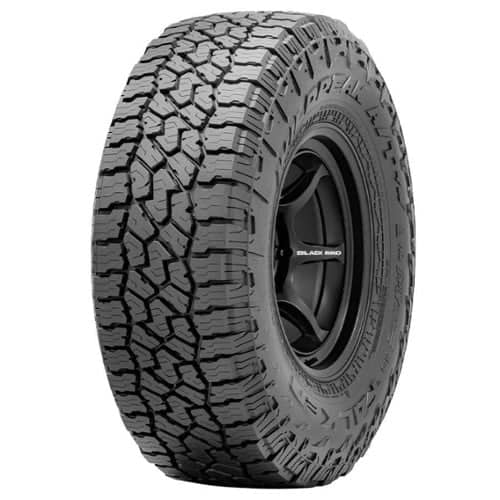
The A/T4W is the one tire in this roundup that covers every load range question in 285/70R17. You can buy it as a P285/70R17 116T passenger tire for $324.00, an LT Load Range C 116 for $303.00, or an LT Load Range E 126 for $316.00. That last one is the number that jumps out at me: the higher 126 rating for less than most premium brands charge for a 121.
Falken backs it for up to 65,000 miles on non-LT sizes and 60,000 on LT sizes, it carries the Three-Peak Mountain Snowflake symbol, and in independent testing it has posted some of the shortest wet and dry stops among off-road all-terrains. Our Falken Wildpeak A/T4W review covers how it holds up over time.
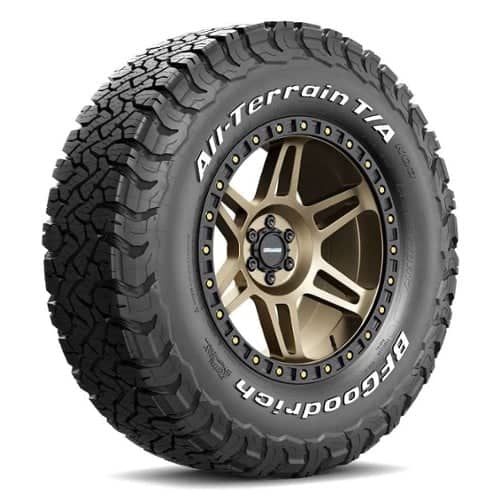
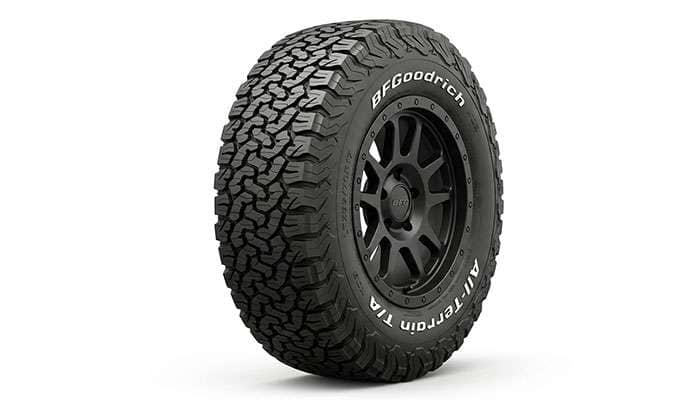
The KO3 is an LT-only tire, so in this size you choose between the Load Range C 116 at $319.99 and the Load Range E 126 with raised white letters at $329.99. The C-range is the factory-style fit for a Bronco, Colorado or Wrangler. The E-range 126 is the one for loaded rigs.
Where it earns the price: snow traction, where it has out-braked the A/T4W in independent snow testing, and CoreGard Max sidewall protection on every size. BFGoodrich backs it for 50,000 miles. And if you like the look of white letters on a 33, this is the one to buy.
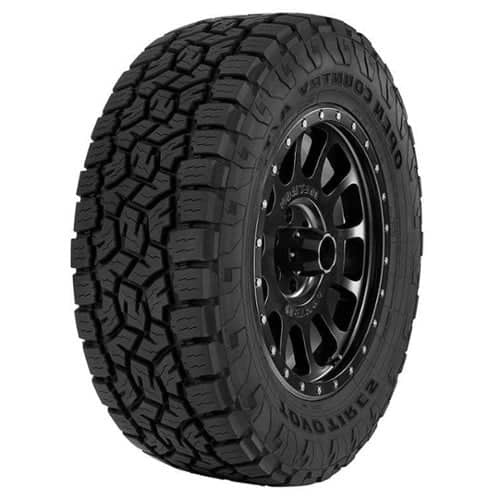
If your truck runs on passenger tires and you want the most capacity a passenger 285/70R17 offers, the Toyo's P285/70R17 117T at $326.81 is rated for 2,833 lb, a notch above the common 116. Toyo backs its passenger sizes for 65,000 miles, and the A/T III is one of the lighter tires in the class.
It also comes as an LT Load Range C 116 at $345.73 and an LT Load Range E 121 at $362.09. Note that 121: if you need the 126 rating, look elsewhere. Toyo's LT sizes carry a 50,000-mile warranty.
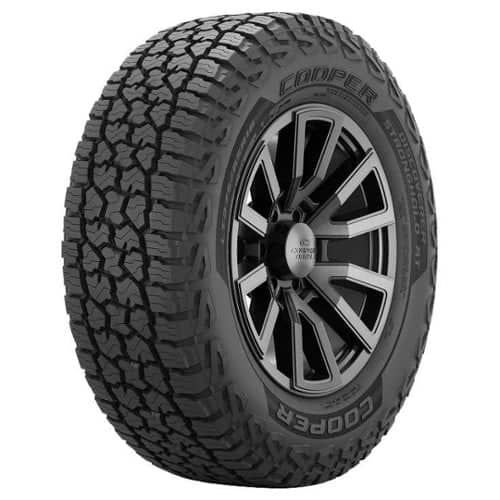
Cooper built the Stronghold AT for work trucks that haul and tow, and in this size it comes as an LT Load Range E 126 at $329.99. It carries a 60,000-mile warranty and the Three-Peak Mountain Snowflake symbol. If you run a Power Wagon, or you hook a heavy trailer to a half-ton on 33s, this is the kind of tire I want under it. Our guide to which load range a half-ton needs for towing helps you decide whether you need it.
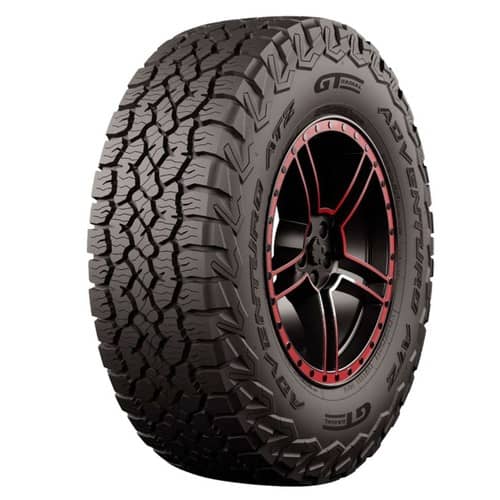
A budget tire that does not cut corners on the load rating. The Adventuro ATZ comes as a 117T passenger tire at $242.57 and an LT Load Range E 126 at $261.66. GT Radial backs it for 60,000 miles on non-LT sizes and 55,000 on LT sizes, and it is severe-snow rated. A 126 E for about $55 to $70 less per tire than the premium brands is a lot of capacity for the money.
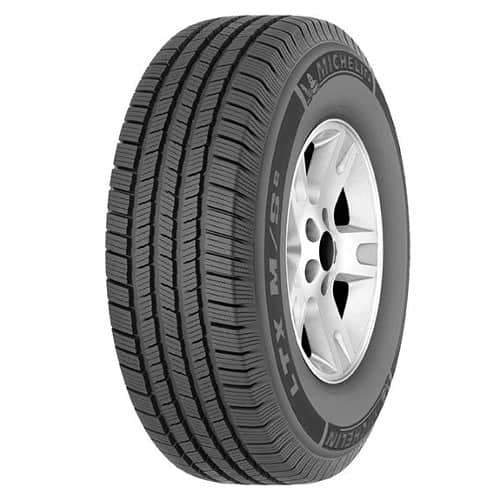
Not every 285/70R17 needs to go off-road. If your truck lives on the highway and tows on pavement, the Defender LTX M/S 2 in LT Load Range E 126 at $368.99 is the quiet, long-wearing choice. Michelin backs its LT sizes for 50,000 miles. It starts with 14/32 inch of tread, less than the all-terrains, but highway rib tires wear slowly and evenly when they are inflated right.
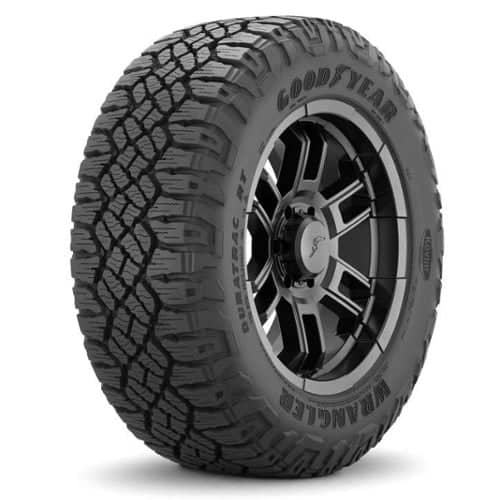
Rugged-terrain tires sit between an all-terrain and a mud-terrain, and the DuraTrac RT is the one I would pick in this size. The LT Load Range E 126 at $339.99 starts with 18/32 inch of tread, uses a three-ply sidewall, carries the Three-Peak Mountain Snowflake symbol and comes with a 50,000-mile warranty, which is unusual for a tire this aggressive.
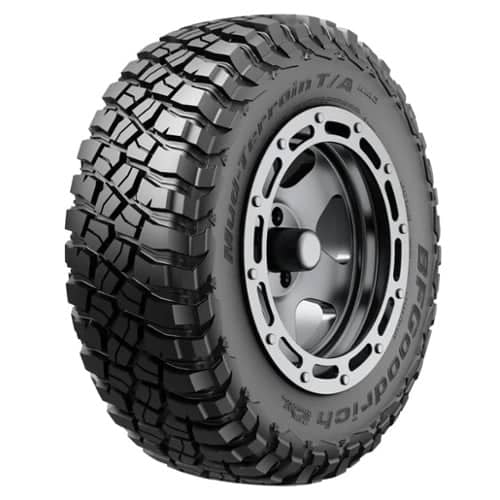
For trucks that really live in the mud and rocks, the KM3 in LT Load Range E 126 at $339.99 is still the benchmark. BFGoodrich gives it CoreGard Max sidewall protection and its Krawl-Tek compound. Know what you are buying: like most mud-terrains, it carries BFGoodrich's standard limited warranty rather than a treadwear mileage warranty, and it will be louder on the highway than anything else on this list.
Tire |
Category |
285/70R17 Versions |
Treadwear Warranty |
Price From |
|---|---|---|---|---|
Falken Wildpeak A/T4W |
All-terrain |
Passenger 116, LT C 116, LT E 126 |
65,000 passenger / 60,000 LT |
$303.00 |
BFGoodrich All-Terrain T/A KO3 |
All-terrain |
LT C 116, LT E 126 |
50,000 |
$319.99 |
Toyo Open Country A/T III |
All-terrain |
Passenger 117, LT C 116, LT E 121 |
65,000 passenger / 50,000 LT |
$326.81 |
Cooper Discoverer Stronghold AT |
All-terrain, heavy-duty |
LT E 126 |
60,000 |
$329.99 |
GT Radial Adventuro ATZ |
All-terrain, budget |
Passenger 117, LT E 126 |
60,000 passenger / 55,000 LT |
$242.57 |
Michelin Defender LTX M/S 2 |
Highway |
LT E 126 |
50,000 (LT) |
$368.99 |
Goodyear Wrangler DuraTrac RT |
Rugged-terrain |
LT E 126 |
50,000 |
$339.99 |
BFGoodrich Mud-Terrain T/A KM3 |
Mud-terrain |
LT E 126 |
Standard limited warranty only |
$339.99 |
Notice how many of the picks come only in Load Range E 126. That is the market telling you something: in this size, most serious all-terrain and off-road tires are built for trucks that carry weight. If your truck does not, the passenger and C-range versions of the first three picks are where you will find the softer ride.
Wranglers and Broncos that came on 285/70R17 from the factory came on LT Load Range C tires, so the straight replacement is a C-range 116. My order of picks for these rigs:
Do you need Load Range E on a Jeep or Bronco? Usually not. Where it starts to make sense is a heavy build: steel bumpers, a winch, a rooftop tent, drawers and a full fridge add up fast, and a rig carrying all of that can run near its axle ratings every day. Weigh the rig on a truck scale before you decide. One more thing surprises people: in some models the C-range and E-range weigh nearly the same in this size, so much of the ride difference comes from the higher pressure an E-range tire is designed to run, not from the tire itself.
The other big group buying this size is half-ton and mid-size owners moving up from a passenger 265/70R17. If that is you and the truck is mostly a daily driver, stay in passenger construction. You keep a pressure close to what the truck was engineered around, a softer ride and a longer warranty. My picks:
If that half-ton tows a heavy camper or trailer, the math changes. Step to an LT tire, usually an E-range 126, and set pressure from the tire maker's load table rather than your door sticker.
A 285/70R17 measures about 32.7 to 33 inches tall depending on the tire, which is why everybody calls it a 33. On trucks that came with it from the factory, it bolts right back on. On trucks moving up from 265/70R17, it is about an inch taller and roughly three-quarters of an inch wider, and whether it fits stock depends on your wheel offset and how much room you have at full lock and full compression.
We have worked through the most common upgrade in our guide to running 285/70R17 instead of 265/70R17, and for one of the most popular trucks for this size, see will 33s fit a stock Tacoma. Remember that a taller tire also changes your speedometer reading and your effective gearing, which matters more if you tow.
Picking the wrong load range does not show up on the drive home. It shows up over the next few years, and it gets more expensive as it goes:
The cheap fix is at the start: buy the load range your truck needs, and set pressure from the tire maker's load and inflation table.
There is no single best 285/70R17 tire, because there is no single 285/70R17. The same size covers a passenger tire, a Load Range C, a D, and two kinds of E. Get the load range right for your truck and every tire on this list is a good choice for its job. If you want one name, the Falken Wildpeak A/T4W is it, because it comes in each construction the size is sold in, matches the best warranty among these picks and offers the 126 rating at a price most premium 121s cannot match.
Browse the full lineups for all-terrain, rugged-terrain and mud-terrain tires, or call us in Long Beach and we will read your placard with you before you buy.
For most trucks and Jeeps, the Falken Wildpeak A/T4W, because it comes in passenger, Load Range C and Load Range E 126 versions with up to a 65,000-mile warranty. The best choice for your truck depends first on the load range your placard calls for, then on whether you need a highway, all-terrain, rugged-terrain or mud-terrain tire.
Yes, close to it. A 285/70R17 measures about 32.7 to 33 inches tall depending on the brand and model, which is why it is sold and talked about as a 33-inch tire for 17-inch wheels.
It depends on the tire. The size is sold as a Standard Load passenger tire with a 116 or 117 load index, and as an LT tire in Load Range C (116), D (121) and E (121 or 126). Check your vehicle's tire placard and match or exceed its load index.
If the truck came on LT285/70R17 tires, use the pressure on its placard; factory placards for this size range from 35 psi on some Colorado trims to 60 psi on the Ram 2500. If you switched from passenger tires to LT tires, set pressure from the tire maker's load and inflation table, because LT tires need more air to carry the same load.
A 121 is rated for 3,197 lb per tire and a 126 for 3,748 lb, a 551 lb difference. In 285/70R17 both can be Load Range E with the same 80 psi maximum, so read the full service description on the sidewall, not just the load range letter.
Yes. A higher load range than the factory C-range tire is allowed, as long as you set pressure from the tire maker's load table. Expect a firmer ride and more weight per corner. Unless you carry heavy gear or tow, a Load Range C usually rides better and does the job.