
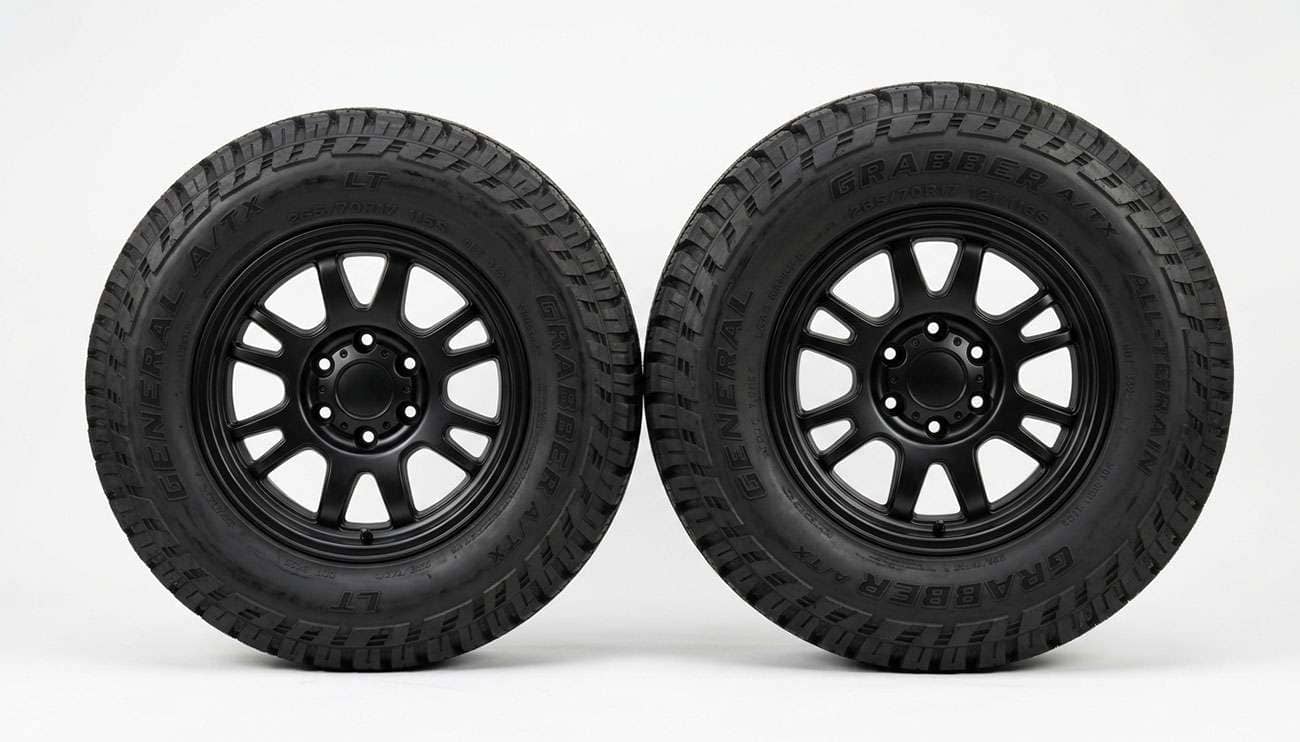
Yes, 285/70R17 can replace 265/70R17 on most midsize and full-size trucks, but two variables decide whether you'll like the result: the construction of the 285 you buy and the offset of the wheel it rides on. The 285 is 1.1 inches taller and 0.8 inches wider. Most 285/70R17s on the market are LT Load Range E tires, while most factory 265/70R17s are P-metric. That construction change, not the size, is what makes the ride harsher and the truck heavier. Wheel offset decides whether it rubs.
I'm Dennis Feldman, and the 265-to-285 swap is one of the most common fitment questions we get on 17-inch trucks. Most answers stop at "it should fit with a level." That's only half the job. Start with the table below. It's keyed to the variable that changes your daily drive the most: which kind of 285/70R17 you're actually buying.
285/70R17 Construction |
Typical Max Load |
Pressure for Max Load |
Weight and Ride vs. Stock 265 |
Best For |
|---|---|---|---|---|
P-metric SL (116) |
2,756 lb (2,505 lb on a truck) |
35 psi |
Lightest 285. Ride closest to stock. |
Daily drivers that want the look without the weight |
LT Load Range C (116/113) |
2,756 lb |
50 psi |
Moderate weight gain. Firmer, but the softest LT. |
Light off-road, midsize trucks |
LT Load Range D (about 118/115) |
About 2,910 lb |
65 psi |
Heavier. Noticeably firmer. |
Mixed trail use, light towing |
LT Load Range E (121/118) |
3,195 lb |
80 psi |
Heaviest. Firmest ride and stiffest sidewall. |
Regular towing, rocky trails, loaded trucks |
Load index values come from the standardized tables of the Tire and Rim Association, so a 121 means 3,195 pounds on every brand. The truck figure for P-metric tires reflects the 1.10 derating that FMVSS 120 applies when a passenger tire goes on a truck. More on that below.
The second axis is fitment. Here's how a 285/70R17 sits relative to a stock 265/70R17 on a typical factory 17x7.5 wheel with +30 mm offset, depending on the wheel you mount it on.
Wheel |
Backspacing |
Inner Sidewall vs. Stock |
Outer Sidewall vs. Stock |
What to Expect |
|---|---|---|---|---|
Stock 17x7.5 +30 |
5.43 in |
0.39 in closer to suspension |
0.39 in farther out |
Most likely to touch the upper control arm or frame at full lock |
17x8.5 +18 |
5.46 in |
0.08 in more clearance |
0.87 in farther out |
Inner clearance about like stock, mild fender contact risk |
17x8.5 0 |
4.75 in |
0.79 in more clearance |
1.57 in farther out |
Clears suspension, watch the front of the fender liner and mud flaps |
17x8.5 -12 |
4.28 in |
1.26 in more clearance |
2.05 in farther out |
Tire pokes past the fender on most trucks, more scrub radius |
Your factory wheel's offset may differ, so check the number stamped on the back of the spoke or the inside of the barrel and redo the math. The direction of each change won't move.
Both sizes share the 70 aspect ratio and the 17-inch rim. Only the section width changes, from 265 mm to 285 mm. Because aspect ratio is a percentage of width, that 20 mm also makes the sidewall taller. One number changed, and the tire grew in both directions.
Measurement |
265/70R17 |
285/70R17 |
Difference |
|---|---|---|---|
Section width |
10.43 in |
11.22 in |
+0.79 in |
Sidewall height |
7.30 in |
7.85 in |
+0.55 in |
Overall diameter |
31.61 in |
32.71 in |
+1.10 in (+3.5%) |
Circumference |
99.3 in |
102.8 in |
+3.5 in |
Revolutions per mile |
638 |
617 |
-21 |
Ground clearance at the axle |
Baseline |
+0.55 in |
Half the diameter change |
Those are calculated dimensions on the tire's measuring rim. Real tires vary by brand and tread design, and aggressive all-terrain and mud-terrain treads often measure a bit taller than the math. For the full conversion of each size, see what size a 265/70R17 is in inches and our guide to what a 285/70R17 is equivalent to.
At 32.7 inches, the 285/70R17 is the classic "33" for 17-inch trucks, which is why this swap is so popular on midsize pickups and SUVs. If you're weighing width more broadly, our 265 vs. 285 tire comparison covers the trade-offs across rim sizes.
On the rim itself, yes. A 265/70R17 is designed around an 8-inch measuring rim, with an approved range of roughly 7 to 9 inches. A 285/70R17 is designed around an 8.5-inch measuring rim, with an approved range that typically starts at 7.5 inches and runs to 9 or 9.5 inches depending on the manufacturer.
Most factory 17-inch truck wheels are 7.5 or 8 inches wide, so they fall inside the 285's approved range. A 7.5-inch wheel sits at the narrow end, which pinches the bead in and lets the sidewall bulge a little. That's within spec. It also slightly softens steering response and puts a bit more sidewall out where it can contact the fender liner.
Mounting on the rim is the easy part. Whether the tire clears everything around it is a different question.
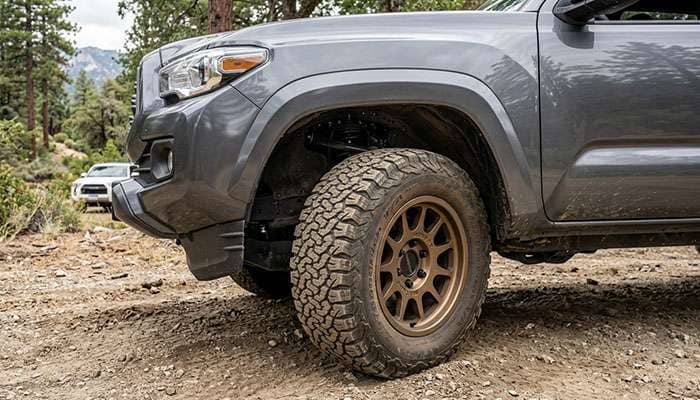
It depends on two dimensions that point in opposite directions. The extra 0.55 inches of radius moves the tread closer to the fender liner and the front body mount area. The extra 0.39 inches of half-width moves the inner sidewall closer to the upper control arm, sway bar, and frame. Which one touches first depends on your truck, your suspension, and above all your wheel offset.
Offset is the distance from the wheel's mounting face to its centerline. Lower offset moves the whole wheel and tire outward. That buys clearance on the inside, where stock wheels with high positive offset tend to put a wider tire into the suspension at full lock. It costs clearance on the outside, where the tread now swings closer to the fender opening when you turn and when the suspension compresses.
That trade-off is why the fitment table near the top of this article matters more than any "will it fit" answer you'll find. Across the market, most aftermarket 17x8.5 truck wheels run 0 mm offset, with most of the rest between -12 and +25. A 0 offset 17x8.5 is a common choice for this swap because it gets the inner sidewall away from the suspension without pushing the tire far past the fender.
A front leveling kit raises the front of the truck, which gives the taller tire more room in the fender opening. It doesn't add inner clearance at the control arm, and on some trucks it changes the arc the tire travels at full lock. Many owners run 285/70R17 on stock suspension with only light liner contact at full lock. Others need a level, a trimmed liner, or a body mount modification. Midsize trucks tend to have tighter wheel wells than full-size half-tons, so they're the ones most likely to need extra work.
If you already have contact, our breakdown of why your tires are rubbing will help you pin down where and why before you start cutting anything.
Most people blame the size. The size is only part of it. The bigger factor is that the swap usually changes the tire's construction too, and nobody mentions that until after the tires are on.
Look at the market for each size. The 265/70R17 is split roughly evenly between P-metric and LT tires, and most trucks that left the factory on 265/70R17 wore P-metric standard-load tires. The 285/70R17 is a different market. The large majority of tires in that size are LT construction, and most of those are Load Range E. P-metric 285/70R17s exist, but they're a small minority. Unless you look specifically for one, you'll almost certainly end up on an LT tire.
For a full explanation of the two construction types, read P-metric vs. LT tires. Here's what the change means for this swap specifically.
An LT Load Range E tire has more or heavier plies in the carcass so it can hold 80 psi and carry 3,195 pounds. Those plies make the sidewall stiffer. A stiffer sidewall flexes less over small bumps, so more of the road reaches the cabin. Across the market, a typical 285/70R17 weighs about 8 to 10 pounds more than a typical 265/70R17, and heavy-duty LT versions can run well past 60 pounds each. That's 30 to 40-plus pounds of extra unsprung, rotating weight across the set, and the suspension feels every pound of it.
LT all-terrains in this size typically start around 16/32 inch of tread depth, compared with about 12/32 inch for a P-metric highway or all-season 265. More tread means more life and more off-road bite. It also means taller, more flexible tread blocks that can feel a little vague on pavement and make more noise.
Here's the part that makes the biggest difference and costs nothing. A lot of LT tires get installed at the 80 psi molded on the sidewall, or close to it. That's the pressure for maximum load, not the pressure your truck needs. An empty half-ton or midsize truck on LT tires at 80 psi rides like a hay wagon and wears out the center of the tread. Set the pressure for the weight you actually carry and most of the harshness goes away.
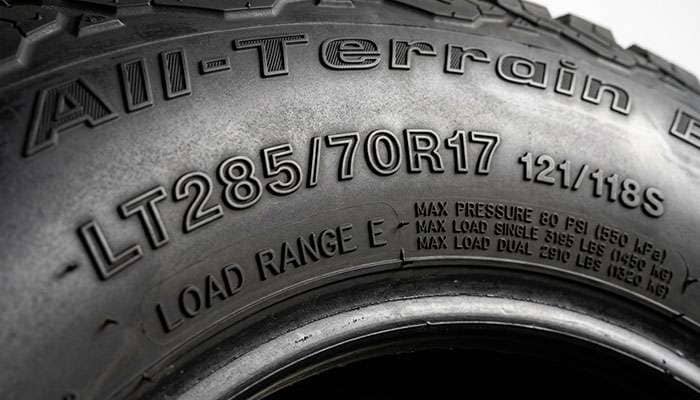
Run the pressure at which the LT 285/70R17 carries at least what your original 265/70R17 was rated to carry on your truck. Not the door placard pressure, and not the sidewall maximum. Here's the math behind that.
Federal Motor Vehicle Safety Standard 120, administered by NHTSA, requires the tires on each axle to carry at least that axle's Gross Axle Weight Rating. When the tires are P-metric, the standard divides their rated load by 1.10 before that check. LT tires get no such derating, because they're built for truck duty.
Tire |
Rated Load |
Load on a Truck |
Pressure |
|---|---|---|---|
P265/70R17 113 SL (stock) |
2,535 lb |
2,305 lb |
35 psi |
P265/70R17 115 SL (stock) |
2,679 lb |
2,435 lb |
35 psi |
LT285/70R17 Load Range E |
3,195 lb |
3,195 lb (no derating) |
80 psi |
So your target is the stock tire's truck load, usually around 2,300 to 2,450 pounds per tire. The LT 285 doesn't need anywhere near 80 psi to carry that.
LT load/inflation tables are built differently from P-metric tables. At low pressures, an LT tire carries less than its size suggests, and capacity climbs as pressure rises toward the load range maximum. That's why you can't just copy the 35 psi from your door placard. For an LT285/70R17 on a typical half-ton or midsize truck, the pressure that matches stock capacity usually lands somewhere in the high 30s to mid 40s psi. That's an estimate, not a prescription. Every tire maker publishes an LT load/inflation table for its sizes, and that table is the authority.
A chalk test is a good real-world check once you're in the right range. Draw a line across the tread, drive straight a short distance, and look at the wear. If only the center is gone, you're too high. If only the edges are gone, you're too low.
A bigger tire turns fewer times per mile, so your speedometer reads low and your odometer under-counts. With a 3.5% diameter increase, here's the real speed behind each reading:
Speedometer Shows |
Actual Speed on 285/70R17 |
Error |
|---|---|---|
30 mph |
31.0 mph |
+1.0 mph |
45 mph |
46.6 mph |
+1.6 mph |
60 mph |
62.1 mph |
+2.1 mph |
70 mph |
72.4 mph |
+2.4 mph |
80 mph |
82.8 mph |
+2.8 mph |
This one can get you a ticket. At an indicated 70, you're doing 72.4. The odometer also records about 9,660 miles for every 10,000 you actually drive, which matters for oil changes, warranty limits, and service intervals. Our guide to bigger tires and your speedometer covers the recalibration options. Most dealers and many aftermarket programmers can enter the new tire size, which also corrects the transmission's shift points.
A 3.5% taller tire acts like a 3.5% numerically lower axle ratio. A 3.73 rear behaves like a 3.60, and a 4.10 behaves like a 3.96. Add the extra weight of an LT tire, and a midsize truck with a smaller engine will feel it in launches, on grades, and in how often the transmission hunts for a gear. Full-size trucks with larger engines usually shrug it off. If you tow near your rating, factor the gearing change into how much you're willing to give up.
Usually, yes, and the loss is real even though your trip computer overstates it in one way and understates it in another. Three things work against you:
Now the measurement problem. Because the odometer under-counts by about 3.4%, your indicated fuel economy looks worse than it really is until you correct the tire size in the computer. On the other hand, the tread pattern and construction often matter more than the size itself. A 285/70R17 LT mud-terrain and a 285/70R17 P-metric all-terrain can deliver very different results on the same truck.
A wrong-offset, wrong-pressure 285 swap doesn't fail on day one. It costs you a little at a time, and the bill climbs.
An LT tire at sidewall-max pressure on an empty truck wears the center of the tread first. An underinflated one wears both shoulders. Either way, you lose thousands of miles from a set of tires that cost more than the ones they replaced.
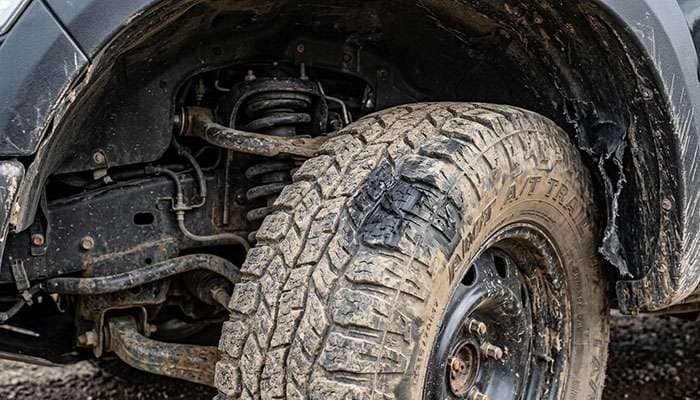
A tire that touches at full lock or under compression chews through the plastic fender liner, then starts contacting the body mount, the bumper cover, or the mud flap. The tire's sidewall takes the same abrasion on every contact.
On the inside, a tire rubbing the upper control arm, sway bar, or frame scuffs the inner sidewall where you can't see it. That's the most dangerous kind of rub, because you won't notice it until the damage is deep.
Repeated rubbing wears through the rubber and into the cords that hold the sidewall's shape. Once the cords are exposed or cut, the tire is done, regardless of tread depth. Our guide on whether tire sidewall damage is safe to drive on shows what to look for and when to pull a tire.
A sidewall that fails at speed takes the tire with it and often damages the liner, the fender, or the wheel. At that point, you're buying another tire, likely a matched set on a 4WD truck, plus whatever the wheel offset or a leveling kit should have fixed in the first place.
The fix at the front of that ladder is cheap. The right wheel offset and the right pressure cost little or nothing compared with what's at the bottom.
Follow these steps in order and you'll get the look and capability without the surprises.
When you're ready to shop, our all-terrain tires section lets you compare 285/70R17 options by load range, so you can match the construction to the way you actually use your truck.
The 285/70R17 is a proven upgrade for trucks that came on 265/70R17. It's 1.1 inches taller, 0.8 inches wider, mounts on the same 17-inch wheels, and adds half an inch of ground clearance. That's the part everybody already knows.
The part that decides whether you'll be happy with it is construction and offset. Most 285/70R17s are LT Load Range E, which means more weight, a stiffer sidewall, and a ride that turns harsh fast if you run sidewall-max pressure. And your wheel's offset decides whether the wider tire hits the suspension or the fender. Choose the load range for how you really drive, set the pressure from the load table, put the tire on the right offset, and recalibrate the speedometer. Do that and you'll get the stance and the capability without paying for it every mile.
Yes, on most midsize and full-size trucks. The 285/70R17 mounts on the same 17-inch wheel, typically 7.5 inches wide or wider. It is 1.10 inches taller and 0.79 inches wider, so clearance at full lock depends on your suspension and wheel offset. Most 285/70R17s are LT Load Range E, which rides firmer than a stock P-metric 265/70R17.
Nearly. A 285/70R17 measures about 32.71 inches tall by calculation, which is why it's commonly called a 33-inch tire. Aggressive all-terrain and mud-terrain versions often measure slightly taller. A 265/70R17 is about 31.61 inches tall.
It can. The taller tire may touch the fender liner or body mount area at full lock, and the wider tire may touch the upper control arm on wheels with high positive offset. Many trucks run 285/70R17 with only light liner contact, while others need a leveling kit, liner trimming, or a lower-offset wheel.
Yes. Because the 285/70R17 is about 3.5% taller than a 265/70R17, your speedometer reads low. At an indicated 60 mph, you're going about 62.1 mph, and at an indicated 70 mph, about 72.4 mph. A dealer or aftermarket programmer can correct it by entering the new tire size.
Run the pressure where the LT tire carries at least what your stock tire was rated for on your truck, using the tire manufacturer's LT load/inflation table. On a typical half-ton or midsize truck, that usually lands in the high 30s to mid 40s psi when empty. Add pressure for heavy loads or towing, and never exceed the sidewall or wheel maximum.
Usually, yes. A 285/70R17 is heavier, wider, and often has a more aggressive tread than a stock 265/70R17, which adds rotating weight, rolling resistance, and drag. Your indicated mileage will also look worse until the speedometer is recalibrated, because the odometer under-counts miles by about 3.4%.



