
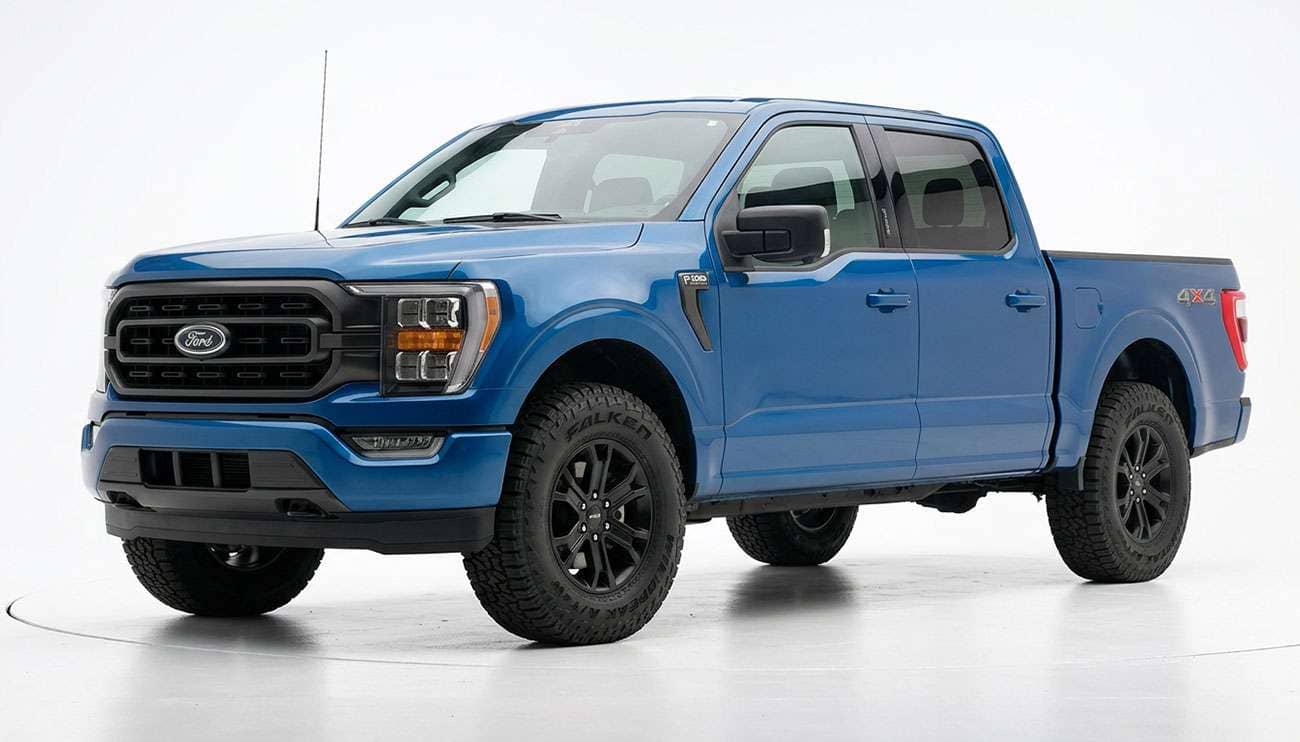
I get this question at the counter three or four times a week. Usually it's a guy standing next to a half-ton with 70,000 miles on a set of bald highway tires. He's heard the Wildpeak name from a buddy. He's looked at the price next to a BFGoodrich. And what he really wants to know is whether the cheaper tire is the compromise it looks like.
Short version: it isn't. The Falken Wildpeak A/T4W is a legitimately good all-terrain tire, and in two specific areas it beats tires that cost thirty percent more. But it is not the right tire for every vehicle that can physically bolt it on, and the reason why lives in a spec almost nobody checks before they buy.
Let's go through it the way I would if you were leaning on the counter.
The A/T4W is Falken's flagship all-terrain, launched as the follow-up to the Wildpeak A/T3W, which was one of the best-selling all-terrains in North America for the better part of a decade. That's a hard act to follow, and Falken didn't just facelift it. They changed the tire's personality.
Here's what it does well, with no hedging.
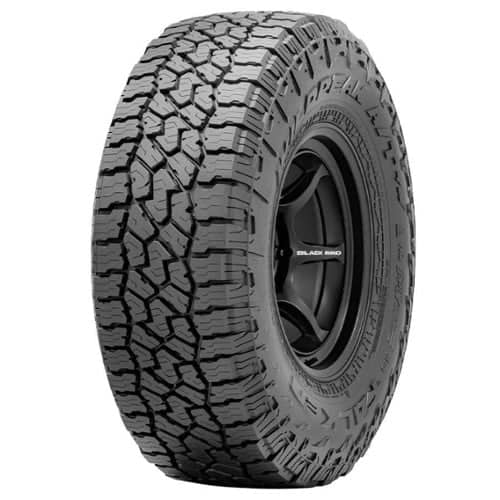
It carries the Three-Peak Mountain Snowflake symbol, which means it passed a standardized severe-snow traction test rather than just wearing an aggressive-looking tread. More importantly, the sipes are cut full depth. A lot of tires earn a snow rating on fresh rubber and then quietly lose the biting edges by the time you're at half tread. This one keeps them until the tire is done.
It uses Falken's Duraspec three-ply sidewall on the LT-rated sizes. Three plies instead of two is not a marketing number. It's the difference between a casing that squirms under a loaded trailer and one that stays put, and it's the single biggest reason the A/T4W tows better than the tire it replaced.
And Falken put money behind the durability claim. The A/T4W carries a 65,000-mile limited treadwear warranty on P-metric sizes and 60,000 miles on LT sizes, both up from the 55,000 the A/T3W carried. Manufacturers do not extend warranties out of generosity. They extend them when the internal wear data supports it.
Now the condition, and this is the part that costs people money when they skip it.
Going from the A/T3W to the A/T4W, Falken made a deliberate trade. Stiffer sidewalls and broader tread blocks bought towing composure and rock durability. What they cost was a few feet of dry braking distance and some ride compliance over sharp bumps and expansion joints. Independent testing bears this out consistently: the outgoing A/T3W stops shorter on dry pavement and rides softer, while the A/T4W wins on snow, on wet grip, and on rock.
That trade is a bargain if you drive a truck that works. It's a penalty you pay for nothing if you drive a crossover that never sees a trailer hitch or a fire road. Which brings us to the table you should actually be reading.
Falken sells five different tires with Wildpeak on the sidewall, and half the disappointment I hear about the brand traces back to somebody buying the wrong one. Find your row before you find your size.
Your Setup |
The Right Wildpeak |
Why |
|---|---|---|
Half-ton truck that tows a few times a month |
A/T4W in an LT size |
Three-ply Duraspec casing is exactly what the stiffer sidewall was built for |
Three-quarter ton or one ton, regular payload |
A/T4W in LT, load range E or higher |
Casing rigidity under load is non-negotiable and this is where the tire shines |
Crossover or light SUV, pavement only |
Wildpeak A/T Trail |
Quieter and lighter, and you skip paying in ride quality for casing you'll never load |
Midsize SUV, want sharper steering feel |
Falken Rubitrek A/T |
This is the tire that inherited the A/T3W's nimble on-road character |
Real rock crawling and deep mud |
Wildpeak R/T01 or M/T01 |
An all-terrain tread runs out of bite long before the A/T4W casing runs out of strength |
Snow is the top priority and budget is tight |
A/T3W while stock lasts |
Still 3PMSF rated, still excellent on ice, and pricing is soft as it winds down |
That last row is worth a note. The A/T3W is being phased out, and most retailers have already burned through it. We still carry 89 sizes of it alongside the A/T4W, so if your size is there and ice traction matters more to you than towing, you have a real choice that most shops can't offer you anymore.
This is the question I field most often, and the honest answer is that these are not the same tire with a new number stamped on it.
Feature |
Wildpeak A/T4W |
Wildpeak A/T3W |
|---|---|---|
Sidewall construction |
Three-ply Duraspec on select sizes |
Two-ply on most sizes |
Treadwear warranty, P-metric |
65,000 miles |
55,000 miles |
Treadwear warranty, LT |
60,000 miles |
55,000 miles |
UTQG treadwear grade |
660 |
660 |
Severe snow rating |
3PMSF, full-depth sipes |
3PMSF, full-depth sipes |
Towing and payload composure |
Noticeably better |
Good, but more sidewall flex |
Dry braking and steering feel |
Slightly behind |
Class-leading for its era |
Ride comfort over sharp bumps |
Firmer |
More compliant |
Deep snow and rock |
Better on both |
Still strong on ice specifically |
A few things worth pulling out of that table.
The UTQG grade didn't move. Both tires carry a 660 treadwear number, which tells you the compound isn't dramatically harder. The extra 10,000 miles of warranty on the P-metric sizes comes from the tread design and the casing holding its shape longer, not from Falken pouring in a rock-hard rubber that would have wrecked the wet grip.
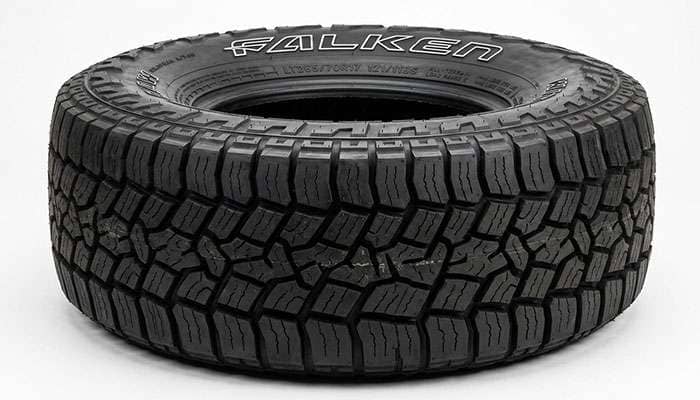
Falken also reworked the stone ejectors. If you've ever driven a set of all-terrains down a gravel road and listened to rocks pinging off the inside of your wheel wells for the next twenty miles, you'll appreciate that more than the spec sheet suggests. The A/T4W self-cleans better.
And on snow, the two tires split the difference in an interesting way. The A/T3W is the better ice tire, thanks to how densely it's siped. The A/T4W, with deeper scalloped shoulders and more aggressive sidewall lugs, is better in loose powder because it throws snow backward more effectively. If you live somewhere that freezes and thaws into a skating rink, that distinction is worth thinking about. If you live where it dumps, take the newer tire.
The warranty says 65,000 miles on P-metric and 60,000 on LT. In the real world, on a half-ton that gets rotated on schedule and isn't running a wild alignment, 50,000 to 60,000 miles is a realistic expectation. Guys who tow heavy and constantly land closer to 40,000.
That's a good number for an all-terrain, and it's better than a lot of the aggressive tires people cross-shop it against. But I want to be straight with you about what actually determines where you land in that range, because it usually isn't the tire.
Rotation is the big one. All-terrains wear their shoulders when they're left in one corner too long, and once a tire starts wearing unevenly the noise gets worse and the wear accelerates. Every 5,000 to 7,000 miles, without fail.
Inflation is the second. LT-rated tires want real pressure, and running them at the pressure printed on a placard meant for the P-metric tires your truck came with is the fastest way to cook the shoulders and lose 15,000 miles. If you moved from a P-metric to an LT size, the pressure changes. Look it up on a load and inflation table rather than guessing. Our guide to how to read tire load range and ply ratings walks through what those numbers on the sidewall are actually telling you.
Alignment is the third, and it's the one people skip. A truck that's had a leveling kit thrown at it and never been aligned afterward will eat the inside edges of a brand-new set in 20,000 miles, and no warranty covers that.
If you want a broader look at how this tire family holds up over real mileage, we put a set of Wildpeaks through a long-term test and wrote up the results in our 10,000-mile Falken Wildpeak evaluation.
It's an all-terrain. It makes more noise than the highway tire it's replacing. Anybody who tells you otherwise is selling something.
But the useful answer is comparative, and here the A/T4W does well. Falken worked on pitch sequencing between the tread lugs, which is the trick of varying block spacing so the tire generates a spread of frequencies instead of one concentrated hum. It's quieter than the A/T3W both when new and, more importantly, as it wears. That second part matters more than most buyers realize, because plenty of all-terrains are perfectly civil for 15,000 miles and then turn into a droning mess as the blocks round over.
Put it on a scale: it's quieter than a Nitto Ridge Grappler and considerably quieter than any mud-terrain. It's louder than a Wildpeak A/T Trail or a dedicated highway tire. Against a BFGoodrich KO2 it's roughly a wash, maybe a touch better as the miles pile up.
One thing I'll add from the shop floor. When somebody comes back complaining about all-terrain noise at 30,000 miles, the tire is usually not the problem. It's cupping from a worn shock or a skipped rotation, and the noise is a symptom. We covered the diagnostic side of this in our road noise test results if you want to know what you're actually hearing.
I'm not going to pretend this tire is perfect, because you'd stop trusting the rest of the page. Here's what comes back across the counter, and what's behind each one.
"It rides harder than my old tires." This is the most common one, and it's real. The stiffer casing that makes the A/T4W good under load is the same casing that transmits more of a sharp expansion joint into the cab. If your truck is unloaded most of the time, you feel the cost without collecting the benefit. This is a buying decision, not a defect. Match the tire to the job.
"It's heavy." Also true, particularly in the LT sizes. Three plies of sidewall weigh something. On a lighter vehicle you may notice a small change in acceleration and braking feel, and on the fuel economy front you're looking at a fraction of a mile per gallon. On a three-quarter-ton truck, nobody notices.
"The dry braking isn't as good as my A/T3Ws." Correct, and Falken knew it when they made the change. The stiffer construction gave up a small amount of dry stopping performance to gain durability and load stability. We're talking a few feet, not a safety concern, and the A/T4W gets some of it back in the wet.
"I couldn't get my size." This was a legitimate gripe during the rollout and it's largely resolved now. The size chart runs from 15-inch up to 22-inch, P-metric and LT, all the way out to 37x12.50R22.
"I heard the brand is unreliable." This one comes from the internet rather than from anybody's actual tires, and it usually traces back to a misunderstanding about where Falken comes from. Which is the next section, because it deserves a straight answer.
Notice what isn't on this list. Nobody comes back saying the tire failed early, wore out fast, or let them down in snow. The complaints are all about a trade Falken made on purpose, and the fix for every one of them is buying the right Wildpeak for your vehicle instead of the toughest one on the shelf.
No. Falken is a Japanese brand, and it has been since day one.
The name was created in 1983 by Ohtsu Tire and Rubber in Japan as their high-performance line. The word is German for falcon, which is where people sometimes get confused about the origin. Ohtsu merged into Sumitomo Rubber Industries, and Falken has been an SRI brand ever since. Sumitomo traces back to 1909, when it started life as Dunlop's Japanese operation. That's a company with over a century of building rubber, and it supplies original equipment tires to manufacturers including Toyota and Subaru.
So where does the rumor come from? From the fact that Sumitomo, like every global tire maker, runs plants in a lot of countries. Depending on the model and the size, a Falken can come out of Japan, Thailand, Brazil, Turkey, or China. For several years some Wildpeaks were built in the United States, at a plant in Tonawanda near Buffalo, New York, that Sumitomo picked up in the Goodyear Dunlop deal. That plant closed in 2024, so American-built Falkens are now old stock.
Here's the part nobody tells you, and it's the only part that's actually actionable.
You don't have to guess where your tire was built. The DOT code molded into the sidewall starts with a two-character plant identifier, and that code tells you the exact factory. If country of origin matters to you, read the tire in front of you rather than trusting a forum post about a different size from three years ago. Our walkthrough on how to read DOT tire date codes covers how to decode that stamp, including the plant characters and the week-and-year build date.
One more thing worth saying plainly. Sumitomo builds to the same engineering standard across its network because it has to. When you're supplying original equipment tires to Japanese automakers, you don't get to run a lower spec at one plant. The plant code tells you the address. It doesn't tell you the tire is worse.
People ask this like they're trying to find the catch. There usually isn't one, but there are reasons, and they're worth understanding.
Falken sits deliberately in a value tier. Sumitomo positions Dunlop as its premium badge and Falken a step below it, which means the pricing target is set at a corporate level before a single tire gets designed. That's a strategy decision, not a quality decision.
Then there's what you're not paying for. BFGoodrich and Michelin carry enormous North American marketing spend, decades of brand equity, and dealer network costs baked into every tire. Falken runs a leaner operation here and spends its marketing money on motorsports rather than television.
Sumitomo also owns its plants and its supply chain end to end, which takes a layer of margin out compared to brands that contract production out.
And there's a straightforward one people forget: Falken is fighting for share in the North American all-terrain market. When you're the challenger and not the incumbent, you price like it.
What you should not conclude is that cheap means thin. This tire carries a three-ply casing, a severe snow certification, a 65,000-mile warranty, road hazard protection, and a 30-day ride guarantee. Those are not the specs of a corner-cutting product. If you want the broader picture on where the brand lands across its whole lineup, we dug into that in our full assessment of Falken as a tire brand.
This comparison comes up constantly, and it's a little unfair to both tires because they're aiming at different targets. The Ridge Grappler is a hybrid, sitting between an all-terrain and a mud-terrain. The A/T4W is a heavy-duty all-terrain that stayed in its lane.
Category |
Falken Wildpeak A/T4W |
Nitto Ridge Grappler |
|---|---|---|
Highway noise |
Quieter, and stays that way as it wears |
Louder, more of a hybrid growl |
Mud and deep ruts |
Good for an all-terrain |
Clearly better, that's the whole point of it |
Severe snow rating |
3PMSF certified |
Not 3PMSF certified |
Daily driving comfort |
More civil |
Firmer and busier |
Tread life |
Longer, with a mileage warranty |
Shorter, no mileage warranty |
Looks |
Purposeful but conventional |
The reason a lot of people buy it |
My read after selling both: if you commute in your truck and it snows where you live, take the A/T4W and it isn't close. The snow rating alone settles it. If your truck is a weekend machine, you spend real time in mud, and you want the stance and the stare that a hybrid tread gives you, the Grappler earns its keep. We broke that tire down separately in our Nitto Ridge Grappler review.
Against the BFGoodrich All-Terrain T/A KO2, the calculus is different again. The Falken is cheaper, carries a stronger snow credential, and comes with a longer warranty. The KO2 has thirty years of proven reputation and a chunkier sidewall look. That one's covered in our take on whether the KO2 is still worth buying as it gets phased out.
The A/T4W runs 95 sizes, from 15-inch through 22-inch, in both P-metric and LT construction. Here's a representative slice so you know what you're walking into.
Size |
Construction |
Price Each |
|---|---|---|
235/75R15 |
P-metric |
$172 |
265/70R17 |
P-metric |
$234 |
LT265/70R17 |
LT, 10 ply |
$297 |
275/60R20 |
P-metric |
$342 |
LT285/70R17 |
LT, 10 ply |
$312 |
LT33x12.50R20 |
LT, 12 ply |
$475 |
LT35x12.50R20 |
LT, 12 ply |
$514 |
LT37x12.50R22 |
LT, 12 ply |
$609 |
Two notes on choosing between them.
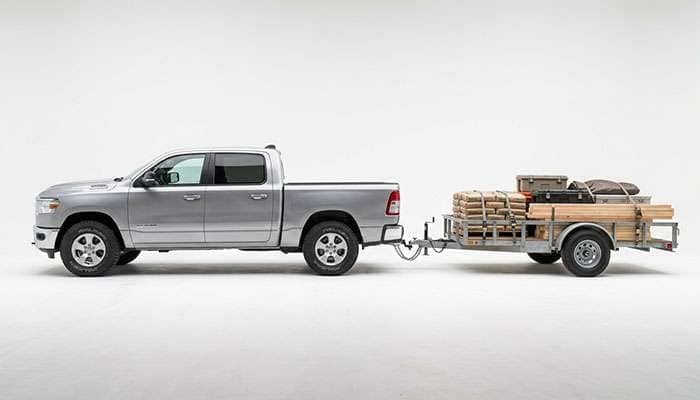
First, if a size exists in both P-metric and LT, that's a real decision and not a formality. The LT version gets you the heavier casing and the higher load rating, and it costs more, weighs more, rides firmer, and needs different inflation pressure. Take the LT if you tow, haul, or air down. Take the P-metric if you don't.
Second, if you're changing sizes rather than replacing what came off, check your speedometer calibration and your clearance before you commit. Going up an inch in diameter on a truck with a leveling kit is usually fine. Going up three inches is a project, not a tire purchase.
You can see current pricing and every available size on the Falken Wildpeak A/T4W product page, and if your size is showing tight, call us at 888-926-2689 and we'll tell you straight what's actually on the shelf.
The Falken Wildpeak A/T4W is a good tire. It's the right tire for a truck that works for a living, and it's a very good value at the price it's asking, especially once you account for the 65,000-mile warranty and the severe snow certification that a lot of its competition doesn't carry.
What it isn't is a universal answer. Falken built this generation stiffer on purpose, aimed squarely at half-tons and heavy-duty trucks that tow. If that's your vehicle, buy it and don't think twice. If you're driving a crossover or a light SUV that never leaves pavement, the A/T Trail or the Rubitrek will make you happier for less money and a smoother ride.
Match the tire to the job. That's the whole trick, and it's been the whole trick since I started doing this.
Yes. It carries a three-ply Duraspec sidewall on LT sizes, a Three-Peak Mountain Snowflake severe snow rating with full-depth sipes, and a 65,000-mile treadwear warranty on P-metric sizes. It is strongest on trucks that tow or haul. Lighter pavement-focused vehicles are better served by the Wildpeak A/T Trail or the Falken Rubitrek A/T.
The A/T4W adds a three-ply sidewall, raises the treadwear warranty from 55,000 miles to 65,000 on P-metric and 60,000 on LT, and improves stone ejection, towing stability, wet grip, and deep snow traction. The A/T3W stops slightly shorter on dry pavement, rides more compliantly, and remains the better tire on ice. Both carry a UTQG treadwear grade of 660 and both are 3PMSF rated.
The warranty runs 65,000 miles on P-metric sizes and 60,000 miles on LT sizes. Real-world expectation on a half-ton truck is 50,000 to 60,000 miles, dropping toward 40,000 for drivers who tow heavy loads constantly. Rotation every 5,000 to 7,000 miles, correct inflation pressure for LT sizes, and a current alignment matter more to the outcome than the tire itself.
The most frequent A/T4W feedback is a firmer ride than the tire it replaced, added weight in LT sizes, and slightly longer dry braking distances. All three trace back to the same deliberate engineering choice to build a stiffer casing for load carrying. The fix is matching the correct Wildpeak model to your vehicle rather than defaulting to the toughest option.
No. Falken is a Japanese brand created in 1983 by Ohtsu Tire and Rubber and now owned by Sumitomo Rubber Industries, a company founded in 1909. Sumitomo operates plants in Japan, Thailand, Brazil, Turkey, China, and formerly the United States, so individual tires vary by build location. The DOT code on the sidewall begins with a plant identifier that tells you exactly which factory produced your specific tire.
It produces more noise than a highway tire but is quieter than the A/T3W it replaced, both when new and as it wears, thanks to varied pitch sequencing across the tread blocks. It is quieter than a Nitto Ridge Grappler and roughly comparable to a BFGoodrich KO2. Sudden noise increases after 20,000 or 30,000 miles usually indicate cupping from worn shocks or skipped rotations rather than a tire fault.
Falken is positioned as Sumitomo's value tier beneath the Dunlop premium badge, carries lower North American marketing overhead than legacy brands, and benefits from Sumitomo owning its plants and supply chain outright. The pricing reflects market positioning rather than reduced specification. The A/T4W still includes a three-ply casing, severe snow certification, road hazard protection, and a 30-day ride guarantee.
They target different buyers. The Wildpeak A/T4W is quieter, lasts longer, comes with a mileage warranty, and carries a 3PMSF severe snow rating that the Ridge Grappler does not have. The Ridge Grappler is a hybrid tread that performs better in mud and delivers a more aggressive look. For a daily-driven truck in a snowy climate, choose the A/T4W. For a weekend rig that sees real mud, the Ridge Grappler is the better fit.



