
Title= Balancing Beads vs Wheel Weights: Which Actually Works? Description= Beads or weights? Dennis breaks down the physics, the ounce charts, and which balancing method your tires actually need. Slug= balancing-beads-vs-wheel-weights
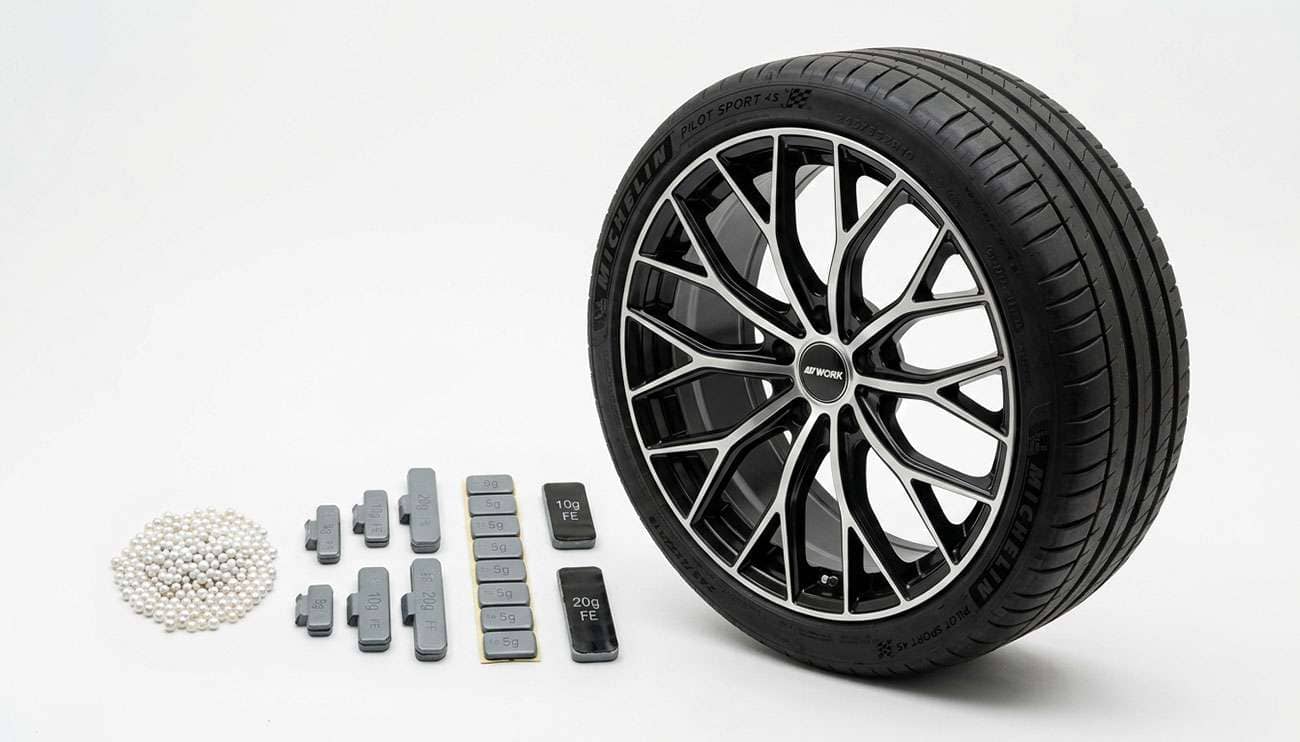
Here is the short answer: wheel weights applied on a modern balancer are the more precise method for street cars, low-profile fitments, and highway speeds, while balancing beads earn their keep on 35-inch and larger off-road tires, heavy trucks, RVs, and rigs that get rotated or aired down constantly. Beads self-adjust for the life of the tire; weights deliver a laboratory-exact balance that beads cannot match on a lightweight passenger tire. The right choice comes down to tire size, sidewall profile, and how you drive.
I spend a lot of my week looking at balance data, so let me walk you through the physics of both methods, the actual ounce requirements, and the situations where each one wins. If you have ever chased a stubborn steering wheel vibration without finding the cause, this is the engineering behind the fix.
Balancing beads are small spheres, usually tempered glass or ceramic, that get poured inside the tire cavity before mounting or injected through the valve stem afterward. A typical passenger application uses a few ounces; big off-road tires can take ten ounces or more per corner.
The physics is genuinely elegant. Once the wheel is rolling, centrifugal force pins the beads against the inner liner of the tire. When a heavy spot in the assembly causes the tire to hop, the beads momentarily lose contact with the liner at that point and inertia carries them away from it. That process repeats on every rotation, and within a mile or two the beads have migrated opposite the heavy spot, canceling the imbalance. If the tire wears, picks up mud, or loses a chunk of tread, the beads redistribute automatically.
That self-correcting behavior is the whole sales pitch. There is no return trip to the shop after a rotation, no rebalance after a tread chunk goes missing on the trail, and nothing bolted to the rim to corrode or fly off against a rock.
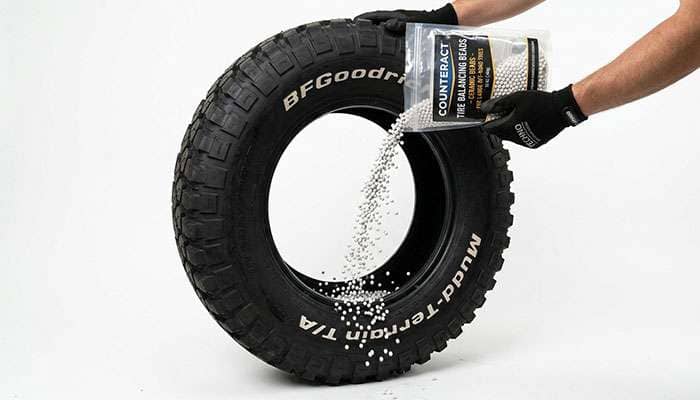
The catch is that beads need room and rotational mass to work. They perform best in tall, heavy tires spinning at highway speed. In a low-profile passenger tire there is not enough cavity volume or hop amplitude for the beads to distribute reliably, which is exactly why several major bead manufacturers refuse to sell them for cars and crossovers at all.
Wheel weights are the method every OEM assembly line and nearly every tire shop on earth uses. The mounted tire and wheel spin on a balancer that measures the exact magnitude and location of the imbalance, then the technician attaches a counterweight, either a clip-on weight crimped to the rim flange or an adhesive tape weight stuck inside the barrel.
Done correctly, this is a static and dynamic balance accurate to a fraction of an ounce, at a fixed, verified location. The best shops go a step further with road force balancing, which presses a load roller against the spinning tire to simulate the weight of the vehicle and catch stiffness variations a spin balance misses. I covered that process in detail in our guide to road force balancing, and it remains the gold standard for solving vibrations on street-driven vehicles.
The weaknesses of weights are practical, not theoretical. Clip-on weights can get knocked off by rocks, curbs, and oversized brake calipers. Adhesive weights can let go when wheel cleaner attacks the tape. Steel weights can corrode. And the balance is only valid until the tire wears unevenly, which is why the standard recommendation is a rebalance at every rotation.
Here is how the two methods stack up on the factors that actually matter:
Feature |
Balancing Beads |
Wheel Weights |
|---|---|---|
Precision |
Good on large, heavy tires; poor on low-profile |
Excellent, measured to a fraction of an ounce |
Adjusts as tire wears |
Yes, continuously and automatically |
No, requires rebalancing at the shop |
Rebalance after rotation |
Not needed |
Recommended every rotation |
Rim appearance |
Nothing visible, nothing to corrode |
Visible clip-ons; tape weights hidden inside barrel |
Off-road durability |
Cannot be knocked off |
Clip-ons vulnerable to rocks and trail impacts |
TPMS compatibility |
Yes, with TPMS-rated beads and filtered valve cores |
Fully compatible |
Typical cost per tire |
USD 5-20 in beads, installed once |
USD 10-25 per balance, repeated over tire life |
Best application |
35-inch and up off-road tires, heavy trucks, RVs |
Street cars, low-profile tires, highway drivers |
Notice the pattern: nearly every bead advantage compounds with tire size, and nearly every weight advantage compounds with precision demands. That is why the answer splits so cleanly by vehicle type.
Yes, in the right application. The physics is proven and fleet operators have run beads in commercial truck tires for decades. High-speed camera footage of beads inside a spinning tire shows them migrating away from an induced heavy spot exactly as designed. Where results get mixed is in undersized applications: too few ounces, low-profile tires without enough cavity volume, or vibrations that were never balance problems in the first place. Beads cannot fix a bent wheel, a worn ball joint, or a death wobble caused by loose steering components.
The working rule of thumb is roughly one ounce of beads per 13 pounds of tire weight. In practice that shakes out to these ranges:
Feature |
Typical Bead Amount Per Tire |
|---|---|
Motorcycle tires |
1-2 oz |
Passenger car and light truck |
2-4 oz |
33-35 inch off-road tires |
6-12 oz |
37 inch and larger |
10-16 oz |
Heavy truck and RV |
4 oz and up per manufacturer chart |
Under-dosing is the single most common reason beads fail to smooth a tire out, so always check the manufacturer chart for your exact size. Too many beads is harmless within reason, but wildly overfilling adds rotating mass and can generate noise at low speed. If you are stepping up through tire sizes, our 31s vs 33s vs 35s comparison covers how weight climbs with each jump.
Modern beads are, provided you use TPMS-rated beads and the filtered valve cores that come with quality kits. The filter keeps bead dust out of the valve and sensor. Cheap uncoated beads or improvised media like airsoft BBs are where TPMS horror stories come from.
Not well, and some bead manufacturers openly decline to sell them for low-profile passenger fitments. A short sidewall means a shallow cavity, less hop amplitude for the beads to respond to, and more bead noise transmitted into the cabin. If your tires are 50-series or shorter, stick with weights on a quality balancer.
You can, and some off-road shops do exactly this: a proper weight balance at mounting, then beads added to absorb the changes that come from wear, mud packing, and airing down. If the assembly is already balanced, the beads simply distribute evenly and stay out of the fight. The one downside is that a shop balancer can no longer give a clean reading with beads inside, so plan on the beads handling everything from that point forward.
Lead weights thrown from wheels end up ground into road dust and washed into waterways, so a growing list of US states along with the EU has banned lead for wheel balancing. Steel and zinc weights are the compliant standard now, which is worth knowing if you are cleaning up an older set of wheels that still carry lead clip-ons.
The life of the tire. Tempered glass and ceramic beads do not wear out, break down, or need topping off under normal use. When the tire is replaced, the beads are swept out and fresh beads go into the new tire. Moisture is the one enemy: water inside the tire makes beads clump and stop migrating, so use dry air when seating and inflating.
Choose wheel weights with a road force balance if you drive a street car or anything wearing low-profile tires. Precision wins on pavement, and the vibration threshold your hands can feel through a modern steering column is remarkably small.
Choose beads if you run big off-road rubber, tow heavy, or rack up serious miles between shop visits. Mud terrains and aggressive all terrains are notorious for shedding clip-on weights on the trail and for wearing unevenly enough to drift out of balance between rotations, a pattern I broke down in our off-road tire tread life guide. Beads solve both problems permanently.
These are the three tires I see beads paired with most often, all strong performers in the 35-inch class we stock:
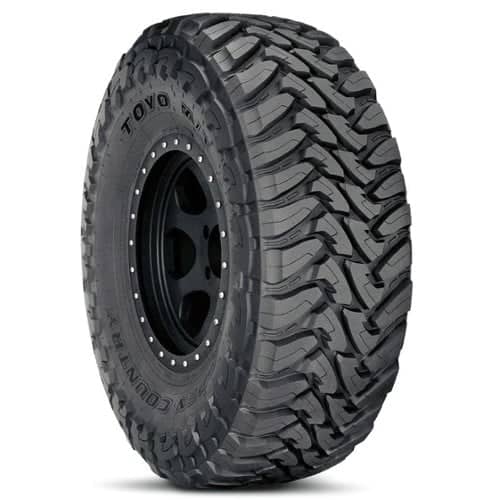
Toyo Open Country M/T (LT35x11.50R20) - The benchmark premium mud terrain, with a 10-ply rating and massive sidewall lugs. At roughly 80 pounds per tire, this is exactly the rotating mass where beads shine. USD 497.35 at Performance Plus Tire.
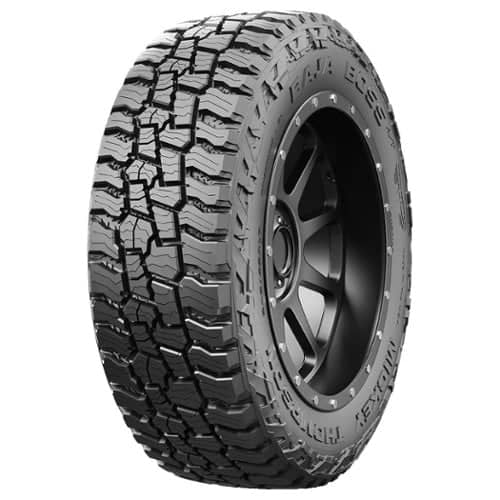
Mickey Thompson Baja Boss A/T (LT35x12.50-17) - The crossover pick for drivers who split time between trail and daily commuting, a balance question I dug into in our guide to daily driving off-road tires. USD 404.39.
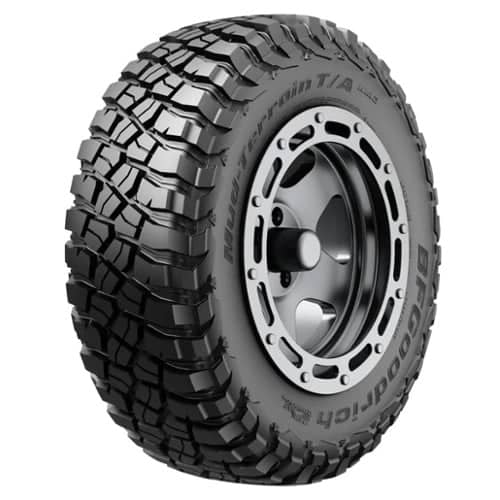
BFGoodrich Mud-Terrain T/A KM3 (LT35x12.50R15) - The rock crawler favorite, built for airing down, which is precisely the use case where fixed weights lose the plot and beads keep adjusting. USD 362.99.
Not sure whether your driving even calls for a mud terrain? Our HT vs AT vs MT comparison sorts the categories out, and you can browse the full Toyo tire lineup to see every size we carry.
Balancing beads and wheel weights are both legitimate engineering solutions aimed at different problems. Weights deliver a precise, verified balance that suits street tires and low-profile fitments, and paired with road force measurement they solve vibrations beads never could. Beads trade absolute precision for continuous self-adjustment, which is exactly what a heavy 35-inch mud terrain living a hard life actually needs. Match the method to the tire, dose the beads correctly if you go that route, and either way you will put the vibration behind you.
Neither is universally better. Wheel weights are more precise and the right choice for street cars and low-profile tires, while balancing beads self-adjust continuously and work best in large off-road tires, heavy trucks, and RVs.
Quality tempered glass or ceramic beads will not damage the tire liner or wheel. Problems only arise from moisture clumping the beads, non-TPMS-rated beads fouling sensors, or improvised media like metal shot.
No. Once the correct amount of beads is inside the tire, they rebalance the assembly automatically on every drive, including after rotations and as the tread wears. No return trips to the balancer are needed for the life of that tire.
Most shops are equipped and trained for weight balancing, beads make a spin balancer unable to give a clean reading, and loose beads create a mess at dismount. On low-profile passenger tires the shops also have a point, since beads genuinely underperform there.



